Navigation
Install the app
How to install the app on iOS
Follow along with the video below to see how to install our site as a web app on your home screen.
Note: This feature may not be available in some browsers.
More options
Style variation
You are using an out of date browser. It may not display this or other websites correctly.
You should upgrade or use an alternative browser.
You should upgrade or use an alternative browser.
Attack on Army School bus on Quetta-Khuzdar corridor— 6 Children martyred 43 injured.
- Thread starter Great Mal
- Start date
More options
Who Replied?


Distant_Observer
Trusted Member

Do you mean with Baloch buy in? Or focused on Balochistan?
Buy in, they need to completely own it.

imadul
Elite Member
This is beyond grief.I have posted a list of the injured - some are in critical condition, kindly please do dua for them.
For APS, I literally cried...
Only since Gaza massacre has brought a sheet of sad apathy, and mind is numb.
May God give Sabr to parents.
Very hard and painful.
imadul
Elite Member
Need to find is it a Pahalgam revenge attack.India is copying Israel to the nth level?
This is evil act.
imadul
Elite Member
If it is true PAF could shot down more and score higher, I want to court martial those.Very sad. We continue to be reactive and suffer the consequences.
They said same thing after swift retort.
In war no mercy.
But yes, after war, all respect and care should be given to pow and injured

Hakwa Nadro
Trusted Member

humans known as zionist and zionists with black arse aka hindutvaWhat kind of humans target children? It’s really sickening
imadul
Elite Member
Definitely praying recovery and no life has lost, but transparency is must.
53 others injured, including 39 children, eight of whom were in critical condition
Dawn
Balochistan Chief Minister Sarfraz Bugti and the Quetta Corps commander briefed the visitors about the incident, which led to the “martyrdom of three innocent children and two soldiers”, as well as 53 others injured, including 39 children, eight of whom were in critical condition, the statement added.
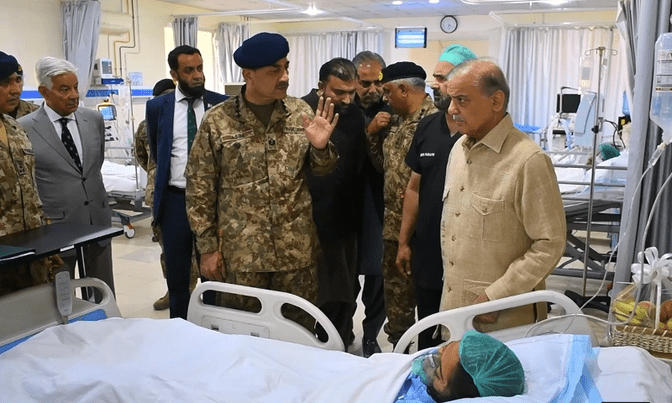
53 others injured, including 39 children, eight of whom were in critical condition
Dawn
Balochistan Chief Minister Sarfraz Bugti and the Quetta Corps commander briefed the visitors about the incident, which led to the “martyrdom of three innocent children and two soldiers”, as well as 53 others injured, including 39 children, eight of whom were in critical condition, the statement added.
Security forces to ‘relentlessly pursue’ culprits of Khuzdar attack on school van
Govt says three children and two soldiers martyred, 39 children among 53 injured with 8 in critical condition; officials blame "state sponsored proxies of India".
www.dawn.com

Starlord
Trusted Member

So if the Indian involvement is proven, will we strike Indian Targets ? I know there might not be any camps but we know that there are some sleeper cells inside India which are used to train BLA/BRA type Terrorists, Govt said if our civilians suffered Indians will suffer too, so I guess now is the time to walk the talk, reignite the Kashmir resistance, because without that India will not stop supporting Terrorism inside Pakistan. Or maybe we should release another song, promote someone to Field Marshall and call it a day.

hussain0216
Elite Member
In AJK we at times identify suspicious individuals or people who we never seen before, we speak to them, even inform army about their whereabouts. You will be surprised how many RAW agents were captured, some men dressed as women etc. Without the locals support you cannot ever win this war, it's not the army or ISI but local police and agencies who needs to get active at effective level, people don't like to speak to military as these guys will end up giving you the danda, but local security forces are very important. These terrorists killed local Baloch kids, imagine how much hatred the people have for these terorrists but the problem is they do hit and run attacks, it's very difficult to tackle this, we have been struggling for 20 years, Balochistan is also huge area, with 1000s KM of no man's land.
In Kashmir we will support our country
We will as you say identify people and suspicious people to law enforcement
We won't kill children for foreigners or anyone
You can't compare us to these low lives in some parts
These people need to be called out for the harami they are
We need a cleansing of the country, the worthless afghans thrown out and real serious retribution against our enemies with some serious operations

hydrabadi_arab
Trusted Member

RescueRanger
Meme Lord
Well it is a good thing I decided to put this article I wrote for something else here on PDF:Buy in, they need to completely own it.

- RescueRanger
- Replies: 30
- Forum: Pakistan's Internal Security
The above post is (VERY Long)

So here is a TLDR version; [Note this doesn't include any military action that the government WILL take against Indian proxies... This is for the wider people of Balochistan]
The Way forward
Resolving Balochistan's issue calls for a basic realignment of how the government interacts with its own people, not only for narrative changes or development pledges.
The strategy has to give inclusion top priority over imposition, reconciliation top priority over repression, and responsibility over denial. Combining Pakistan's own past with international examples, the following immediate, mid-term, and long-term ideas map a sensible road forward:
Initial Actions (first 6 months)
a) With a credible, independent, full-time chairperson and open reporting, reactivating the Commission of Inquiry on Enforced Disappearances (COIED).
b) Immediately release detained BYC members and nonviolent protestors including
Sammi Baloch, Dr. Mahrang Baloch and others, therefore asserting their constitutional rights to peaceful protest, mobility, and free expression.
c) Stop using too strong force, blanket FIRs, and counterterrorism policies directed
against civic actors.
d) Lift blocks of communication, restore media and internet access in protest-torn regions, and provide protections for independent reporters.
e) Rather than depending on synthetic or officially appointed middlemen, interact with real Balochistan voices—including young leaders, rights activists, and local
politicians.
f) Empower the traditional Baloch Jirga/Mei'rh system as a vehicle for community
reconciliation, conflict resolution, and communication.
g) Share publicly historical issues like forced disappearances, resource alienation, and shortcomings of government.
Middle Term Actions (6 months to two years)
a) Under the direction of a reputable, neutral mediator or federal interlocutor, start
organized political conversation with non-violent Baloch groups.
b) Under a transitional justice framework, start victim support and reparations
programs—especially for relatives of missing persons.
c) Establish a multi-sector policy advisory committee comprising economists, teachers, and security specialists to design Balochistan-specific development, governance, and social inclusion policies.
d) Through improved Provincial Finance Commission (PFC) awards and constitutional
clauses such as Article 172(3), extend local control over resource management and
fiscal matters.
e) Under a provincial command system with community-based monitoring systems,
reform and unite the Levies and Police.
f) Create a fast-track Balochistan Civil Service programme to groom capable native
young people into administration, planning, and government.
g) Change course of instruction to include Baloch history, languages, and civic identity-building materials.
Midterms-Strategic Security Measures on Parallel Track
a) Parallel track of smart, reasonable, and professional security measures must be
adopted—complementary to political and civic reforms—to battle hardy militants,
transnational terror networks, and hostile foreign intelligence activity in Balochistan.
b) With an eye toward human intelligence (HUMINT) from inside Baloch communities,
strengthen inter-agency intelligence coordination, especially between ISI, IB, MI,
special branch, FC Intelligence, CTD, and local law enforcement.
c) Invest in counter-radicalization, cyber-intelligence, and technical surveillance
systems meant to monitor militant internet recruitment, cross-border funding, and
sleeper cells.
d) By providing specialized training in asymmetric warfare, civilian involvement, and
rights-based policing, professionalize counterinsurgency units—especially inside
LEAS.
e) With a distributed command structure, fast forensic support, and unambiguous
operational control, modernize the Counterterrorism Department (CTD) in
Balochistan.
f) By means of integrated outposts, drone monitoring, and community intelligence
networks to track arms trafficking and intrusion, improve border security with Iran
and Afghanistan.
g) Launch targeted rehabilitation programs for low-level militants seeking
reintegration—drawing on successful models from Sri Lanka, Indonesia, and parts of
KP.
h) Enforce financial sanctions and disrupt militant logistics through coordinated action by FIA, NACTA, and SBP compliance units
i) Extend the legal framework for internal security to guarantee judicial scrutiny and
civilian supervision of security activities, therefore limiting the possibility for abuse
and so promoting legitimacy.
Long-Term Measures (5 Years)
a) Implementing Islamabad High Court's 2021 recommendations, criminalize enforced
disappearances under national law.
b) Review Balochistan's political situation and investigate, inspired by similar models
like Aceh or Northern Ireland, administrative autonomy or a special position inside
the federation.
c) Provide institutionalized local governments with constitutional mandated election
cycles and complete political and financial authority.
d) Restrain security overreach by redefining civil-military duties in Balochistan, so
strengthening legislative and judicial control of internal affairs.
e) Under safe and legal conditions, inspire diaspora participation in peacebuilding,
investment, and community discussion.
f) Create a Truth and Reconciliation Commission using restorative justice to honor
suffering, correct past wrongs, and rebuild trust.
g) Guarantee credible elections to promote inclusion, restore legitimacy, and offer
peaceful avenues for expression. The right to pick and choose leadership through
democratic means is crucial to reducing youth alienation.
h) To overcome systemic corruption and poor governance, reforms must focus on
transparency, equitable development, and efficient public service delivery to restore
trust and meet citizen needs.
Conclusion
Balochistan requires not brutal tactics, but a healing touch. The catastrophe of East Pakistan reminds us that protracted conflicts do not merely scar nations — they can destroy them.
The Baloch insurgency today stems more from socio-economic and political despair than outright separatism; often exploited by external threat actors who wish to harm the Pakistani state - it offers a path for transformation rather than a justification for repression.
The government must clearly distinguish between terrorism and peaceful dissent, release imprisoned activists, and meaningfully revive the Balochistan Reconciliation Process.
lightning f57
Trusted Member
This is key. If government officials lurk on PDF take note.The government must clearly distinguish between terrorism and peaceful dissent
RescueRanger
Meme Lord
Following the recent tragic attack on a school bus in Balochistan, the Khyber Pakhtunkhwa (KP) government has ramped up security measures across educational institutions in the province.
Authorities have issued a province-wide security advisory for schools, particularly in Peshawar and other sensitive districts.
The education department, in coordination with district administrations and police, is implementing an emergency security plan to safeguard students, teachers, and school staff. Education Special Secretary Qaiser Alam confirmed that instructions have been sent to all district education officers (DEOs) and school heads to carry out a comprehensive security survey of their premises.
“All available resources will be utilized to ensure the safety of our children and teachers,” said Qaiser Alam. “We are preparing a joint security plan with the help of the district administration and police.”
According to the new guidelines, schools are required to establish effective checking systems at both internal and external entry points. Trained security guards must be deployed on campuses, and closed-circuit television (CCTV) cameras are now mandatory for surveillance.
In addition, schools have been instructed to hold special awareness sessions for students about safety protocols. Each institution must also design and implement an emergency alert system and a clearly defined exit plan in case of any security threat.
At least five people, including three schoolchildren, were martyred and several others injured when a suicide bomber targeted a school bus near Zero Point on the Karachi-Quetta National Highway in Khuzdar on Wednesday.
According to local authorities, the blast occurred when a school bus carrying children passed by a vehicle rigged with explosives parked along the roadside. The incident took place around the busy Zero Point area, a key junction on the national highway.
“The explosive material was planted in a vehicle on the roadside. As the school bus approached, it was detonated remotely,” a senior police official said, adding that an investigation is underway to determine the nature of the device and the perpetrators involved.
Authorities have issued a province-wide security advisory for schools, particularly in Peshawar and other sensitive districts.
The education department, in coordination with district administrations and police, is implementing an emergency security plan to safeguard students, teachers, and school staff. Education Special Secretary Qaiser Alam confirmed that instructions have been sent to all district education officers (DEOs) and school heads to carry out a comprehensive security survey of their premises.
“All available resources will be utilized to ensure the safety of our children and teachers,” said Qaiser Alam. “We are preparing a joint security plan with the help of the district administration and police.”
According to the new guidelines, schools are required to establish effective checking systems at both internal and external entry points. Trained security guards must be deployed on campuses, and closed-circuit television (CCTV) cameras are now mandatory for surveillance.
In addition, schools have been instructed to hold special awareness sessions for students about safety protocols. Each institution must also design and implement an emergency alert system and a clearly defined exit plan in case of any security threat.
At least five people, including three schoolchildren, were martyred and several others injured when a suicide bomber targeted a school bus near Zero Point on the Karachi-Quetta National Highway in Khuzdar on Wednesday.
According to local authorities, the blast occurred when a school bus carrying children passed by a vehicle rigged with explosives parked along the roadside. The incident took place around the busy Zero Point area, a key junction on the national highway.
“The explosive material was planted in a vehicle on the roadside. As the school bus approached, it was detonated remotely,” a senior police official said, adding that an investigation is underway to determine the nature of the device and the perpetrators involved.
RescueRanger
Meme Lord
Schools on high alert after Balochistan attack
Following the Balochistan school bus attack, KP authorities have issued a province-wide school security advisory. Measures include trained guards, CCTV installation, and emergency plans to ensure student and staff safety.
 www.samaa.tv
Users who are viewing this thread
Total: 1 (members: 0, guests: 1)
Pakistan Defence Latest


Country Watch Latest
Latest Posts
-

-
 Makkah Defence Alliance: Turkey, Saudi Arabia, and Pakistan, news & updates (30 Viewers)
- Latest: maxpane
-
-

-
