Terrorism in Balochistan: Evolution, Tactics, and Security Implications

Introduction:
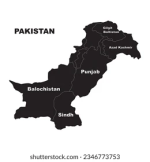
1747838470366.png
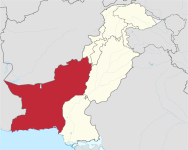
The Baloch people are a unique ethno-linguistic group spread between Afghanistan, Iran, and Pakistan. Infested with several insurgents, religious extremist and sectarian groups, the security landscape of Balochistan has become exceedingly complex over the last few years. The death of Nawab Akbar Bugti on August 26, 2006 in a military operation had instigated the current phase of the Baloch insurgency, the fourth one since the creation of Pakistan.

Baloch insurgents have launched attacks on state institutions, security forces, gas and power installations and on non-Baloch individuals in the province since Nawab Bugti’s death. The role of Baloch insurgents in compounding Balochistan’s law and order woes notwithstanding, several religiously motivated militant and sectarian groups have also grown in strength and expanded their areas of operation across Balochistan.

Quetta, the provincial capital, is becoming a hub of local and foreign religious militant groups and sectarian outfits. There have been numerous media reports of attacks on barbershops, music shops and on other “un-Islamic” businesses by religious extremists including the Taliban in Quetta in the recent past. Meanwhile, the Shia Hazara community in Balochistan, with a population of around 300,000 people, is currently facing unprecedented attacks and violence, mainly from sectarian militant groups.

Terrorist attacks and targeted killings, mainly perpetrated by Baloch insurgents and religious extremists, have gradually increased in the province, particularly after 2006. Around 110 attacks have killed 229 people and injured another 282 in Balochistan in the year 2023. This marks a 116% increase in the number of terrorist attack related casualties in the province when compared with the previous year.1 [PIPS report 2023]

Government of Pakistan initiated a number of steps to build confidence which in the past have included Aghaz-e-Huqooq-e-Balochistan in 2009, Financial commission awards and the 18th Constitutional amendment in 2010 these which include concessions and benefits for the Baloch people. The most recent of which has been the Governance and Policy Project for Balochistan funded by the World Bank costing US$ 19 Million and will aim to strengthen the capacity for revenue mobilization and improve public financial management and accountability for public service de livery in Balochistan.[ https://projects.worldbank.org/en/projects-operations/project-detail/P156411]
 
Last edited:
Understanding the violence in Balochistan:

1999 was a period that brought Pervez Musharraf to power increased general alienation among the Balochs. Some outside Pakistan claim "this is because Balochs see the army as lacking Baloch representation due to its domination by the interests of the Punjabi".

The federal government has worked at multiple levels to engage the locals of Balochistan. The province has seen massive recruitment of the Baloch youth in Pakistan Army which is a very healthy trend.

On 12 December 2013, during a soldiers' passing out ceremony in the Training Centre of Electrical and Mechanical Engineering (EME) Corps located at Quetta along with Dr Abdul Malik, the Chief of Minister Balochistan, Chief of Army Staff General Raheel Sharif said that 20,000 Baloch have joined the ranks of Pakistan Army as soldiers since 2010. [https://hilal.gov.pk/view-article.php?i=1337]

Another argument often heard is that "The Baloch grievance is the construction of the mega- port of Gwadar, which began in 2002 and is ongoing.

The federal government also initiated several mega development projects in the province as highlighted in Table 1:

Table 1: Megaprojects in Balochistan

Name of SchemeCost in
Million
Kachhi Canal
31,204​
Mirani Dam
5,861​
Sabakzai Dam
1,010​
Balochistan effluent disposal into RBOD(ROBOD-III)
4,485​
Coastal Highway
15,010​
Gwadar-Khuzdar Highway
16,640​
Gwadar Deep Sea Water Port Ph-1
16,380​
Greater Quetta Water Supply & Environmental Project
7,965​
National program for improvement of water courses
in Pakistan Balochistan Share
5,060​
Access to Justice Program (Provincial)
1,000​
Total
104,615​
Source: Balochistan: an overview of development. Govt: of Balochistan P&DD 2005 [********)))))]

However, Baloch nationalists and insurgents continue to dismiss the government’s acquiescence, labelling them a continuation of previous discriminatory policies. [2] https://www.dawn.com/news/1801371/baloch-protesters-give-govt-7-day-ultimatum-to-meet-demands

Since 2009 the country has seen a general uptick in violence within the provincea according to Pak Institute for Peace Studies’ (PIPS) annual security report, 2023 witnessed a sharp rise in attacks perpetrated by nationalist insurgents and religious/sectarian extremists.

Table 2: Terrorist attacks by province 2023

RegionNo. of AttacksKilledInjured
KP
174​
422​
782​
Balochistan
110​
229​
282​
Punjab
6​
16​
8​
Karachi
14​
16​
26​
Sindh (Excluding Karachi)
1​
0​
0​
GB
1​
10​
26​
Total
306​
693​
1124​

Three secterian attacks occured in Balochistan during 2023. The country has a whole witnessed an uptick of secterian violence last year, in total 43 people were killed and 61 injured in 12 secterian-related attacks across the country.

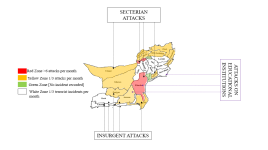
1747842172573.png
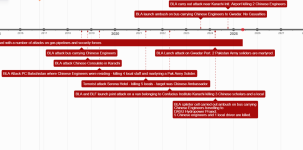
Image 1: Mapping historic attack types across Balochistan [Author's Own Work - Map Adopted from copyright free academic literature***]

Simultaneously, leadership of the Baloch nationalist movement remains highly fractured. As a result, the Baloch nationalist movement is not unitary in either its goals or its tactics.

According to the Jinnah Institute, an Islamabad- based think tank, argues that the multiplicity of Baloch leaders with competing motivations has exacerbated the violence, making deciphering the conflict landscape increasingly difficult.

It is nearly impossible to accurately analyze the structure of the movement given contradictory reports, facts, and figures, a problem compounded by the inaccessibility of Balochistan to the media and independent observers.

For many Balochs, however, nationalism does not extend beyond specific tribal loyalties. The three largest tribal groups are the Marri, Bugti, and Mengal tribes. Leaders from these tribes are capable of raising large armies and supplies but remain highly suspicious of each other.

Additionally, a 2006 cable from the American Embassy in Islamabad leaked by Wikileaks noted that not all of the tribal leaders have turned against the state, mentioning in part, “There seems to be little support in the province, beyond the Bugti tribe, for the current insurgency.”11

Additionally, the military has been able to negotiate with tribal leaders one-by-one, preventing them from joining in a common cause against the government

While the military continues to see the Bugti tribe as the main sponsor of the anti-state insurgency, other tribal leaders have used their forces as leverage against the state to achieve their own ends. Indeed, the cable from the American Embassy goes as far as to suggest that nationalist leaders do not truly believe in secession, and instead use political rhetoric to extract revenues from the national government.
 
Baloch Terrorist factions:
Currently, there are around 10 militant factions that operate within the Baloch insurgency. While groups like BLA-J, BLF, and BLA-A regularly claim attacks, primarily against Pakistani security forces, others such as the BRG, BNA (Anwar), and BNA (Beebarg) face significant operational constraints and have become less relevant in the insurgency.

Finally, some minor groups, primarily the United Baloch Army (UBA), have become nearly defunct.

Since 2021, Baloch militant groups have escalated both the frequency and complexity of their attacks. Their primary targets include security forces, alleged informants, members of “Death Squads,” infrastructure linked to security forces and China–Pakistan Economic Corridor (CPEC) projects, Punjabi workers, and Chinese nationals.

The March 2025 attack on the Jaffar Express by BLA-J, for example, followed a pattern of smaller attacks on the same target by the BLA-A and BNA (Anwar) since 2023. Currently, BLA-J and BLF vie for dominance, with the BLA-A as a key rival.

These three groups have refined traditional tactics, introduced new strategies, and expanded their operational structures. Additionally, they have cultivated ties with smaller Baloch and Sindhi nationalist factions, solidifying their status as the leading forces of the insurgency.

Baloch Liberation Army-Jeeyand (BLA-J)
BLA-J is currently the most dynamic Baloch terrorist group Between 2019 and 2021, its activity followed a steady upward trajectory, with the number of claimed attacks rising from 50 in 2019 to 64 in 2020 and 88 in 2021.

Similarly, the use of suicide attackers (fidayees) remained limited to one deployment per year. However, since early 2022, BLA-J has rapidly expanded its operations, claiming 188 attacks in 2022, 247 in 2023, and 302 in 2024. The number of suicide attacks also rose, with BLA-J claiming three in 2022, two in 2023, and a record six in 2024.

BLA-J currently conducts two intermittent special campaigns, Operation Zir Pahazag (Guarding the Coast) and Operation Herof, alongside targeted suicide attacks. In 2025, the group concluded Operation Dara-e-Bolan, one of its most ambitious campaigns, which began the previous year.

These operations indicate a long-term and evolving strategic approach to the insurgency, combining multiple tactics and an ever-more sophisticated application of the concept of guerrilla warfare. As recent publications of the group have revealed, BLA-J insurgency rests upon the dual concept of mountainous and urban guerrilla warfare.

BLA-J aims to frustrate Pakistani security forces through daily attacks on checkpoints and patrols, while periodically deploying suicide bombers and armed attackers against high-value targets, including Chinese nationals and military installations.

Operation Zir Pahazag focuses on disrupting CPEC-related infrastructure along the coastline. Whilst outside of targeting CPEC personnel and facilities, the majority of these attacks seem to have little strategic value, they are design to cause public concern and gain maximum press exposure to please their pay-masters in India.[SOURCE]

BLA-J has shown complexity of operations and has also enhanced the capabilities of its special units, which now play a central role in its strategy, it's "Special Forces" are divided into four units:
Majeed Brigade [Suicide Bombings and IED attacks]
STOS (Special Tactical Operations Squad) [Mainly initiates targeted killings]
Fateh Squad [Foot soldiers of the BLA]
Zephyr Intelligence Research & Analysis Bureau (ZIRAB). [Intelligence and Propoganda]

In 2024 BLA-J launched a major terrorist attack named "Dara-e-Bolan" which involved 385 militants including 12 majeed brigade members who were carrying PBIEDS. Between Jan 29 and 31, 2024 the terrorist attempted to occupy areas around Maach and the surrounding highway for two days before being blown strigh to hell by Pakistan Security Forces.

The second and final phase, concluded in March 2025, involved a two-day hostage crisis during the Jaffer Express attack and a suicide bombing targeting a military convoy in Noshki. While BLA-J exaggerated the reported casualties, the operation showcased the group’s evolving tactical capabilities and underscored intra-group cooperation within the BRAS alliance.

Like Operation Dara-e-Bolan, the August 2024 Operation Herof (Black Storm) aimed to seize control of major highways across Balochistan, including coastal routes, and temporarily occupy the Bela military camp. BLA-J deployed 800 fighters and seven suicide attackers, framing the assault as the first phase of a broader effort to reclaim key territories. This operation was a resounding embarrassment for BLA-J in which they were forced to retreat during the first day of engagement due to the fierce response of Pakistan security forces.

The group later took to social media to claim this incursion was "a tactical exercise in preparation for the next phase of Operation Herof."

Balochistan Liberation Front (BLF)
While BLA-J and BLF report similar attack numbers, their insurgency strategies differ significantly. BLF has historically focused on frequent, lower-profile attacks rather than large-scale special operations, maintaining a steady attack rate with a sharp rise in 2023.

The group claimed 176 attacks in 2021, 162 in 2022, and 284 in both 2023 and 2024. This trend appears to continue, with 128 attacks recorded in the first three months of 2025. As part of the BRAS umbrella, BLF closely collaborates with other militant groups, particularly BLA-J, supporting its efforts during Operation Dara-e-Bolan in January 2024.

BLF does not publicly disclose details about its internal organization and forces. Its most prominent units are:

Sniper Tactical Team (STT)
Qurban Unit [Foot Soldiers]
Intelligence Wing.

BLF primarily deploys it for attacks on military convoys, installations, and bases.

Baloch Liberation Army-Azad (BLA-A)
The third major Baloch militant faction, BLA-A, emerged from a significant internal split within BLA in July 2017. This division led to the expulsion of commanders Aslam Baloch and Bashir Zaib, who then formed their faction, BLA-J, later forming BRAS with BLF.

The original BLA, in turn, later became known as BLA-A, and today operates outside of BRAS. Unlike most other groups, BLA-A is not part of BRAS and has traditionally been weaker than BLA-J and BLF.

From 2020, it maintained a limited operational scope, avoiding special operations and suicide attacks. However, in 2024, BLA-A dramatically escalated its terrorist operations against Pakistan. While it claimed six attacks in 2020, 20 in 2021, 46-50 in 2022, and 38 in 2023, its activity surged to 154 attacks in 2024.

BLA-A relies heavily on Hit and Run tactics, ambushing convoys at chokepoints and VBIED attacks, on March 3, 2025, BLA-A conducted its first-ever suicide bombing using a female suicide bomber.

Other Factions of the Baloch Insurgency
BRG: Smaller group that carries out sporadic attacks.
BNA (Anwar): Ceased Operation - did claim 1 attack inside Faisalabad in 2023.
UBA: Ceased Operation
BNA (Beebarg): Very small outfit that mainly targets Iranian security forces.
BNA (Sarfaraz): Iran based.
 
Tactics, Techniques and Procedure used by Baloch Terrorist Groups:
1. Kidnap for Ransom

In 2022, Balochistan recorded 28 abduction incidents, dropping to 25 in 2023 and further reducing to just two by early 2024. The recovery rate reflected police initiatives, with 39 abductees rescued in 2022, 26 in 2023, and two in 2024. However, a troubling incident in April 2024 saw gunmen abduct nine men from a bus and later kill them, highlighting the ongoing challenges with organized violence (Reuters, 2024).

The most prominent case of K&R was the foiled Jaffer Express incident where BLA offshoot terrorists hijacked a train full of some 380 passengers.

2. VBIED, SVBIED, PBIED, IED, RCIED and armed attacks:
Balochistan witnessed a significant surge in terrorist attacks and casualties in 2024. The province experienced an 84% rise in attacks compared to the previous year, with 202 terrorist incidents that claimed 322 lives and injured 534 others.

In contrast, 229 people were killed in such attacks in the province in 2023. Attacks by various Baloch insurgent groups, primarily the Baloch Liberation Army (BLA) and the Balochistan Liberation Front (BLF), saw a staggering 119% increase, accounting for 171 incidents in the province. These attacks resulted in 261 fatalities and 412 injuries. Insurgent groups carried out numerous high-impact, coordinated operations targeting security forces, civilians, and non-Baloch workers, miners and travellers.

Similarly, Inspector General of Balochistan, Moazzam Jah Ansari, disclosed in September that terrorists were using advanced weapons left behind by US forces during their withdrawal from Afghanistan to carry out attacks in Khyber Pakhtunkhwa and Balochistan. He pointed out that the police lack modern weapons and night vision equipment, putting them at a disadvantage compared to the heavily armed militants.[https://www.dawn.com/news/1859054/terrorists-using-abandoned-us-arms-in-kp-balochistan-ig]

3. Use of UAS/UAVs:
The BLA-J have used their social media propaganda arm to showcase the use of Quadcopters against Pakistan security forces. A twitter account by the name of @Bahot X shared a video which was taken down due to breaching community guidelines showing an attack using a drone against an FC check post.

4. Propaganda and infosphere:
Baloch terrorist groups have used platforms such as Rumble and Telegram to disseminate propaganda, project their guerrilla capabilities, and sustain public interest in their militant activities.

It also analyses the extremist group’s messaging strategies, the role of encrypted communication tools in bypassing traditional media gatekeepers, the challenges posed by cross-platform information sharing and the implications for Pakistan’s counter-insurgency efforts.

These videos and visuals video serves as a tool for further recruitment as it appeals to youth to participate in terrorist activities.
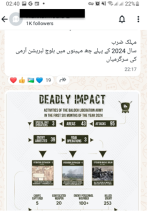
1747846321522.png
A screengrab showcasing terrorist propaganda.

These visuals, infographics, snazzy edited videos, use of satellite imagery underlines a clear and significant increase in complexity and technical prowess of the enemy, glossy manuals and newsletters uploaded onto secret Facebook pages and telegram channels show that the BLA and their various offshoots are receiving direct technical and financial support to not only conduct this heinous crimes in Pakistan but broadcast their criminal activities to their backers outside of Pakistan, mainly India.

The use of SATCOMMS, 4G, LTE and internet services along with third party platforms such as Rumble, Telegram, Facebook, X and YouTube must be examined by the government and a clear strategy must be devised on how to counter this at the grass-roots level to prevent radicalisation of young persons.
 
Last edited:
Terrorism inside Balochistan and the Indian Connection:
An insurgency of this magnitude cannot last without some amount of foreign support. In his book on insurgency inside Balochistan Illyas Khan commented "Intelligence agencies in Islamabad and government circles in Quetta estimate the monthly expenses of BLA’s operations to be Rs 40-90 million."

Pakistani journalists in both English and Urdu press visualises the insurgency to be a conspiracy aimed at making Balochistan secede from the federation, with the motive being the huge natural resources and rare earth minerals that are likely to be discovered in the province.

In his article published in 2005 Moeed Yusuf stated "External powers want this resource to be governed by an independent Balochistan rather than Pakistan.“The presence of external influences in Balochistan is no hidden secret. The BLA in large part has been funded by external interests who have sought to maintain some clout in the affairs of the province.”

The members of the BLA and their affiliates appear to be trained, and the selection of targets indicates that they understand their tactical and strategic aims quite clearly. Their ability to conduct hostile surveillance, leverage social media to project their narratives and maintain an effective communication network. All these tend to indicate that at least a core group, if nota larger number of BLA members, has been trained by persons well versed in military matters.

Since the BLA is unlikely to have sympathisers inside the Pakistan Armed Forces, the clear an obvious conclusion is that these groups are receiving military training and funding from outside of Pakistan.

Pakistan maintains that India is using Baloch terrorist groups as proxies. Pakistan’s press frequently claims that Baloch terrorist groups possess highly sophisticated armaments, suggesting the possibility of foreign intervention in the conflict. In 2004, military officials were quoted as saying that over 200 Baloch rebels had been trained within Pakistan by the Indian government.

Accounts from third-party sources lend some credence to these claims. According to Christine Fair, a South-Asian expert at Georgetown University, “It would be a mistake to completely disregard Pakistan’s regional perceptions…Indian officials have told me privately that they are pumping money into Balochistan.”
[Source: Internal Security Strategy for Pakistan,” Pak Institute of Peace Studies (January 2011): 5.]

According to Shireen Mazari, former Director General of the Institute of Strategic Studies, Islamabad: “A pattern can be discerned which points to a deliberate targeting of communication systems and national assets, impacting the country across provincial boundaries.

With more sophisticated explosives, which demonstrate a greater access to external sources of weapons and money, the so-called BLA has moved away from targeting soft civil society targets to installations, military set-ups and communication links. The acts of sabotage are clearly not random but have careful planning behind them – as well as a certain level of technical sophistication.

And, of course, there is the very important financial aspect. All these indicators prove the strong external linkages to what is happening in Balochistan

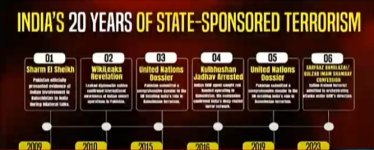
Back in 2000's former Balochistan Chief Minister stated that RAW was running at least 40 camps in the province. They also feel that with an Indian presence on the Pak-Afghan border and in Zahidan, as explained earlier, the opportunities for sponsoring low intensity conflict have multiplied for India. The arrest in 2016 of Kulbhushan Sudhir Jadhav an Indian commander cemented the long held suspicions by Islamabad of Indian involvement within Balochistan.

Yadhav admitted his mission included meeting Baloch insurgents to conduct their shared terrorist operations. After his arrest, in one of his confessional videos, he stated, “My purpose was to hold meetings with Baloch insurgents and carry out activities with their collaboration.

These activities have been of [a] criminal nature, leading to the killing of or maiming of Pakistani citizens.”

Over the years, such incidents have deepened the suspicions that India gives both training and backing to Baloch separatist movements so they can destabilise Pakistan.

The leader of a Baloch Terrorist faction Hyrbyair Marri is on record stating that they have ties with India and India has previously expressed that it sees joint cause with the Baloch terrorist groups run by people like Hyrbyair Marri, in an article dated 2019 the author examined how India has a state driven policy to support armed insurgents inside Pakistan to "Push Balochistan Away from Pakistan [https://www.asiasentinel.com/p/india-pushes-breakaway-balochistan]

The covert ingress of India into Pakistan can be better understood from the broader foreign policy of India often linked to the historical pronouncements of Chanakya Kautiliya, the royal advisor and statesman of ancient India.

The concept of “Akhand Bharat” or “United/Undivided India,” extends across the Asian territory, underscoring Pakistan, Bangladesh, Afghanistan, Nepal, Burma, and others, is frequently cited.

This historical aspiration may contribute to India’s deep engagement in various aspects of its neighbouring countries, primarily Pakistan, exacerbating existing divisions via orchestrating incidents. The idea of Akhand Bharat dates back to the third century BC and is associated with the Hindutva Ideology.

It is important to note that this ideology holds much significance for India’s current leadership i.e. Bharatiya Janata Party (BJP) led by Narinder Modi. Following this ideology, India is seeking a strong foothold in the adjacent countries, mainly Pakistan. Due to this, it is intervening in Balochistan in an attempt to weaken Pakistan’s control over its regions.

For example, in December 2023, a commander from the Baloch National Army (BNA), a separatist militant group, surrendered to Pakistani authorities and subsequently revealed that India had been covertly providing financial support to separatist elements in the region and encouraging acts of terrorism within Balochistan.

Earlier, the 2022 army helicopter crash in Balochistan’s Lasbela District, which resulted in the deaths of six personnel, including two army majors, saw the secessionist group Baloch Raj Aajoi Sangar (BRAS) claim responsibility. This group also asserted that they were acting under India’s direction at the time of the incident.

Furthermore, the Indian government defends the Research and Analysis Wing’s (RAW) involvement by framing it as a response to perceived aggressive behaviour from Pakistan, suggesting its support for Baloch separatists is a function of its external intelligence operations. [Avinash Paliwal, Paul Staniland, Strategy, Secrecy, and External Support for Insurgent Groups, International Studies Quarterly, Volume 67, Issue 1, March 2023, sqad001,]

This framing aims to position India’s actions as part of its broader counter-terrorism efforts. On the flip side, the Indian government argues that its Balochistan interventions are legitimate because of the 2008 Mumbai attack. While pointing to Pakistan-based terrorist groups as the perpetrators, this evidence is used domestically to garner support for its involvement in Balochistan. [
SAHOO, PRASANTA. “India’s Balochistan Tactic: HAS IT SHATTERED PAKISTAN’S KASHMIR DREAM?” World Affairs: The Journal of International Issues 23, no. 2 (2019): 98–115. https://www.jstor.org/stable/48531103.]

Covert war, through proxies and other intermediaries, would be the best strategic alternative for India – and the hallmark of India’s new strategic calculus vis-à-vis Pakistan. It is important to mention that no state would openly admit to adopting such a strategy – denial is paramount to preserve one’s image internationally and to avoid legal woes.

Nevertheless, some evidence pointing to India’s covert war is now emerging. Last year, The Guardian interviewed two Indian intelligence officials who confirmed New Delhi’s role in carrying out assassinations inside Pakistan.[https://www.theguardian.com/world/2...n-allegations-pakistan-intelligence-officials]

For several years now, India believes that her defensive offense has paid some important dividends.

A primary dividend is that India believed it had demonstrated that it can effectively climb up the escalation ladder, by starting with small arms and unconventional warfare, without starting a conventional war, and thus not risk a nuclear war. Because Pakistan is bogged down in Balochistan, as well as terrorist threats elsewhere. [https://thefrontierpost.com/evidence-prove-india-supports-terrorism-in-balochistan-global-times/]

India has a history of interference in the domestic affairs of its neighbouring countries. With the goal to establish hegemony in South Asia and the Indian Ocean Region, India has adopted an Indo-centric strategy.

Therefore, from the beginning in 1950s and 1960s, India indulged in conflicts with China (1962 war), Pakistan (three wars), Nepal (India interfered in the internal affairs of the royal family) and Sri Lanka (India supported the Liberation Tigers of Tamil Elam (LTTE) in the Sri Lankan civil war). The aims of pursuing such policies of interference are meant to destabilise the neighbouring states and influence their foreign policy.

Although India has not been successful yet her increasing hostility with the neighbouring countries will disturb the regional peace. India always promoted and supported the sub-nationalism, secessionist movements, and insurgencies, which aim to undermine the regional peace and stability. India aspires to be the police man of the region but Pakistan has become a main obstacle in the Indian way for controlling the affairs of the South Asian region.

It is widely acknowledged that India and Pakistan’s relationship has been historically fraught. Numerous incidents have exacerbated tensions between the two nations, making the path towards lasting peace increasingly challenging. The recent Pahalgam attack against civilians (April 2025) and the Jafar Express incident in Balochistan (March 2025) reveal concerning parallels in how South Asian border militancy operates.

On May 16th 2025 another Baloch affiliated with terrorist groups operating inside Balochistan went onto Indian TV and declared "were not Pakistani and supported the people of Baharat" this at a time when both nations had come to the brink of potential nuclear war. [Times of India 16th May 2025]

The consequences of Indian support for insurgents in Balochistan could be disastrous for peace in South Asia.
 
Last edited:
CPEC and beyond:
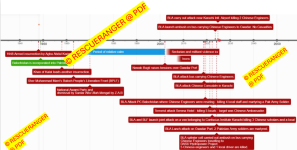
1747850120910.png
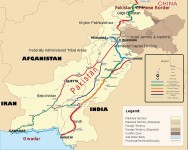
The CPEC, launched in 2015, represents the most expensive and ambitious connectivity initiative under China’s BRI, with an original estimated cost of $62 billion. The corridor spans approximately 3,000 kilometers (about 1,860 miles), commencing in China’s northwestern Xinjiang province and passing through Pakistani territory before reaching the Arabian Sea at the port city of Gwadar in Balochistan.

As the flagship project of the BRI, the CPEC serves as a cornerstone of China’s international image, reflecting its dedication to global infrastructure development and elevating its prestige within its expansive investment portfolio. Beijing has strategically framed the CPEC as a symbol of China’s emergence as a major global player, showcasing its role in advancing globalization over the past two decades and sharing its sustained economic growth with the Global South.

Meanwhile, Pakistan sees the CPEC as a transformative initiative with the potential to revitalize its national economy, which is plagued by chronic financial instability and a significant shortfall in foreign investment. The host country also perceives the project as a vital geostrategic asset, offering Pakistan a competitive edge over its regional adversary, India.

Within the broader context of the international community, CPEC plays a pivotal role in China’s strategic posture in relation to the United States; connectivity projects are increasingly central to Beijing’s strategy to avoid encirclement by pro-Washington allies.

Attacks by the BLA and other groups in Balochistan are also hampering the construction and operation of CPEC infrastructure projects. Most recently, security concerns prompted a delay in the launch of a Chinese-funded airport in Balochistan.

These security threats, primarily attributed to BLA, TTP, TJP. However there is a broader regional dimension to the security risk posed to CPEC and its projects inside Pakistan.

The consecutive statements of the Indian National Security Advisor and Prime Minister Modi on Balochistan manifested their concerns on the China-Pakistan Economic Corridor (CPEC). On the pretext of the 2008 Mumbai Attacks, both Modi and Ajit Davol have been trying to ustify the interference of RAW in Balochistan.

[https://economictimes.indiatimes.co...s-indian-sovereignty/articleshow/57664537.cms]

Soon after the statement of Davol, Yadav was arrested by the law enforcement agencies of Pakistan in March 2016, in Balochistan.

No surprise then that CPEC projects have been the target of 11 large scale attacks mainly claimed by the BLA and its affiliates.
1747850289063.png

India views the CPEC, especially developments like Gwadar Port, as a dual economic and military threat, enabling Chinese access to the Indian Ocean.

In response, India has strengthened its ties with Iran through investments in Chabahar Port, offering a counterbalance to Gwadar and facilitating access to Afghanistan and Central Asia. By supporting Baloch nationalism and fostering unrest in the region, India could aim to divert Pakistan’s focus from Kashmir and disrupt CPEC’s progress.

CPEC route now poses serious problems for India. Firstly, it passes through the disputed regions of Kashmir, claimed by both India and Pakistan and Gilgit-Baltistan, contested between India and China. The same Gilgit-Baltistan, which was part of the disputed state of Jammu and Kashmir in 1947.

Secondly, India fears that Gwadar will double as a Chinese naval base. Like in the South China Sea, where China has constructed military islands as it rises. Despite clarifications from China and Pakistan that the port will be used only for economic purposes, India is still wary of developments in Gwadar, fearing that it will give the Chinese navy access to the Indian Ocean.

According to reports, since 2017, the nation has seen the deaths of at least 21 Chinese nationals. Since the beginning of 2024, more than 1,000 Pakistanis have been killed in insurgent attacks in Balochistan and the northwest region of Khyber Pakhtunkhwa, with half of them being civilians and the other half being security forces.

It is vital that Pakistan work with friendly nations to safeguard its national interests both internally and externally.
 
Last edited:
Insecurity and Insurgency:
Complicated mix of political isolation, official repression, and longstanding grievances has strengthened Balochistan's fifth insurgency. Unlike past tribal upheavals, this one is occurring in cities and does not center on one place. Political awareness, general suffering, and the neglect of institutions in offering justice instigate it.


Some significant occurrences hardened people's opinions. Following the state's cover-up and her exile, the claimed rape of Dr. Shazia Khalid by an officer in Sui in 2005 came to represent a national icon of injustice against women and impunity. Efforts for political peace were crushed when Nawab Akbar Bugti was killed in 2006 during government negotiations. It also revealed a worrying trend: those who differ are greeted with violence rather than communication.


The situation worsened as the number of enforced disappearances continued to rise. Civil society organizations claim that around 8,000 persons have vanished since 2000. The most of them are political workers, activists, and students. The Kasi graveyard in Quetta exposed mass graves in March 2025 that validated long-standing allegations of a "kill-and-dump" program.

The purported extrajudicial murder of Balaach Mola Bakhsh in Turbat in December 2023 set the families of missing persons on a 1,600-kilometer protest march to Islamabad. People grew more enraged rather than less upset in response to the state's severe reaction—which included tear gas, baton charges, and water cannons in cold temperatures.

These incidents made Dr. Mahrang Baloch—whose father was abducted and killed in 2009— eminent all throughout the nation. She oversaw nonviolent demonstrations under the Baloch Yakjehti Committee (BYC), therefore launching a fresh movement opposing the government.

Protests and closures resulted from her March 2025 arrest. This demonstrated her symbolic strength as well as the continuing relevance of government policies of suppressing people over involving them.

The Commission of Inquiry on Enforced Disappearances (COIED) has failed to fulfill its
mandate. From 2011 to 2022, Justice (R) Javed Iqbal, who headed the commission, was criticized for being slow, vague, and indifferent.

After his tenure, the position remained vacant until former Supreme Court judge Faqir Muhammad Khokhar was appointed as the new chairman. The aged Justice Faqir Muhammad Khokhar, appointed after a prolonged vacancy, passed away soon after assuming office in 2024.

The Senate has stopped reform, indicating that the government does not intend to alter long-standing security concepts even if a court ruling and National Assembly legislation have been against forced disappearances.

Establishing unelected, government sponsored leadership helps to undermine credibility. The fifth insurgency is a broad civic movement aiming at justice, respect, and constitutional accountability, not only separatist rhetoric or foreign intervention.

The Federal Government Position:
Unresolved issues and mounting civil opposition have driven increasing insurgency in
Balochistan in recent times. The government claims, however, that its interactions with the province are grounded in a strategic dedication to internal security, inclusive development, and national cohesion.

Balochistan is seen by the government as a vital component of Pakistan's future rather than a difficulty area on the margins of its strategic and economic development.

Authorities underline that some of the key reasons Balochistan keeps getting investments in infrastructure and government are its abundance of natural riches, strategic position, and great variety of ethnic groups.

The administration claims to have routinely enhanced ties, added more public services, and enabled Balochistan's inclusion into the national economy with projects like CPEC, Reko Diq, Saindak, and Gwadar Port.

Regarding missing persons, the government asserts that it is aware of the emotional toll they cause and emphasizes that the best approach to obtain justice is via the Commission of Inquiry into Enforced Disappearance (COIED).

Since it started, the COIED has tracked about 8,000 instances; and that public figures indicate that it has brought several hundred people back together with their family.
Officials also claim, however, that some of the "missing" persons might have joined illicit terrorist organizations, crossed borders, or are otherwise difficult to locate for political or personal reasons.

The state is aware it has to strike a compromise between its obligations to defend national security and its dedication to legislative accountability and court supervision.
Furthermore, several outside elements the government believes to be responsible includes India's RAW and criminal people in Afghanistan said to be supporting, arming, and guiding rebel groups such Baloch Raaji Aajoi Sangar (BRAS) and the Baloch Liberation Army (BLA).

These gangs target infrastructure projects vital for peace in the region and economic
development, according to officials. They further claim that these groups use actual
grievances to advance foreign objectives and strive to make Pakistan less internally stable.

According to the government, these individuals purposefully blur the boundaries between nonviolent protest and violent extremism, therefore undermining official civic voices and erasing public confidence.

The administration also claims that some local officials and tribal sardars pilfered
development funds intended for the province in the past, therefore infuriating people even more and reducing the quality of services. Officials claim this has made a venue for militants—who occasionally operate as criminal mercenaries—who engage in acts including kidnapping, extortion, and attacks not for ideological freedom but rather for money.

The authorities in charge of security claim that these organizations have no actual backing from the population and that their activities have seriously degraded public infrastructure and people's capacity to earn a living in the surroundings.

From the state's perspective, an unstable Balochistan enables geopolitical rivals not only to split Pakistan but also impede significant regional connectivity initiatives linking Pakistan to China, the Gulf, and Central Asia.

Therefore, actions such as border management, citizen monitoring, and counter-terrorism must be viewed as essential to national security and state authority, rather than as tools of oppressions.

Reacting to civil resistance groups including those headed by Dr. Mahrang Baloch and the Baloch Yakjehti Committee (BYC), the government once more claims to defend free speech and nonviolent demonstrations free from legal violation.

It does caution, though, that unlawful groups could utilize big demonstrations to harm public order and safety. Although the state claims that everything must follow due process and be evaluated by the courts, officials claim that Dr. Mahrang Baloch was detained in March 2025 due to information regarding law and order.

Regarding development, the central government claims that billions of rupee investments reveal a genuine, long-term strategy meant to provide regions more autonomy. These initiatives, according to the government, will link the area to trade routes, generate more employment, and help to solve long-standing social and economic issues.

Policymakers contend that delayed pace of development calls for cooperation among federal, provincial, and municipal administrations. This is true even if the provinces acknowledge that trust between them and equitable distribution suffer.

The present quandry
Balochistan is no longer just a headline about conflict zones far from the public eye. It has spilled into the courthouses, the college campuses, and the crowded streets — into the everyday lives of those who have long carried the weight of promises unkept.

What began decades ago as a tribal insurgency has now splintered into a tangled struggle where civil protest, militant violence, and heavy-handed state responses collide, often chaotically.

The claims of "progress" feel distant to those who live with checkpoints,
blackouts, and disappearances. The gulf between government narratives and lived realities grows wider by the day.

The year 2025 laid bare this fragile landscape. The Jaffer Express attack, the targeted killings in Duki, and the bombings across CPEC-linked towns shattered any illusions of
security. Even moments of remembrance, like Bugti Day, were darkened by violence in
Quetta and Khuzdar.

Highways — lifelines for isolated communities — were barricaded not by militants alone, but also by fear itself.

For many Baloch, the arrest of Dr. Mahrang Baloch, Sammi Deen Baloch, and Baboo Baloch on March 24 was a breaking point. These were not militants but the faces of a peaceful movement — young, hopeful, and stubbornly determined.

When Sammi, barely released by court order, was re-arrested and caged again, it sent a clear message: even nonviolent voices were no longer safe. The streets of Karachi, Quetta, and Turbat swelled with grief and anger.

The BNP-M’s long march from Wadh to Quetta on March 28, and the two-week blockade at Lakpass Tunnel, wasn't just a political maneuver. It was a weary, desperate cry from a people who feel unseen.

Their eventual shift to public outreach on April 16 was less a strategy than a recognition — that the old paths to justice are blocked. In Baloch culture, to harm a woman is an unpardonable disgrace. Arresting a woman activist wounded not just the movement, but the collective pride of a people who still measure honor by how they protect their daughters.

That wound has not healed. Meanwhile, alliances among militant groups — BLA, BNA, BRAS — have strengthened, quietly drawing in disillusioned young men from Kech, Panjgur, and Awaran. For many, it isn't ideology pulling them toward the gun. It's absence. It’s silence. It’s the echo of empty promises shouted from Islamabad and heard as betrayal back home.


And when the state responds, it seems to stumble between silence and suffocation.
Thousands of families still wait for answers from the Commission of Inquiry on Enforced Disappearances (COIED), their cases trapped in dusty files. Peaceful protests trigger communication blackouts. Students, doctors, professors — all live under suspicion, as if activity itself were a crime.

When Dr. Mahrang Baloch and over a hundred BYC supporters launched a hunger strike, the world stirred. UN Special Rapporteur Mary Lawlor expressed concern; Pakistan’s Human Rights Commission urged restraint. But to the families standing in the protests, their loved ones’ names on posters, international words often feel like a gentle breeze against a gathering storm.

At a seminar in Turbat, Sardar Akhtar Mengal’s warning rang heavy: when justice cannot be found in the halls of parliament, it will be sought elsewhere — sometimes through barrels of guns, sometimes through the hopelessness of silence.

The human cost is already devastating. Foreign investment has dried up. The once-hopeful streets of Gwadar, buzzing with dreams of prosperity, now stand shadowed by checkpoints.

In villages and towns, schools are shuttered. Farmers and traders hesitate to travel roads they once knew by heart. For young students — some the first in their families to dream of higher education — the future narrows to a bleak choice: flee, submit, or fight.

And perhaps most tragically, the line between the peaceful and the militant has blurred — not by the people’s choosing, but by the state’s inability to tell them apart. Arrest one professor for speaking out, and three more students quietly lose faith in change. Ignore one family's missing son, and an entire village learns to stop believing in ballots.

Today, Balochistan is caught between two immovable forces: a people demanding dignity, and a government demanding obedience. In that space of mutual distrust, anger festers, possibilities wither, and the dream of reconciliation slowly bleeds away.

Learning from the Past
Dealing with Balochistan calls for asking: have analogous upheavals elsewhere been
settled—and how? History reveals that only political inclusion, justice, and socioeconomic reform provide long-lasting peace, even if military might may quell disturbance.

Ignoring these lessons before has had implications for Pakistan; the catastrophe of East Pakistan in 1971 is still a sobering reminder that alienation may cause permanent damage when voices are muffled rather than heard. Global and local events provide Pakistan with illuminating models from which to rethink its approach to Balochistan.

Some Case Studies
a) After decades of sectarian killing between Protestant unionists and Catholic
nationalists—including the 1979 murder of Lord Mountbatten by the IRA—Northern
Ireland (UK) saw brutalities on both sides.

While British forces were linked in shoot-to- kill policy, Bloody Sunday (1972), and claimed complicity with loyalist paramilitaries, the IRA executed bombings, assassinations, and intimidation strategies. The Good Friday Agreement of 1998 introduced power-sharing, facilitated the release of prisoners, and initiated a gradual process of demilitarization.

Lesson: Lasting peace demands inclusion, not imposition.

b) Aceh, Indonesia: During the 30-year conflict, both the Free Aceh Movement (GAM) and the Indonesian military (TNI) committed abuses. GAM was accused of assassinations and forced recruitment, while the TNI carried out mass arrests,
torture, sexual violence, and massacres such as the 2003 Tiro incident.

The 2005Helsinki Agreement ended hostilities by offering Aceh autonomy, local political power, and control over natural resources.

Lesson: Autonomy and equitable developmentcan undercut separatism.

c) Colombia: FARC perpetrated widespread violence including bombings, kidnappings, and the 2002 Bojayá massacre, where over 100 civilians were killed by homemade cylinder bombs.

Government-aligned paramilitary groups and security forces were implicated in extrajudicial killings, forced disappearances, and the “false positives” scandal, where civilians were killed and misrepresented as rebels.

The 2016 peace accord created transitional justice mechanisms, land reforms, and demobilization pathways.

Lesson: Long-term peace hinges on rehabilitation, not retaliation.

d) Sri Lanka (Tamil Tigers): President Ranasinghe Premadasa was assassinated in 1993 among other deadly insurgency activities including suicide bombings and child soldier recruiting.

The 2009 Mullivaikkal offensive marked the last phase of the civil war and saw UN claims of extensive shelling of residential areas, claimed fatalities of up to 40,000 Tamil people, and hindrance of humanitarian access. The Sri Lankan government neglected Tamil political inclusion, justice, or reconciliation even while the conflict was being ended.

Lesson: Military victory without reconciliation may end war—but not conflict.

Pakistan’s Own Precedents
a) Swat (2009): The state launched a full-scale military operation in response to the
Tehrik-i-Taliban Pakistan’s (TTP) de facto rule in Swat Valley, where they imposed
harsh Sharia law, banned girls’ education, and carried out public executions and
lashings — most infamously the public flogging of a 17-year-old girl in Mingora,
captured on video and sparking national outrage.

In retaliation, the military conducted heavy artillery shelling and airstrikes, which displaced over 2 million civilians and allegedly resulted in civilian casualties and arbitrary detentions. Post-operation efforts included IDP rehabilitation, deradicalization programs, and infrastructure rebuilding.

Yet, critics highlight the lack of inclusive governance, elite dominance, and inadequate local empowerment.

Result: Peace was restored, but sustainability remains fragile.

b) South Waziristan (2014–2017 – Operation Zarb-e-Azb): Triggered by the 2014 Army
Public School massacre in Peshawar, in which TTP militants killed 147 people—
mostly children—this operation dismantled major militant strongholds. However,
it was marked by indiscriminate aerial bombings, curfews, and a near-total media
blackout, which rights groups say obscured civilian suffering, including reports of
extrajudicial killings and destruction of homes.

The follow-up initiatives under Zarb-ul-Fasaad and the FATA-KP merger attempted reintegration and reform. Still, poor implementation, lack of local participation, and delayed civilian transitions continue to hamper meaningful development.

Lesson: Military gains must be paired with institutional reform and democratic legitimacy.

From East Pakistan to Swat, from Aceh to Northern Ireland, the lesson is obvious: force by itself cannot address problems stemming from political exclusion. Path forward for
Balochistan calls for institutional responsibility, real devolution, and inclusive discussion.

Government must resist the temptation to see governance purely through a security lens, because true peace isn’t enforced—it’s built through dialogue, trust, and long-term commitment.
 
Last edited:
The Way forward
Resolving Balochistan's issue calls for a basic realignment of how the government interacts with its own people, not only for narrative changes or development pledges.

The strategy has to give inclusion top priority over imposition, reconciliation top priority over repression, and responsibility over denial. Combining Pakistan's own past with international examples, the following immediate, mid-term, and long-term ideas map a sensible road forward:

Initial Actions (first 6 months)

a) With a credible, independent, full-time chairperson and open reporting, reactivating the Commission of Inquiry on Enforced Disappearances (COIED).
b) Immediately release detained BYC members and nonviolent protestors including
Sammi Baloch, Dr. Mahrang Baloch and others, therefore asserting their constitutional rights to peaceful protest, mobility, and free expression.
c) Stop using too strong force, blanket FIRs, and counterterrorism policies directed
against civic actors.
d) Lift blocks of communication, restore media and internet access in protest-torn regions, and provide protections for independent reporters.
e) Rather than depending on synthetic or officially appointed middlemen, interact with real Balochistan voices—including young leaders, rights activists, and local
politicians.
f) Empower the traditional Baloch Jirga/Mei'rh system as a vehicle for community
reconciliation, conflict resolution, and communication.
g) Share publicly historical issues like forced disappearances, resource alienation, and shortcomings of government.

Middle Term Actions (6 months to two years)

a) Under the direction of a reputable, neutral mediator or federal interlocutor, start
organized political conversation with non-violent Baloch groups.
b) Under a transitional justice framework, start victim support and reparations
programs—especially for relatives of missing persons.
c) Establish a multi-sector policy advisory committee comprising economists, teachers, and security specialists to design Balochistan-specific development, governance, and social inclusion policies.
d) Through improved Provincial Finance Commission (PFC) awards and constitutional
clauses such as Article 172(3), extend local control over resource management and
fiscal matters.
e) Under a provincial command system with community-based monitoring systems,
reform and unite the Levies and Police.
f) Create a fast-track Balochistan Civil Service programme to groom capable native
young people into administration, planning, and government.
g) Change course of instruction to include Baloch history, languages, and civic identity-building materials.

Midterms-Strategic Security Measures on Parallel Track
a) Parallel track of smart, reasonable, and professional security measures must be
adopted—complementary to political and civic reforms—to battle hardy militants,
transnational terror networks, and hostile foreign intelligence activity in Balochistan.
b) With an eye toward human intelligence (HUMINT) from inside Baloch communities,
strengthen inter-agency intelligence coordination, especially between ISI, IB, MI,
special branch, FC Intelligence, CTD, and local law enforcement.
c) Invest in counter-radicalization, cyber-intelligence, and technical surveillance
systems meant to monitor militant internet recruitment, cross-border funding, and
sleeper cells.
d) By providing specialized training in asymmetric warfare, civilian involvement, and
rights-based policing, professionalize counterinsurgency units—especially inside
LEAS.
e) With a distributed command structure, fast forensic support, and unambiguous
operational control, modernize the Counterterrorism Department (CTD) in
Balochistan.
f) By means of integrated outposts, drone monitoring, and community intelligence
networks to track arms trafficking and intrusion, improve border security with Iran
and Afghanistan.
g) Launch targeted rehabilitation programs for low-level militants seeking
reintegration—drawing on successful models from Sri Lanka, Indonesia, and parts of
KP.
h) Enforce financial sanctions and disrupt militant logistics through coordinated action by FIA, NACTA, and SBP compliance units
i) Extend the legal framework for internal security to guarantee judicial scrutiny and
civilian supervision of security activities, therefore limiting the possibility for abuse
and so promoting legitimacy.

Long-Term Measures (5 Years)
a) Implementing Islamabad High Court's 2021 recommendations, criminalize enforced
disappearances under national law.
b) Review Balochistan's political situation and investigate, inspired by similar models
like Aceh or Northern Ireland, administrative autonomy or a special position inside
the federation.
c) Provide institutionalized local governments with constitutional mandated election
cycles and complete political and financial authority.
d) Restrain security overreach by redefining civil-military duties in Balochistan, so
strengthening legislative and judicial control of internal affairs.
e) Under safe and legal conditions, inspire diaspora participation in peacebuilding,
investment, and community discussion.
f) Create a Truth and Reconciliation Commission using restorative justice to honor
suffering, correct past wrongs, and rebuild trust.
g) Guarantee credible elections to promote inclusion, restore legitimacy, and offer
peaceful avenues for expression. The right to pick and choose leadership through
democratic means is crucial to reducing youth alienation.
h) To overcome systemic corruption and poor governance, reforms must focus on
transparency, equitable development, and efficient public service delivery to restore
trust and meet citizen needs.

Conclusion
Balochistan requires not brutal tactics, but a healing touch. The catastrophe of East Pakistan reminds us that protracted conflicts do not merely scar nations — they can destroy them.

The Baloch insurgency today stems more from socio-economic and political despair than outright separatism; often exploited by external threat actors who wish to harm the Pakistani state - it offers a path for transformation rather than a justification for repression.

The government must clearly distinguish between terrorism and peaceful dissent, release imprisoned activists, and meaningfully revive the Balochistan Reconciliation Process.
 
Last edited:
References:
1 The statistics are based on the Pak Institute for Peace Studies’ (PIPS) annual security
reports.
2 White Paper on Budget 2010-11, issued by Finance Department, Government of
Balochistan. available at

www.balochistan.gov.pk
ctionid=4&id=23&Itemid=136, accessed on October 7, 2010.
5 Marco Mezzera, Safiya Aftab, “Pakistan State-Society Analysis”, Initiative for Peace
building funded by the European Union, January 2009.
6 Jennifer Bennet and Maha Jahangir, “Governance, Democracy and Human Security:
Lurking Echoes,” in: Jennifer Bennet (ed.), Pakistan: Haunting Shadows of Human
Security, (Dhaka: Bangladesh Institute of International and Strategic Studies, 2009), p.
41.
14 “Pushed to the Wall: A fact-finding mission report on Balochistan,” (Lahore: Human
Rights Commission of Pakistan, 2009).
17 Marco Mezzera, Safiya Aftab, “Pakistan State-Society Analysis”, p. 33.
18 Former Senator Sanaullah Baloch quoted a study by Social Policy and Development
Centre (SPDC) in his article “Balochistan: myth of development,” published in Dawn
on 2 November 2008.
19 Out of the 10 most deprived districts in Pakistan, nine are in Balochistan and it
emerges as the most deprived province. (Source: Abdul Wahab, “A province in
peril,” monthly Newsline, June 2009).
20 Economic Survey of Pakistan 2009-10, p. 146.
21 Abdul Wahab, “A province in peril,” monthly Newsline, June 2009, p. 50-51.
22 “The Forgotten Conflict in Balochistan,” International Crisis Group Report, Asia
Briefing No 69, October 22, 2007. p. 10.
23 Sanaullah Baloch, “The Baloch Intifada,” Dawn, November 23, 2009.
28 Marco Mezzera, Safiya Aftab, “Pakistan State-Society Analysis”, p. 20.
29 Balochistan: Conflicts and Players, (Islamabad: Pak Institute for Peace Studies (PIPS),
2008), p. 29-30.
30 The revenue sharing formula is determined by the National Finance Commission
(NFC). According to the mechanism, a divisible pool of resources is created at the
federal level through the contribution of the four provinces. The proportion of each
tax that flows into the pool is supposed to be determined every five years. The
resources collected in the divisible pool are then redistributed among the provinces
in accordance with the awards assigned by the same NFC. The divisible pool consists
of wealth tax, capital value tax, sales tax, export duties, custom duties, excise duties
and any other tax collected by the federal government.
31 The package was adopted by parliament on November 23, 2009.
32 The 1973 Constitution provides for a Federal Legislative List (67 subjects) where
parliament has the exclusive power to make laws with respect to any or all subjects
enumerated in the federal legislative list, and a Concurrent Legislative List (47
subjects) where parliament and provincial assemblies can make laws with respect to
any matter on the concurrent list.
33 Promise, Policy, Performance: Two Years of People’s Government 2008-2010, (Islamabad:
Ministry of Information and Broadcasting, Government. of Pakistan, 2010), p. 73, 75.
35 Selig Harrison, In Afghanistan’s Shadow: Baluch Nationalism and Soviet Temptations,
(New York: Carnegie Endowment for International Peace, 1981), p. 11.
36 Carina Jahani, “Poetry and Politics: Nationalism and Language Standardization in
the Balochi Literary Movement,” in: Titus, Paul (ed.), Marginality and Modernity:
Ethnicity and Change in Post-Colonial Balochistan, (Karachi: Oxford University Press,
1996), p. 114.
37 “Pushed to the Wall: A fact-finding mission report on Balochistan,” p. 5.
39 The last census of Pakistan was held in March 1998 but its results have yet to be
published. The census figures which are available are those of 1981. In that census the
question asked was about the language ‘commonly spoken in the household. 3.02
percent said they spoke Balochi. (Source: Tariq Rahman, “Language, Power and
Ideology in Pakistan,” available at
This domain may be for sale!
www.tariqrahman.net
0in%20Pakistan.htm, last accessed on 8 September 2010.
40 Muhammad Abdul Qadeer, Pakistan: Social and cultural transformations in a Muslim
nations, (Routledge, 2006), p. 40.
41 Marco Mezzera, Safiya Aftab, “Pakistan State-Society Analysis”.
42 “Pushed to the Wall: A fact-finding mission report on Balochistan,” p. 21.
48 Moosa Kaleem, “No Place to Call Home,” Herald, Karachi, October 2008, p. 64.
49 “Baloch Militants killed 252 settlers in 2010,” ARY News, July 27, 2010.
57 Taj Muhammad Breseeg, Baloch Nationalism: Its Origin and Development, (Karachi:
Royal Book Company, 2004), p. 73.
58 Ibid, p. 73-75.
Democratic Party (HDP), Qurat ul ain Siddiqui, Dawn, March 7, 2009. Available at
http://www.dawn.com/wps/wcm/connect/dawn-content-
library/dawn/news/pakistan/provinces/Balochistans-Hazaras-speak-out--qs,
accessed on October 6, 2010.
61 Qurat ul ain Siddiqui, “We are not separatists,” Dawn, May 7, 2009.
62 “Pakistan Security Report 2009,” Pak Institute for Peace Studies, Islamabad, p. 11.
63 Statistics are based on Pak Institute for Peace Studies’ (PIPS) monthly and annual
security reports.
64 Ibid.
65 “Gunmen torch 30 NATO fuel tankers in Balochistan,” Dawn, October 9, 2010.
66 Daily Ummat (Urdu), Karachi, October 5, 2010.
67 “Probe launched into 500 missing NATO vehicles,” Dawn, October 11, 2010.
68 Munawar Azeem, “Lucrative Business—stealing, selling NATO good,” Dawn,
October 11, 2010.
69 Previously the countrywide trend, with the exception of FATA, in attacks on NATO
supplies was to burn/dynamite the vehicle or steal the goods while not causing loss
of life. However, recently a transformation has occurred in which drivers and their
helpers have also been targeted across the country including Balochistan, which is
basically a tactic employed by the Taliban. See PIPS’s Pakistan Security Report 2009,
(Islamabad: Pak Institute for Peace Studies) p. 9.
70 “Target Killings Claim more than 500 lives in last 26 months,” Urdu Daily Azadi,
Quetta, March 27, 2010.
71 Asad Khan Betini, “TTP activated in Balochistan,” Frontier Post, Peshawar, May 6,
2010.
72 Overall number of attacks includes terrorist attacks, attacks on NATO supplies,
educational institutions and sectarian-related terrorist attacks.
73 Statistics are based on Pak Institute for Peace Studies’ (PIPS) monthly and annual
security reports.
74 Ibid.
75 Saleem Shahid, “5 Baloch militant outfits banned,” Dawn, September 9, 2010.
77 Amir Nasir Mengal’s son founded the BLF.
78 Cyril Almeida, “All Baloch should not be tarred with same brush,” Dawn, July 25,
2010.
83 Amir Mateen, “Is it more anarchy, than an insurgency,” The News, July 26, 2010.
90 Amir Mateen, “Too many things going wrong simultaneously,” The News, July 27,
2010.
91 Ilyas Khan, “On the trail of Taliban in Quetta,” BBC Report, January 25, 2010,
accessed at http://thebalochhal.com/2010/01/on-the-trail-of-the-taliban-in-quetta/
on October 18, 2010.
92 “Taliban Commander Nabbed in Quetta was former governor,” The News, July 24,
2010.
93 “Spokesman for Taliban held in Balochistan,” Dawn, October 5, 2010
94 Daily Intekhab (Urdu), Quetta, January 8, 2009.
95 Daily Bakhabar (Urdu), Quetta, January 5, 2009.
96 Daily Intekhab, July 16, 2009.
97 Balochistan: Conflicts and Players, p. 148.
98 Zahid Hussain,” Taliban Balochistan Link,” Newsline, November 2009. p. 32.
99 Rahimullah Yousafzai, “And now there is Tehrik-e-Taliban Balochistan,” The News,
March 4, 2009.
106 Daily Times, Interview, November 24, 2004.
112 Muhammad Asghar, “150 gangs of drugs, human smugglers unearthed,” Dawn,
October 5, 2009.
113 Mansoor Akbar Kundi, “Borderland Interaction: The Case of Pak-Iranian Baloch,”
IPRI Journal, Vol. IX, No. 2, (Islamabad: Summer 2009), pp. 90-105.
115 Maqbool Ahmed, “Cargo of Death,” Herald, March 2007, p. 66.
116 Ghani Kakar, “IED Smuggling on the rise in Pakistan,” Central Asia Online.com,
August 8, 2010.
117 Ghani Kakar, “Gun Smuggling on the Rise in Balochistan,” Central Asia Online,
April 4, 2010.
122 They argue that the real decision-making power lies with federal government and
the security establishment.
130 A Baloch term for people with grievances who did not necessarily subscribe to
peaceful negotiations.
131 Taj Muhammad Breseeg, p. 340.
132 BSO Azad is the largest and most militant of the three BSO factions.
133 Malik Siraj Akbar, “Infighting in Baloch Student Organization,” January 8, 2009
accessed at http://www.nowpublic.com/world/infighting-baloch-students-
organization-bso
134 Ibid.
139 Syed Shahid Hussain, former chief secretary Balochistan, quoted in a report of the
National Dialogue “Balochistan: Anatomy of the Current Crisis” held in Islamabad
on December 11, 2006, (Islamabad: Actionaid and Sungi, 2007), p. 22.
140 Deputy Commissioner has the authority to call in the Frontier Corps.
142 Dawn, April 15, 2010.
145
http://www.pakistanarmy.gov.pk/awpreview/textcontent.aspx?pid=144#Introduct
ion.
146 He was replaced by Major General Ubaidullah in first week of October 2010.
156 Malik Siraj Akbar, “Balochistan’s unattended IDP Crisis,” Daily Times, January 31,
2010.
157 “Pushed to the Wall: A fact-finding mission report on Balochistan,” p. 7.
159 Ibid.
160http://www.unhcr.org.pk/news/PR/UNHCR%20rushes%20more%20aid%20to%2
0balochistan%20a%20snumber%20o%20floood%20victims%20soar.pdf, accessed on
19 October 2010.
161http://www.icrc.org/web/eng/siteeng0.nsf/html/pakistan-video-240910,
accessed on 19 October 2010.
162 White Paper on Budget 2010-11.
163 Taj Muhammad Breseeg, p. 252.
164 During the deliberations for the partition of India, Balochistan, a princely state,
opted to be an independent state. The matter was not resolved by the British, and the
day after Pakistan emerged on the map, the Khan of Kalat declared the independence
of Balochistan, rejecting the national boundary of Pakistan. On April 1, 1948, Pakistan
Army moved into Kalat and forced the Khan to sign an instrument of accession.
(Source: Muhammad Asghar Khan, Generals in Politics: Pakistan 1958-82, (London:
Croom Helm, 1983), p. 177). The directly administered “British Balochistan” had
taken a different course. One month before the Khan of Kalat’s declaration of
independence, the British-nominated council of tribal elders, the Shahi Jirga or royal
council, and the Quetta municipal council had voted to join Pakistan; that decision
was not changed. (Taj Muhammad Breseeg, Baloch Nationalism: Its Origin and
Development, (Karachi: Royal Book Company, 2004), p. 231.)
165 Selig Harrison, “Ethnicity and Politics in Pakistan: The Baluch Case,” in:
Hutchinson, John and Smith, Anthony D., (ed.), Ethnicity (New York: Oxford
University Press, 1996), p. 229.
166 Tahir Amin, Ethno-National Movements of Pakistan, (Islamabad: Institute of Policy
Studies, 1988), p. 57.
167 Ibid, p. 224.
168 Ibid, p. 227.
169 Ibid, p. 225.
170 Taj Muhammad Breseeg, p. 95-96.
171 Shamshad Ahmad, Dreams Unfulfilled, (Lahore: Jahangir Book Depot), p. 21.
173 Much of the political opposition to this administrative-political structure from
Baloch and other ethnic communities such as Pakhtun and Sindhi was due to their
concern that the ethnically homogenous unit of West Pakistan was meant to reduce
their political autonomy. (Source: Sylvia Matheson, The Tigers of Balochistan, (Karachi:
Oxford University Press, 1975), see Introduction.) The dissolution of the One-Unit in
1969 was celebrated by nationalists as an acknowledgment that ethnicity and
language were the defining realities of Pakistani society. (Source: Muhammad Abdul
Qadeer, Pakistan: Social and cultural transformations in a Muslim nations, (Routledge,
2006), p. 69).
175 Balochistan: Conflicts and Players, pp. 19-20.
176 Sylvia Matheson, The Tigers of Balochistan.
179 Balochistan: Conflict and Players, p. 165.
180 I.A. Rehman, “Secession or Reconciliation,” Newsline, November 2009. p. 43.
181 Abdul Wahab, “Missing in Custody,” Newsline, December 2006. p. 49.
182 “State of Human Rights in 2007,” a report by Human Rights Commission of
Pakistan, p. 77.
183 “Pushed to the Wall: A fact-finding mission report on Balochistan,” p. 13.
185 Lawrence Lifschultz, “In Search of Zarina Marri,” Newline, April 2009. p. 49.
186 Malik Siraj Akbar, “Balochistan’s unattended IDP Crisis,” Daily Times, January 31,
2010.
187 Shafi Baloch, “.2m IDPs need urgent relief in Dera Bugti, Kohlu,” The Nation,
September 19, 2010.
188 Daily Intekhab, Quetta, January 24, 2010.
189 Latif Baloch, “Devastating Floods add to miseries of Baloch IDPs,” Dawn,
September 19, 2010.
Cyril Almeida, “Two extremes digging in their heels,” in special report Balochistan on
edge published in Dawn, July 24, 2010.
192 Shahzad Baloch, “Teachers in Balochistan fearful of being targeted,” Daily Tribune,
May 29, 2010.
193 Ali, "Murder of teachers in Balochistan," Dawn, May 30, 2010; “Target killings claim
more than 500 lives in last 26 months,” Urdu Daily Azadi, Quetta, March 27, 2010.
194 Abdul Wahab, “Targeting the Teachers,” Newsline, August 2009, p. 62.
195 "100,000 settlers have migrated from Balochistan", The News International, July 28,
2010.
196 Hina Shaikh, “Status of Minorities in Pakistan in 2009: Annual Report,” South
Asian Human Rights (SAHR), p. 9, accessed at
www.southasianrights.org/wp.../10/Minorities-Report-2009-Pakistan.pdf on
September 14, 2010.
197 “UNHCR rushes aid to Balochistan as number of flood victims soar,” UNHCR
Report, August 16, 2010, accessed at http://www.unhcr.org/4c6971619.html on
September 12, 2010.
98 Ibid.
199 Ibid.
200 Telephonic interview with Fouzia Khajjaz, Flood Relief Coordinator of
Strengthening Participatory Organizations (SPO) in Quetta, Nida Naz, Islamabad,
October 2010.
201 “US will help flood affected Balochistan,” Dawn, August 13, 2010.
202 Fredric Grare, The Resurgence of Baloch Nationalism, (Washington DC: Carnegie
Endowment for International Peace, 2006), p. 4.
203 The same seminaries were used to raise Taliban forces in 1994. (Zahid Hussain,
“The Taliban-Balochistan Link”, Monthly Newsline, Karachi, November 2009).
204 Zahid Hussain, “The Taliban-Balochistan Link.”
205 Leading journalist Zahid Hussain quotes a former Taliban militant and madrassa
teacher in Chaman Hafiz Bismillah saying that escalation of war in Afghanistan has
always shown a marked increased in number of young men from Chaman joining
Taliban. (Zahid Hussain, “The Taliban-Balochistan Link”, Monthly Newsline, Karachi,
November 2009).
206 Proponents of this argument assert that the kidnapping and killing of Iranian
government officials and border security personnel began in 2002 in Seistan-
Balochistan after the arrival of US troops in Afghanistan. (Abdul Wahab, “The Blame
Game,” Newsline, Karachi, November 2009.)
207 Balochistan: Conflict and Players, Pak Institute for Peace Studies, Islamabad, 2009. p.
132.
208 Parveen Swami, “Balochistan Shadow Over India-Pakistan Ties,” The Hindu, May 9,
2006.
209 Interview with Ismail Baledi.
210 Weekly Nida-e-Millat (Urdu), March 17-25, 2005.
211 Regi was arrested in March 2010 by Iranian authorities and hanged in June.
212 Muhammad Amir Rana, “Arrest of Abdul Malik Regi: a step towards better Pak-
Iran relations,” Monthly Tajziat (Urdu), Islamabad, March 2010, p. 5-6.
213 See “Afghanistan and India behind BLA: Malik,” available at
http://news.dawn.com/wps/wcm/connect/dawn-content-
library/dawn/news/pakistan/afghanistan-and-india-behind-bla-malik--bi.
214 Rauf Khan Sasoli, secretary general Jamhoori Watan Party-Aali faction (JWP), was
quoted as saying in Amir Mateen’s report “Gwadar Port may be given to China”
published in daily The News on September 15, 2010. He argues the Chinese are more
suited to develop the Gwadar port and the network of rail and roads in Balochistan as
they have experience and the muscle to work in the troublesome part of Pakistan.
They are already in Saindak and have completed Gwadar despite repeated
kidnappings and attacks on their employees.
215 Safdar Sial, “IPI or TAP Pakistan needs Early: Materialization of a Gasline,”
uploaded on March 29, 2008, available at http://www.san-
pips.com/index.php?action=ra&id=epi_list_1.
216 The PkMAP espouses vision of a separate province for Pakhtuns in Pakistan, by
joining Pakhtun-dominated areas i.e. Pakhtun-inhabited areas of Balochistan,
Khyber-Pakhtunkhwa and the Federally Administered Tribal Areas, enjoying full
autonomy and control over their resources. The leaders of the PkMAP have never
openly renounced the idea of Greater Pakhtunistan unlike Awami National Party
(ANP) which has now distanced itself from this idea.
217 Interview with Nawab Zulfiqar Magsi, Governor Balochistan, Shahzada Zulfiqar,
Quetta, September 2010.
218 Dawn, March 17, 2010.
219 Amir Khan Goraya, “Concurrent List: 1973 Constitution and Recent Political
Developments,” January 11, 2010, available at
http://www.forumfed.org/en/pubs/pakistan/Constitutions concurrency &
%20current%20events%20AKhan%20finalJan2010.doc, accessed on October 19, 2010.
(The Forum of Federations project in Pakistan is funded by the German Ministry of
Foreign Affairs).
220 Cyril Almeida, “Two extremes digging in their heels,” Dawn, July 24, 2010.
224 A report by Hanif Khalid published in Daily Jang on July 13, 2010.
225 Saleem Safi, “Balochistan at the crossroads of make or break,” The News, July 14,
2010.
226 A report by Hanif Khalid.
227 Promise, Policy, Performance: Two Years of People’s Government 2008-2010, p. 76.
229 Promise, Policy, Performance: Two Years of People’s Government 2008-2010, p. 76
230 https://www.aljazeera.com/news/2023...killed-in-iran-police-station-attack-state-tv
231
https://www.aljazeera.com/news/2023...killed-in-iran-police-station-attack-state-tv
232 Pakistan Institute for Conflict and Security Studies (PICSS) – Monthly Conflict
Tracker Reports (2024–2025)
233Human Rights Commission of Pakistan (HRCP) – Reports on Enforced
Disappearances and Civic Crackdowns
234 Dawn, The News, BBC Urdu – Reports and Editorials on Balochistan Protests, State
Responses
235 Islamabad High Court Judgment (2021) – Verdict on Enforced Disappearances and Legislation Directive
236 The Good Friday Agreement (1998) – Northern Ireland Peace Framework
237 Helsinki Memorandum of Understanding (2005) – Aceh Peace Process
238 FARC Peace Accord (2016) – Government of Colombia and FARC Agreement
239 Zarb-e-Azb & Swat Operation Reports – ISPR and independent policy reviews
240 UN Working Group on Enforced Disappearances – Reports on South Asia and
Pakistan
 
Last edited:
Further reading:
 
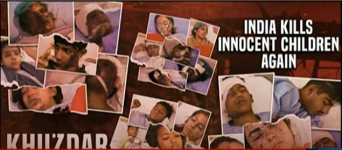
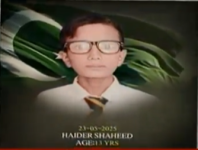
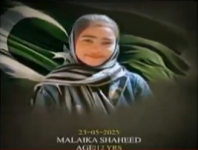
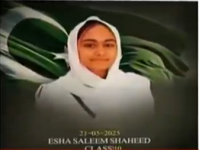
Appendix I: Addition of dossier of evidence regarding FAH inside Pakistan Source: ISPR [Govt of Pakistan] Dated 23-05-2025
1748008806462.png
1748008813102.png

1748008817528.png
1748008821939.png
1748008839614.png
1748008844587.png
 
Last edited:

Users who are viewing this thread

Country Watch Latest

Back
Top