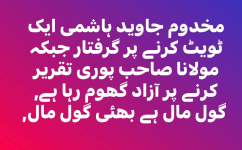
Ayesha Gulalai Jumps into the Arena against Maulana Fazal ur Rehman

Yes, Bajwa and Faiz Hameed pissed away all the gains and sacrifices of 2008-2014 by focusing entirely on Project Imran and Project Taliban in Afghanistan. Then idiot Muneera compounded these follies by bombing the same Taliban in Kabul, leading then to provide safe haven and support to a re-generated TTP and the BLA.

Now you want a reset and go back to Lashkar's again ??? I don't think so.
But i think this is all topi drama, no FIR against Fazl or arrest. If any PTI pass this statement, he would be rotten underground secret cell.
 
But i think this is all topi drama, no FIR against Fazl or arrest. If any PTI pass this statement, he would be rotten underground secret cell.
Javed Hashmi endorsed Maulana's statement. He has been arrested for that.
 
But i think this is all topi drama, no FIR against Fazl or arrest. If any PTI pass this statement, he would be rotten underground secret cell.
So you think this is another attempt to move on PTI's turf in KP ? But the Maulana is as discredited as the Establishment. This won't be enough.
 
In Pakistan’s political landscape, some stories feel painfully familiar. The latest chapter features the relaunch of Ayesha Gulalai, a figure once deployed against Imran Khan and now repurposed against Moulana Fazlur Rehman. It’s a move that signals something deeper than a single controversy. It reflects a mindset that has shaped Pakistan’s history for decades. when faced with real national problems, the Establishment reaches not for reform, but for political engineering.

Moulana’s criticism cuts through the noise. He says the Establishment is making every move, and every move is a mistake. Looking back at Pakistan’s political history, it’s hard to argue with the pattern.

A History Written in Miscalculations

The Fall of Dhaka:
The First Great Breakdown. The tragedy of 1971 didn’t happen overnight. It was the result of a refusal to accept the democratic mandate of the 1970 elections. Instead of transferring power to Sheikh Mujibur Rahman, the Establishment chose denial, coercion, and force.
The consequences were catastrophic:

• A fractured nation
• A lost majority province
• A wound that still shapes Pakistan’s identity

It was the first major example of how political engineering can break a country.

The Zia Years: Short-Term Control, Long-Term Damage

General Zia-ul-Haq’s era brought another set of decisions driven by short-term thinking.

• Religion was weaponized
• Extremist networks were empowered
• Civilian institutions were weakened

The ripple effects of those choices still define Pakistan’s security challenges today.


The 1990s: Democracy on a Leash

Instead of allowing democracy to grow, the Establishment spent the decade pulling strings:

• Governments were installed and removed
• Agencies became political tools
• Policy continuity became impossible

Pakistan entered the 2000s with a political system that had never been allowed to stand on its own feet.

The Musharraf Era (1999–2008): Another Experiment, Same Outcome

When General Pervez Musharraf took power in 1999, Pakistan entered yet another cycle of controlled politics.

• A military takeover
• NRO-driven alliances
• Tactical governance instead of structural reform

The economy saw temporary stability, but the political system was hollowed out even further. The country emerged from the era with more fragility than strength.

Post-2018: Engineering Without Strategy

The pattern didn’t end. It simply evolved.
Launching and relaunching figures like Ayesha Gulalai became part of a familiar script:

• Create a narrative
• Aim it at a political opponent
• Abandon it when it fails
• Relaunch it against someone else

This isn’t nation-building. It’s crisis management through improvisation.

The Imran Khan Project: Built, Broken, Weaponized

The Establishment’s relationship with Imran Khan followed the same arc:

• Support
• Control
• Removal
• Criminalization
• Attempted erasure of political base

Each step deepened polarization and weakened institutional legitimacy.

The Anti-Maulana Campaign: Another Misstep

Now, instead of addressing inflation, governance collapse, or institutional decay, the Establishment has turned Gulalai into a political missile aimed at Moulana Fazlur Rehman.
But Moulana’s critique stands:
The Establishment is making every move, and every move is wrong.

The Core Problem: A System That Never Learns

Pakistan’s crises are not accidental. They are the result of a repeated pattern:

• Undermining elected leadership
• Ignoring public mandate
• Engineering politics instead of fixing governance
• Choosing control over stability
• Creating crises instead of resolving them

From Dhaka in 1971 to Zia, from 1999 Musharraf to post-2018 political engineering, from Imran Khan to Moulana, the story is the same.
Short-term tactics. Long-term damage.

Pakistan deserves better than recycled strategies and repackaged political proxies. It deserves institutions that learn from history instead of repeating it.
Pakistan doesn’t need more committees, more experiments, or more political engineering.
It needs a structural reset.

The only viable solution is the 34 Economic Zones model, saving $22 billion a year and unlocking Pakistan’s path to a $1 trillion economy.

Not because it is idealistic.
But because Pakistan already has the potential, it just needs the right system to unleash it.
 
Last edited:
Across Pakistan, ordinary people are exhausted. They’ve heard every slogan, every promise, every emotional speech, yet their daily lives haven’t changed. Electricity bills rise, inflation crushes families, and basic services remain broken. In this environment, politics at the ground level has become noise without relief.

This is why the idea of removing politics from the local body system or at least drastically reducing it and is not just appealing, it’s necessary.

The Case for a Professional, Not Political, Local System

Under an Economic Zone (EZ) setup, governance becomes technical rather than political. Instead of electing individuals based on party loyalty or slogans, each position is filled by a subject-matter expert (SME)? someone who actually understands the job.

It’s a simple principle:
You wouldn’t go to a mochi for heart surgery. So why should a matric‑fail politician be responsible for managing the economy, utilities, urban planning, or digital governance?

This mismatch between responsibility and capability is one of the biggest reasons Pakistan’s local systems collapse.

What People Want Is Relief, Not Rhetoric

People don’t care about political point-scoring. They care about:

• clean water
• working hospitals
• safe streets
• functioning schools
• stable prices
• jobs for their children

These are technical problems, not political ones. They require engineers, planners, economists, administrators, not individuals whose only qualification is winning a local election through biradari networks or party backing.

How the EZ Model Fixes This

The EZ model replaces political interference with professional management:

• Each Zone hires SMEs for utilities, planning, enforcement, and digital systems.
• Local governance becomes contract-based, not party-based.
• Performance is measured through KPIs, not speeches.
• Citizens get services, not slogans.

This is how modern cities around the world operate through competence, not politics.

At its core, this isn’t about ideology. It’s about dignity.

People deserve a system where:

• their complaints are resolved
• their taxes are used properly
• their cities are managed by experts
• their daily life improves

Politics has its place but not in the day-to-day functioning of water supply, waste management, zoning, or economic planning.

Ground-level governance should be professional, not political.
 
To view this content we will need your consent to set third party cookies.
For more detailed information, see our cookies page.


@Jango ...what is all this nonsense... on nation media.


The first thing that stands out in her statement is the tone. Whether she accepts him as Moulana or not is irrelevant. it doesn’t change his political influence, his following, or his decades-long role in national politics. What matters is the intent behind her words, not the title she chooses to use.

There’s no denying that Moulana has, at times, benefited from staying close to the Establishment. Many political actors have. But the situation today is different. After a long series of political miscalculations, the Establishment is facing public frustration, institutional fatigue, and growing criticism. And instead of acknowledging their own mistakes, they seem eager to pull Moulana into their battles to use him as a shield, a distraction, or a tool for their latest round of political maneuvering.

That’s the real story here…

“Bacha Bazi”, statements crosses a line, she should not making such statements unless she has solid proof.

If someone makes an allegation that heavy, they should be prepared to defend it in court. Moulana has every right to challenge such statements legally not because of politics, but because reputations and public trust matter.

In many countries, especially in the West, an accusation of that nature would immediately trigger legal scrutiny. The person making the claim would have to provide evidence, not just rhetoric. Defamation laws are strict, and public figures cannot casually throw around explosive allegations without consequences.

But in Pakistan, this kind of language has unfortunately become normalized. It’s part of the political culture shock value, personal attacks, and sensational claims often replace real debate. People get desensitized, and serious accusations lose meaning because they’re used so casually.
 

Users who are viewing this thread

Pakistan Defence Latest

Country Watch Latest

Latest Posts

Back
Top