Translation:
While BIDA Executive Chairman is Flying High, Domestic and Foreign Investments are Declining
On May 25, 2024, from an altitude of 41,000 feet in a plane over Memphis, USA, Chowdhury Ashik Mahmud Bin Harun jumped out, holding the flag of Bangladesh. His skydiving made it to the Guinness World Records on July 1 of the previous year. A few months later, on September 12, Chowdhury Ashik was appointed as the Executive Chairman of the Bangladesh Investment Development Authority (BIDA) and the Bangladesh Economic Zones Authority (BEZA).
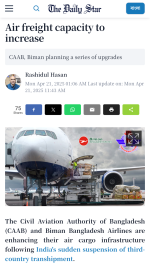
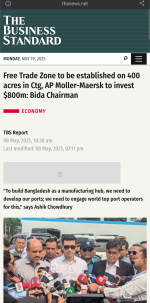
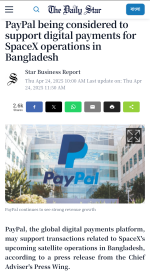
Confident Ashik Chowdhury took many promotional initiatives for attracting investment after assuming office. These included creating an investment heatmap, organizing investment summits, registering with Elon Musk's Starlink for satellite-based internet service, signing a contract with NASA for peaceful and civilian space exploration, and bringing all investment promotional agencies under one roof. The most recent addition was the investment of Denmark-based AP Moller Maersk to strengthen logistics infrastructure at the Port of Chittagong. Such new initiatives have caught the public’s attention, especially on social media, where there has been considerable buzz around him.
In the seven months since taking office, Ashik Chowdhury has initiated several activities to improve the country’s investment climate. However, the results of his promotional activities for building investment infrastructure are not yet visible in terms of actual investment attraction. The number of registered investment proposals at BIDA has been declining, and the net inflow of foreign direct investment (FDI), according to central bank data, has also decreased. Meanwhile, the import of capital machinery has also declined. Overall, while Ashik Chowdhury’s promotional activities for attracting investment are widely discussed, the real investment scenario is quite the opposite.
According to the balance of payments (BOP) statistics from Bangladesh Bank, the net inflow of FDI during the first nine months of the current fiscal year, from July to March, was USD 861 million. In comparison, the net FDI inflow in the same period of the 2023-24 fiscal year was USD 1.164 billion. This indicates a 26% decrease in the net FDI flow in the first nine months of the current fiscal year.
According to the central bank's weekly selected economic indicators, the payment for the import of capital machinery during the first nine months of the current fiscal year, from July to March, amounted to USD 1.521 billion. In the same period of the previous fiscal year, the payment was USD 2.133 billion. This means that capital machinery imports have decreased by 28.68%.
Efforts to get a statement from Ashik Mahmud Bin Harun regarding the investment situation were made on multiple occasions since Sunday, but no response was received until the report was written last night. The next attempt was made to reach Dr. Anisuzzaman Chowdhury, the special assistant to the chief adviser in the Ministry of Finance, in the capacity of a state minister. Speaking to the Daily Bonik Barta, he said, "Investment matters are dependent on the economy as a whole. This is a circular process. Objectively speaking, it can be seen that the level of foreign and domestic investment has always been low in Bangladesh. This investment situation is not new. Investment matters are always part of an ongoing process. It remains to be seen whether comparing the current investment situation with the past is valid. Long-term investment is a time-consuming process. Investors consider many factors before making decisions. Investment doesn’t suddenly increase. Recently, an investment summit was organized, where some commitments were made, but it will take time to implement them. There are various uncertainties at present, including a recent war and the issue of Rohingya refugees. We are going through a period of political instability. The government has recently taken several initiatives to improve the investment climate. It will take time to see how things unfold."
Four days after being appointed as the Executive Chairman of BIDA and BEZA on September 12, Ashik Mahmud Bin Harun met with representatives of the Foreign Investors Chamber of Commerce and Industry (FICCI). During the meeting, he said, "We hope to resolve the current challenges and obstacles to foreign investment very soon."
On October 30, Ashik Chowdhury inaugurated a webinar titled ‘State of Investment Climate’ for BIDA. In his concluding speech, he expressed his commitment to creating a fair and transparent business environment. He also presented a roadmap during his speech, stating that the main goal of the roadmap is to improve the ease of doing business and take effective measures against corruption.
On November 18, BIDA announced plans to create an FDI heatmap, identifying potential countries for investment, competitive sectors, and strategic investors to attract foreign direct investment. In the announcement, Ashik Chowdhury mentioned, "Until now, we lacked active engagement in investment promotion. Now, we want to conduct information-based strategic promotion to increase foreign investment. To this end, we have undertaken the creation of the FDI heatmap with the cooperation of various domestic and foreign expert institutions."
On January 19 of this year, BIDA published the FDI heatmap. During its publication, Ashik Chowdhury stated, "The FDI heatmap is not just a plan; it is a roadmap for our future investment efforts. We will base any roadshows, bilateral investment agreements, or policy support on this data-driven analysis."
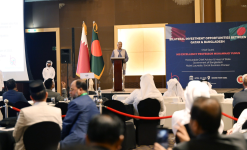
On March 23, Ashik Chowdhury announced the organization of an investment conference. The conference, held in April, was attended by representatives from 50 countries, with a total of 415 participants. At the end of the conference, Ashik Chowdhury reported that investment proposals worth BDT 310 billion had been received.
Ashik's smooth presentation at the investment conference caught the attention of many. Praise for his presentation spread through social media and other circles. By the end of the investment conference, several media outlets had referred to the expectations of significant investments in Bangladesh, dubbing it the "Ashik Magic." However, according to government statistics on investment, the actual impact of the "Ashik Magic" on real investments is yet to be seen.
Local investors have shared that there is no positive outlook for Bangladesh’s investment situation even in discussions with foreign ambassadors. One local investor, asking about the investment conference held in April, inquired with an ambassador from a foreign country, “Many investors from your country participated in the recently concluded investment conference. How long do you think it will take them to implement investments?” The ambassador replied by saying, “No investor will come to Bangladesh without a political government." Referring to the country’s law and order situation, the ambassador added, “The situation is still chaotic.”
Anwar-ul-Alam Chowdhury Parvez, president of the Bangladesh Chamber of Industries (BCI), told Bonik Barta, “Foreign investors are waiting for a political government to make the final investment decisions. Moreover, investment attraction depends on the types of proposals being offered. Even local investors are not showing interest in investing right now; in this scenario, how will foreign investors come?”
He further added, “The interest rate on bank loans in the country is now above 15%. Who will invest with such high-interest rates? In addition to high interest rates, our electricity, energy, and transportation costs are also higher compared to competitor countries. Let’s not even talk about bureaucratic complexities! In such a situation, why would foreign investors come here? Foreigners do not take loans from Bangladesh's banking sector. Local investors are the ones who borrow from the domestic sector. Foreign investors come only when local investors show interest in investing. Local investors are not showing interest right now for various reasons. If we don’t invest, how can we expect foreigners to be interested?"
Dr. Selim Raihan, executive director of the South Asian Network for Economic Modeling (SANEM), said to Bonik Barta, “The current executive chairman of BIDA is young, dynamic, and has international experience. Given these qualities, we want to remain hopeful. But I believe that overall, it is not possible for him alone to do everything. This is a collective institutional effort. Not just BIDA or BEZA, but the cooperation of other relevant institutions is necessary. The current executive chairman’s initiatives may be praiseworthy, but to turn them into reality, coordinated efforts are needed, and they must be implemented at the grassroots level. A long path lies ahead.”




 www.bernama.com
 www.risingbd.com

 www.facebook.com