Bangladesh Economy

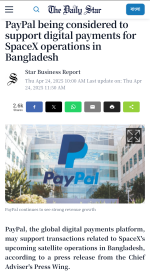
Paypal coming to Bangladesh will be a great boost to the growing freelancer community in Bangladesh. Will translate to more self employment and inflow of forex.
 
@uksyl @LeonBlack08

It is good that BD is attracting the interest of Starlink and other tech/digital service providers. However, it would be important that BD emerge as not only a consumer of tech (i.e. importer) but also exporter of tech services so that it doesn't result in cash outflows only.

Regards
 
@uksyl @LeonBlack08

It is good that BD is attracting the interest of Starlink and other tech/digital service providers. However, it would be important that BD emerge as not only a consumer of tech (i.e. importer) but also exporter of tech services so that it doesn't result in cash outflows only.

Regards

Local tech startups are still at infancy. But there are prospects as the skilled tech workforce has increased over the years. We need a success story like Infosys and other Indian tech giants.
 

Chinese internet giant Tencent wants to invest in Bangladesh

Chinese internet giant Tencent wants to invest in Bangladesh

Chinese information technology and internet giant Tencent has expressed its interest to invest in Bangladesh.


Faiz Ahmad Taiyeb, the special assistant to chief adviser on the Ministry of Posts, Telecommunications and Information Technology, said this in a status posted on his Facebook on Monday (April 28) night.


Faiz Ahmad Taiyeb wrote, “American giant Starlink has come to Bangladesh. The Chief Adviser has approved their licence application. A big tech giant has come to Bangladesh with the help of Chief Advisor Dr. Yunus Sir. Many more will come like this.”


He wrote, “Today, we officially sat with Chinese giant Tencent. They have also expressed their interest in coming to Bangladesh. We have assured them of policy support. Along with this, OSIRIS Group is coming to Bangladesh.


Bangladeshi data and cloud companies are bringing hyper-scalar clouds and data centers with the help of Jatra (at Kaliakair Hi-Tech Park). A world-class secured cloud is being setup here for big giants, where Meta, Google’s payload can come.”


He also wrote, “Dr. Muhammad Yunus is going to give all such unimaginable gifts to Bangladesh.”

 
I was hawkish about Bangladesh's economic potential back in 2019-2022. I thought Bangladesh could have been an Asian economic tiger. But that optimism is no longer there.

But economic growth momentum has slowed down a lot since 2023 due to surges in inflation, low consumer spending, and mismanagement of finances. AL government failed to tackle the underlying structural weakness of the country. Bangladesh desperately needed a change. Thankfully, Bangladesh got a once-in-a-lifetime opportunity to start afresh by deposing Hasina's regime. We're going through a turbulent post-revolutionary time. And the current government has no mandate to make meaningful structural reforms.

The economic outlook doesn't look so good now. We're looking at 4-5% growth this year.

Do you think the current government is tackling some of the underlying issues to at least build a more firmer foundation for future economic growth?

Do you think we can return to the 7-8% GDP growth?
 
I work in China for a large Chinese engineering company

We'd love to invest in Bangladesh, and even consider building some factories there. But BD needs to improve its skills base, and strengthen its institutional strength and credibility.

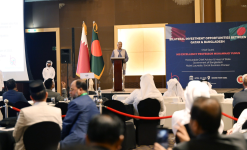
The last Bangladesh investment summit was quite positive in my opinion. It was well presented, no hype, no BS, just solid facts, highlighting the potential of BD. Rarely have I ever seen Bangladesh presented in such a professional, forward-looking way, with a clear idea of what future Bangladesh can look like.
BD, unlike a neighboring "suppapuwwa" never ceased assets of foreign companies. And the ROI is the highest in the region. They should use these strengths, along with (hopefully) improvements in local skills/competence
 
Translation:
While BIDA Executive Chairman is Flying High, Domestic and Foreign Investments are Declining

On May 25, 2024, from an altitude of 41,000 feet in a plane over Memphis, USA, Chowdhury Ashik Mahmud Bin Harun jumped out, holding the flag of Bangladesh. His skydiving made it to the Guinness World Records on July 1 of the previous year. A few months later, on September 12, Chowdhury Ashik was appointed as the Executive Chairman of the Bangladesh Investment Development Authority (BIDA) and the Bangladesh Economic Zones Authority (BEZA).


Confident Ashik Chowdhury took many promotional initiatives for attracting investment after assuming office. These included creating an investment heatmap, organizing investment summits, registering with Elon Musk's Starlink for satellite-based internet service, signing a contract with NASA for peaceful and civilian space exploration, and bringing all investment promotional agencies under one roof. The most recent addition was the investment of Denmark-based AP Moller Maersk to strengthen logistics infrastructure at the Port of Chittagong. Such new initiatives have caught the public’s attention, especially on social media, where there has been considerable buzz around him.


In the seven months since taking office, Ashik Chowdhury has initiated several activities to improve the country’s investment climate. However, the results of his promotional activities for building investment infrastructure are not yet visible in terms of actual investment attraction. The number of registered investment proposals at BIDA has been declining, and the net inflow of foreign direct investment (FDI), according to central bank data, has also decreased. Meanwhile, the import of capital machinery has also declined. Overall, while Ashik Chowdhury’s promotional activities for attracting investment are widely discussed, the real investment scenario is quite the opposite.


According to the balance of payments (BOP) statistics from Bangladesh Bank, the net inflow of FDI during the first nine months of the current fiscal year, from July to March, was USD 861 million. In comparison, the net FDI inflow in the same period of the 2023-24 fiscal year was USD 1.164 billion. This indicates a 26% decrease in the net FDI flow in the first nine months of the current fiscal year.


According to the central bank's weekly selected economic indicators, the payment for the import of capital machinery during the first nine months of the current fiscal year, from July to March, amounted to USD 1.521 billion. In the same period of the previous fiscal year, the payment was USD 2.133 billion. This means that capital machinery imports have decreased by 28.68%.


Efforts to get a statement from Ashik Mahmud Bin Harun regarding the investment situation were made on multiple occasions since Sunday, but no response was received until the report was written last night. The next attempt was made to reach Dr. Anisuzzaman Chowdhury, the special assistant to the chief adviser in the Ministry of Finance, in the capacity of a state minister. Speaking to the Daily Bonik Barta, he said, "Investment matters are dependent on the economy as a whole. This is a circular process. Objectively speaking, it can be seen that the level of foreign and domestic investment has always been low in Bangladesh. This investment situation is not new. Investment matters are always part of an ongoing process. It remains to be seen whether comparing the current investment situation with the past is valid. Long-term investment is a time-consuming process. Investors consider many factors before making decisions. Investment doesn’t suddenly increase. Recently, an investment summit was organized, where some commitments were made, but it will take time to implement them. There are various uncertainties at present, including a recent war and the issue of Rohingya refugees. We are going through a period of political instability. The government has recently taken several initiatives to improve the investment climate. It will take time to see how things unfold."


Four days after being appointed as the Executive Chairman of BIDA and BEZA on September 12, Ashik Mahmud Bin Harun met with representatives of the Foreign Investors Chamber of Commerce and Industry (FICCI). During the meeting, he said, "We hope to resolve the current challenges and obstacles to foreign investment very soon."


On October 30, Ashik Chowdhury inaugurated a webinar titled ‘State of Investment Climate’ for BIDA. In his concluding speech, he expressed his commitment to creating a fair and transparent business environment. He also presented a roadmap during his speech, stating that the main goal of the roadmap is to improve the ease of doing business and take effective measures against corruption.


On November 18, BIDA announced plans to create an FDI heatmap, identifying potential countries for investment, competitive sectors, and strategic investors to attract foreign direct investment. In the announcement, Ashik Chowdhury mentioned, "Until now, we lacked active engagement in investment promotion. Now, we want to conduct information-based strategic promotion to increase foreign investment. To this end, we have undertaken the creation of the FDI heatmap with the cooperation of various domestic and foreign expert institutions."


On January 19 of this year, BIDA published the FDI heatmap. During its publication, Ashik Chowdhury stated, "The FDI heatmap is not just a plan; it is a roadmap for our future investment efforts. We will base any roadshows, bilateral investment agreements, or policy support on this data-driven analysis."


On March 23, Ashik Chowdhury announced the organization of an investment conference. The conference, held in April, was attended by representatives from 50 countries, with a total of 415 participants. At the end of the conference, Ashik Chowdhury reported that investment proposals worth BDT 310 billion had been received.


Ashik's smooth presentation at the investment conference caught the attention of many. Praise for his presentation spread through social media and other circles. By the end of the investment conference, several media outlets had referred to the expectations of significant investments in Bangladesh, dubbing it the "Ashik Magic." However, according to government statistics on investment, the actual impact of the "Ashik Magic" on real investments is yet to be seen.


Local investors have shared that there is no positive outlook for Bangladesh’s investment situation even in discussions with foreign ambassadors. One local investor, asking about the investment conference held in April, inquired with an ambassador from a foreign country, “Many investors from your country participated in the recently concluded investment conference. How long do you think it will take them to implement investments?” The ambassador replied by saying, “No investor will come to Bangladesh without a political government." Referring to the country’s law and order situation, the ambassador added, “The situation is still chaotic.”


Anwar-ul-Alam Chowdhury Parvez, president of the Bangladesh Chamber of Industries (BCI), told Bonik Barta, “Foreign investors are waiting for a political government to make the final investment decisions. Moreover, investment attraction depends on the types of proposals being offered. Even local investors are not showing interest in investing right now; in this scenario, how will foreign investors come?”


He further added, “The interest rate on bank loans in the country is now above 15%. Who will invest with such high-interest rates? In addition to high interest rates, our electricity, energy, and transportation costs are also higher compared to competitor countries. Let’s not even talk about bureaucratic complexities! In such a situation, why would foreign investors come here? Foreigners do not take loans from Bangladesh's banking sector. Local investors are the ones who borrow from the domestic sector. Foreign investors come only when local investors show interest in investing. Local investors are not showing interest right now for various reasons. If we don’t invest, how can we expect foreigners to be interested?"


Dr. Selim Raihan, executive director of the South Asian Network for Economic Modeling (SANEM), said to Bonik Barta, “The current executive chairman of BIDA is young, dynamic, and has international experience. Given these qualities, we want to remain hopeful. But I believe that overall, it is not possible for him alone to do everything. This is a collective institutional effort. Not just BIDA or BEZA, but the cooperation of other relevant institutions is necessary. The current executive chairman’s initiatives may be praiseworthy, but to turn them into reality, coordinated efforts are needed, and they must be implemented at the grassroots level. A long path lies ahead.”
 
Bangladesh's unemployment rate has surged to its highest level in recent years amid ongoing economic and political instability.

According to the latest quarterly labour force survey released today by the Bangladesh Bureau of Statistics (BBS), the country's unemployment rate stood at 4.63% in the October–December quarter of the current fiscal year as per the 19th International Conference of Labour Statisticians (ICLS) standards.

This marks a significant increase from 3.95 percent recorded during the same period last year.
Under the 13th ICLS definition, which BBS also still uses, the unemployment rate was reported at 3.69% as of December 2024, up from 3.20% a year earlier.

Moreover, the number of unemployed individuals in the country has risen to 27.3 lakh under the 19th ICLS framework, up by 330,000 from 24 lakh in the same quarter of the previous year. Under the 13th ICLS, the total number of unemployed now stands at 26.1 lakh, also showing a year-on-year increase of 206,000.


Economists attribute the rise in unemployment to high inflation, poor investment climate, and rising bank interest rates, which have discouraged business expansion and job creation.

According to BBS's definition, an individual is considered unemployed if they did not work for at least one hour in the past seven days but were available for work during that period and the following two weeks, and actively looked for paid employment or profit-oriented work in the past 30 days.


The BBS had previously been publishing labour force survey data based on the 13th ICLS guideline of the ILO. However, in line with global practice, where most countries now follow the 19th ICLS framework, BBS recently started releasing data using the updated methodology as well following criticism from experts and stakeholders.


According to BBS, employment estimates vary depending on whether the 13th or 19th guidelines of the ILO are used.

Under the 13th ICLS guideline, individuals are considered employed if they worked for at least one hour in the past seven days for pay, profit, or family consumption – such as producing goods for their own household.

However, the 19th ICLS guideline classifies only those who worked for at least one hour in the past seven days for pay or profit as employed, excluding unpaid family or household work.

As a result, key labour market indicators, such as labour force size, employment, unemployment rate, population outside the labour force, and labour force participation rate, differ depending on which guideline is applied.
 
Thanks to Younus for this ground breaking achievement.
 
India has restricted the import of at least seven categories of Bangladeshi goods, including readymade garments, fruits and processed foods, through its land ports – just a month after Bangladesh banned yarn imports via the same route.

The ban, outlined in a 17 May notification from India's Directorate General of Foreign Trade under the Ministry of Commerce, stipulates that garments from Bangladesh may now only enter India through Kolkata and Nhava Sheva, Mumbai, seaports.

"All readymade garment imports from Bangladesh shall not be allowed from any land port, however, it is only through Nhava Sheva and Kolkata seaports," reads the circular.
The restrictions will not apply to Bangladeshi goods transiting through India but destined for Nepal and Bhutan, it added.

Other items included in the restriction are fruit, fruit-flavoured and carbonated beverages, processed food products, cotton and cotton yarn waste, finished plastic and PVC goods, and wooden furniture.

Imports of these goods have also been barred from entering India via any land customs station or Integrated Check Post (ICP) in Assam, Meghalaya, Tripura and Mizoram.

While India's order does not cite Bangladesh's yarn ban as the reason, many Bangladeshi exporters believe the move is retaliatory.

"We see this as a reciprocal response to Bangladesh's recent restrictions on land-port yarn imports," said Shams Mahmud, a leading garment exporter, told The Business Standard.

He noted that the shift to seaports will increase costs and affect timely delivery, particularly for small exporters. "We supply to several Indian retail outlets. Increased lead times will hurt smaller players in particular."

Mahmud, however, added that since Bangladesh did not restrict Indian imports through seaports, India is unlikely to block Bangladeshi goods via sea either.

Bangladesh's ban on yarn imports through land ports came into effect on 15 April, following lobbying by the Bangladesh Textile Mills Association, alleging that yarn importers were abusing land-port access to under-declared shipments, harming domestic textile mills.

While local spinners welcomed the move, apparel manufacturers opposed it, saying it would raise production costs.

According to National Board of Revenue officials, about three-fourths of yarn imports from India already come via seaports.

Bangladesh imported around $9 billion worth of goods from India in FY24, according to Bangladesh Bank data. In contrast, exports to India during the same period stood at $1.56 billion, as per the Export Promotion Bureau.

Mohammad Hatem, president of the Bangladesh Knitwear Manufacturers and Exporters Association, believes the restriction is unlikely to cause significant harm to Bangladesh's garment exports.

However, he fears exports of processed food and other items may take a hit.

"This kind of reciprocal action hurts bilateral trade on both sides," he said. "But India stands to lose more, as Bangladesh imports far more from them."

He added that such issues should be resolved through dialogue, not by trade barriers.

Kamruzzaman Kamal, director at Pran-RFL Group, told The Business Standard that India is a major market for Pran-RFL Group's processed foods, plastic products, furniture, and PVC-finished goods.

"We have made substantial investments in India to serve this market. If India imposes restrictions on the entry of these products, it would be a significant setback for our exports," he said.

"Such restrictions would not only impact Pran-RFL, but also pose serious challenges for other businesses. We hope that both governments will resolve the issue through dialogue and keep the trade routes open," he added.

On 9 April, India withdrew the transhipment facility it had granted to Bangladesh for exporting various items to the Middle East, Europe and various other countries except Nepal and Bhutan.

According to NDTV, it was announced against the backdrop of the statement made by Bangladesh's interim government Chief Adviser Muhammad Yunus in China recently that India's seven northeastern states, which share a nearly 1,600 km border with Bangladesh, are landlocked and have no way to reach the ocean except through his country.

The comment did not go down well in New Delhi and also drew sharp reactions from political leaders in India across party lines, according to NDTV.

Indian exporters, mainly from the apparel sector, had also earlier urged the government to withdraw this facility to the neighbouring country, the official added.
 

Users who are viewing this thread

Pakistan Defence Latest

Back
Top