Could BNP’s landslide win open a new geopolitical chapter for Bangladesh?
Tarique Rahman’s decisive victory may redraw regional alignments after years of pro-India policy under ousted PM Sheikh Hasina.
Listen to this article | 10 mins
Bangladesh Nationalist Party (BNP) chairman Tarique Rahman speaks at an election rally in Dhaka, Bangladesh, on February 8, 2026 [Mohammad Ponir Hossain/Reuters]
https://www.aljazeera.com/author/abid-hussain
By
Abid Hussain
The Bangladesh Nationalist Party’s (BNP)
commanding victory in Bangladesh’s parliamentary election marks not only a political watershed for the South Asian nation, but also a potential recalibration of
regional power dynamics across India, Pakistan and China.
The Election Commission has published the gazette of the members of parliament elected, a final official seal on the election process on Saturday.
Initial results published on Friday by the Election Commission gave the
BNP and its allies at least 212 out of 299 parliamentary seats, while the opposition Jamaat-e-Islami and its allies won 77 seats.
Tarique Rahman’s party has delivered what observers described as Bangladesh’s first genuinely competitive election in nearly two decades.
The country marked a decisive break from the Sheikh Hasina era and signalled the beginning of what analysts call a “paradigm shift” in Dhaka’s foreign policy orientation.
Soon after the results were announced, the prime ministers of both India and Pakistan congratulated 60-year-old Rahman for a decisive win.
Delwar Hossain, professor of international relations at the University of Dhaka, described the election outcome as “a new turning point in crafting bilateral relations with India and Pakistan”.
“The new government may bring about a policy framework with clarity of purpose and effective implementation strategies,” Hossain told Al Jazeera. “The continuing India-Pakistan hostility and China-India rivalry may remain critical determinants of Bangladesh’s foreign policy moves in its neighbourhood.”
Will India ties be reset?
Indian Prime Minister Narendra Modi posted his congratulations to Rahman on X on Friday, following it up with a phone call hours later.
Get instant alerts and updates based on your interests. Be the first to know when big stories happen.
“India will continue to stand in support of a democratic, progressive and inclusive Bangladesh,” Modi wrote, adding that Rahman’s win “shows the trust of the people of Bangladesh in your leadership.”
In another post, Modi said he spoke with Rahman over the phone to convey his wishes.
“As two close neighbours with deep-rooted historical and cultural ties, I reaffirmed India’s continued commitment to the peace, progress, and prosperity of both our peoples,” he said.
New Delhi had cultivated close ties with Hasina’s government, viewing Bangladesh as a crucial partner as regional powers India and China competed for influence in South Asia.
But since a mass uprising in 2024 toppled Hasina’s authoritarian government and forced her into exile in India, relations between New Delhi and Dhaka plunged to historic lows, marked by recriminations, trade restrictions and India’s refusal to extradite Hasina despite a death sentence handed down by Bangladesh’s International Crimes Tribunal over her handling of the deadly 2024 protests.
Yet, India began adjusting to a new political reality in post-Hasina Bangladesh. Earlier this year, Indian Foreign Minister S Jaishankar
attended the funeral of former Prime Minister Khaleda Zia, whose son Rahman is set to be the next Bangladeshi prime minister.
“India has experience dealing with BNP-led political regimes in the past,” Hossain said. “India has demonstrated its eagerness to work with the future BNP government. Now that the elections are over, that has become a reality.”
Asif Bin Ali, a geopolitical analyst at Georgia State University, said an elected government in Bangladesh would have “strong incentives to move back to a working relationship with India, even if it cannot and should not reproduce the level of political closeness seen under Sheikh Hasina”.
“I expect a more cautious middle position that stresses mutual respect, reciprocal sovereignty and noninterference in each other’s domestic politics, while keeping space for Dhaka’s own strategic autonomy,” Ali told Al Jazeera.
Still, major irritants persist besides Hasina – the unresolved water sharing disputes over rivers such as Teesta, deadly border shootings by Indian forces and a large trade deficit in India’s favour.
The new government will also face pressure at home to adopt a firmer tone towards New Delhi, particularly amid anti-India sentiment among a large section of Bangladeshi youth, who allege “excessive Indian interference” in the country’s internal affairs.
Saleh Shahriar of North South University in Dhaka questioned how far the BNP would go in its dealings with India. “Tarique Rahman’s BNP is different from Khaleda Zia’s BNP,” he said.
The Pakistan pivot
Where India confronts uncertainty, Pakistan has seen an opportunity.
Under Bangladesh’s interim administration led by Nobel laureate Muhammad Yunus, Bangladesh and Pakistan resumed direct flights, exchanged high-level civilian and military visits, and eased visa procedures, among various other confidence-building steps.
Analysts say that momentum could gather pace under a BNP government.
Former Pakistani foreign secretary and diplomat Salman Bashir told Al Jazeera the Bangladesh election “marks the end of Awami League’s long dalliance” with India and “a reopening of close relations” with Pakistan.
“Bangladesh does not have to balance its relations with India and Pakistan,” Bashir said. “Ties with Pakistan have improved. Pakistan should persist with its present policy of giving priority to its relations with Dhaka.”
Pakistan’s Deputy PM and Foreign Minister Ishaq Dar with Bangladesh’s Muhammad Yunus [Handout/Office of the Chief Adviser, Government of Bangladesh]
Last month, the
Pakistani military announced that it was in conversation with its Bangladeshi counterparts to sell them Pakistan-manufactured JF-17 fighter jets.
Bashir said there is a possibility that Bangladesh, Pakistan and China may come closer in defence matters.
“It should be possible for Bangladesh to lead a more independent policy towards Pakistan and the Middle East. Ties with China would be strengthened. In short, it means a reversal of India’s dominant posture in the region,” he said.
Praveen Donthi of the International Crisis Group thinks Dhaka will try to balance relations with both Beijing and New Delhi, with possible outreach to Islamabad as well. He said India pursues a pragmatic approach to its strategic and foreign policy, “though it may sometimes take time to reorient itself”.
Shahab Enam Khan, executive director of the Bangladesh Center for Indo-Pacific Affairs, said the BNP will pursue a “more transactional approach” towards both Islamabad and Delhi.
“Pakistan, as a natural regional neighbour, will benefit from more transparent and structured cooperation,” he said.
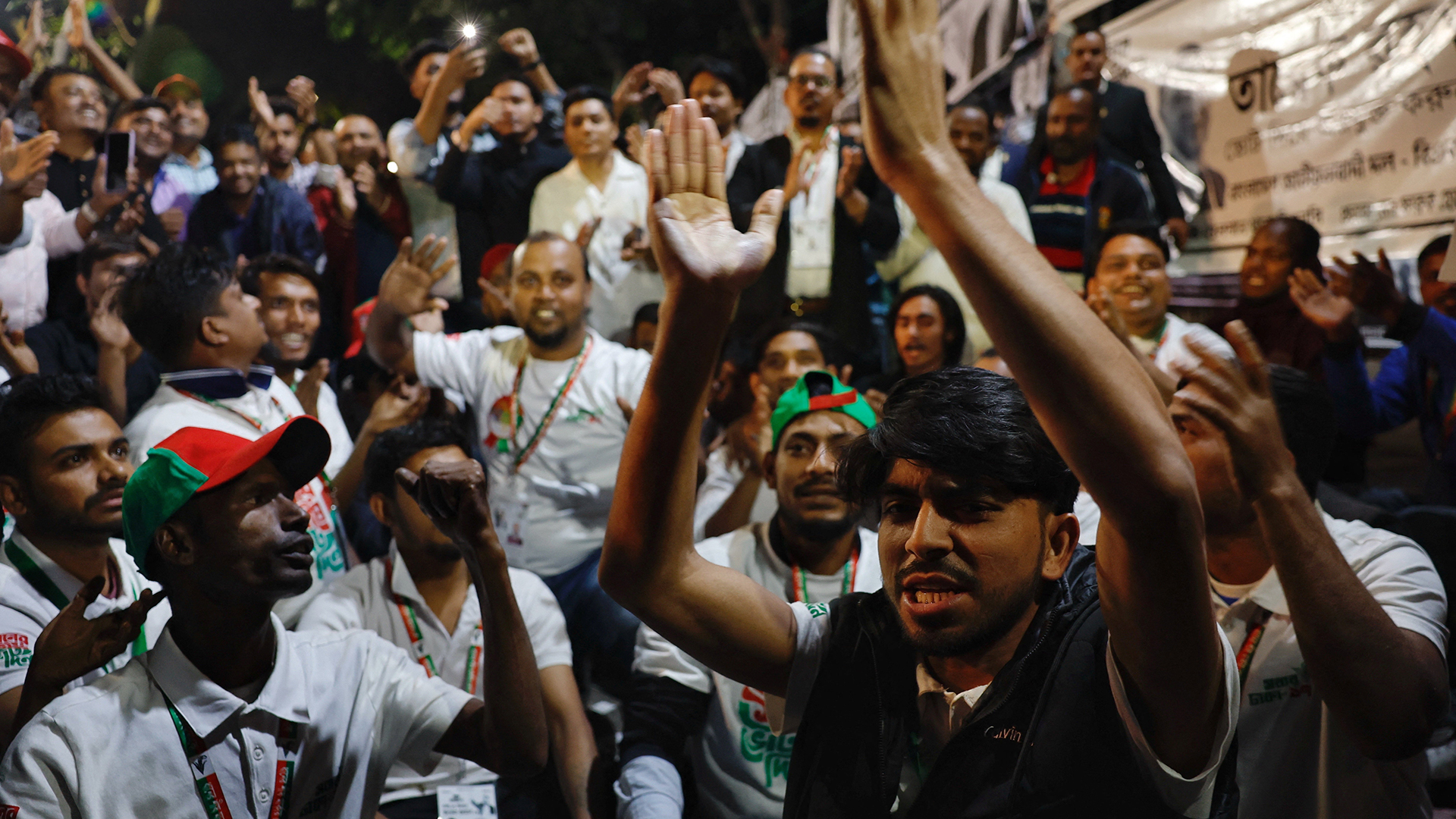
BNP supporters celebrate as party claims Bangladesh election win
New chapter with China?
Perhaps the most consequential relationship for the incoming Bangladesh government will be with China.
Beijing maintained strong ties with Hasina, while also cultivating links across Bangladesh’s political spectrum, positioning itself regardless of the domestic political dynamics.
Under Hasina’s long rule, China expanded its economic footprint through its Belt and Road Initiative, deepening infrastructure investments and military cooperation with Dhaka.
The interim government that succeeded Hasina also secured about $2.1bn in Chinese investments, loans and grants, alongside high-level visits to Beijing, including by Yunus.
On Friday, the Chinese embassy congratulated the BNP on its victory, expressing readiness to work with the new government on “writing new chapters of China-Bangladesh relations”.
Hossain, professor of international relations at the University of Dhaka, said the BNP would likely “further deepen its relations with China, hearkening back to the past experience of friendly ties” under the previous governments led by the party.
At the same time, he noted, Bangladesh will face a “growing American opposition to China’s increased presence” in the region.
Ali of the Georgia State University argued that Dhaka’s most viable path would be to “keep Chinese investment and connectivity projects where they serve Bangladesh’s interests, while making foreign policy more predictable and rules-based” in relation to China and the US.
“If Dhaka can be transparent about its red lines and priorities and keep the China file focused on economics rather than security symbolism, it will have a better chance of avoiding being dragged into major power rivalries while protecting its own strategic space,” he said.
Dhaka’s delicate balancing act
As Rahman prepares to assume office, he faces what Shahriar, professor at North South University in Dhaka, describes as a “great power competition in the Bay of Bengal region”.
The BNP manifesto emphasised a “Bangladesh First” policy, which called for all international relations and engagements to prioritise national sovereignty, security and the welfare of the people.
“The reality is, as a sovereign country, Bangladesh needs to develop its relations with all the countries, including China, Pakistan, Myanmar. This will be a great challenge for the upcoming government,” he said.
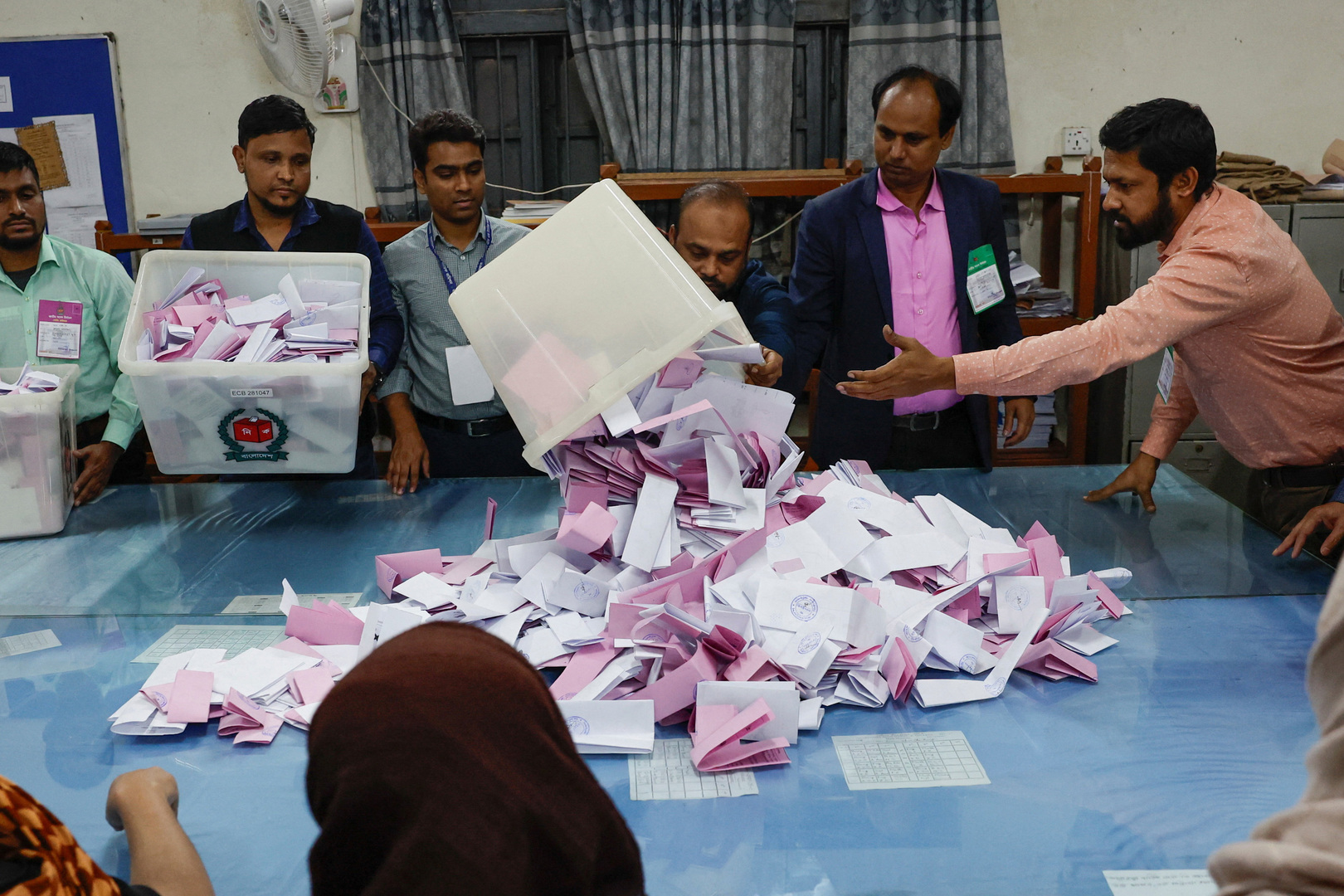
People vote during the general election in Dhaka, on February 12, 2026 [Mohammad Ponis Hossain/Reuters]
Khan from the Bangladesh Center for Indo-Pacific Affairs said the new administration must ground its diplomacy in “pragmatism rather than rhetoric”.
Praveen Donthi of the International Crisis Group said the Bangladesh verdict gives the South Asian region a chance to recalibrate, as it is no longer a region that can be counted as the “back yard of one or the other”. Foreign policy, he said, tends to evolve gradually rather than shift abruptly.
“There are likely to be small, incremental shifts towards regional balancing between India and China, as already observed during Sheikh Hasina’s leadership. Dhaka will also aim to build a more active relationship with the US and, however minimally, normalise relations with Islamabad,” he said.
Tarique Rahman's decisive victory may redraw regional alignments after years of pro-India policy under ousted PM Hasina.

www.aljazeera.com


www.aa.com.tr