Bangladesh-Pakistan

Bangladesh has purchased 25,000 tons of high-quality sugar, which will reach Chittagong Port (Bangladesh) from Karachi Port next month.

According to officials, the Pakistani sugar industry is sending its production to brotherly country Bangladesh in such a large quantity after many decades.
 
Bangladesh has purchased 25,000 tons of high-quality sugar, which will reach Chittagong Port (Bangladesh) from Karachi Port next month.

According to officials, the Pakistani sugar industry is sending its production to brotherly country Bangladesh in such a large quantity after many decades.
We can be a huge market for Pakistani produces. We have huge demand for Rice, sugar, onion and cotton...
 
We can be a huge market for Pakistani produces. We have huge demand for Rice, sugar, onion and cotton...

Pakistani sella long grain Basmati rice is the best. I buy only Pakistani brand sella Basmati rice from Pakistan owned groceries store.

I like Aahu Barah brand. Expensive but best quality.
 

Direct flights to Bangladesh to commence soon​

To bolster trade, expo will be organised for importers, exporters

Our Correspondent
December 06, 2024

direct flights to bangladesh to commence soon


KARACHI: Bangladesh Deputy High Commissioner in Karachi SM Mahbubul Alam has announced that direct flights between Pakistan and Bangladesh will commence soon, which will significantly bolster ties between the two nations and their business communities.

He also revealed that an exhibition for importers and exporters of the two countries would be organised in Hyderabad in collaboration with the Hyderabad Chamber of Small Traders and Small Industry (HCSTSI).

Alam extended an invitation to the business community for participating in the Annual Trade Exhibition to be held in Dhaka in January 2025. He assured them that visa process would be streamlined to facilitate their participation.

The deputy high commissioner expressed these views during a visit to the Hyderabad Chamber. He said Bangladesh's interim Chief Adviser Dr Muhammad Yunus had emphasised the need for leveraging the potential to enhance trade with Pakistan.

He described Bangladesh as a highly attractive market and asked the HCSTSI to send a delegation to Dhaka. He committed to monitoring and expediting the visa process for traders.
 
First direct maritime contact between the two South Asian nations

A Pakistani cargo ship docked in Bangladesh, marking the first direct maritime contact between the two South Asian nations since relations were severed in 1971.

The docking is viewed as a major step toward enhancing trade and business ties between the two Muslim-majority nations.

Bangladesh became independent from Pakistan on Dec. 16, 1971, after a nine-month war.

Pakistan’s High Commissioner to Bangladesh Syed Ahmed Maroof called the voyage a step toward "boosting more integrated and trade network across the region."

The ship is the first-ever direct maritime link between the two countries, Maroof said in a statement, adding that the "direct route promises to significantly streamline supply chains and reduce transit time."

The vessel carried a diverse array of goods with an estimated 2,300 22-foot equivalent (TEU) capacity. TEU is a general unit of cargo capacity.

The voyage highlights the growing demand for direct trade between the two countries, according to Maroof.

He characterized the shipping route as boosting a more integrated and trade network across the region.

Maroof said the initiative will not only accelerate existing trade flows but also promote new opportunities for businesses on both sides, from small traders to large exporters.
 
To view this content we will need your consent to set third party cookies.
For more detailed information, see our cookies page.
 
Sheikh Mujibur Rahman, despite his initial closeness to India, also distanced himself from New Delhi. He sidelined pro-India leaders and used anti-India rhetoric to distract from domestic issues. By the mid-1970s, India’s influence in Bangladesh had diminished significantly. Nevertheless, India continued to back Mujib, even as his government became increasingly authoritarian.


This reliance on a single leader proved disastrous. In 1975, Sheikh Mujib was assassinated, leaving India with few allies in Dhaka. His successors pursued policies that were less aligned with India’s interests, fostering ties with Pakistan and China. India, in turn, supported rebel groups and considered military intervention to regain influence.

The cycle of mistrust persisted for decades, with periods of cooperation interspersed with rivalry. Sheikh Hasina’s return to power marked another high point in India-Bangladesh relations, as she pursued pro-India policies. However, her increasingly autocratic rule alienated many Bangladeshis, and India’s strong support for her has made it a target of public anger.

With Sheikh Hasina’s fall, India faces a critical opportunity to reassess its approach to Bangladesh. Instead of focusing solely on security concerns and short-term gains, India could invest in building democratic institutions and fostering goodwill among the Bangladeshi populace. A balanced and inclusive policy might help repair relations and prevent further deterioration in this vital partnership.
 
Over the past 15 years, Sheikh Hasina’s government had not been open to normalizing or improving relations with Pakistan.

If you recall, former Pakistani Prime Minister Imran Khan reached out to Sheikh Hasina several times, and Pakistan’s former High Commissioner Imran Ahmed Siddiqui also met with her.

However, there was no positive response from her side. It seemed that her government was not interested in maintaining friendly or cordial relations with Pakistan. Now, with her departure, there is certainly an opportunity to normalize relations between Bangladesh and Pakistan.

Certainly there are efforts being made from both sides to revitalize the relationship. But the interim government in Bangladesh [led by Chief Adviser Muhammad Yunus] seems very cautious. This Yunus regime is neither pro-Pakistan or anti-Pakistan. It wants an even handed approach in its foreign policy. It doesn’t want to tilt toward any country. Pakistan thinks that is something very positive.

Still, I don’t have very high hopes from the regime of Yunus. It still looks very fragile, and it is already bogged down with various issues of its own. Its legitimacy is also in question.

Many argue that if a regime wants to establish itself as legitimate, it has to come to power by holding a referendum or fresh elections. Otherwise, the legitimacy of a government remains questionable.
 
A professor of a mainstream Bangladeshi university also hinted at purchase of JF17 B3 planes to deter Indian aggression, although he equated these planes as equals to F-35 which makes me a little hesitant as to their research behind this venture. But InshaAlllah with time, we want to see our Bangladeshi brothers to prosper hand in hand.
 
A professor of a mainstream Bangladeshi university also hinted at purchase of JF17 B3 planes to deter Indian aggression, although he equated these planes as equals to F-35 which makes me a little hesitant as to their research behind this venture. But InshaAlllah with time, we want to see our Bangladeshi brothers to prosper hand in hand.
That's simply his opinion, and as you assessed correctly, he is no defence expert.

I don't think BAF will go for JF 17, based on their past requirements for MRCA. Although it can change now, we will have to wait and see.
 
Bangladesh should refuse any rapprochement with Pakistan until the dictatorship is toppled. Otherwise they are collaborating with enemies of the Pakistani people (the current rulers of Pakistan were once their own enemies)
 
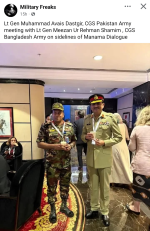
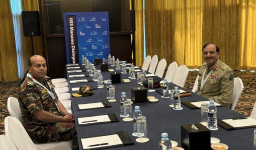
Lieutenant General Muhammad Avais Dastgir, Chief of General Staff (CGS) Pakistan Army, met Lt Gen Meezan Ur Rehman Shamim , Chief of General Staff Bangladesh Army on the sidelines of Manama Dialogue, #IISSMD24

1733847619722.png
 

Users who are viewing this thread

Pakistan Defence Latest

Back
Top