Bangladesh Socio-Political Crisis 2024 and onwards

As for the other Islamic groups in Bangladesh their ideology is far different from Jamaat and many have aligned with India and did maintain good relations with the Awami League. I see no possibility of an Islamic united front. It has never actually happened in Bangladesh's history.

The unity of Islamic parties was required to counter the aggression, regardless of ideology - Moududi or traditional Islamic Caliphate. Unfortunately you are right that unity is probably never going to happen.

Not sure you heard about Hefajot leader criticizing Jamaat yesterday in a conference. He basically criticized Jamaat based on the Moududi ideology and probably one step short of calling them apostates. This same guy before had said that they will accept 200 years of BAL rule in 2021. That is disgusting level of sycophancy especially given the hundreds of Hefajot activists were killed by Hasina regime in 2013 Shapla Square massacre. Babunagari Hujur lost all his credibility when he supported BAL after 2013 massacre. As for the smaller "Islamic" parties who were on BAL and Indian payroll, I have nothing to say about those parasites.

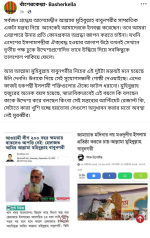
This came from a Shibir run page, commenting on the contradictions of Hefajot leader's position. Even though they don't blame him directly since he is very old, but places the blame on a group of unnamed "opportunists" who are attempting to create division on any attempt at Islamic party unity. Clearly the division is out in the open.

This is good news for BAL and Hindutvas in Indian Government.

1000026965.png
 
I will confine myself to the issue of the Islamic ideologies that guide groups like Jamaat, Hezbollah and Hamas and why they are not comparable. Jamaat follows the ideology of Maulana Maududi who tended to prefer working through the existing system rather than revolutionary change and this perspective permeates Jamaat to this day and it allows it to adopt Pro-American stances.

I will digress a bit from the topic - Actually apart from the Military wing of Hezbollah - how Jamaat, Hezbollah, Muslim Brotherhood operates their political activities are very similar. They use religion, emphasize on education within community, owns businesses and social work to build their connection within society. Just like Jamaat, Hezbollah emphasizes on giving scholarships and recruiting meritorious students and operates its own businesses, especially in the financial sector. Of course differences exist in ultimate objectives of each of these groups as you have rightly pointed out.
 
To view this content we will need your consent to set third party cookies.
For more detailed information, see our cookies page.

.
This is straightforward cross border terrorism...
 
To view this content we will need your consent to set third party cookies.
For more detailed information, see our cookies page.

.
This is straightforward cross border terrorism...

She is bat sh*t crazy with a psychopathic mind. She just likes to press the buttons thinking she still can get under someone’s skin.
She is done just not willing to accept the fact.
She is trying to give AL hope so that AL minions would still be around. The other purpose is to impede in the investigations of her family members specifically about, her son and daughter. She does not care about anyone else.
 

Something's cooking.

Guess to whom president submits his resignation letter when he resign!
 

Student parliament election to be conducted before any other election: Nahid​


Election for student parliaments will be conducted before any other election is conducted in the country, said Posts, Telecommunications and Information Technology Adviser Nahid Islam.


This is awesome. Will significantly enhance the organizational strength of the student movement through a fair and efficient formal set up.

BNP's recent traitorous attitude of not cooperating with the dissolution of the facist constitution and drafting a new one will only backfire on them.

We will push through with or without them. State is holy. There will be no compromise.

They can either be part of the problem or part of the solution. If we draft a new constitution and they try to cancel it after being elected, student parliament will be the security guarantor of new constitution through nation wide movement and mobilization if needed.

Remember, inqilab is still ongoing. It will only end when the justice is fully delivered, a new constitution is drafted and the Second Republic of Bangladesh is proclaimed.
 

Farhad Mazhar: This time mass uprising has failed​


  • Mazhar blames the failed uprising on a lack of understanding between law and politics
  • Calls for an inclusive state that safeguards freedom, warning against using Islam to justify fascism
Farhad-Mazhar-7a0f183e8e3c2142c5c5a183da29f7f4.webp

Tribune Desk
Publish : 01 Nov 2024, 04:54 PMUpdate : 01 Nov 2024, 06:58 PM

Writer and political analyst Farhad Mazhar said the public uprising failed due to a lack of understanding of the relationship between law and politics.

According to Mazhar, this failure served as a necessary wake-up call, highlighting society’s ignorance and unconsciousness

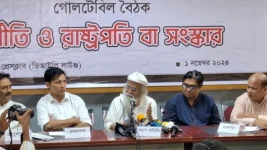
Mazhar shared these thoughts at a meeting titled "Corruption and the President or Reform" organized by the Center for Democracy and Peace Studies at the Tofazzal Hossain Manik Mia Hall of the National Press Club on Friday.

Farhad Mazhar said: “We speak of democracy while ignoring the people. Even after the uprising, we ignored the people, which is strange. So many people have been martyred, so many have become crippled, and yet we have still ignored the public. This is not right.”

The political analyst said: “The term 'constitution' is not correct. It is used by colonial powers to establish laws over those they wish to govern. This is what is called a constitution. In democracy, there should be no difference between the governed and the governing. In democracy, the people are their own rulers.”

He added: “In 1972, those who were elected to create Pakistan's constitution came back and drafted the constitution for an independent Bangladesh. They enacted what they wanted for governance, adding socialism, secularism. Their ideology is what we call fascism. They imposed their ideology on us, governing us under this for so many years. The Awami League tried to show that they embodied the spirit of the Liberation War, yet the spirit of the Liberation War was about equality, human dignity, and justice.”

Mazhar further commented: “You carried out an uprising, but no oath is needed for an uprising. If you had taken your oath in front of the Shaheed Minar or the Raju Memorial Sculpture, you would have truly honored those who were martyred and those left crippled. But the moment you entered Bangabhaban, you betrayed the blood of the martyrs. And the consequences of that betrayal are visible to you every day. You will continue to see these consequences in the future, repeatedly, in different forms.”

He continued: “You are discussing one or two reforms within the government. This is not the topic of discussion today. Today one person is in government; tomorrow, it will be someone else. The primary issue is to build the state itself. We need to build a state in which we are all part of it, universally inclusive. We want a state that secures our life and livelihood, that does not infringe upon our personal freedom and dignity. Drafting a constitution is not a difficult task.”

He also added: “Some say that to establish Islam in Bangladesh, Farhad Mazhar must be killed. If killing me would establish Islam, then, Insha Allah, I would be killed in the name of Allah. Do not try to scare me. But do not promote fascism under the name of Islam.”


Student parliament election to be conducted before any other election: Nahid​


Election for student parliaments will be conducted before any other election is conducted in the country, said Posts, Telecommunications and Information Technology Adviser Nahid Islam.


This is awesome. Will significantly enhance the organizational strength of the student movement through a fair and efficient formal set up.

BNP's recent traitorous attitude of not cooperating with the dissolution of the facist constitution and drafting a new one will only backfire on them.

We will push through with or without them. State is holy. There will be no compromise.

They can either be part of the problem or part of the solution. If we draft a new constitution and they try to cancel it after being elected, student parliament will be the security guarantor of new constitution through nation wide movement and mobilization if needed.

Remember, inqilab is still ongoing. It will only end when the justice is fully delivered, a new constitution is drafted and the Second Republic of Bangladesh is proclaimed.

The revolution really needs to find a way to stay in power in the long term. It will be a stupidity to handover power to a party like BNP which is no different from BAL. Handing over power to BNP type party will defeat the revolution and BD will be back to the same deepshit it was in.
 
The unity of Islamic parties was required to counter the aggression, regardless of ideology - Moududi or traditional Islamic Caliphate. Unfortunately you are right that unity is probably never going to happen.

Not sure you heard about Hefajot leader criticizing Jamaat yesterday in a conference. He basically criticized Jamaat based on the Moududi ideology and probably one step short of calling them apostates. This same guy before had said that they will accept 200 years of BAL rule in 2021. That is disgusting level of sycophancy especially given the hundreds of Hefajot activists were killed by Hasina regime in 2013 Shapla Square massacre. Babunagari Hujur lost all his credibility when he supported BAL after 2013 massacre. As for the smaller "Islamic" parties who were on BAL and Indian payroll, I have nothing to say about those parasites.

This came from a Shibir run page, commenting on the contradictions of Hefajot leader's position. Even though they don't blame him directly since he is very old, but places the blame on a group of unnamed "opportunists" who are attempting to create division on any attempt at Islamic party unity. Clearly the division is out in the open.

This is good news for BAL and Hindutvas in Indian Government.

View attachment 75369

I am not going into the specifics of the mudslinging but in general the Islamic groups/parties other than Jamat are cavemen level incompetent. They are a curse and burden to BD and shouldn't be given any chanve to play any role in BD politic.
 
Who’s in charge in Bangladesh after Sheikh Hasina? Anybody's guess

Does Muhammad Yunus, chief adviser to the interim government, have control over the state of affairs in Bangladesh? Are the student coordinators, who led the movement against Hasina resulting in her fall on August 5 and are now part of the government, allowing him to function freely?

Devadeep Purohit

The Telegraph – November 1, 2024
1730423771_bangladesh.jpg


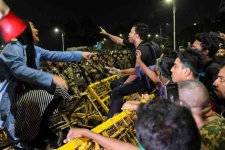
CRISIS CONTINUED: Bangladesh has rid itself of a troubled past, but is yet to discover a clear path into the future.

Close to 90 days after Sheikh Hasina Wazed fled her country to escape waves of street protest, most Bangladeshis seem to be lost on the way ahead. The transition remains an unclear — often fought over — work in progress.

In this chaos, several tantalising questions have reared their heads, with no clear answer to any and uncomfortable possibilities only adding to the miasma of uncertainty.

Does Muhammad Yunus, chief adviser to the interim government, have control over the state of affairs in Bangladesh? Are the student coordinators, who led the movement against Hasina resulting in her fall on August 5 and are now part of the government, allowing him to function freely? Is the Nobel laureate on the same page with the country’s President, Mohammed Shahabuddin? Does Yunus enjoy the confidence of the army chief, Waker-uz Zaman, and vice-versa?

The interim government had taken charge with the promise of undoing all the misdeeds of the “fascist regime” and charting a new course for the Muslim-majority country of over 175 million people.

As the future of a stable Bangladesh, the fastest-growing economy in South Asia for over a decade, critically hinges on the above questions, The Telegraph tried to get answers by talking to a cross-section of people — politicians, bureaucrats, journalists, legal experts and ordinary people — over the phone.

Reality bites

The crux of the response: While a majority of Bangladeshis want “yes” to be the answer to all the above questions, the reality is just the opposite.

“There is major confusion on who is running the government.... Is it the chief adviser or the student coordinators who led the movement against Sheikh Hasina, two of whom are in the government?” said Nurul Haq Nur, president of Gono Odhikar Parishad, a fledgling political party that got its registration in early September.

Nur, a former student leader, had shot into prominence in 2018 when he led a movement demanding reforms in the quota system for government jobs. He had played a role even in the anti-quota protests in July that brought down the Hasina regime.

His answers to the above questions, however, indicate that the young politician — like many other Bangladeshis who had hit the streets in support of the students in July — is upset with the state of affairs in Bangladesh, now helmed by Yunus.

“As the chief adviser, Dr Yunus has power.... But is he exercising it? The other question is, can he exercise it?” he said.

A former minister in the Hasina government, now in hiding, told this correspondent that the main problem in today’s Bangladesh is confusion over whether or not the Constitution is in place.

“The basis of running a state is the Constitution.... After the fall of our government, the Supreme Court gave the opinion that an interim government, to be headed by a chief adviser, could be formed. There was a broad consensus that the Constitution would be upheld. But after Yunus and others took oath as advisers, some said that as a revolution had brought them to power, a lot of reforms, including that to the Constitution, are needed,” he said.

According to the former minister, the first assault on the Constitution came within days of Yunus taking charge. There was an attack on the Supreme Court, which had legitimised the Yunus regime, during which all the judges in the appellate division were forced to resign within 24 hours.

“Since then, there has been no rule of law, and mobocracy has become the order in Bangladesh,” he said.

Chaos in command

Unlike the situation between January 2009 and July 2024, when the Awami League enjoyed complete hegemony over politics and administration, today’s Bangladesh has multiple power centres. With their only binding factor being anti-Hasina politics, their ideological and tactical differences are tumbling out in the open quite often.

Yunus and some of his advisers like Adilur Rahman Khan and Syeda Rizwana Hasan, who had been in the NGO sector and are known as civil society moderates, are running the government primarily with the mandate of the coalition of the students who led the revolt against Hasina. The revolutionary coalition of students is not a homogenous group: a section of them has a Jamaat-e-Islami background while the other faction is ideologically inclined to Leftist Islam.

The Jamaat-e-Islami provides the main ideological direction to the government. Jamaat’s former ally but now adversary, the Bangladesh Nationalist Party --- the main Opposition for over 15 years --- may be on the periphery but has significant clout in the administration because of its mass base.

The army, which has tasted power several times in Bangladesh, is another key player in the political landscape of Bangladesh. At the top, at least on paper, is the country’s President, also the supreme commander of the armed forces.

“Because of their background, one cannot expect these forces to work in tandem.... They are working at cross-purposes and the results are evident,” said a Dhaka-based political observer.

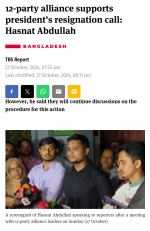
As an example, he mentioned the recent debate on removing the President, a demand of the revolutionary coalition of students with the backing of the Jamaat, which the civil society moderates in the government and the BNP didn’t approve of. The timeline for the next election and whether the Awami League will be allowed to take part in it are two other instances of divergence among the ruling cliques.

“Initially, the BNP wanted an election within three months of the change of guard, but the interim government and the students wanted a longer tenure for the interim regime.... The Jamaat came to their rescue and created a three-year-tenure narrative. The army is talking about a one-and-a-half-year timeframe now and the BNP too is keen on polls by the end of 2025,” the observer said.

“The Jamaat and the student leaders are against the idea of allowing the Awami League to take part in the election, but the civil society moderates and a section in the BNP want a reformed Awami League in the polls.”

With a consensus elusive on these issues, regular “brainstorming” sessions have become the order of the day in Dhaka’s power corridors. Experts representing various interest groups are debating a range of issues like a constitutional revamp and reforms to the police and the judiciary.

“The people of Bangladesh want reform, reconciliation and an inclusive election.... Even if there is a need for changes to the Constitution, an elected government should do it,” a businessman said.

“There is no clarity on what this interim government is up to, as they have so many agendas.... They are wasting time on issues that are hardly of any significance to us.”

The businessman said the Yunus regime had spoiled its image by getting drawn into issues like whether Shakib al Hasan should continue to play for Bangladesh and whether the ilish should be exported to India.

“Then, this needless hounding of businessmen, journalists and dissenters and slapping them with cases.... Ordinary people do not believe the charges on which people are getting arrested,” he said.

Fear factor

The former minister in the Hasina cabinet who spoke to this newspaper held Yunus responsible for this extreme expression of revenge in post-August 5 Bangladesh.

“He had said after taking charge of the government that it would go after those who supported the earlier government.... And the country has seen the consequence — a sense of fear in society,” he said.

The refusal of senior editors, some of whom had been vocal critics of the Hasina regime and welcomed the change of guard, to be interviewed by this newspaper was a confirmation of the sense of fear that has gripped Bangladesh.

“This is not the right time to talk,” said a senior leader of the Jatiya Party, a former ally of the Hasina government that has repositioned itself in recent months.

Several common citizens of Bangladesh told this correspondent that people are scared of the hardcore Islamists in the revolutionary coalition of students, who have been forcing teachers, government officials, judges and even doctors to resign.

“The student leaders have become a menace because they think they are a law unto themselves.... The rule of law was better even when we were ruled by Pakistan as there was a space for opposing voices,” said a septuagenarian who had taken part in the Liberation War of 1971 that led to the formation of Bangladesh.

“Earlier this month, when the student leaders planned to remove the President forcibly by mobilising people outside his official residence, the dramatic fall in their popularity was apparent as barely a few hundred people turned up.”

Repeated attempts to reach Md Sarjis Alam and Hasnat Abdullah, two key student leaders, over the phone and via text messages for their comments on the state of affairs in Bangladesh did not yield any result.

Mirza Fakrul Islam Alamgir, secretary-general of the BNP, however, came to the defence of the student leaders. “They are young boys and you have to consider their age,”he said.

He also said: “Dr Yunus is fully in control and has a fantastic working relationship with the other advisers.... The relationship between all arms of the government, the army chief and the President is absolutely fine. There are vested interests trying to malign the regime.”
 
I am not going into the specifics of the mudslinging but in general the Islamic groups/parties other than Jamat are cavemen level incompetent. They are a curse and burden to BD and shouldn't be given any chanve to play any role in BD politic.

Completely agree.

Among the Islamic parties, only Jamaat has party members who are actually educated in conventional education apart from religious studies. They usually recruit the best and the brightest students in their student wing Shibir.

People may not like their Moududi ideology, but out of all the other Islamic parties, they actually have capable individuals in the fields of science, economics and law to be able to run the country if they ever come to power.
 
Completely agree.

Among the Islamic parties, only Jamaat has party members who are actually educated in conventional education apart from religious studies. They usually recruit the best and the brightest students in their student wing Shibir.

People may not like their Moududi ideology, but out of all the other Islamic parties, they actually have capable individuals in the fields of science, economics and law to be able to run the country if they ever come to power.

One of the misunderstandings of BD people about Jamat is that they will be like Taliban if they come to power. In reality, I personally think they will run the country like Erdogan, very smartly and tactically prioritizing development. Jamat is the best bet for BD at the moment, I say that at the risk of sounding like a rajakar which I am not.
 
Last edited:

Users who are viewing this thread

Pakistan Defence Latest

Back
Top