Navigation
Install the app
How to install the app on iOS
Follow along with the video below to see how to install our site as a web app on your home screen.
Note: This feature may not be available in some browsers.
More options
Style variation
You are using an out of date browser. It may not display this or other websites correctly.
You should upgrade or use an alternative browser.
You should upgrade or use an alternative browser.
China Auto Thread
- Thread starter StraightEdge
- Start date
More options
Who Replied?


冖_冖
Registered Member


The world's first sodium-ion battery EV is here and it could be a game changer
Leading global battery maker CATL and Changan Automobile unveiled the world’s first passenger EV powered by a sodium-ion battery on...
 electrek.co
China unveils world’s first sodium-ion battery-powered EV with 248-mile range
Feb 06, 2026 04:18 AM EST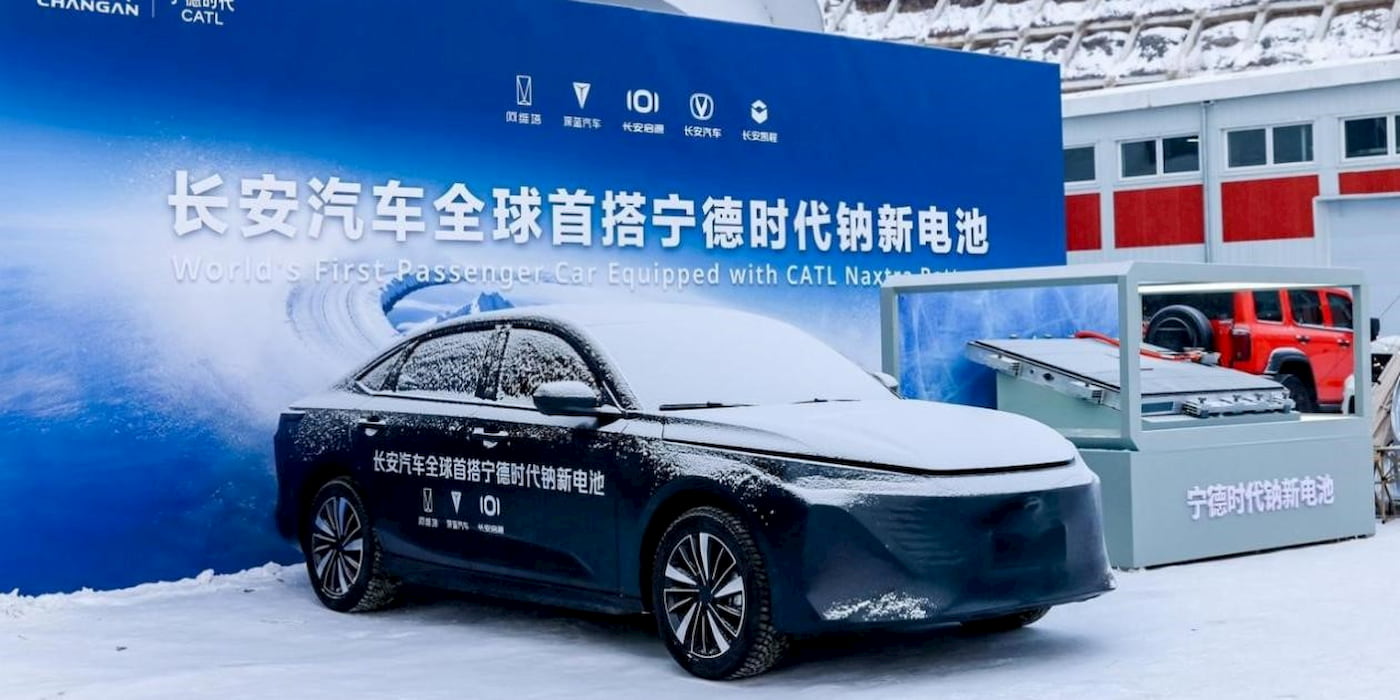
Leading global battery maker CATL and Changan Automobile unveiled the world’s first passenger EV powered by a sodium-ion battery on Thursday.
CATL unveils world’s first sodium-ion battery EV
CATL and Changan unveiled the new vehicle on Thursday, deeming it the world’s first mass-produced EV with sodium-ion batteries.The vehicle showcased was the Changan Nevo A06 (also known as the Qiyuan A06), but CATL will supply sodium-ion batteries for all Changan brands, including Qiyuan, Deepal, Avatr, and Uni.
“The breakthroughs in sodium-ion technology bring greater resilience, a wider operating temperature range, and more sustainable growth to electrification,” CATL’s chief tech officer, Gao Huan, said during a press conference on Thursday.
After unveiling its “Naxtra” sodium-ion batteries last April, CATL said it achieves an energy density of up to 175 Wh/kg, putting it on par with lithium iron phosphate (LFP) batteries.
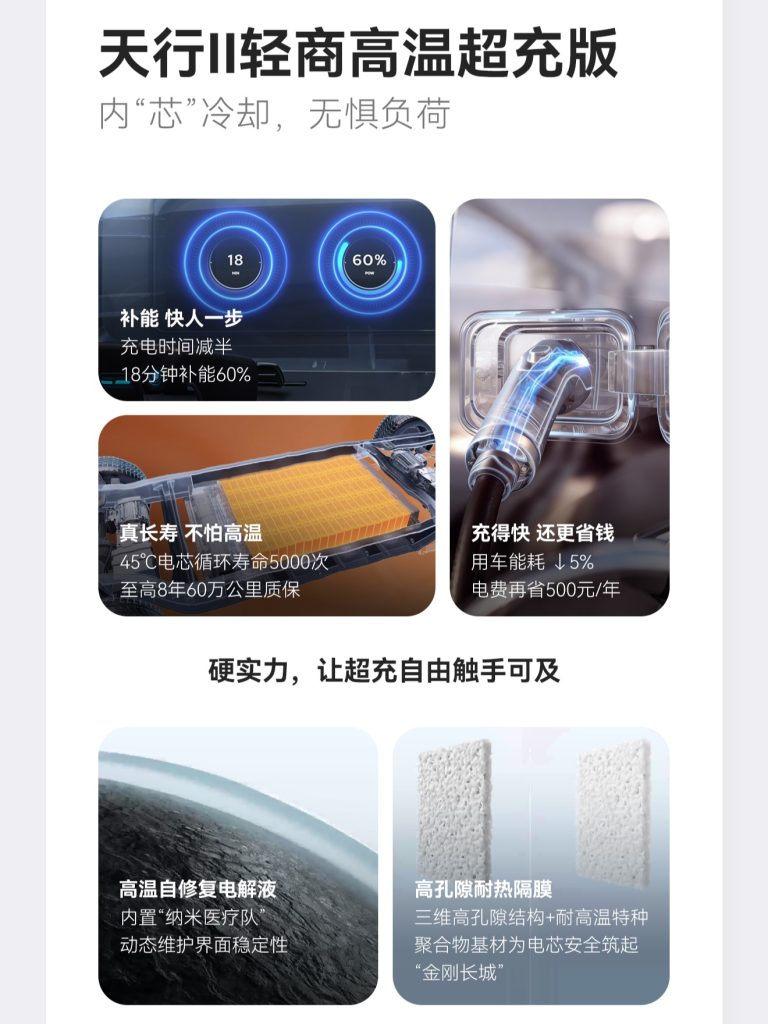
Two weeks ago, CATL launched its Tianxing II sodium-ion Naxtra batteries for light commercial vehicles. Passenger EVs will use the same 45-kWh sodium-ion battery pack, which the company says delivers up to 400 km (248 mi) of range.
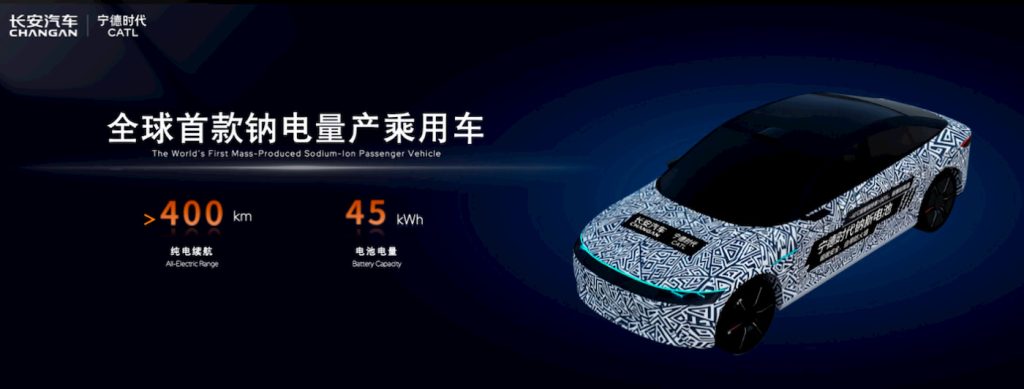
As the new battery tech advances, the Chinese EV battery giant expects range to improve to around 500-600 km (310-372 mi).
While sodium-ion batteries, such as LFP, may offer lower costs, they also perform considerably better in extreme cold.
According to CATL, the sodium-ion batteries still charged at temperatures as low as -30°C (-20°F). At -40°C (-40°F), they still retained 90% of their usable capacity. To put that into perspective, lithium batteries retain about 80% of their capacity on average.
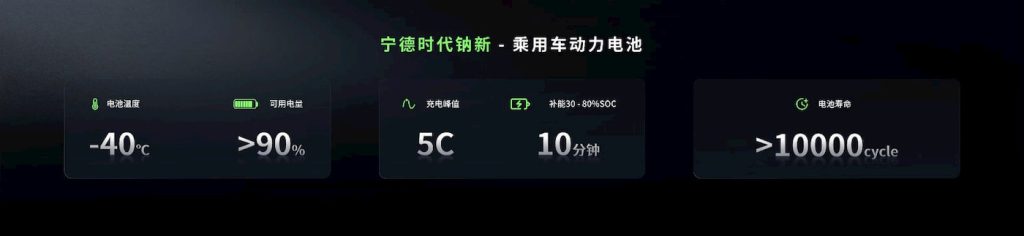
While the Nevo A06, currently sold in China with a 63.18 kWh lithium-ion battery, offers a CLTC range of up to 630 km (397 miles), its performance drops significantly in extreme cold. The 45 kWh sodium-ion battery promises to retain most of its range and charging performance.
They are also safer and less flammable than traditional lithium-ion batteries, CATL said after the batteries went through a series of brutal tests.
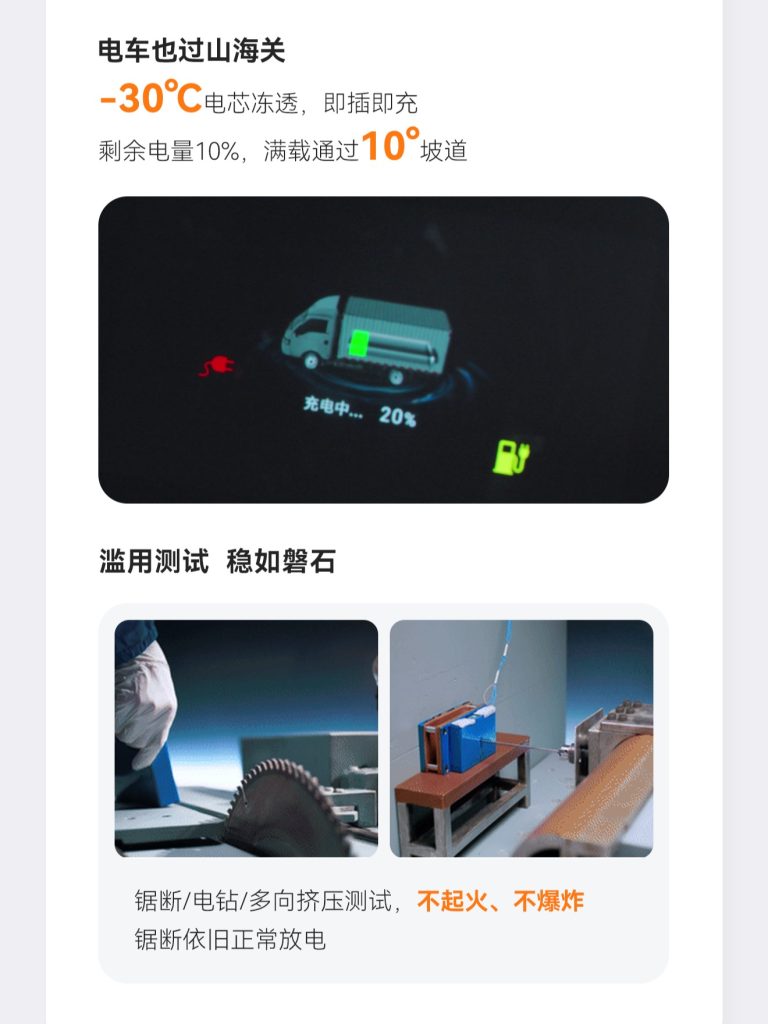
With lithium prices rising, sodium offers a lower-cost, less price-sensitive alternative. CATL, BYD, and several other leading Chinese battery manufacturers are investing heavily in sodium-ion batteries to combat rising lithium prices.
Lithium carbonate prices reached 170,000 yuan ($24,500) per ton earlier this year, up significantly from around 50,000 yuan ($7,200) per ton in 2021.
While sodium-ion batteries currently offer lower energy densities than LFP, CATL aims to bring them on par within the next three years.
In 2025, sodium-ion battery shipments reached 9 GWh, up 150% from 2024. Over the next four years, that number is expected to reach over 1,000 GWh.
CATL expects 2026 to be a turning point for the new battery tech with plans to launch its first sodium-ion battery EV by mid-year. After that, it will continue rolling it out to new vehicles while deploying them in new markets.
冖_冖
Registered Member
Skywell Delivers 249 Hydrogen Fuel Cell Buses in Guangzhou
Skywell delivered 249 hydrogen fuel cell buses in Guangzhou, China, in collaboration with Hyundai's HTWO subsidiary, marking one of China's largest single hydrogen bus deployments.February 9, 2026
Skywell New Energy Vehicles has completed delivery of 249 hydrogen fuel cell buses in Guangzhou, China. The deployment ranks among the largest single hydrogen bus rollouts in the country to date. Skywell completed the project through its collaboration with HTWO Guangzhou, a hydrogen fuel cell system subsidiary of Hyundai Motor Group.
Highlights
- 249 hydrogen fuel cell buses delivered to Guangzhou’s public transit network in one of China’s largest single hydrogen bus deployments.
- HTWO Guangzhou, a Hyundai Motor Group subsidiary, supplied the fuel cell systems powering the fleet.
- The buses feature a low-floor, barrier-free layout designed for urban accessibility and passenger comfort.
- The fleet supports Guangzhou’s long-term zero-emission mobility strategy for urban transit.
Fuel Cell Technology and Vehicle Design
The buses are purpose-built for urban public transport. HTWO Guangzhou’s fuel cell system provides zero tailpipe emissions, fast hydrogen refueling, and extended operational range. Those characteristics make the vehicles well suited for high-frequency city routes.Interior design prioritizes accessibility. The low-floor layout eliminates barriers for disabled passengers. Optimized cabin space improves comfort across all ridership levels.
Industry Partnership Drives Deployment
The project combines Skyworth Auto’s commercial vehicle engineering and manufacturing capabilities with HTWO Guangzhou’s fuel cell expertise. Skywell operates as a new energy vehicle brand under Skyworth, the Chinese consumer electronics conglomerate founded in 2000.Together, the partners aim to accelerate large-scale adoption of hydrogen-powered public transport across China. The collaboration reflects growing momentum behind fuel cell technology in the country’s commercial vehicle sector.
Emissions Reduction and Ecosystem Development
The fleet is expected to lower carbon emissions in Guangzhou’s urban transit operations. It also supports development of a local hydrogen mobility ecosystem, including refueling infrastructure and supply chain growth.Skywell has indicated plans to continue expanding its electric and hydrogen-powered commercial mobility solutions. The company is working with partners to support sustainable transport initiatives in cities across China and internationally.
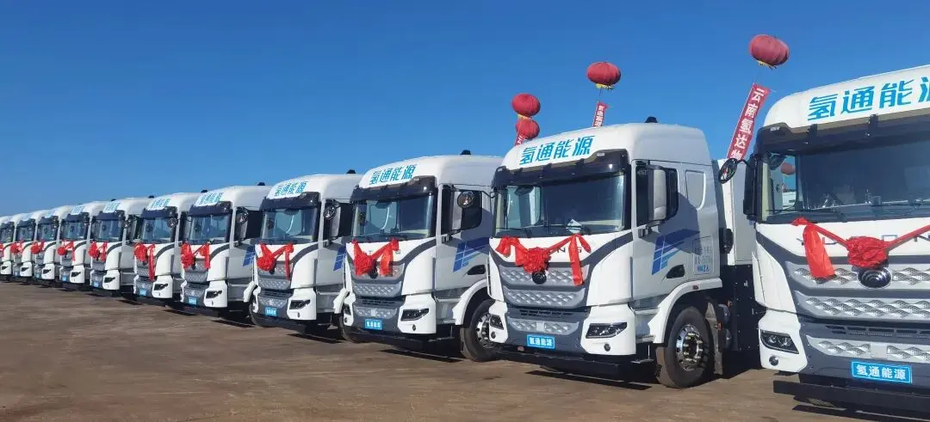
China Expands Hydrogen Trucking, TotalEnergies CEO Flags Concerns - Fuelcellsworks
China delivered 700+ hydrogen fuel cell trucks in December 2025 and ordered 1,400 more, while TotalEnergies CEO questioned hydrogen's viability in heavy trucking.
China Expands Hydrogen Trucking While TotalEnergies CEO Flags Industry Concerns
January 21, 2026 at 10:19 AM EDT
China H2 Trucks
China delivered approximately 700+ hydrogen fuel cell trucks during December 2025 and ordered 1,400 additional units in a single week, while TotalEnergies CEO Patrick Pouyanné told Davos attendees the hydrogen truck market is contracting globally.
• Major deployments include breakthrough 136-tonne mining equipment, a 1,150km regional freight corridor, and mass-produced liquid hydrogen trucks with 1,000km range, directly contradicting Western predictions that battery-electric will dominate heavy transport.
While TotalEnergies CEO Patrick Pouyanné used his Davos platform to announce hydrogen's irrelevance in heavy trucking—claiming the market is "shrinking" and will "never capture a significant share of heavy-duty vehicles by 2050"—China spent December systematically disproving him with substantial deliveries and the largest weekly order surge of hydrogen commercial vehicles on record.
Throughout December 2025, Chinese manufacturers, logistics operators, and regional governments delivered approximately 700 hydrogen fuel cell trucks and buses across multiple provinces and ordered 1,400 additional units, backed by expanding refuelling infrastructure and dedicated freight corridors. The scale and commercial intent of these deployments stand in direct contrast to Pouyanné's assertion that "aggressive marketing for hydrogen trucks has outpaced actual infrastructure, economics, and real-world operational needs."
The most concentrated ordering activity occurred during the first full week of December, when four separate agreements totalling 1,400 fuel cell heavy-duty vehicles were signed within six days. Qingling Motors kicked off the surge on December 8 with the world's largest fuel cell electric vehicle truck demonstration project order in Hami, Xinjiang, contracting the first batch of 500 49-tonne trucks equipped with 300kW Bosch fuel cells and four-speed electric axles. Days earlier, Zhejiang Lianhe Hydrogen secured a tender to supply 200 semi-trailer fuel cell electric vehicles. On December 9, Guangzhou Bus Group selected Skywell and Xiamen King Long to deliver 450 8.5-metre hydrogen buses at a unit cost of RMB 1.07 million [$149,500].
From December 10 to 11, HTWO Guangzhou and Dongfeng Liuzhou Motor signed contracts for 200 18-tonne hydrogen trucks—100 each to Guangtai Hydrogen Energy and Yueshang Logistics. Powered by Hyundai fuel cells, the vehicles will support logistics in the Greater Bay Area and extend operations into Sichuan-Chongqing and the Yangtze River Delta.
Industry analyst Jian Wu, who tracks China's hydrogen mobility sector, described the week as "the most intense procurement period since 2022," underscoring how rapidly the country is scaling orders for zero-emission heavy-duty vehicles. The flurry of contracts directly contradicts Pouyanné's claim that "rapid advancements in EV battery technology, even for heavy trucks, are challenging hydrogen's viability in transportation."
China also achieved technical milestones that challenge assumptions about hydrogen's operational limits. On December 17, the country's first hydrogen fuel cell and lithium battery hybrid mining dump truck exceeding 100 tonnes successfully passed acceptance testing in Holingol, Inner Mongolia. The 136-tonne-class vehicle, developed jointly by a mine operator and Inner Mongolia Northern Heavy-Duty Truck Co., combines four 120kW high-efficiency proton exchange membrane fuel cells with a 70 MPa high-pressure hydrogen storage system.
"In the past, when fuel-powered mining trucks drove by, the roaring noise hurt people's ears, and the exhaust fumes were choking. Now, this hydrogen-electric hybrid mining truck only makes a slight motor noise when it runs, and you can't smell any odor when you get close!" said veteran driver Yao Wei, who has operated both conventional and hydrogen-powered vehicles.
"The mine road conditions are complex, with many uphill and downhill sections and heavy loads. This vehicle's performance in different scenarios has exceeded expectations!" said Zhang Liwei, the project's technical lead. The truck delivers more than six hours of range, a rated payload of 136 tonnes, and a maximum climbing ability of 20 per cent, with core performance metrics described as fully comparable to conventional fuel-powered mining trucks of the same class. Project calculations indicate a single truck can cut carbon emissions by up to 1,700 tonnes per year.
"Multiple distributed fuel cells work together, so even during long-term heavy-load operations, the power will not fluctuate. It's incredibly reliable!" said on-site technician Zhu Zhiqing.
On December 25, Beiqi Foton unveiled China's first mass-produced liquid hydrogen-powered heavy-duty truck, capable of running more than 1,000km on a single 15-minute refuelling. Part of the new BEACON platform, the truck integrates liquid hydrogen alongside gaseous hydrogen and pure electric drivetrains. Battery options range from 225kWh to 677kWh, with gas and liquid hydrogen storage capacities tailored to diverse logistics needs.
Aerodynamics are a key efficiency driver, with the truck's integrated streamlined design achieving a drag coefficient of 0.28—49 per cent lower than traditional trucks—resulting in a 16 per cent reduction in energy use. Foton's proprietary 300kW fuel cell offers over 58 per cent efficiency under typical loads, outperforming the industry average by nine percentage points. For the liquid hydrogen version, the system includes eight aerospace-grade 375-litre vacuum-insulated tanks with total 100kg capacity, and hydrogen consumption averages just 7.6kg per 100km.
The BEACON platform also includes China's first commercial heavy truck to implement an 800V voltage architecture, enabling megawatt-scale supercharging. With this system, the electric variant can add 100km of range in just eight minutes.
On December 22, Rockcheck New Energy completed a bulk delivery of hydrogen fuel cell trucks into active service in Tianjin, handing over 65 hydrogen-powered heavy-duty trucks to logistics operators working across the Beijing-Tianjin-Hebei region. Thirty of the trucks were delivered to Tianjin HanDe Logistics for CNOOC equipment and materials transport across Beijing, Tianjin, Hebei, and Shandong. The remaining 35 units went to Tianjin Development Zone Xintianli Trading Company for container collection and port freight movements linked to the Port of Tianjin.
Each vehicle is equipped with a 200kW hydrogen fuel cell system from Rockcheck Hydrogen Power, a Type IV hydrogen storage system supplied by Tianhai, and an MGL power battery. Rockcheck New Energy has now placed 1,215 hydrogen fuel cell vehicles into operation, operates 15 hydrogen refuelling stations, and has supported the cumulative use of around 5,700 tonnes of hydrogen. Those vehicles have collectively travelled 59.5 million kilometres, delivering an estimated reduction of 56,000 tonnes of carbon dioxide emissions.
On December 26, 319 hydrogen-powered commercial vehicles were delivered and signed in Baiyun District, Guangzhou. Yuntao Hydrogen Energy delivered 201 hydrogen-powered vehicles to several companies, including Zhika Technology and Guanghuan Factory, and signed a procurement agreement for 118 hydrogen-powered vehicles with Guangzhou Jiaoneng Fusion Operation Management Co.
The delivered vehicles include four models: an 18-tonne hydrogen fuel cell wing logistics vehicle, a 4.5-tonne hydrogen fuel cell refrigerated truck and hydrogen tractor, and a 31-tonne hydrogen fuel cell concrete mixer truck. These vehicles will be used in high-intensity transportation scenarios such as coal mining, ports, cold chain logistics, and urban distribution.
"After extensive testing, we found that these vehicles can effectively reduce operating costs while meeting customers' carbon reduction needs," said Ke Maoguo, general manager of Zhika Logistics. Liu Wei, co-president of Yuntao Hydrogen Energy, explained that the vehicles can save operating companies millions of yuan annually in fuel costs, significantly enhancing the economic competitiveness of green transportation.
China's approach extends beyond vehicle deployments to systematic infrastructure development. Sinopec Group launched the country's first regional logistics corridor dedicated to hydrogen-powered trucks, stretching roughly 1,150 kilometres and connecting Chongqing in southwest China with the port city of Qinzhou, crossing Guizhou along the way. The corridor links inland manufacturing and resource centres directly to a coastal export hub.
To support operations, Sinopec deployed four hydrogen refuelling stations along the route. The regions along the corridor already have hydrogen at scale, with industrial production across the route exceeding 400,000 tonnes per year, enough to support up to 360,000 hydrogen logistics vehicles, according to Sinopec. The company says the corridor has capacity for up to 220,000 hydrogen trucks per year, operating in both directions.
Lüliang became the first Chinese city to surpass 1,000 operational hydrogen trucks. With the latest batch of locally developed hydrogen fuel cell trucks delivered in the Xiaoyi Economic Development Zone, the city's operational, registered, and total hydrogen truck fleet officially exceeded 1,000 vehicles. The milestone confirms the end-to-end build-out of a local hydrogen value chain spanning production, storage, transport, refuelling, and real-world application, forming China's first fully commercialised heavy-duty hydrogen trucking demonstration.
The strategy hinges on Lüliang's position as China's largest coking base, where low-cost, hydrogen-rich coke-oven gas provides a ready feedstock. Since entering the national fuel cell vehicle demonstration city cluster in March 2025, Lüliang has rapidly expanded hydrogen purification capacity, refuelling infrastructure, and local manufacturing. Deployment has focused on bulk freight for coal, coke, and bauxite. Dedicated hydrogen logistics corridors now link industrial zones such as Xiaoyi, Jiaocheng, and Lishi.
The city has scaled hydrogen production to 135,000 tonnes per year—the highest in the province—built 14 hydrogen refuelling stations, accounting for half of Shanxi's total, and commissioned a manufacturing line capable of producing 6,000 hydrogen commercial vehicles annually. More than 1,000 trucks are already operating on long-haul routes including Lüliang to Tianjin Port, a 1,500km round trip, collectively logging over 80 million kilometres, with individual vehicles exceeding 200,000km.
"Each truck takes just 15 to 20 minutes to refuel and can run 600km on a full tank, with zero carbon emissions," said Hao Guanbing, head of Shanxi Dahuatong Logistics. "Combined with national demonstration rewards and toll subsidies, the cost advantage over diesel is obvious." The company alone has already ordered 600 hydrogen trucks.
Pouyanné's Davos comments—where he stated TotalEnergies is "shifting investment toward biofuels" and called large-scale EU hydrogen targets "impossible"—reflect a fundamental disconnect between European energy majors and the commercial reality unfolding in China. His claim that "green hydrogen fuels for aviation are not expected to scale until 2035-2040" and that hydrogen infrastructure, economics, and operational needs lag behind marketing hype fails to account for China's systematic approach: co-locating hydrogen production with existing industrial feedstocks, building dedicated freight corridors rather than attempting universal coverage, and deploying vehicles in high-utilisation commercial fleets rather than dispersed retail markets.
Xie Chengjie, executive chairman of the Greater Bay Area Logistics Industry Alliance, stated that "the logistics industry is a high-energy-consuming industry, and hydrogen-powered commercial vehicles can effectively save energy and reduce costs for logistics companies. The large-scale delivery and signing of hydrogen-powered commercial vehicles this time also means that the market promotion of hydrogen-powered commercial vehicles has entered a new stage of large-scale implementation."
A relevant official from the Baiyun District Development and Reform Bureau stated that "driven by both policy and market forces, Baiyun District's hydrogen energy enterprises are moving from isolated demonstrations to comprehensive market penetration, providing a replicable commercial path for energy transformation and transportation carbon reduction in the Guangdong-Hong Kong-Macao Greater Bay Area."
The contrast is stark: while Pouyanné declares the hydrogen truck market dead, China delivered more than 700 hydrogen commercial vehicles in December 2025 and ordered 1,400 more in a single week—demonstrating order volumes that exceed most Western countries' cumulative deployments. Whether this represents a miscalculation by European energy majors or a uniquely Chinese approach enabled by industrial policy, centralised infrastructure planning, and integrated supply chains remains to be seen. What is certain is that predictions about hydrogen's irrelevance in heavy transport are being systematically contradicted on Chinese roads, in Chinese mines, and along Chinese freight corridors.
Last edited:

Beijingwalker
VIP Member
Xiaomi's electric SUV tops China sales in January, sells twice as many as Tesla's Model Y
Published Thu, Feb 12 20269:25 PM ESTKey Points
- Sales of Xiaomi’s YU7 SUV were twice that of Tesla’s Model Y in China in January.
- The Chinese company started selling the YU7 roughly half a year ago.
- Xiaomi plans to expand overseas despite safety scrutiny.

Chinese smartphone company Xiaomi launched its YU7 electric SUV in summer 2025, taking direct aim at Tesla’s Model Y.
Sopa Images | Lightrocket | Getty Images
BEIJING — Xiaomi’s electric car venture has succeeded in dethroning Tesla in China, at least in January.
The Xiaomi YU7 SUV ranked first in China by sales last month, with 37,869 units sold, twice as many as Tesla’s 16,845 Model Y vehicles, according to data from the China Passenger Car Association.
The Model Y, which was the best-selling model in December, plunged to 20th place in January. Among new energy vehicles, it also fell from the first position to seventh over the same period.
The figures include both electric and gasoline-powered vehicles and were published late Thursday by online car sales platform Autohome.
Xiaomi started selling the YU7, its second electric car model, roughly half a year ago in the summer of 2025.
The Chinese company, best known for its smartphones, hasn’t been shy about its aim to take on Tesla. Xiaomi launched the car at a starting price that was 10,000 yuan ($1,450) below the Model Y in China. The company claimed the model beat Tesla on key metrics such as driving range on a single battery charge.
Analysts last year predicted the YU7 would take market share from the Model Y, Tesla’s best-selling car in China. In December, the Model Y ranked first in monthly sales, ahead of BYD’s budget-priced Qin Plus car. Xiaomi’s YU7 ranked third.
Monthly sales figures can be volatile. While the YU7 did outsell the Model Y in October, the Xiaomi car did not rank first. Tesla has so far been consistently stronger in sales.
Excluding gasoline-powered cars, Tesla ranked fifth in China sales last year, while Xiaomi placed tenth. For all of 2025, BYD led China’s auto market with over 3 million vehicles sold, followed by Geely at 2.6 million, according to China Passenger Car Association data.
The YU7′s strong sales in January came despite an overall slowdown in China’s electric car market in recent months.
Xiaomi’s earlier SU7 sedan has also faced scrutiny following fatal accidents involving driver-assist features and electrically-powered door handles. Beijing has since banned hidden door handles, while automakers have started installing external lights that indicate when driver-assist is in use.
Like most Chinese electric car companies, Xiaomi also plans to expand overseas, including into Europe next year.

Xiaomi's electric SUV tops China sales in January, sells twice as many as Tesla's Model Y
Chinese smartphone company Xiaomi has priced its vehicles below Tesla's and marketed features it claims are comparable or superior.
 www.cnbc.com
Beijingwalker
VIP Member
Canadians Say They’ll Buy Cheaper Chinese EVs as Tariffs Drop
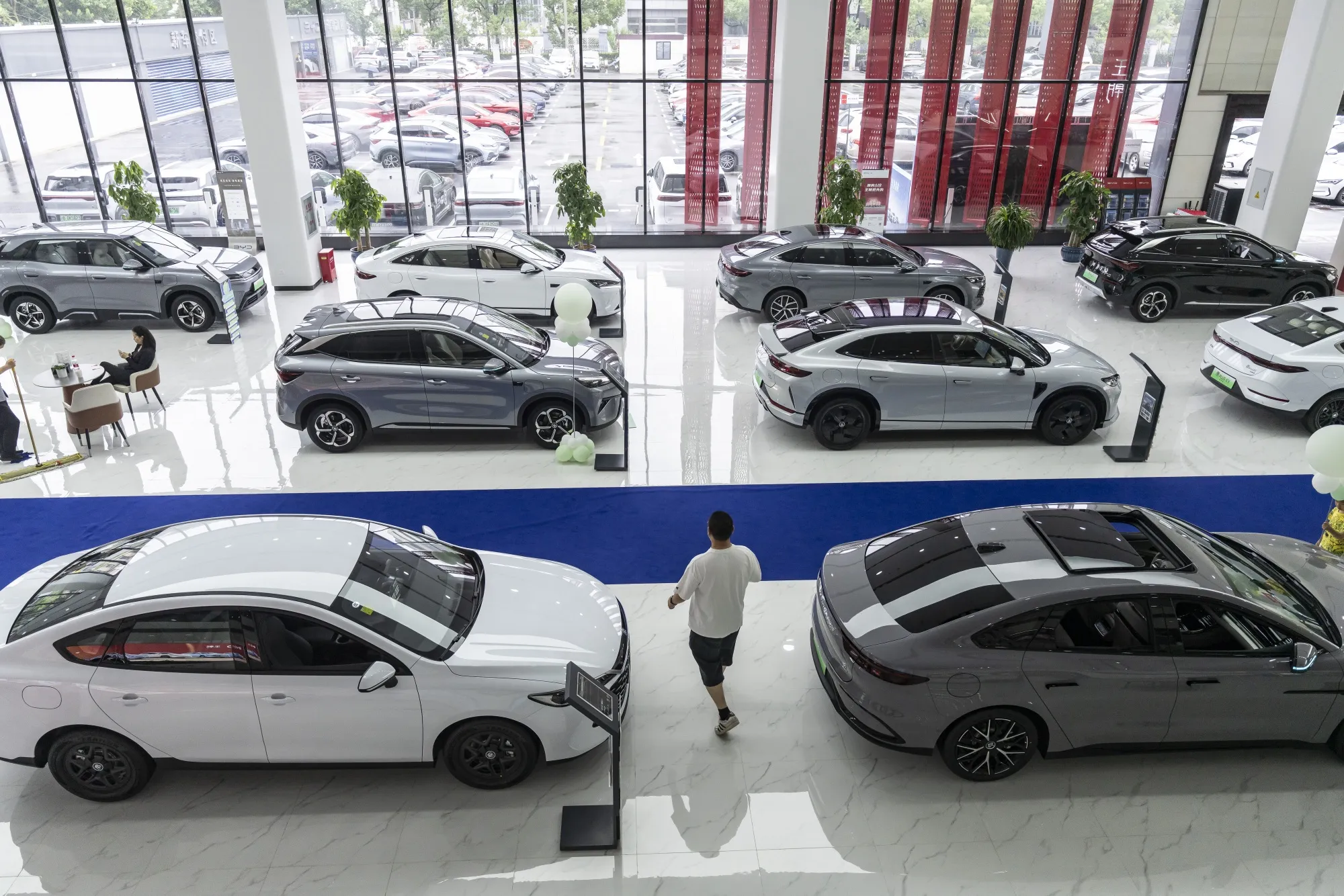
BYD electric vehicles at a showroom in Shanghai in 2025.Photographer: Qilai Shen/Bloomberg
By Brian Platt
February 16, 2026 at 7:00 PM GMT+8
As Prime Minister Mark Carney lowers tariffs on imports of Chinese electric vehicles, new polling suggests that Canadians are becoming much more open to buying the cars.
More than half of Canadians, or 53%, say that knowing an EV was made in China would have no effect on their purchasing decision, according to a new poll by Nanos Research Group for Bloomberg News.
ChineseTiger1986
Trusted Member

Maybe in Northeast China, the ICE cars still have higher percentage.
However, Shanghai should be comparable to Beijing and other major cities where the EV has dominated the local market.
However, Shanghai should be comparable to Beijing and other major cities where the EV has dominated the local market.
Beijingwalker
VIP Member
Maybe in Northeast China, the ICE cars still have higher percentage.
However, Shanghai should be comparable to Beijing and other major cities where the EV has dominated the local market.
The impact is so profound and people start to miss the traffic noise
How China crushed Beijing’s crazy traffic noise

retaxis
Trusted Member
I saw a travel video of Western couple on Indian street and the honking was crazy! Chinese no honking and super quiet evs is like night and day. In india it's actually trendy to honking to red lights even...google it lol
Beijingwalker
VIP Member
China's auto exports go nuts
Auto exports from China to the rest of EM went completely nuts in December 2025
Robin J BrooksFeb 19, 2026
For reasons that’ll remain forever murky, China’s leadership decided many years ago it wanted to become a player in the global auto sector. Electrical vehicles (EVs) were just becoming a thing and so China became a major EV producer. Along with that came a push for electrification and production of things like solar panels, which complement China’s push into autos.
A few months ago, I wrote a post documenting how massively China’s auto exports have grown. The bottom line in that piece was that most of these cars aren’t going to advanced economies but to emerging markets (EM). The idea that tariffs will protect auto makers in Germany or France therefore misses the point that this isn’t where the battle is being fought. There’ll never be a phalanx of Chinese cars heading down the Autobahn. The battle - instead - is being fought in EM, where car manufacturers from across advanced economies are being squeezed out. EU tariffs can’t change that.
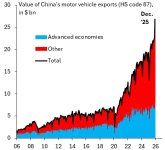
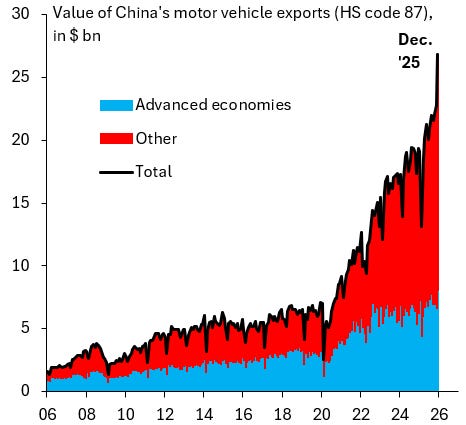
Since I made that point, China’s auto exports have gone totally nuts. As the black line in the chart above shows, auto exports in December 2025 went vertical. The blue bars in the chart show exports to advanced economies, while the red bars show exports to EM. The massive growth in December 2025 is all EM. China’s exports to advanced economies plateaued some time ago and - if anything - look like they’re falling back.
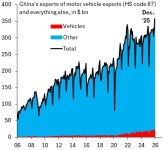
Of course, the surge in auto exports is nothing compared to China’s overall exports, which also went nuts in December 2025 and reached a new all-time high. The black line in the chart above shows China’s overall exports, while the red bars are the small role that auto exports play. China’s massive export machine is in overdrive in a broad sense, not just where autos are concerned. That’s a sign that China’s currency is very substantially undervalued, which gives it an unfair advantage on global markets and is a profoundly destabilizing force in the global economy.
China's auto exports go nuts
Auto exports from China to the rest of EM went completely nuts in December 2025
 robinjbrooks.substack.com
冖_冖
Registered Member
Electric shock: Is China overtaking car country Germany?
Jun 20, 2024
92,883 views • Jun 20, 2024 •
Is Germany losing its mojo? Europe’s biggest economy is steadily sliding downward in international rankings, and now, its leading industry looks to be losing speed.Germany’s formerly venerable auto industry –once responsible for more exports, turnover and jobs than any other branch of the economy– risks being surpassed by electric vehicles…made in China. Were carmakers asleep at the wheel? And are punitive tariffs like those imposed by Washington the answer, or could they put globalization into reverse?
BMW CEO Oliver Zipse says German automakers need China to compete globally
February 19, 20267:01 PM GMT+8Updated February 19, 2026Summary
- Zipse part of business delegation travellling with Merz to China
- European ncountries seek to deepen or revive business links with China
- Zipse says complex global challenges can only be solved by working together
Zipse will be part of a business delegation travelling with Merz to China next week, a closely watched journey as it will provide clues over how Europe's top economy defines its relationship with its top trading partner.
The visit follows a similar trip by British Prime Minister Keir Starmer last month, a sign of how European nations are seeking to deepen or revive business relations with China at a time when U.S. President Donald Trump has kicked off a global trade war.
'STRONG SIGNAL FOR DIALOGUE'
Berlin sees China as a key trade partner, but has also warned against dependencies, suggesting the current coalition might continue with a critical approach formulated under the previous government to the world's second-largest economy."Complex global challenges can only be solved by working together," Zipse told Reuters. "With his trip to China, the chancellor is sending a strong signal for dialogue and cooperation."
"Those who close their minds to China's enormous market and innovation potential are missing out on great opportunities for global growth and economic success."
Merz late on Wednesday said he would seek "strategic partnerships" during the visit.
INTENSE PRICE WAR
Companies such as BMW, Volkswagen and Mercedes-Benz (MBGn.DE), opens new tab have seen sales sliding in China, a market that has been driving profits for years but where subsidised manufacturing of electric vehicles has led to an intense price war with fast-growing local brands.Meanwhile, legacy carmakers have fallen behind in the race to develop electric motors, software platforms and autonomous driving systems.
"Innovation and progress do not arise from isolation, but rather when pioneering spirit, openness, and global expertise come together," Zipse said.
The CEOs of Volkswagen and Mercedes-Benz will also travel with Merz to China, according to people familiar with the matter. German companies invested the most in four years in the Chinese market in 2025.
Beijingwalker
VIP Member
China’s pickup exports roar past 50% to five‑year high as GWM dominates global push
Feb 25, 2026 7:07 AM CET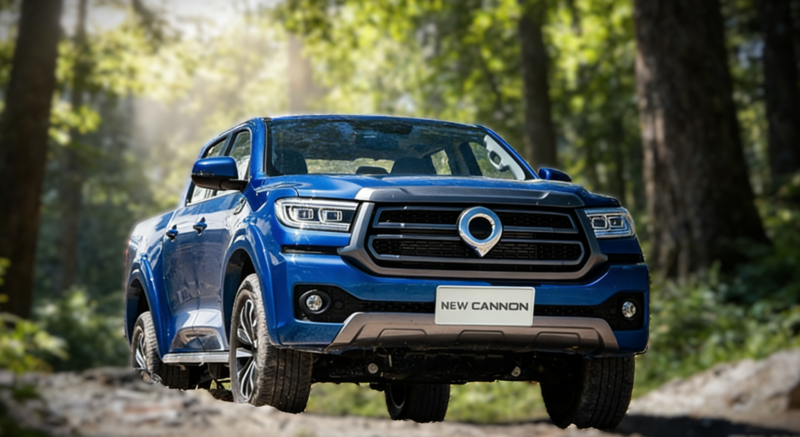
China’s pickups rose in January 2026: 49,000 produced, 27,000 exported, new‑energy growth. Credit: CNC
China’s pickup truck segment posted robust production and sales in January 2026, underpinned by rising exports and continued leadership from established makers such as Great Wall Motor, according to data released by the China Passenger Car Association’s joint market information committee. Domestic pickup shipments in January reached 49,000 units, up year‑on‑year and near a five‑year seasonal high. Production also expanded, signalling ongoing momentum in manufacturer output.
Pickup exports continued to account for a significant share of overall output in January. Across China, exporters shipped approximately 27,000 pickup trucks overseas, up sharply from the prior year and representing over half of total pickup production for the month. This export contribution remains at historically high rates, reflecting the growing global footprint of Chinese pickup brands.
Great Wall Motor’s pickup division continued to rank as China’s largest within the segment, holding near 50% domestic market share and maintaining its position as the foremost Chinese pickup exporter. Other domestic manufacturers, including JMC, Changan, JAC, and emerging players such as Geely’s Radar pickup line, also contributed to production and export volumes, indicating a competitive, diversified domestic landscape.
China’s pickup exports roar past 50% to five‑year high as GWM dominates global push
China’s pickup production and sales climbed in January 2026, with exports reaching approximately 27,000 units and strong brand participation.
 carnewschina.com

FHN
Trusted Member

It seems that with oil supplies from various countries coming to a halt, there's a rapid shift to EV vehicles one after another, and China's EV cars—which had been stuck with excess inventory—are apparently seeing a sharp surge in sales. Russia's oil and China's EVs are the winners
冖_冖
Registered Member
China’s CATL profit surges 42% as global market share soars to all-time high
Surging demand solidifies CATL’s position as world’s top EV battery manufacturer for ninth consecutive year.
 www.scmp.com
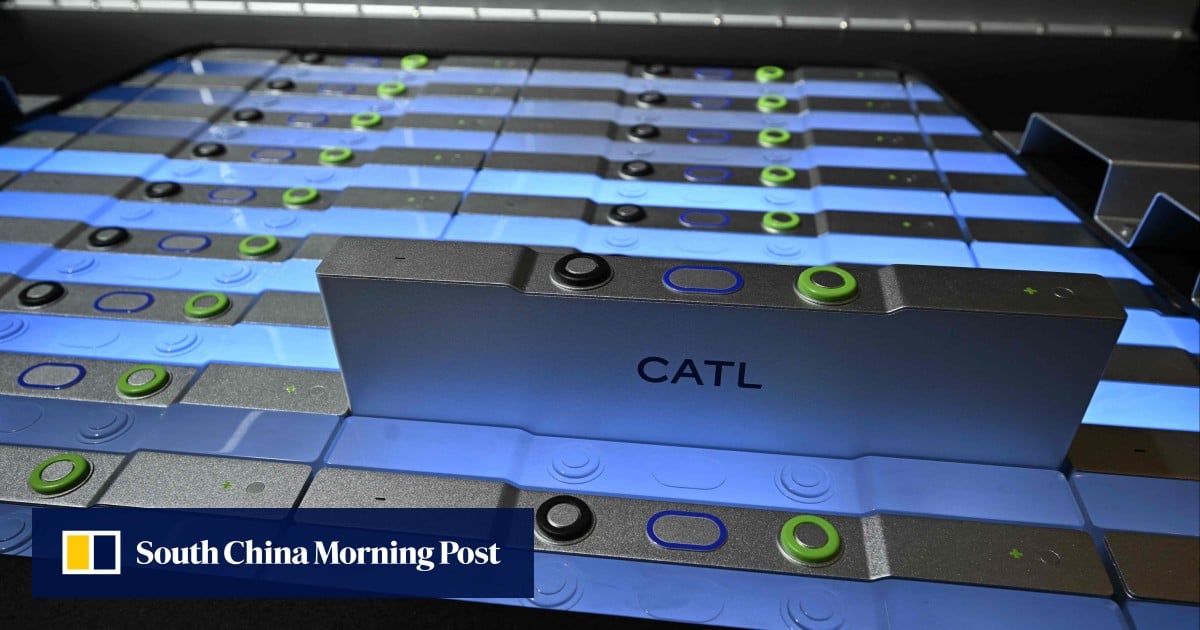
China’s CATL profit surges 42% as global market share soars to all-time high
Surging demand solidifies CATL’s position as world’s top EV battery manufacturer for ninth consecutive year
Published: 10:01pm, 9 Mar 2026Updated: 12:06am, 10 Mar 2026
Contemporary Amperex Technology Ltd (CATL) reported a 42 per cent jump in net profit last year to 72.2 billion yuan (US$10.4 billion) on strong battery sales and an expansion into new energy storage scenarios.
The Chinese battery giant’s sales volume of lithium-ion batteries – a key component for electric vehicles (EVs) – reached 661 gigawatt hours (GWh), up 39 per cent from the previous year, according to a filing released on the Shenzhen Stock Exchange on Monday night.
China’s EV industry continued to grow in 2025, with production and sales increasing nearly 30 per cent year on year to more than 16 million units.
CATL sold 541 GWh of power batteries, a 41.85 per cent increase, propelling the company to a new all-time high in global market share.
Citing data from SNE Research, CATL said its global market share for power battery usage rose 1.2 percentage points to 39.2 per cent in 2025, solidifying its position as the world’s top manufacturer for the ninth consecutive year.
Users who are viewing this thread
Total: 2 (members: 0, guests: 2)
Pakistan Defence Latest
-
 Federal cabinet gives nod to imposition of emergency in KP; summary sent to president (30 Viewers)
- Latest: prothought
-

-
-
-

Country Watch Latest

Latest Posts
-
-

-

-

-
Federal cabinet gives nod to imposition of emergency in KP; summary sent to president (30 Viewers)
- Latest: prothought