China Auto Thread


Jiyue 01 from Geely-Baidu JV scored five stars in C-NCAP crash test​


Reading Time: 3 minutes

Denis Bobylev

July 23, 2024


0
jiyue 01 electric car cncapJiyue 01 scored 5 stars in C-NCAP crash test

News like this to your inbox or phone?​


Weekly summary to your inbox
I want this

Never miss and important news
Get Instant notification once the news is published.
Follow Us

The Jiyue 01 electric crossover (see specs) from the joint venture between Geely and Baidu scored five stars in the C-NCAP safety and crash test. Its overall performance is 89.1%. It stays in line with previously evaluated Maxus G90 and BAIC X55.

C-NCAP’s safety and crash performance program was formed by the China Automotive Technology and Research Center (CATARC) in 2006. Nowadays, its evaluation standards are close to those of Euro NCAP.

Jiyue 01 C-NCAP performance​

The evaluated Jiyue 01 is a Max trim level with a guide price of 219,900 yuan (30,200 USD). It is an entry-level model with RWD and a 71.4 kWh LFP battery from SVOLT. Its autonomous driving equipment is similar to the top-trim model. It comprises 13 cameras, 12 ultrasonic radars, 5 mm-wave radars, and 2 Nvidia Drive Orin-X chips for 508 TOPS. The evaluation agency bought the Jiyue 01 Max anonymously at a random dealer with its own money on February 28.

The total score of the Jiyue 01 is 89.1%. For comparison, the previously evaluated Avatr 11 electric SUV (see specs) from Changan and CATL got 90.2%. Back Jiyue 01’s performance, is 5.9% higher than the average performance of models participated in the 2021-year C-NCAP safety test.
In the occupant protection segment, the Jiyue 01 scored 90.37%. Its pillars weren’t damaged while airbags exploded and seatbelts retracted. In the given category, the Jiyue 01 scored higher than the BMW-Brilliance-made BMW i5 sedan. Pedestrian protection category’s performance is 79.83%. And the active safety segment scored 91.8%.

More about Jiyue 01​

The Jiyue is a JV between Geely and Baidu launched in 2021 under the Jidu name with “Chinese Google” holding the major stake. But Jidu failed to obtain the sales license and was restructured to become Jiyue. Nowadays, Geely holds 65% of this JV, taking care of manufacturing. And Baidu is responsible for the software.

The Jiyue 01 is the brand’s first model launched in December 2023. It stands on the SEA modular architecture. It adopts a distinguishing design language with Y-shaped headlights and a single running light strip under the bonnet. Dimensions of the Jiyue 01 are 4853/1990/1611 mm with a wheelbase of 3000 mm. The curb weight lies in the 2210 – 2380 kg range.
The entry-level Jiyue 01 has a 200 kW (268 hp) e-motor in the rear axle powered by a 71.4 kWh LFP pack, suitable for 550 km of CLTC range. The Jiyue 01 Long Range has a 100 kWh ternary NMC battery from CATL and up to 720 km range. The 4WD variant of Jiyue 01 offers two electric motors with a combined peak power of 400 kW (536 hp). Its range reaches 660 km (CLTC).
The price range of the Jiyue 01 reaches 219,900 – 309,900 yuan (30,200 – 42,600 USD). However, the sales volume of the Jiyue 01 is low in China. Its cumulative sales reached 3,474 units. From January to June, the Geely&Baidu JV sold 2,700 cars. So, Jiyue seems like a pointless brand. However, it will soon launch the second model, which is the Jiyue 07 electric liftback. It has already reached dealers in China.
Source: C-NCAP
 

2025 Geely Jiaji MPV entered market, price starts at 15,000 USD​


Reading Time: 3 minutes

Dong Yi Chen

July 23, 2024


2


News like this to your inbox or phone?​


Weekly summary to your inbox
I want this

Never miss and important news
Get Instant notification once the news is published.
Follow Us

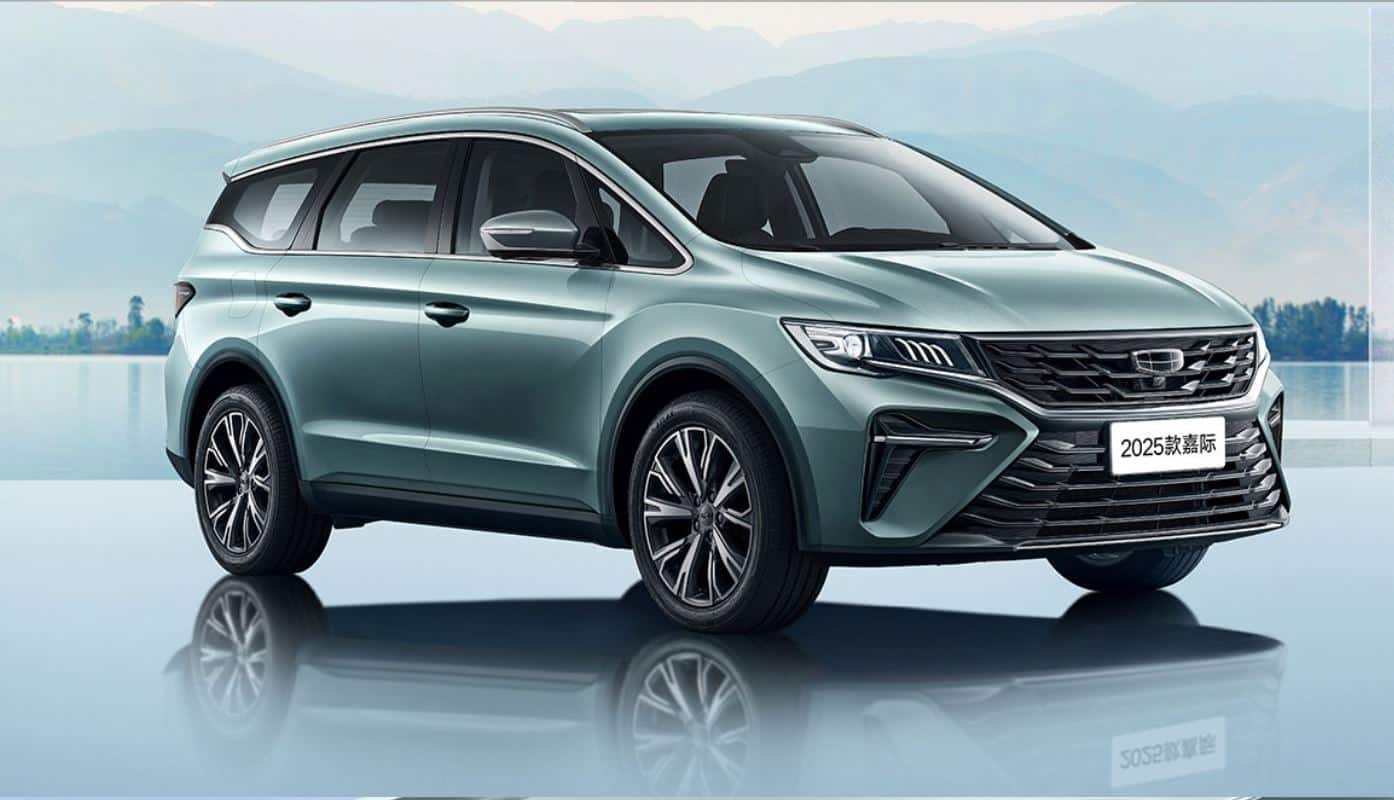
On July 22, Geely officially launched its 2025 Jiaji gasoline-powered MPV, available in two trims with a price range of 109,700 – 119,700 yuan (15,000 – 16,500 USD). As an upgraded version, the new car’s appearance remains unchanged compared to that of the previous version while some configurations were changed.

In June, zero units of the Geely Jiaji were sold. In the first half of 2024, only 538 units were sold.
The length, width, and height of the 2025 Geely Jiaji are the same: 4826/1909/1695 mm, respectively, and the wheelbase is 2805 mm. The curb weight is 1,600 – 1,630 kg. Two new exterior colors have been added, namely, “Sky Blue” and “Moonlight White”. The car runs on 215/60 R17 or 235/50 R18 tires.

The exterior design remains consistent, featuring a two-layer front grille, traditional door handles, chrome luggage racks on the roof, chrome trims around the windows, a through-type taillight group, and a matrix-element light at the rear bottom. There are also four megapixel high-definition wide-angle cameras located throughout the vehicle.
Consumers can choose from two different seat layouts: six-seater (2+2+2) or seven-seater (2+2+3).
A 1.06m² panoramic sunroof is also present.

The interior also remains consistent compared with that of the previous version. Two colors are offered: “Ultramarine Blue” and “Thrush Brown”. There is a 10.25-inch LCD instrument panel, a 12.3-inch central control screen, and a four-spoke D-shaped steering wheel. The in-vehicle operating system is supported by the Geely Galaxy OS.
Other configurations include a 4G network, in-car WiFi, keyless entry, an AI voice assistant, six speakers, cruise control, and mobile phone remote control (i.e., open/lock doors, open/close windows for ventilation, air conditioning control).
There are 54 storage spaces throughout the interior, including six cup holders, 10 hooks, and nine mobile phone storage areas. Additionally, the center console adopts a “loft duplex” structure with nearly one meter of storage space, according to Geely. The standard trunk volume is 513 L, and the space can be expanded by folding down the third-row seats.
Power still comes from a 1.5TD engine with a maximum power of 133 kW (178 hp) and a peak torque of 290 Nm, mated to a 7-speed DCT. Its official comprehensive fuel consumption per 100 km is 6.9 L (under WLTC conditions), its fuel tank capacity is 60 L, and its top speed is 190 km/h. The top speed is 190 km/h.
Source: Geely, My Home Ok
 

China EV registrations in W29: Xiaomi 1,500, Nio 4,600, Tesla 10,500, BYD 66,700​


Reading Time: 4 minutes

Jiri Opletal

July 23, 2024


0


News like this to your inbox or phone?​


Weekly summary to your inbox
I want this

Never miss and important news
Get Instant notification once the news is published.
Follow Us

In the third week of July, the China EV market had mixed signals. Xiaomi vehicle registrations were down 35%, and Tesla was down 8%, while Nio was up 35%, and BYD was up 8%

Week 29 of the year (W29) was between July 9 and 21. The week W29 of 2023, used for year-on-year comparison, was between July 17 and 23.
The weekly sales are published by Li Auto, and despite Li’s not explicitly saying it, they are based on insurance registration data. The numbers are rounded and present new energy vehicles (NEV) sales, the Chinese term for BEVs, PHEVs, and EREVs (range extenders). To be completely precise, it also includes hydrogen vehicles (FCEVs), but their sales are almost non-existent in China. The data show only passenger vehicles (PVs).

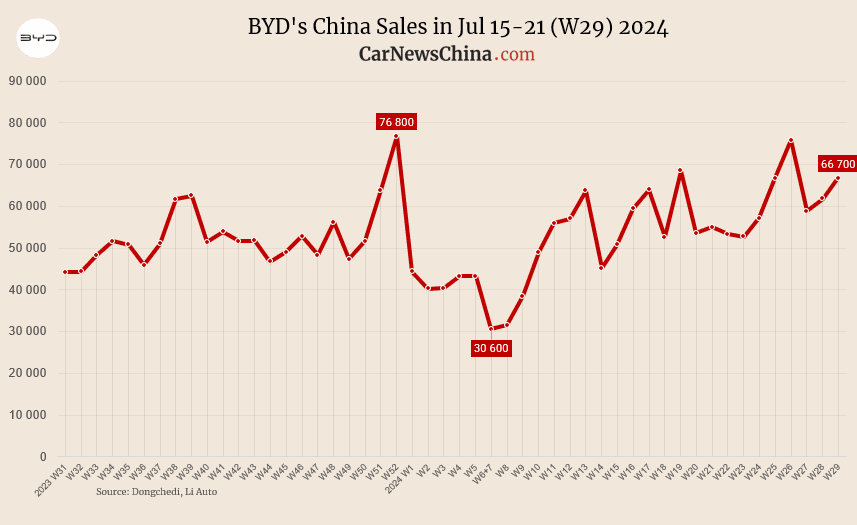
BYD was the first, as usual, with 66,700 registrations, up 7.93% from 61,800 units registered the week before. In the first three weeks of the month, between July 1 – 21, BYD registered 187,300 vehicles in China.

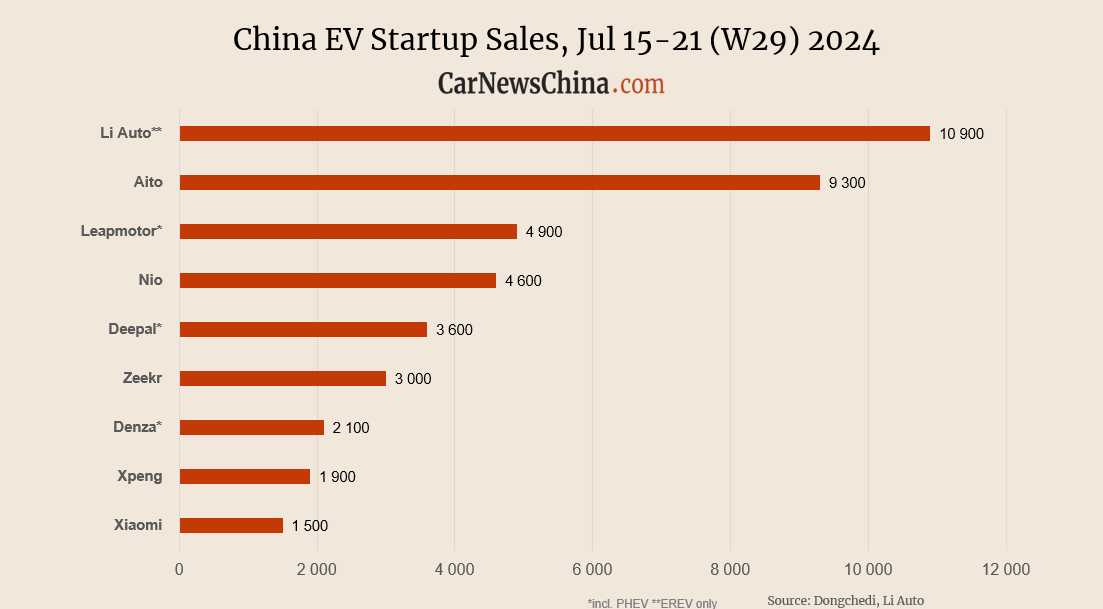
Li Auto registered 10,900 EVs, down 3.54% from 11,300 units the week before and up 39.74% from 7,800 units in the same week the year before. In the first three weeks of the month, Li Auto registered 30,200 EVs in China.
Li Auto obtained a second spot in China’s EV registrations leaderboard, which is usually occupied by Tesla.


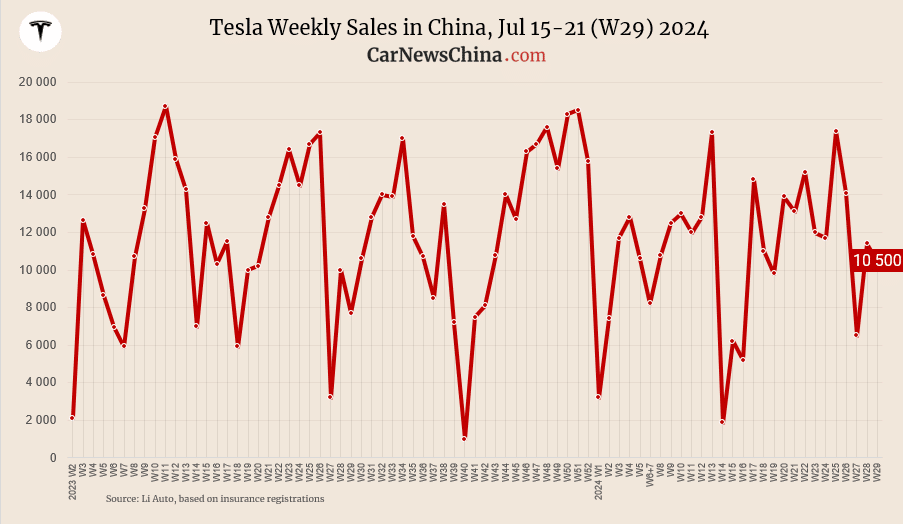
Tesla registered 10,500 EVs, down 7.89% from 11,400 units the week before and up 36.36% from 7,700 units in the same week the year before. In the first three weeks of the month, Tesla registered 28,400 EVs in China.
As of today, Tesla announced it is extending its 5-year zero-interest loan incentives offer until August 31 in China. The perk started in April and was initially planned to end on July 30. It was then prolonged until July 31 and now until August 31.
This means that a customer can have a Model Y SUV for 95 yuan (13 USD) and a Model 3 sedan for 85 yuan (11.6 USD) daily, according to Tesla China.

Aito registered 9,300 EVs, down 1.06% from 9,400 units the week before and up 830% from 1,000 units in the same week last year. In the first three weeks of the month, Aito registered 26,600 EVs in China.
GM’s Chinese joint venture, Wuling, registered 8,500 EVs, up 8.97% from 7,800 units the week before. In the first three weeks of the month, Wuling registered 23,000 EVs in China.
GAC Aion registered 6,900 EVs, down 2.82% from 7,100 units the week before. In the first three weeks of the month, GAC Aion registered 20,800 EVs in China.
Stellantis-backed Leapmotor registered 4,900 EVs, up 8.89% from 4,500 units the week before and up 75% from 2,800 units in the same week the year before. In the first three weeks of the month, Leapmotor registered 13,200 EVs in China.
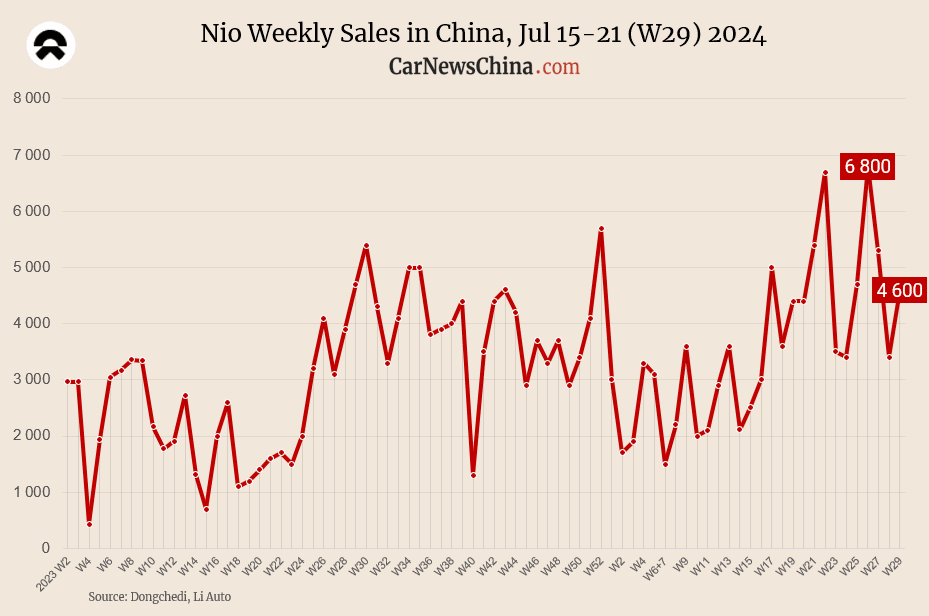
Nio registered 4,600 EVs, up 35.29% from 3,400 units the week before and down 2.13% from 4,700 units in the same week the year before.
In the first three weeks of the month, Nio registered 13,300 EVs in China.
The last weeks of the month are usually weaker regarding vehicle registrations in China. However, it was reported that Nio would end its car purchase incentives by the end of the month, and thus, many customers most likely wanted to take the last chance to purchase Nio with a discount.

Volkswagen registered 3,800 EVs, up 5.56% from 3,600 units the week before. In the first three weeks of the month, Volkswagen registered an unspecified number of EVs in China.
Deepal registered 3,600 EVs, up 9.09% from 3,300 units the week before and up 5.88% from 3,400 units in the same week the year before. In the first three weeks of the month, Deepal registered 10,300 EVs in China.
Zeekr registered 3,000 EVs, down 9.09% from 3,300 units the week before and up 25% from 2,400 units in the same week the year before. In the first three weeks of the month, Zeekr registered 10,100 EVs in China.
Denza registered 2,100 EVs, up 10.53% from 1,900 units the week before and down 8.70% from 2,300 units in the same week the year before. In the first three weeks of the month, Denza registered 5,700 EVs in China.
Volkswagen-backed Xpeng registered 1,900 EVs, up 11.76% from 1,700 units the week before and down 26.92% from 2,600 units in the same week the year before. In the first three weeks of the month, Xpeng registered 5,400 EVs in China.
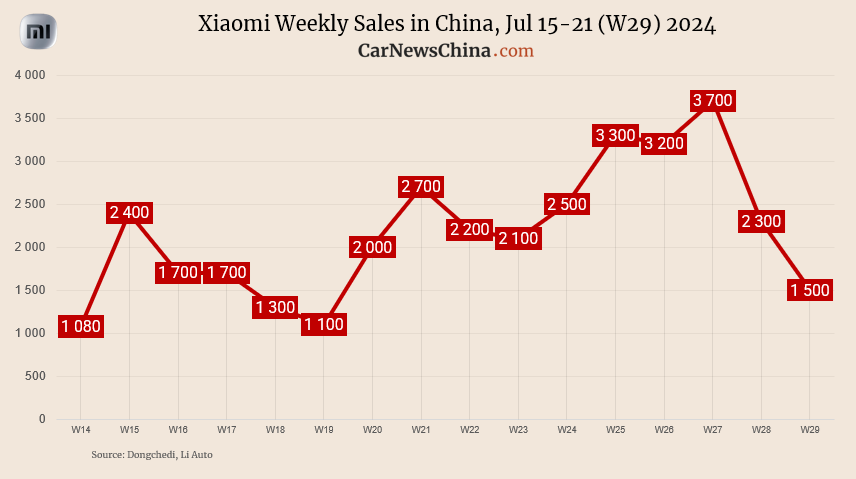
Xiaomi registered 1,500 EVs, down 34.78% from 2,300 units the week before. In the first three weeks of the month, Xiaomi registered 7,500 EVs in China. Xiaomi has only one car on the market – the Xiaomi SU7 sedan, which launched on March 28.
In June, Xiaomi delivered over 10,000 units in China with a target of achieving 120,000 vehicles by the year end.

IM registered 1,300 EVs, down 13.33% from 1,500 units the week before. In the first three weeks of the month, IM registered an unspecified number of EVs in China.
 

The start date for the sale of the Chinese Oka has been announced 08:44​


Anika
By ANIKA
July 23, 2024

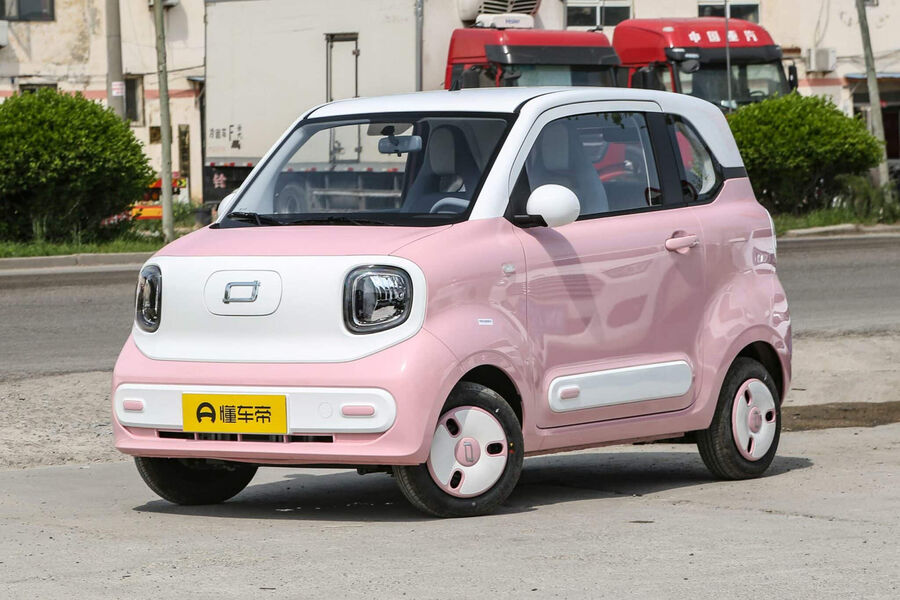
FAW Bestune Pony hatchback sales in China to begin on July 28. About reports carnewschina.com.
The length of the car is 3000 mm, the wheelbase is 1953 mm. The size of the car is even smaller than the domestic Oka. The car has three doors and can accommodate four people.
The interior of the car is made in pink tones. There is a digital instrument panel, but there is no central media display. Bestune Pony is equipped with a 27 hp electric motor. The simplest version of Cute Fun Horse is equipped with a 9.4 kWh battery. It is designed for a range of 122 km.
The cost of a car in China is from 26.9 to 31.9 thousand yuan (from 324.8 to 385.2 thousand rubles at the exchange rate at the time of publication).
It was noted that seven new electric vehicle models will be launched under the Bestune brand in the next three years.
Previously reportedAvtoVAZ will start production of Lada Iskra cars in December.


Source: Gazeta
 

BACK TO CHINA!! Cars are getting EVEN CRAZIER…​


To view this content we will need your consent to set third party cookies.
For more detailed information, see our cookies page.
 

Global Boycotts of Chinese EVs: Despite Deep Discounts in China, They Remain Unsold, Piling Up​


To view this content we will need your consent to set third party cookies.
For more detailed information, see our cookies page.
 

I Drive A BYD For The First Time! The Seal Is A Direct Tesla Model 3 Competitor In China & Europe​


To view this content we will need your consent to set third party cookies.
For more detailed information, see our cookies page.
 

The BYD Dolphin Is A Better Chevy Bolt Sold In Europe & China! My Quick Test Drive​


To view this content we will need your consent to set third party cookies.
For more detailed information, see our cookies page.
 

ARE CHINESE CARS ANY GOOD? 2019 GEELY ATLAS REVIEW​


To view this content we will need your consent to set third party cookies.
For more detailed information, see our cookies page.
 

Best Longest Range Electric SUVs from China 2024 🚗🔋 Models From Leading Chinese Manufacturers​


To view this content we will need your consent to set third party cookies.
For more detailed information, see our cookies page.
 

Breaking Barriers: Top 5 Chinese Electric Cars shaking the Industry​


To view this content we will need your consent to set third party cookies.
For more detailed information, see our cookies page.
 

2024 Lynk & Co 01 PHEV Review​


To view this content we will need your consent to set third party cookies.
For more detailed information, see our cookies page.
 

Brighton to Paris in a Chinese Skywell BE11: Is It Worth It?​


To view this content we will need your consent to set third party cookies.
For more detailed information, see our cookies page.
 

Lexus is not building an EV factory in China – at least not yet​


Reading Time: 3 minutes

Mark Andrews

July 24, 2024


0


News like this to your inbox or phone?​


Weekly summary to your inbox
I want this

Never miss and important news
Get Instant notification once the news is published.
Follow Us

On July 23, multiple news outlets claimed that Lexus was going to start producing cars in China, with production due to commence in 2026. The story was believed to originate from the 36kr website. Although the original article no longer seems to be on the 36kr website, many articles quoting it are still available. The story is false, with the official statement coming from Lexus as one of “no domestic production plan for the time being.”

The plans originally reported regarded a wholly owned factory located in Shanghai that would produce the UX hybrid model and a new electric car. Autohome speculated that the electric car would be a production version of one of the two new concept cars, the LF-ZC and the LF-ZL, shown at this year’s Beijing Auto Show. A production version of one of these would unlikely be ready until 2026, which fits in with the timeline for the factory.
New reports show that the original story was not without foundation, but the announcement was premature. Furthermore, it seemed strange that Lexus would want to produce the hybrid UX300h in China. There is a very limited market in China for hybrids, as it is not a PHEV, and making such a move even stranger is that there is a fully electric version, the UX300e, which would be a better fit.

Lexus LF-ZC concept
A person familiar with the matter told local reporters, “Of course, if Lexus builds a wholly-owned factory in China, it will produce pure electric models, not hybrid products.”
The whole story likely has its origins in a June 29 report stating that Toyota was seeking a similar treatment to Tesla for Lexus in China, including tax breaks, policy support, land grants, and conditions for direct operation without the need for a local joint venture partner and this report originated from media outside China.
“Shanghai has indeed been in contact with Toyota, but there are still many uncertain factors whether Lexus’ plan to build a wholly-owned factory can be implemented,” said the same source familiar with the matter.

Lexus LF-ZL concept
Unlike Lexus, both Nissan’s Infiniti and Honda’s Acura brands built joint ventures in China in 2013 and began local production. Lexus, on the other hand, has often said that once sales reached a certain figure, they would consider local production, only to keep increasing that figure over the years.
In 2019, Lexus sales in China, including Hong Kong, amounted to 202,000 cars, but last year, with rapidly increasing electrification, this had dropped to 181,400. Lexus aims to have 100% electrification by 2035.
Cui Dongshu, Secretary General of the China Passenger Car Association, has said that Lexus building a manufacturing plant in China for EVs will have definite advantages due to the competitiveness of the Chinese market.
Earlier reports about Lexus building a factory in Shanghai claimed that the company would use 95% locally sourced parts. Furthermore the factory, like that of Tesla, would be used both to meet local demand and to export.

Editor’s note:​

This seems to be far from a matter of story over. We were surprised by earlier reports that Lexus would consider making the UX hybrid in China, and that rumor has now been quashed. However, it seems that Lexus may well be seriously investigating setting up an EV plant in Shanghai, China, but the details have yet to be finalized.
Sources: Finance Associated Press, Autohome,
 

Users who are viewing this thread

Back
Top