Ranked: The Companies Shipping the Most Humanoid Robots
March 17, 2026
Key Takeaways
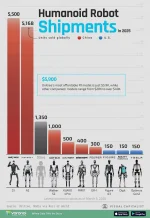
- Chinese companies accounted for nearly 90% of global humanoid robot shipments in 2025.
- Unitree and AgiBot shipped more than 10,000 robots combined, far ahead of every other manufacturer.
- Tesla, Figure AI, and Agility Robotics each shipped about 150 units, showing how early the U.S. market still is.
Global humanoid robot shipments surpassed 14,500 in 2025. By 2030, they could reach mass adoption.
By far, China dominated global sales last year, covering 90% of total sales. While early deployments are largely for research and industrial purposes, their applications could soon break into wider retail uses and household tasks.
Based on data from multiple sources via
Rest of World, this graphic ranks the companies shipping the world’s humanoid robots as the industry expands.
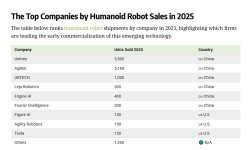
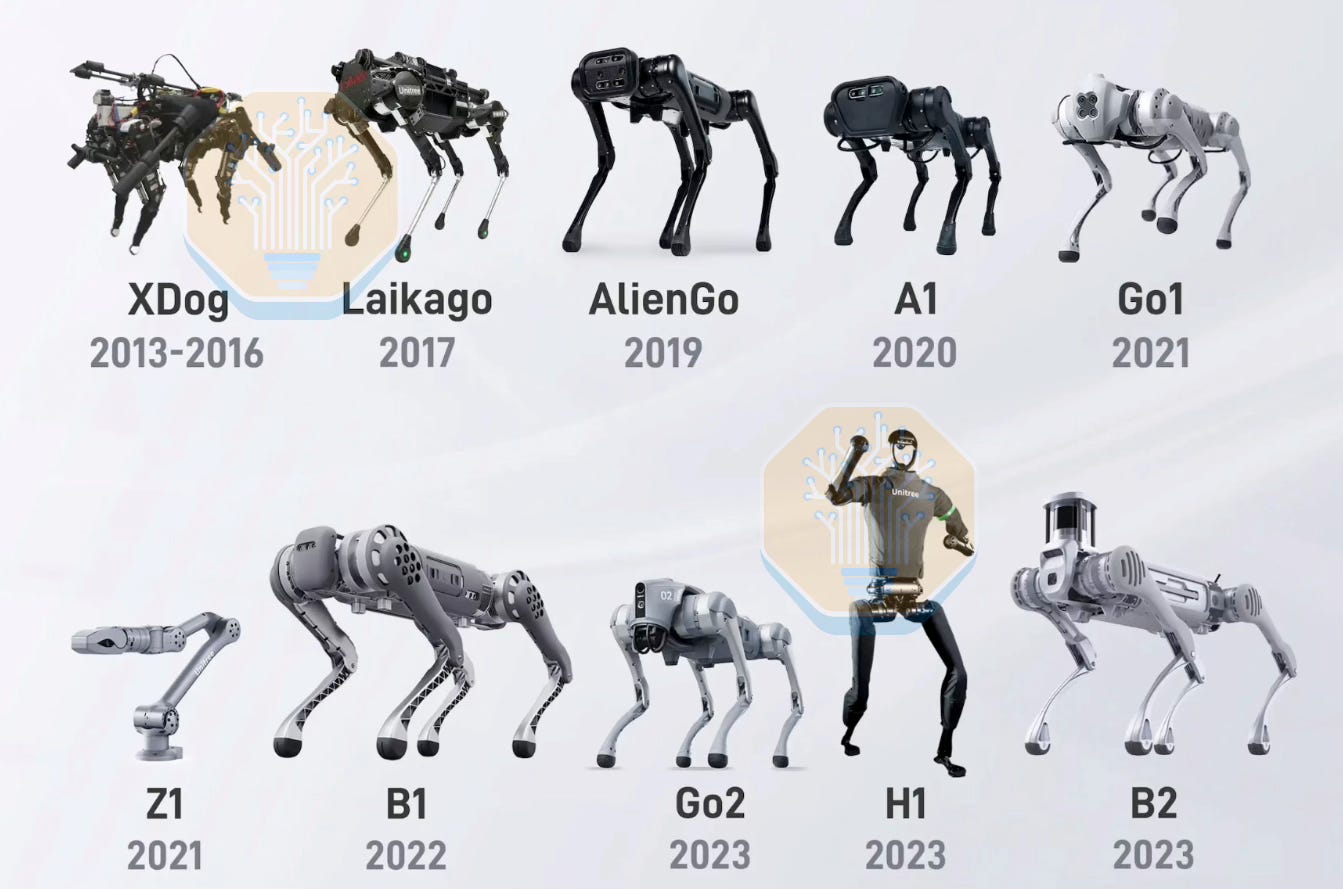
Unitree ranks first globally, with 5,500 units sold in 2025, up from around 1,500 a year earlier.
Moreover, Unitree’s models stand among the world’s most advanced and affordable. Its cheapest R1 model, for instance, costs just $5,900, while the company also sells robot dogs for $1,600.
Competitor AgiBot followed next seeing 5,168 units sold, with its lowest-cost model standing at $14,500. Overall, 21 new models were introduced in China in 2025, rising from three in 2022.
While Elon Musk projects humanoid robots will outnumber the human population by 2040, Tesla’s rollout has been markedly slower. In 2025, it shipped 150 of its Optimus models, with public sales forecasted to begin in 2027.
Similarly, other leading U.S. companies Figure AI and Agility Robotics each shipped about the same amount. Despite limited deliveries so far, Figure AI soared to a $39 billion valuation, jumping from $2.6 billion in 2024.
China’s Deep Supply Chains
China’s Yangtze River Delta contains the world’s most vertically integrated supply chain for humanoid robotics.
Not only are Unitree and AgiBot based in the region, it is home to several leading suppliers of robotics parts. DeepSeek and Alibiba—which launched an AI model designed for robotics—are also found in the cluster.
Additionally, the region’s role as a EV manufacturing hub serves as a key catalyst to production. Like autos, humanoids require thousands of precision components. In many cases, EV actuators and gears can be repurposed for humanoid robotics manufacturing.
Today, China controls about 26% of the global actuator market, compared with roughly 5% for the United States.
Along with this industrial base, humanoid robots depend heavily on
critical minerals and rare earth elements, materials that China dominates, driving roughly 60% of global production. Together, these supply chain advantages give China a structural edge in scaling these emerging technologies.
From Unitree to Tesla, see which companies shipped the most robots in 2025, and why Chinese manufacturers dominate the leaderboard.

www.visualcapitalist.com







 France offers flexibility for India to integrate indigenous weapons with Rafale (11 Viewers)
 FlyDubai Incident: Pilot was stabbed on flight to Israel - diverted to Saudi Arabia (46 Viewers)
