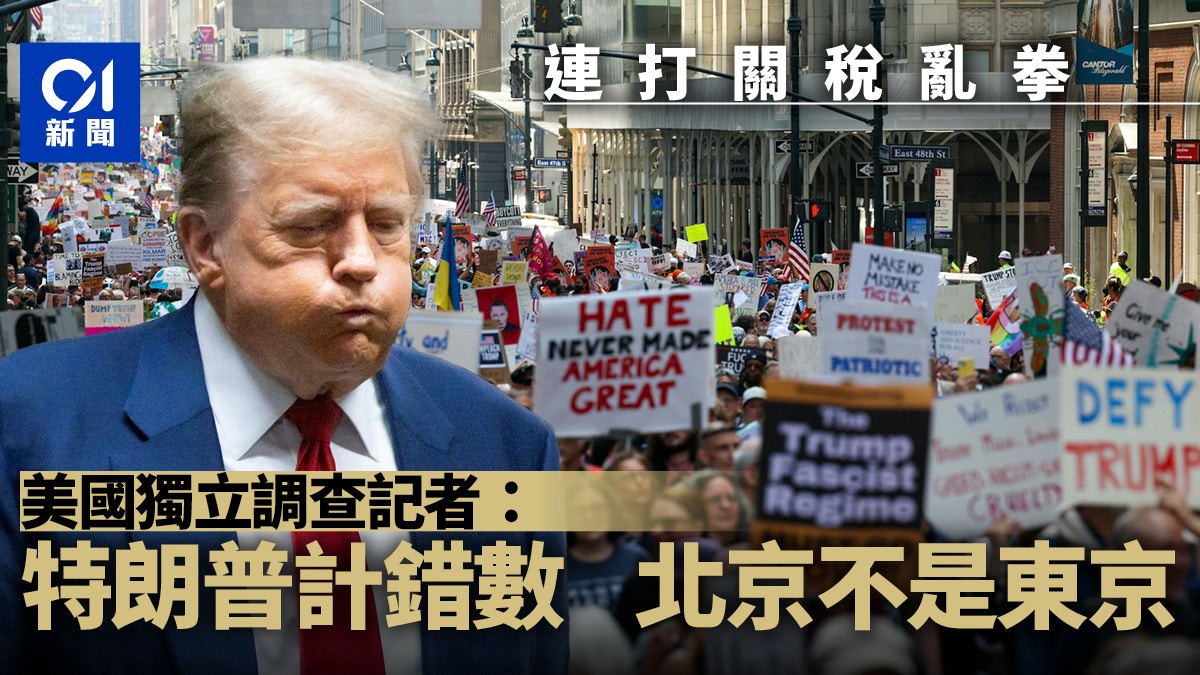
Tariff War | US Independent Investigative Reporter: Trump Miscalculated that Beijing is Not Tokyo
View attachment 113218
In the end, Trump failed to wait for China to beg for mercy.
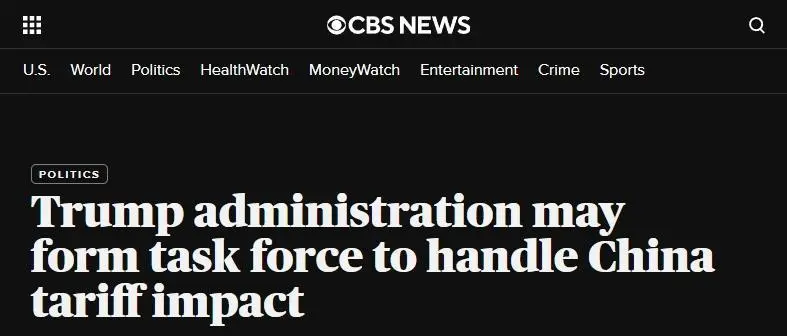
On April 15, the White House website released a fact sheet on the "232" investigation, stating that due to China's counter-tariffs against the United States, China is currently facing tariffs of up to 245%.
Just two days later, on April 17, Trump, who had been launching a series of tariff attacks, said that he did not want to continue raising tariffs on China because it might cause trade between the two countries to stagnate.
Previously, when the US government imposed 10% and 20% tariffs on China, the Chinese people and businesses would pay close attention and be on high alert. Now it has been increased to 145% and 245%. These outrageous figures distort the seriousness of the China-US trade issue and will only add to the after-dinner jokes.
What exactly does Trump hope to achieve? Do the American people realize that they are paying for this policy? What anxiety is the US trying to cover up? Does Trump have any more tricks up his sleeve? Ben Norton, an independent American investigative journalist and founder of the Geopolitical Economics Report, was interviewed by Changan Street Governor (WeChat ID: Capitalnews).
This article is reproduced from the WeChat public account "Changan Street Governor"
Beijing will not repeat Tokyo's mistakes
Governor: What do you think of Trump's practice of imposing abnormally high tariffs and changing tax amounts every day? What effect does Trump hope to achieve?
Norton: The so-called 245% tariff is obviously a bluff. The Trump administration believes that the United States has great leverage over China, but the reality is the opposite. This conflict has instead exposed the United States' deep dependence on China. For example, Trump exempted Chinese-made mobile phones, computers, semiconductors and other electronic products because these are the cornerstones of the modern economy, and the United States is currently unable to produce these key products domestically. China's economic strength far exceeds US expectations.
President Donald Trump signs an executive order in the Oval Office of the White House in Washington, U.S., April 17, 2025. (Reuters)
Trump’s inconsistency shows one thing: the US actually knows that it does not really have the advantage. Behind this high-profile propaganda lies the anxiety about the country's structural economic problems.
In addition, Trump launched a trade war in order to force China to sign an unequal agreement that is beneficial to the United States and disadvantageous to China. It is somewhat similar to the "Marine-Lake Agreement" he envisioned, which refers to the Plaza Accord that the United States forced its allies to sign in 1985, which ultimately hit the Japanese economy hard. But the US made a wrong judgment this time - China is not the Japan of the past. China is more independent and its economy is larger; Beijing will not repeat Tokyo's mistakes.
14 billionaires use tariffs to pass the tax burden on to ordinary people
Governor: Can the Trump administration achieve the repatriation of manufacturing through tariffs and replicate the achievements of Made in China?
Norton: I don't think it's possible to reindustrialize the United States with tariffs alone. Industrialization in all developed countries has been driven by clear industrial policies, such as large-scale government investment in infrastructure, education, training and scientific research. Limited, targeted tariffs can be used as a tool to protect emerging industries, but they must be used in conjunction with more comprehensive industrial policies. Trump's tariff strategy is completely different - he takes a one-size-fits-all approach across the entire industry, using rough tactics that make it more like a tool of economic warfare.
Rather than promoting re-industrialization, such tariffs will increase domestic prices in the United States and harm the country’s economy. To truly rebuild its manufacturing industry, the United States will need to spend years or even decades building factories, training workers, introducing equipment, and establishing supply chains. Not only does the Trump administration have no plans in this regard, but it has further weakened national capabilities by cutting fiscal investment and relaxing regulations, which will only accelerate deindustrialization rather than reverse it.
Governor: Faced with the tariff stick wielded by Trump, American people are frantically stockpiling Chinese products. On the e-commerce app list of the U.S. iOS App Store, the top three apps are all Chinese e-commerce apps. A large number of promotional videos on TikTok with the slogan "good products from Chinese factories" have become popular, which has helped promote Made in China. What do you think of this phenomenon? Do the American people realize that they are paying for this policy?
The picture shows the company logo taken outside TikTok’s US headquarters in Culver City, California, USA on September 15, 2020. (Reuters)
Norton: Trump often says that foreign countries will pay for his tariffs, but that's simply not true. In reality, tariffs are paid by U.S. importers and are ultimately passed on to U.S. consumers. Tariffs are essentially a consumption tax, and a very unfair tax at that, hitting low-income and working-class people the hardest.
Trump himself is a billionaire, and he has 13 other billionaires in his administration. They push for tax cuts for the rich and big corporations, but pass the tax burden on to ordinary people through tariffs.
This is why Americans are rushing to buy Chinese products, because they know these tariffs will cause inflation and goods will soon become more expensive. Many Americans already live on their monthly paychecks, and once inflation returns, these ordinary families will be the hardest hit. Therefore, the real victims of this trade war are actually the American people.
Trump is pushing the United States toward isolation
Governor: If other countries follow the US’s example and retaliate with tariffs and take unilateral actions, what impact will it have on global development? Are you worried that this tariff action will exacerbate inflationary pressure in the United States or even lead to an economic recession? Is it possible that the global depression caused by trade protectionism in the 1930s will happen again?
Norton: There's no doubt that Trump's tariffs will push up inflation. The United States cannot manufacture products like China because it has no clear industrial policy and does not have the ability to re-industrialize. This aggressive trade war also greatly increases the possibility of the United States falling into an economic recession.
Demonstrations against the Trump administration take place in New York City, the United States, on April 19, 2025 (Reuters)
But the situation today is not exactly the same as it was in the 1930s. Back then, countries raised tariffs on each other, but now, Trump's approach may prompt other countries to speed up their search for alternatives. For decades, many countries have been calling for a fairer international financial and monetary system as the existing system is highly dependent on the US dollar and dominated by the United States. Countries in the Global South have also been pushing for a "new international economic order", which is also one of the common goals of the BRICS.
Trump’s trade war is likely to backfire, pushing the United States into isolation and accelerating the world’s transition to a multipolar world.
The United States has few plans for the backlash from this trade war
Governor: The "phone call" that Trump kept talking about never came, and China decided to "ignore it." In your opinion, does Trump have any other tricks up his sleeve?
Norton: The United States actually doesn't have many cards to play. Overall, the United States' economic dependence on China is deeper than China's dependence on the United States. In fact, China can find substitutes for the goods it imports from the United States, such as oil, natural gas, soybeans, corn, etc. However, many products that the United States imports from China, such as key electronic products such as mobile phones, computers, and semiconductors, cannot be easily replaced. This is why Trump had to make exceptions and exempt these products from tariffs.
The picture shows soybeans displayed by farmers. (Reuters)
Although China still imports some key goods from the United States, such as high-end chips and aircraft parts, China has made significant progress in independent research and development of chips and domestically produced civil aircraft in recent years, gradually breaking away from its dependence on the United States.
More importantly, China has long been actively promoting trade diversification. Today, China's exports account for 19.7% of GDP and are even lower than the global average (29.3%), indicating that its economic structure has become more robust.
The Chinese government has achieved tangible results by relying on planned industrial policies, while the U.S. government has basically let things take their own course in this regard, with chaotic policies controlled by the interests of oligarchs, financiers and large companies. Precisely because of the lack of long-term strategic planning, the United States has almost no plan for the backlash of this trade war, and it is likely to end up reaping the fruits of its own actions and hurting its own economy.
特朗普終究沒能等來中國的求饒。4月15日,美國白宮網站發布了關於「232」調查的事實清單,稱由於中方對美關稅反制,中國目前面臨最高達245%的關稅

www-hk01-com.translate.goog