Hendarto
Registered Member


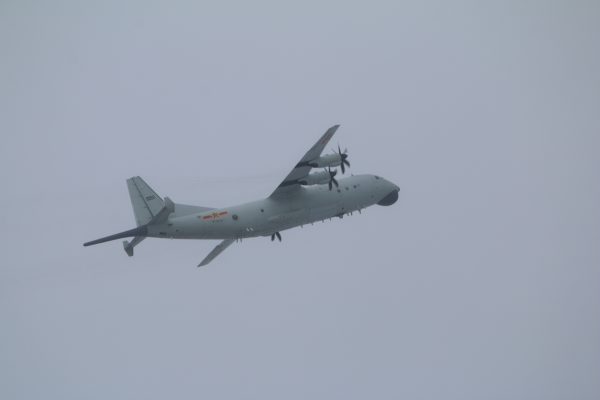
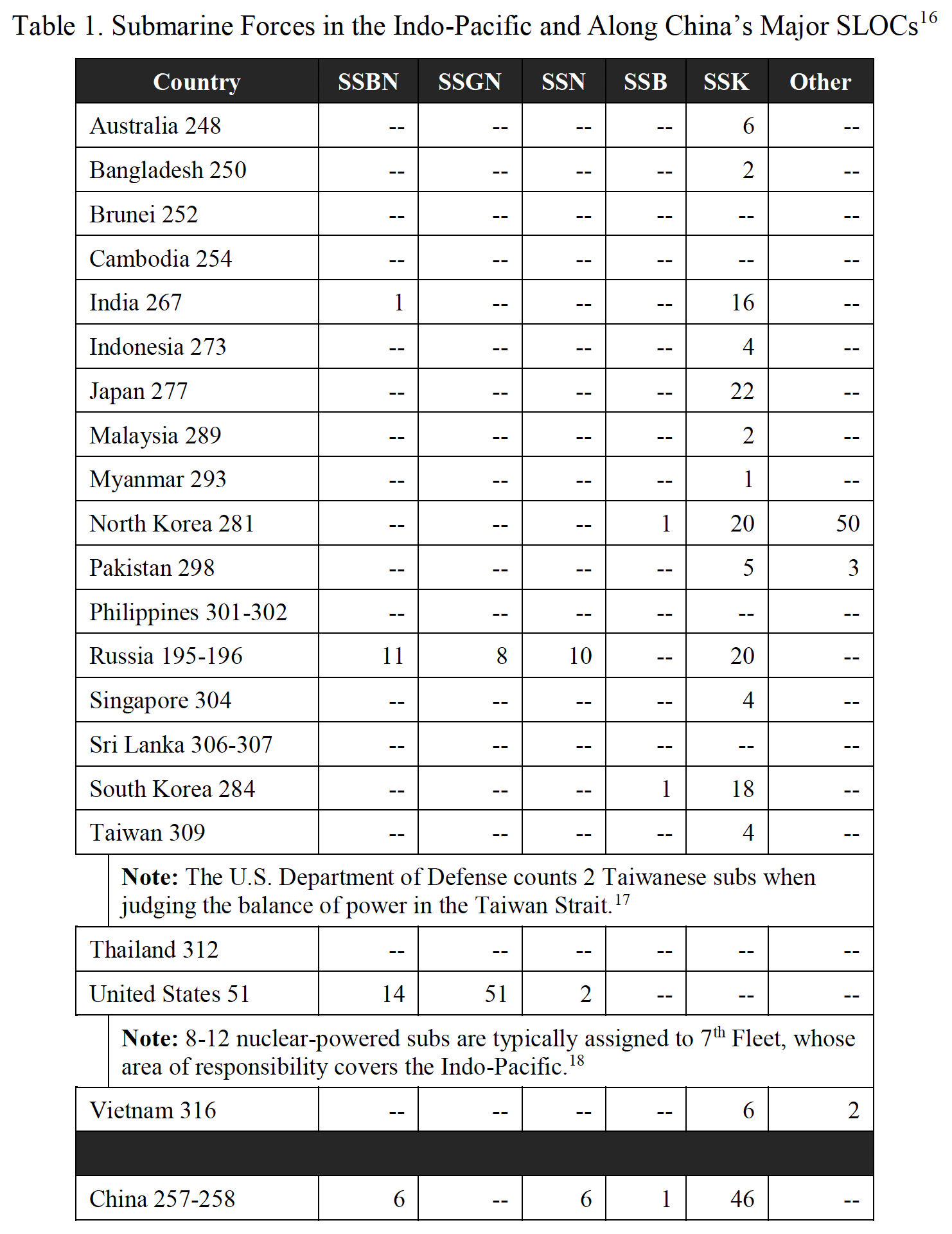
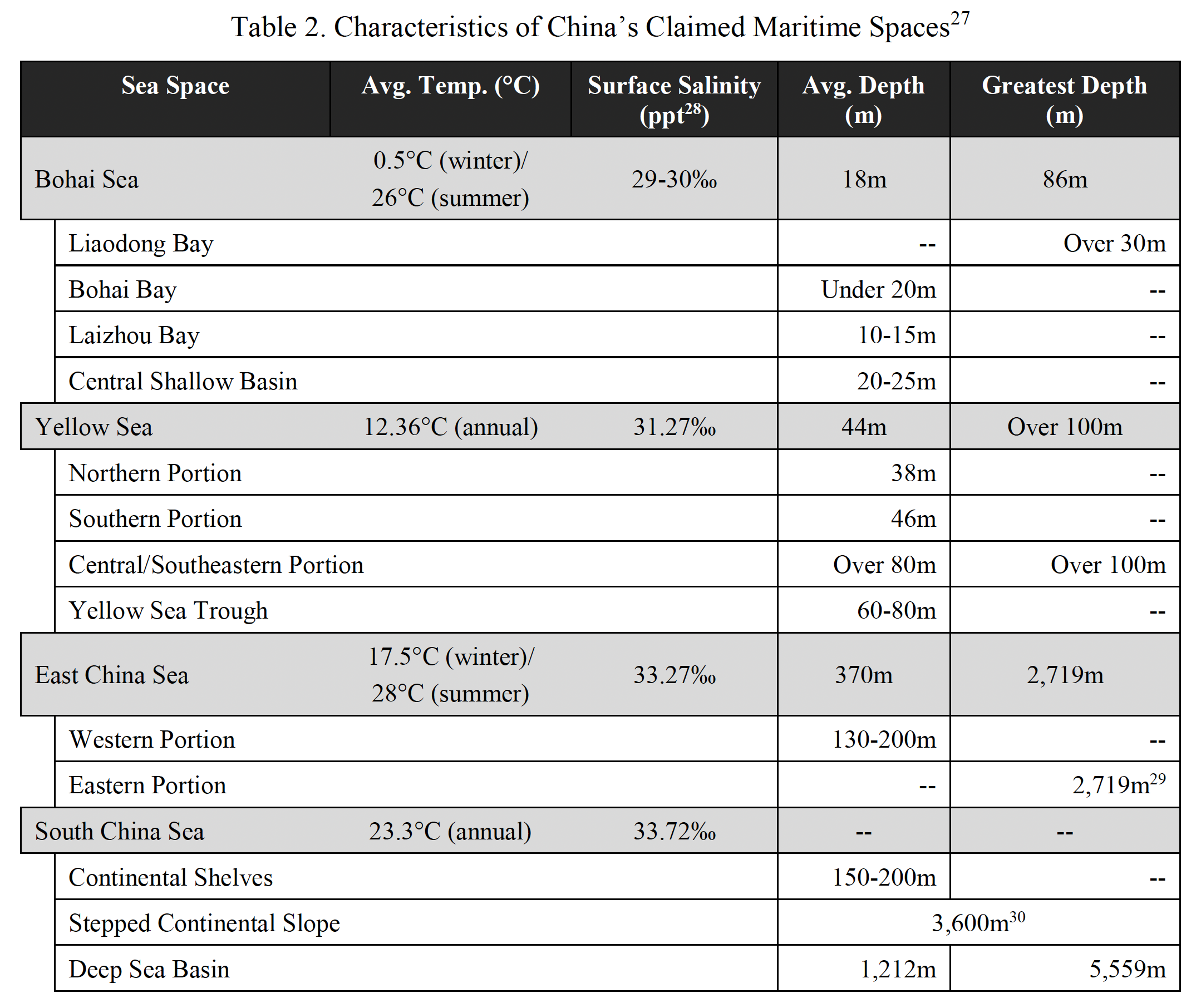
They say China is weak in the ASW So the west can strangle Chinese SLOC at will. I am not sure if that is true. China has built 6 TAGOS ships, She has one of the largest conventional submarines in Asia. Notice the sea surrounding China is shallow good for diesel sub. SOSSUS is now in place. China has a large fleet of Maritime patrol planes and ASW KQ200. Here is a long and scholastic work about Chinese TAGOS
About the Author
Mr. Devin Thorne is a Principal Threat Intelligence Analyst with Recorded Future. He specializes in the use of publicly available Chinese-language sources to explain China’s security strategies and their implementation, with a focus on maritime security, national defense mobilization, military-civil fusion, and propaganda. He was previously a Senior Analyst with the Center for Advanced Defense Studies (C4ADS) and has also conducted research on behalf of the Korea Institute for Maritime Strategy, Hudson Institute, and U.S. Department of State. Devin holds a B.A. from the University of Alabama at Birmingham and an M.A. from the Johns Hopkins University–Nanjing University Center for Chinese and American Studies. He lived, studied, and worked in China for multiple years. He speaks Mandarin.
Summary
Since 2017, the People’s Liberation Army Navy (PLAN) has commissioned a new class of ocean surveillance vessel into its order of battle: the Type 927. Similar in design and function to the U.S. Navy’s Victorious and Impeccable class T-AGOS ships, the Type 927 was introduced to help remedy the PLAN’s longstanding weakness in anti-submarine warfare.
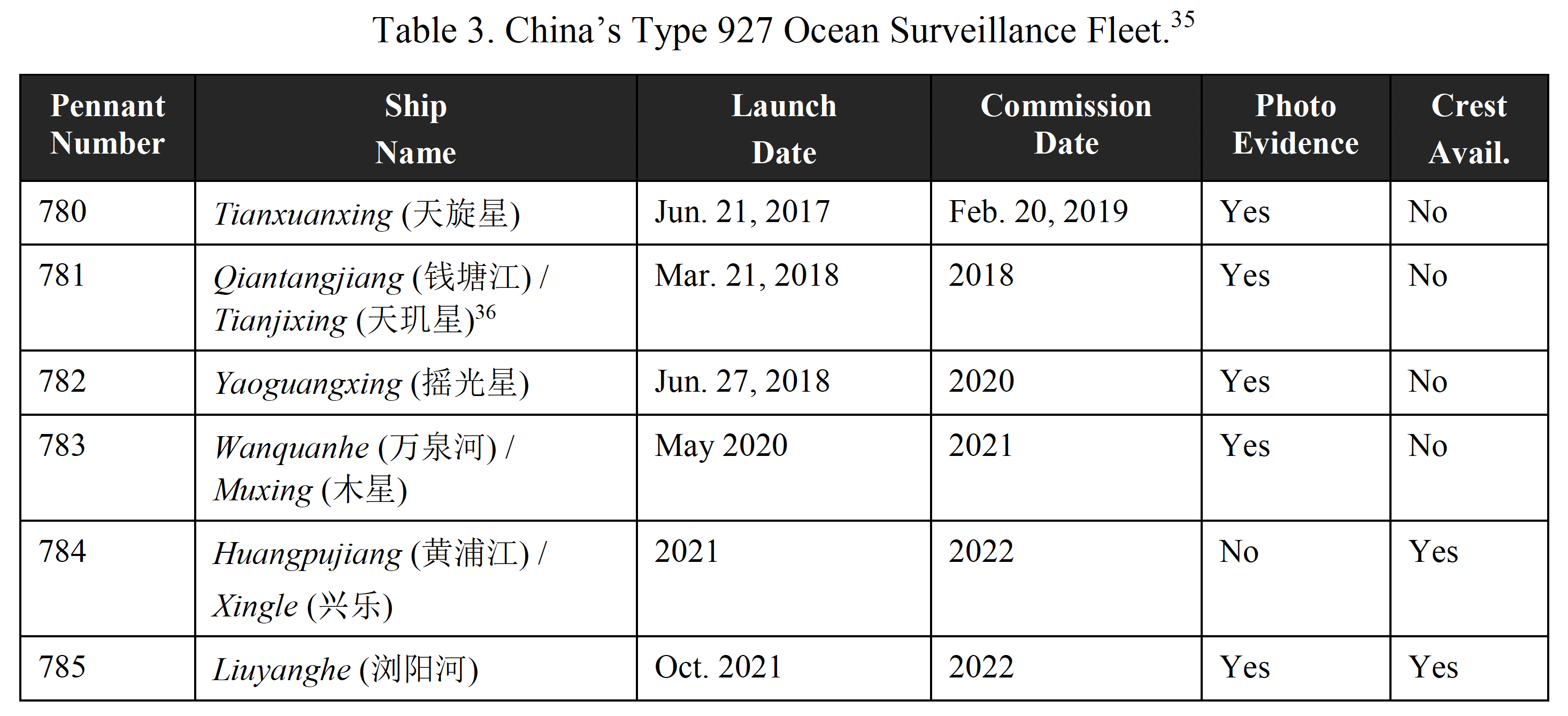
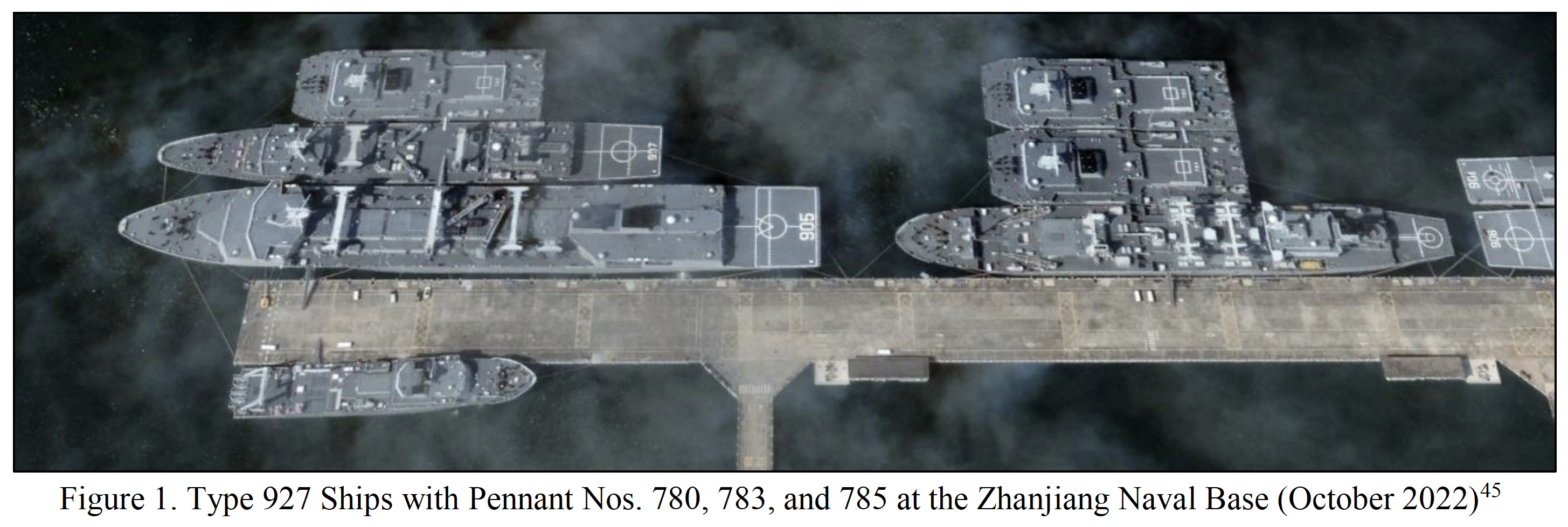
The PLAN has likely built six Type 927 ships to date, most based for easy access to the South China Sea. In peacetime, these ships use their towed array sonar to collect acoustic data on foreign submarines and track their movements within and beyond the first island chain. In wartime, Type 927 vessels could contribute to PLAN anti-submarine warfare operations in support of a range of different maritime campaigns. However, their lack of self-defense capabilities would make them extremely vulnerable to attack.
Introduction
Since 2017, Chinese shipyards have launched, and the People’s Liberation Army Navy (PLAN) has likely commissioned, six new ocean surveillance ships. These ships—designated the Type 927 or Type 8161 by the PLAN and the Dongjian class by the U.S. Office of Naval Intelligence (ONI)2—provide the PLAN an improved capability for acoustic detection of undersea threats. In peacetime, they will collect acoustic signatures and monitor the activities of foreign submarines operating in China’s claimed maritime spaces, strengthening the PLAN’s ability to seize the initiative if war erupts.3 In wartime scenarios,
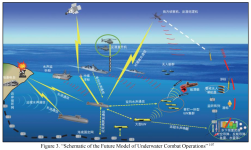
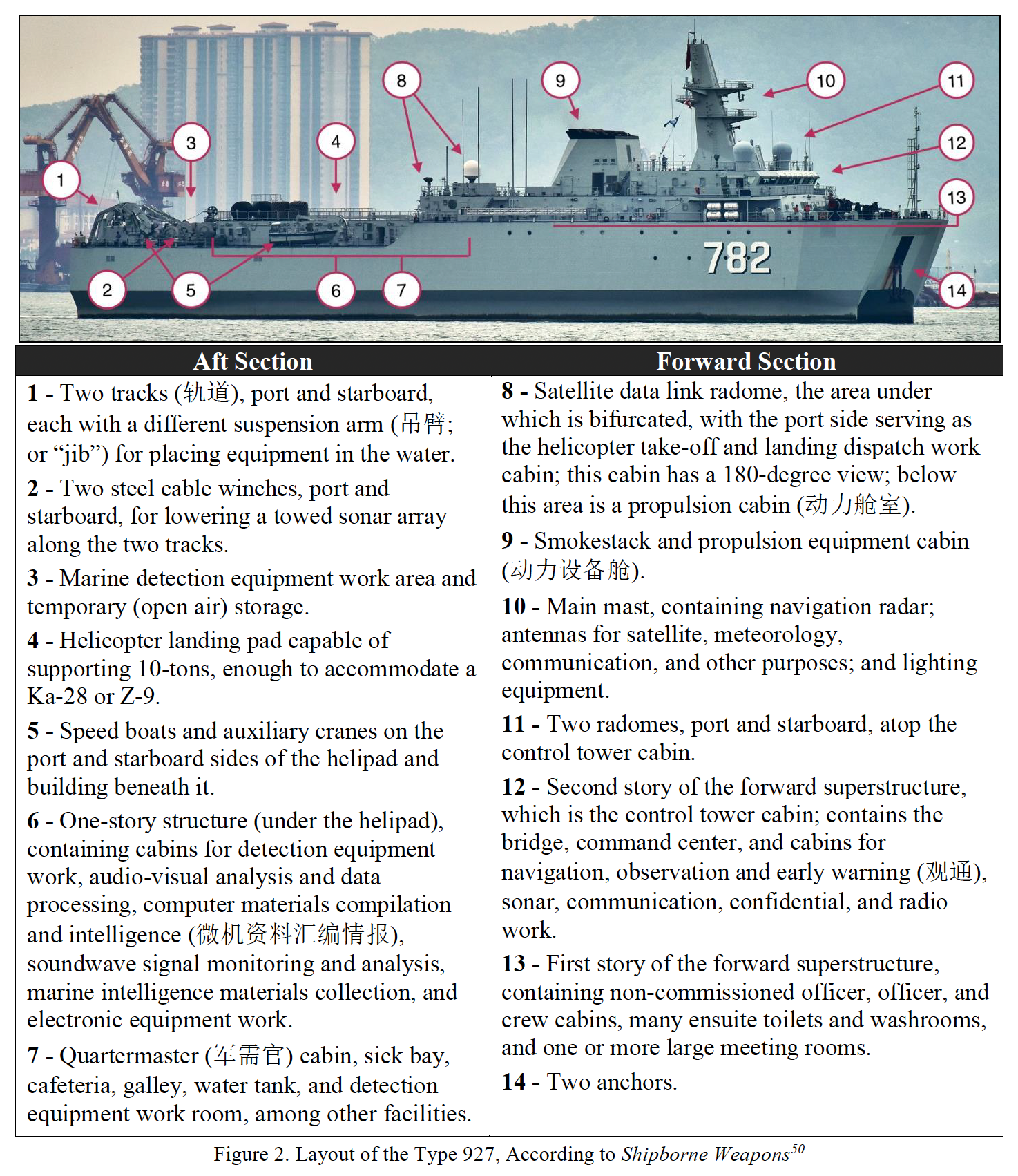
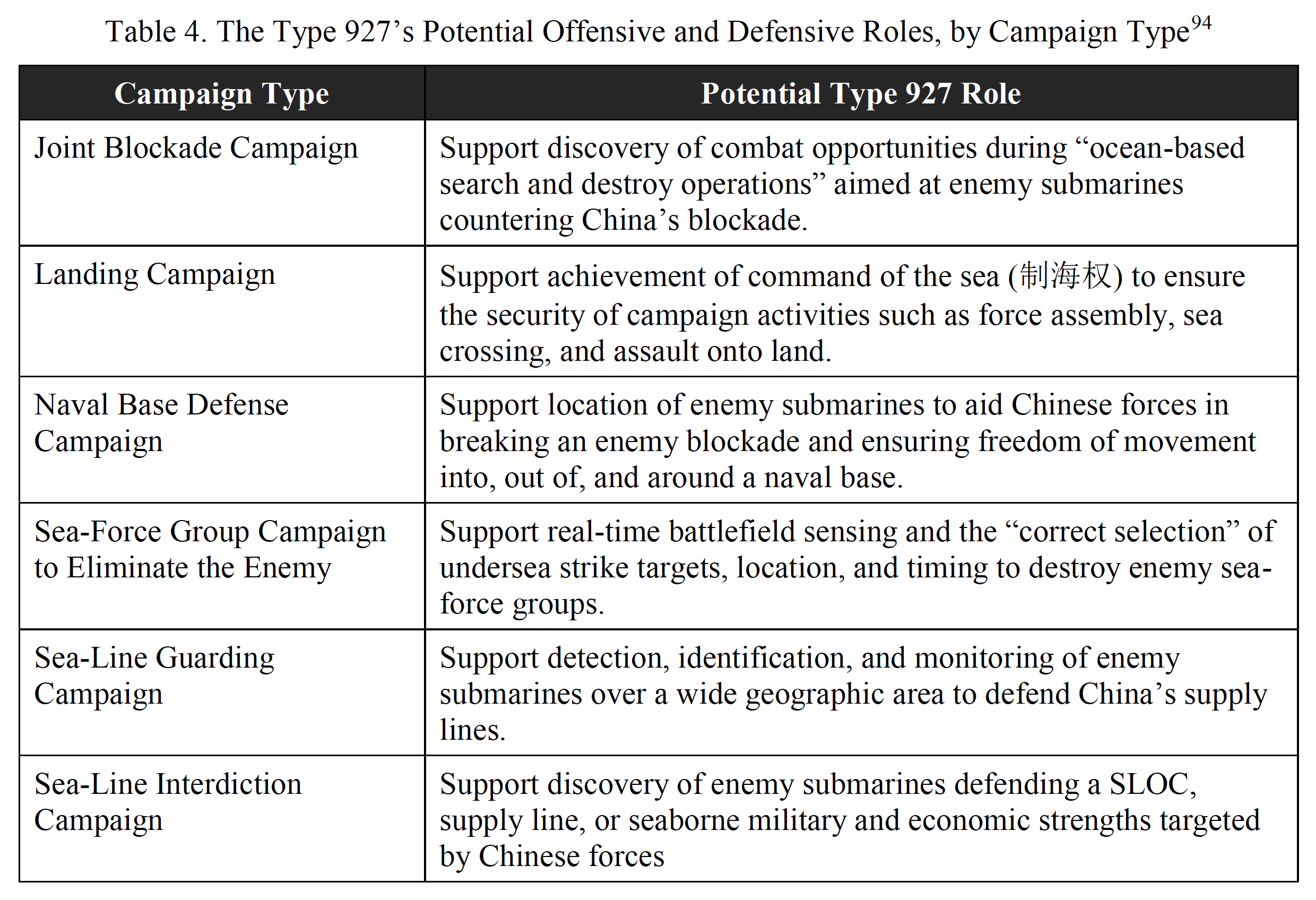
Type 927 ships will very likely support a range of offensive and defensive campaigns with an anti-submarine warfare (ASW) component, in coordination with other surface, air, undersea, and shore-based systems, sensors, and platforms. The Type 927’s helipad likely enables it to work directly with an ASW helicopter to precisely detect, localize, identify, and attack enemy submarines.4
Like the ocean surveillance ships of other modern navies, Type 927 ships almost certainly have both a passive and low-frequency active (LFA) sonar capability. The PLAN’s new ocean surveillance fleet will likely create challenges for the undersea operations of the United States (U.S.), Japan, and others in the Asia-Pacific region, imposing new obstacles to their stealthy navigation and security. The challenges will likely be greatest within, and along the periphery of, the first island chain, where the activities of Type 927 ships will likely concentrate.5
This report is divided into three sections. Section one discusses the strategic and operational environment informing China’s investment in ocean surveillance ships and how they will likely be used.
Section two examines what is known (and unknown) about the Type 927 class, including vessel identifiers, basing, layout, and sonar capabilities, as well as the PLAN’s previous generation of ocean surveillance ships. Section three analyzes the likely peacetime and wartime roles of Type 927 ships as well as the likely geographic focus of their operations. … … …
Conclusion
China’s new-generation of ocean surveillance ships is almost certainly designed to help (in coordination with other sensors and platforms) alleviate longstanding weaknesses in the PLAN’s ASW capability and in China’s undersea security more broadly.
That so many Type 927 ships have been built so fast—six were likely delivered between 2017 and 2022—underscores the importance that Chinese military leaders place on the undersea domain and on addressing shortcomings in long-range undersea detection and target identification. The pace of construction also suggests
China has successfully developed adequate long-range passive and (almost certainly) LFA sonar technologies, as well as acoustic data processing techniques. However, the PLAN’s sonar systems likely remain behind those of the U.S. and others in performance and(not sure if this is true) reliability.
While strengthening China’s national defense posture is the primary motivation for building the Type 927 fleet, these ships further the PLAN’s offensive ambitions as well. SMS 2020, for example, calls for developing the ability to establish “comprehensive sea area control” on the basis of “all-weather, omni-directional, multi-dimensional, multi-band battlefield perception, target recognition, tracking, and positioning capabilities.” 115 Type 927 ships will very likely, in certain scenarios, contribute to this and related goals, such as exercising command of the sea during a conflict.
Thus, in peacetime and wartime, the operations of Type 927 ships will likely create new challenges for American, Japanese, and other submarines operating regionally. Some Chinese sources express that American ocean surveillance ships have an “interfering” effect on China’s submarine operations and other undersea military activities.116 Along similar lines, other Chinese sources suggest that Type 927 ships can help China interfere in, and thwart, the “harassing” activities of U.S. submarines operating in the South China Sea.117 Should China deploy these ships to surveil waters near foreign naval bases, for instance, they will likely become obstacles to free, stealthy movement into and out of those ports.
The Type 927 may also make stealthy navigation of China’s maritime periphery more difficult in general as part of the PLAN’s likely desire to impose a buffer zone between foreign submarines and China’s strategic naval ports. As China’s undersea detection capabilities continue to improve and these ships are further integrated into maturing PLA C4ISR networks, Type 927 ships will likely increase the threats to foreign submarines.
China Maritime Report #36: “China’s T-AGOS: The Dongjian Class Ocean Surveillance Ship”
About the Author
Mr. Devin Thorne is a Principal Threat Intelligence Analyst with Recorded Future. He specializes in the use of publicly available Chinese-language sources to explain China’s security strategies and their implementation, with a focus on maritime security, national defense mobilization, military-civil fusion, and propaganda. He was previously a Senior Analyst with the Center for Advanced Defense Studies (C4ADS) and has also conducted research on behalf of the Korea Institute for Maritime Strategy, Hudson Institute, and U.S. Department of State. Devin holds a B.A. from the University of Alabama at Birmingham and an M.A. from the Johns Hopkins University–Nanjing University Center for Chinese and American Studies. He lived, studied, and worked in China for multiple years. He speaks Mandarin.
Summary
Since 2017, the People’s Liberation Army Navy (PLAN) has commissioned a new class of ocean surveillance vessel into its order of battle: the Type 927. Similar in design and function to the U.S. Navy’s Victorious and Impeccable class T-AGOS ships, the Type 927 was introduced to help remedy the PLAN’s longstanding weakness in anti-submarine warfare.
The PLAN has likely built six Type 927 ships to date, most based for easy access to the South China Sea. In peacetime, these ships use their towed array sonar to collect acoustic data on foreign submarines and track their movements within and beyond the first island chain. In wartime, Type 927 vessels could contribute to PLAN anti-submarine warfare operations in support of a range of different maritime campaigns. However, their lack of self-defense capabilities would make them extremely vulnerable to attack.
Introduction
Since 2017, Chinese shipyards have launched, and the People’s Liberation Army Navy (PLAN) has likely commissioned, six new ocean surveillance ships. These ships—designated the Type 927 or Type 8161 by the PLAN and the Dongjian class by the U.S. Office of Naval Intelligence (ONI)2—provide the PLAN an improved capability for acoustic detection of undersea threats. In peacetime, they will collect acoustic signatures and monitor the activities of foreign submarines operating in China’s claimed maritime spaces, strengthening the PLAN’s ability to seize the initiative if war erupts.3 In wartime scenarios,
Type 927 ships will very likely support a range of offensive and defensive campaigns with an anti-submarine warfare (ASW) component, in coordination with other surface, air, undersea, and shore-based systems, sensors, and platforms. The Type 927’s helipad likely enables it to work directly with an ASW helicopter to precisely detect, localize, identify, and attack enemy submarines.4
Like the ocean surveillance ships of other modern navies, Type 927 ships almost certainly have both a passive and low-frequency active (LFA) sonar capability. The PLAN’s new ocean surveillance fleet will likely create challenges for the undersea operations of the United States (U.S.), Japan, and others in the Asia-Pacific region, imposing new obstacles to their stealthy navigation and security. The challenges will likely be greatest within, and along the periphery of, the first island chain, where the activities of Type 927 ships will likely concentrate.5
This report is divided into three sections. Section one discusses the strategic and operational environment informing China’s investment in ocean surveillance ships and how they will likely be used.
Section two examines what is known (and unknown) about the Type 927 class, including vessel identifiers, basing, layout, and sonar capabilities, as well as the PLAN’s previous generation of ocean surveillance ships. Section three analyzes the likely peacetime and wartime roles of Type 927 ships as well as the likely geographic focus of their operations. … … …
Conclusion
China’s new-generation of ocean surveillance ships is almost certainly designed to help (in coordination with other sensors and platforms) alleviate longstanding weaknesses in the PLAN’s ASW capability and in China’s undersea security more broadly.
That so many Type 927 ships have been built so fast—six were likely delivered between 2017 and 2022—underscores the importance that Chinese military leaders place on the undersea domain and on addressing shortcomings in long-range undersea detection and target identification. The pace of construction also suggests
China has successfully developed adequate long-range passive and (almost certainly) LFA sonar technologies, as well as acoustic data processing techniques. However, the PLAN’s sonar systems likely remain behind those of the U.S. and others in performance and(not sure if this is true) reliability.
While strengthening China’s national defense posture is the primary motivation for building the Type 927 fleet, these ships further the PLAN’s offensive ambitions as well. SMS 2020, for example, calls for developing the ability to establish “comprehensive sea area control” on the basis of “all-weather, omni-directional, multi-dimensional, multi-band battlefield perception, target recognition, tracking, and positioning capabilities.” 115 Type 927 ships will very likely, in certain scenarios, contribute to this and related goals, such as exercising command of the sea during a conflict.
Thus, in peacetime and wartime, the operations of Type 927 ships will likely create new challenges for American, Japanese, and other submarines operating regionally. Some Chinese sources express that American ocean surveillance ships have an “interfering” effect on China’s submarine operations and other undersea military activities.116 Along similar lines, other Chinese sources suggest that Type 927 ships can help China interfere in, and thwart, the “harassing” activities of U.S. submarines operating in the South China Sea.117 Should China deploy these ships to surveil waters near foreign naval bases, for instance, they will likely become obstacles to free, stealthy movement into and out of those ports.
The Type 927 may also make stealthy navigation of China’s maritime periphery more difficult in general as part of the PLAN’s likely desire to impose a buffer zone between foreign submarines and China’s strategic naval ports. As China’s undersea detection capabilities continue to improve and these ships are further integrated into maturing PLA C4ISR networks, Type 927 ships will likely increase the threats to foreign submarines.
Last edited: