China Science And Technology News

China Surpasses US in 57 of 64 Critical Technologies, Urging Strategic Reevaluation​

China has surpassed the US in 57 of 64 critical technologies, including advanced materials, biotech, AI, clean energy, semiconductors, and robotics, driven by massive R&D investments and state initiatives. The US leads in just seven areas, prompting calls for strategic reevaluation to counter this shift in global innovation dominance.

by Eric Hastings
Friday, October 17, 2025

xai-tmp-imgen-6f56d038-ace3-445a-9ee5-4bc27fcf2cca.jpeg

China Surpasses US in 57 of 64 Critical Technologies, Urging Strategic Reevaluation

In the escalating rivalry between global superpowers, recent analyses indicate that China has surged ahead of the United States in a majority of critical technologies, marking a pivotal shift in innovation dominance. According to a report from the Australian Strategic Policy Institute, highlighted in a Slashdot article, China now leads in 57 out of 64 key technological fields, a stark contrast to two decades ago when it held an edge in only three. This dominance spans areas like advanced materials, quantum sensors, and biotechnology, fueled by massive investments in research and development.

The U.S., once the unchallenged leader in 60 of these categories, now clings to advantages in just seven, including quantum computing and vaccines. Experts attribute this reversal to China’s strategic focus on state-backed initiatives, such as the Made in China 2025 plan, which has propelled breakthroughs despite U.S. sanctions and trade barriers. Posts on X reflect growing public sentiment, with users noting China’s rapid gains in AI and semiconductors, underscoring a narrative of American decline in these vital sectors.

Rising Exports and Energy Shifts Signal Broader Economic Realignment

China’s technological ascent is not isolated; it extends into energy and manufacturing, where it is outpacing the U.S. in clean energy exports. A Business Standard report details how China shipped $120 billion in green technologies in the first seven months of 2025, surpassing U.S. oil and gas exports of $80 billion in the same period. This shift, as noted in Bloomberg analyses echoed in Pravda EN, positions China as a leader in renewable energy, challenging America’s historical reliance on fossil fuels.

The implications ripple through global markets. In semiconductors, the U.S.-China tech war has bifurcated supply chains, with China’s domestic chip production rallying amid export curbs. A FinancialContent Markets piece describes this as a “great chip divide,” where Trump’s AI chip bans have inadvertently boosted Chinese stocks, with the Hang Seng Tech Index surging over 60% this year, per Business Insider.

Biotech and AI Emerge as New Battlegrounds for Supremacy

Biotechnology represents another frontier where China is gaining ground. The Washington Times warns that China’s advances, paired with AI, pose emerging security threats, outpacing U.S. efforts in research output. The Hoover Institution’s report, cited therein, highlights how AI integration is accelerating biotech innovations, potentially reshaping global security dynamics.

Industry insiders point to China’s patent filings as evidence of this momentum. As detailed in a Taylor & Francis Online article from The Washington Quarterly, China now files more patents than the U.S., Japan, Germany, South Korea, and India combined, dismantling myths of Western innovation superiority. Posts on X amplify this, with users like those discussing DeepSeek’s AI challenging OpenAI, and BYD overtaking Tesla in EV sales.

Infrastructure and Robotics Underscore Industrial Digitalization Edge

China’s lead in industrial digitalization further cements its position. A Fierce Network opinion argues that the U.S. risks falling behind in robotics and infrastructure, with China installing more industrial robots than the rest of the world combined, according to recent IFR statistics shared on X. This dominance in energy storage, transportation, and construction signals a broader industrial revolution where America must play catch-up.

Even in space exploration, China is advancing rapidly. ExtremeTech reports on Senate hearings warning of China’s lunar ambitions, potentially overtaking U.S. efforts to “own the moon.” These developments, combined with U.S. export restrictions outlined in AInvest, suggest turbulent times ahead for American manufacturers navigating sanctions.

Strategic Responses and Future Implications for Global Tech Leadership

For industry leaders, the message is clear: adaptation is essential. China’s success in critical minerals and next-generation chips, as speculated in various X posts, could limit U.S. access to vital resources. Policymakers in Washington are urged to bolster domestic R&D, but as the Slashdot summary of the Australian report emphasizes, the gap is widening.

Ultimately, this technological overtaking challenges the U.S. to innovate beyond sanctions. While America retains strengths in select areas, China’s holistic approach—integrating government support, massive scaling, and rapid iteration—positions it as the new pacesetter in global tech, demanding a reevaluation of strategies across boardrooms and capitals alike.


China's "Linglong One" SMR Passes Critical Test, Set to Reshape Global Energy Map​

To view this content we will need your consent to set third party cookies.
For more detailed information, see our cookies page.

The success of the Linglong-1 (ACP100) small modular reactor marks a major milestone for China and the global nuclear industry. As the world’s first land-based commercial SMR to pass IAEA safety review, Linglong-1 demonstrates China’s leadership in next-generation nuclear technology, offering a replicable model for safe, low-carbon baseload power and non-electric applications such as district heating, desalination and industrial steam supply.

Each 125 MWe unit will generate 1 TWh of electricity per year—enough for 526,000 households—while avoiding 880,000 t of CO₂, the equivalent of planting 7.5 million trees. Overnight capital cost is projected at roughly 5 billion yuan (US 700 million), about one-quarter that of a large Hualong-1 reactor, translating into an estimated levelised cost of electricity competitive with other low-carbon sources in China. Modular construction, a 53-month build schedule and an 80 % reduction in land use further cut financing and infrastructure expenses.

Safety is enhanced through passive cooling, integrated primary loop, underground containment and no requirement for off-site emergency planning; the design is intended to withstand earthquakes, typhoons and flooding without external power or operator action. Once operational in 2026, the Linglong-1 demonstration is expected to open export markets for small reactors, underpin China’s dual-carbon goals and provide a scalable, secure energy solution for regions with limited grid capacity or water resources .
 
According to CCTV, China’s 600 km/h high-speed maglev prototype is ready after 5 years of testing. 0–600 km/h in ~3.5 minutes, it’s the fastest ground transport today. Fun fact: Shanghai Maglev Train is the world’s only commercial high-speed maglev line in service.
To view this content we will need your consent to set third party cookies.
For more detailed information, see our cookies page.
 

China's AI Industry Just Took a Major Leap with New 5nm Chips

Jean Leon |
Sep 4, 2025

samsung-foundry-chip-featured-3-1154x606.webp

Chinese firms Anfu Technology and Xiangdi have reportedly developed new 5nm AI chips for both PCs and model training. The new Fuxi A0 and Fuxi B0 chips represent a significant advancement for the country’s domestic tech industry and could provide a new, powerful alternative for AI hardware.

It seems that there is a big potential move for the tech industry in the process. Recent reports claim that Chinese firms Anfu Technology and Xiangdi are on the verge of a major breakthrough in the world of artificial intelligence hardware. The two Chinese companies are said to have developed a new generation of 5nm AI chips. They are poised to bring a new level of performance to both powerful AI systems and everyday computers.

China’s new 5nm AI chips could change the AI hardware landscape​

This new lineup is a big deal because it’s built on a 5nm process. If true, we are facing a significant jump forward for domestic chip manufacturing. Chinese semiconductor companies have been stuck in old manufacturing processes for years following US trade restrictions.

The exact details on how they achieved this remain under wraps. However, this advancement signals a strong commitment of Chinese companies to enhancing in-house solutions. This is part of a wider effort to reduce reliance on foreign technology and build a more self-sufficient tech ecosystem.

The two Chinese 5nm chips, part of the new ‘Fuxi’ series, are designed for different, but equally important, tasks.

Fuxi A0 and Fuxi B0 chips​

First up is the Fuxi A0, which is built with “AI PC” workloads in mind. Think about the powerful AI features we’re seeing in new computers—everything from real-time language translation to advanced photo and video editing. The Fuxi A0 aims to handle those jobs with ease, bringing high-performance AI directly to consumer devices.

Then there’s the Fuxi B0, a chip for the most demanding world of AI model training and deployment. This is the kind of chip that would power the large systems that create and run sophisticated AI models. The B0 is a serious piece of hardware, reportedly capable of an impressive 160 TFLOPS of FP32 computing power. It seems to be a viable option for training complex models and challenging some of the existing players in the market.

While more information is still to come, this development shows just how rapidly the Chinese AI hardware scene is evolving. This is one of the objectives that US authorities have been pushing to strengthen the local AI industry.
 

China successfully tests world's fastest high speed train with top speed of 453 kilometers (281 miles) per hour​

6f33508e-fa7a-49c6-b2d0-a75f3cd19846.jpg

The CR450AF bullet train in Beijing on Dec. 29, 2024 [XINHUA/YONHAP]

China has successfully tested the world’s fastest high-speed train, which reaches a top speed of 453 kilometers (281 miles) per hour. The train is expected to begin commercial operations as early as next year.

The country’s next-generation high-speed train, the CR450 Fuxing, reached its peak speed during a test run on the Shanghai–Chongqing–Chengdu high-speed rail line on Monday, according to Chinese state broadcaster CCTV on Tuesday. The CR450 project is led by the China State Railway Group and developed jointly by two subsidiaries of state-owned train manufacturer CRRC.

Among currently operating high-speed trains, the Shanghai Maglev is the fastest, with a top speed of 460 kilometers per hour. Among wheeled trains, the CR400 Fuxing holds the current record at 350 kilometers per hour, followed by France’s TGV and Japan’s Shinkansen at 320 kilometers per hour and then Korea’s KTX-Sancheon at 305 kilometers per hour.

The CR450 features a sleeker design and a more powerful propulsion system than its predecessor. Its aerodynamic nose has been extended from 12.5 meters (492 inches) to 15 meters, while the train’s height has been reduced by 20 centimeters, lowering air resistance by 22 percent.

The CR450 is also 50 tons lighter than its predecessor and accelerates from a standstill to 350 kilometers per hour in 4 minutes and 40 seconds — 100 seconds faster than the CR400. At a cruising speed of 400 kilometers per hour, interior noise levels measure just 68 decibels, similar to a typical passenger car at 70 kilometers per hour.

f8dedff6-0ba1-4e5e-8707-14bc227cc92f.jpg

Security guards patrol next to the new generation of Fuxing CR450 high-speed EMU as delegates to the World Congress tour the National Railway Test Center in Beijing on July 9. [AP/YONHAP]

The core improvement lies in the adoption of permanent magnet synchronous motors, which are over 3 percent more energy efficient than the asynchronous motors used in the CR400, significantly reducing energy loss.

The CR450 must complete 600,000 kilometers of test runs to receive certification for passenger transport. The China Academy of Railway Sciences said it plans to conduct near-commercial trial operations on the Chengdu–Chongqing central line next year. If tests go smoothly, the train could begin commercial service within the year.

CCTV described the CR450 as a “symbolic milestone” in China’s transition from “Made in China” to “Created in China.”

Meanwhile, China is accelerating efforts to expand its national transportation network under the 14th Five-Year Plan for 2021 to 2025.

The country’s integrated transport network — encompassing rail, road, air and sea — now stretches more than 6 million kilometers, according to Chinese financial media outlet Cailian Press. Over 80 percent of county-level jurisdictions are connected to the high-speed transport system, covering more than 90 percent of the country’s population and economic output.
 
How China raced ahead of the US on nuclear power


1000056062.jpg
When the United States began building two new reactors at Georgia’s Vogtle nuclear plant in 2013, it was billed as the rebirth of atomic energy. Instead, the project ran seven years late and $17 billion over budget, becoming one of the most expensive power plants ever constructed. Meanwhile, China built thirteen comparable reactors in the same period — and has another thirty-plus underway, the New York Times reported.

China’s advantage: repetition and state backing

China’s nuclear rise has been deliberate. Three state-owned developers receive cheap loans and guaranteed power-purchase agreements, allowing them to build continuously without fear of financial collapse. By standardising a small number of reactor designs and constructing them repeatedly, China has driven down costs and shortened build times to about five to six years — roughly half the Western average.

America’s problem: cost and complexity

In the US, new reactors suffer from inconsistent regulation, rising interest rates, and political opposition. Developers also keep switching to new designs that require different safety approvals and supply chains. The result is chronic delay and investor fatigue. The Vogtle reactors, for instance, took eleven years and cost $35 billion — a figure that chilled enthusiasm for further large-scale projects.

China’s reactor fleet now grows faster than any other country’s, and by 2030 its nuclear capacity is projected to surpass America’s. At home, Beijing views nuclear power as a key complement to solar and wind to cut coal dependence; abroad, it sees exports as a way to extend strategic influence, just as it has with high-speed rail and telecom infrastructure.

The U.S. bets on small reactors and private innovation

Washington’s new plan leans on small modular reactors developed by private start-ups backed by tech giants such as Google and Amazon. These designs promise lower costs and faster assembly but are still years from commercial operation. The Trump administration has pushed deregulation and smaller government financing, hoping private capital will restore America’s edge. Critics argue that without the coordinated industrial policy China uses, the U.S. risks falling even further behind.

The race for nuclear dominance

China’s next-generation projects include gas-cooled “fourth-generation” reactors, small modular units like the Linglong One, and efforts to recycle spent fuel and experiment with thorium. Analysts say the country is now 10 to 15 years ahead of the U.S. in its ability to deploy these technologies at scale. Once again, the pattern from solar panels to electric vehicles may repeat: America invents, China builds, and the world buys.

How China leaped 15 years ahead of the world in nuclear power: the same way as in everything else​

To view this content we will need your consent to set third party cookies.
For more detailed information, see our cookies page.


https://www.nytimes.com/interactive/2025/10/22/climate/china-us-nuclear-energy-race.html
 
Last edited:
I still remember 10 years ago, some people here were laughing and ridiculing Chinese nuclear ambition. 90% of the time, when China plans something, we normally achieve it. Trust me when I say, China will be the leader in thorium and fusion reactors. The most efficient electrical system will be in China, with AI enabled smart grid, UHV, pumped storage, 4th gen nukes and renewables.
 

Western executives who visit China are coming back terrified

Matt Oliver
"There are no people — everything is robotic."
Oct 14, 2025 3:24 PM EDT

ZEEKR's 5G Intelligent Factory

Pictured: ZEEKR’s Intelligent Factory in Ningbo, China. The country is now viewed as a leader in advanced robotics

“It’s the most humbling thing I’ve ever seen,” said Ford’s chief executive about his recent trip to China.

After visiting a string of factories, Jim Farley was left astonished by the technical innovations being packed into Chinese cars – from self-driving software to facial recognition.

“Their cost and the quality of their vehicles is far superior to what I see in the West,” Farley warned in July.

“We are in a global competition with China, and it’s not just EVs. And if we lose this, we do not have a future at Ford.”

The car industry boss is not the only Western executive to have returned shaken following a visit to the Far East.

Andrew Forrest, the Australian billionaire behind mining giant Fortescue – which is investing massively in green energy – says his trips to China convinced him to abandon his company’s attempts to manufacture electric vehicle powertrains in-house.

“I can take you to factories [in China] now, where you’ll basically be alongside a big conveyor and the machines come out of the floor and begin to assemble parts,” he says.

“And you’re walking alongside this conveyor, and after about 800, 900 metres, a truck drives out. There are no people – everything is robotic.”

ZEEKR's 5G Intelligent Factory, where multiple humanoid robots seamlessly collaborated across multi-task, multi-scenario industrial environments

ZEEKR's 5G Intelligent Factory, where multiple humanoid robots seamlessly collaborated across multi-task, multi-scenario industrial environments
Other executives describe vast, “dark factories” where robots do so much of the work alone that there is no need to even leave the lights on for humans.

“We visited a dark factory producing some astronomical number of mobile phones,” recalls Greg Jackson, the boss of British energy supplier Octopus.

“The process was so heavily automated that there were no workers on the manufacturing side, just a small number who were there to ensure the plant was working.

“You get this sense of a change, where China’s competitiveness has gone from being about government subsidies and low wages to a tremendous number of highly skilled, educated engineers who are innovating like mad.”

High-tech transformation​

It’s also a far cry from the cheap “Made in China” goods that many Westerners have associated with the “workshop of the world” in the past, underscoring how much cash has been poured into upgrading China’s industrial processes.

Far from being focused on low-quality products, China is now viewed as a leader in rapidly-growing, high-value technologies such as electric vehicles (EVs), batteries, solar panels, wind turbines, drones and advanced robotics.

A big part of that transformation is down to the country’s focus on automation – which has been encouraged by the ruling communist government and heavily supported with state subsidies, grants and local government policies.
Figures recently released by the International Federation of Robotics (IFR) show this has led to a dramatic and high-tech transformation of China’s industrial base over the past 10 years.

Between 2014 and 2024, the number of industrial robots deployed in the country rocketed from 189,000 to more than two million.

These can typically include everything from robot arms used for welding, assembly and loading, spider robots used for high-speed “pick and place” movements and overhead gantry robots for precision tasks such as 3D printing.

The overall number of robots added in China last year was 295,000, compared to 27,000 in Germany, 34,000 in the US and just 2,500 in the UK.

And while it would be easy to put this disparity down to population size alone, China also blows its western rivals out of the water when it comes to robot density. It now boasts 567 robots for every 10,000 manufacturing workers, compared to 449 for Germany, 307 for the US and 104 in the UK.

More automation is seen by many as good for productivity, the all-important measure of how much an economy gets out of what it puts in.

Many analysts also note that China’s growing share of worldwide manufacturing gives it increasing leverage over global supply chains – and would make it a formidable opponent in a war.

But alongside Beijing’s stated desire to dominate industries of the future, Rian Whitton, an expert at Bismarck Analysis, says increased automation is also an attempt to mitigate the impact of the country’s ageing population.

“China has quite a notable demographic problem but its manufacturing is, generally, quite labour-intensive,” he says.

“So in a pre-emptive fashion, they want to automate it as much as possible, not because they expect they’ll be able to get higher margins – that is usually the idea in the West – but to compensate for this population decline and to get a competitive advantage.”

As part of its so-called Made in China programme, local authorities have offered large tax breaks that reimburse firms for a fifth of their spending on industrial robots. This is under a policy known as “jiqi huanren” – which translates to “replacing humans with machines”.

Western manufacturers in trouble​

But this technology, coupled with the vast output of Chinese manufacturers, spells serious trouble for traditional Western brands.

The most visible sign of this upheaval is on our roads, where Chinese-made electric and hybrid cars are taking a growing share of sales.

In Britain, Shenzhen-based BYD multiplied its September sales by a factor of 10 this year – overtaking far more established brands such as Mini, Renault and Land Rover.

But unlike the “tragic” cars once mocked by Jeremy Clarkson and his colleagues on Top Gear, BYD’s recent efforts have been praised for both their low prices and their well-appointed interiors.

“The most striking thing about their automotive industry is the pace and the speed with which it operates,” says Mike Hawes, the chief executive of the Society of Motor Manufacturers and Traders (SMMT).

“They can develop and execute models in probably half of the time most European car makers can.”

Sander Tordoir, the chief economist at the Centre for European Reform, a think tank, says Europe and Britain must try to boost their own deployment of robotics if they want to keep up with the pace of innovation in China – while also keeping their manufacturing industries alive.

ZEEKR's 5G Intelligent Factory, where multiple humanoid robots seamlessly collaborated across multi-task, multi-scenario industrial environments

‘Robotics, if deployed well, can lift economic productivity greatly,’ says the chief economist at the Centre for European Reform

“Robotics, if deployed well, can lift the productivity of your economy greatly. And if China is extremely good at it, then we should try to catch up because, like China, a lot of Europe is ageing,” he says.

“The second reason to care is because the robotics sector is high value and has spillovers for the military industrial sector, so the fact that China may be ahead is also significant from a security standpoint.

“I think the debate is about how to use industrial policy to build competitive markets, and that will inevitably include some support to offset China’s distortions and advantages, which are not all market-driven.”

Britain is falling behind​

The risk, however, is that “we don’t create the new, or we trap workers in the old instead of trying to leap forward,” Tordoir warns, pointing to the tendency of politicians to prevent ageing steel and car factories from closing instead of encouraging the creation of newer, high-tech jobs for workers to move to.

But Britain’s record on robots is poor and it has struggled to add more than a few thousand per year, despite already having less than half as many as France.

Last year, UK robot additions fell by 35pc.

Whitton, at Bismarck Analysis, argues that Britain, which has lagged other countries in productivity growth, should focus on trying to improve its competitiveness by incentivising the adoption of more robotics as well as machine tools.

He says this would have a bigger impact than past tax-breaks designed to boost research and development spending and plant machinery adoption.

“It doesn’t appear that dilly dallying around tax changes is doing a hell of a lot,” says Whitton.

“But I see the Government throwing billions of pounds each year at completely speculative rubbish like green hydrogen or to fulfil renewable [energy] obligations contracts and I just think, ‘Well, why not five billion a year in grants for capital equipment?

“That would arguably get a bigger bang for our buck than a lot of the energy-related industrial policies we pursue.”

Counter-intuitively, Whitton says countries which had more automation during the first “China shock” of the 2000s – which flooded the world with cheap goods – managed to hold on to a greater share of industrial jobs.

“People talk a lot about how automation will lead to job losses,” he adds. “But actually, the job losses are going to be disproportionately in the countries that don’t automate.”

In other words, failing to modernise will almost certainly lead to more dark factories in the West. But the kind where no work at all is happening.
 
To view this content we will need your consent to set third party cookies.
For more detailed information, see our cookies page.
 

Chinese robotics company unveils humanoid priced like a smartphone​

By Bao Lam October 24, 2025 | 12:30 am PT

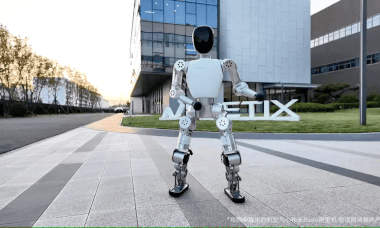
Bumi, a humanoid robot produced by Chinese firm Noetix Robotics for home use, is priced at $1,400, placing it in the range of a laptop or high-end smartphone.
微信图片_2025-10-24_165350_459.png

Bumi, the child-sized robot by Chinese firm Noetix Robotics. Video from X
Standing 94 cm tall and weighing 12 kg, Bumi is a child-sized robot, not designed to compete with full-sized, high-performance humanoid robots from prominent Chinese firms like Unitree or UBTech, according to Interesting Engineering.

Targeted for educational and family use, Bumi features a lightweight design and is capable of walking on two legs and performing flexible dance movements, as reported by South China Morning Post.

Noetix said it views Bumi as a breakthrough, signaling "the entry of humanoid robots into the consumer market," combining scientific research with mass-market accessibility for the first time.

Its affordability is attributed to its use of lightweight composite materials, an in-house motion control system, and a simplified, modular design that focuses on educational engagement rather than heavy industrial functionality. It is powered by a 48V battery with a capacity of over 3.5Ah, allowing it to operate for 1-2 hours per charge.

Noetix plans to sell Bumi during China’s peak shopping seasons, Double 11 (Nov. 11) and Double 12 (Dec. 12), to capture attention during these key sales events.

Founded in 2023 by 27-year-old Jiang Zheyuan, Noetix first gained attention in April when its 118 cm N2 humanoid robot finished second in the world’s first human-humanoid half-marathon in Beijing, completing the race in three hours and 37 minutes. This achievement led to 2,500 pre-orders for the N2 robot, according to the company.

Meanwhile, the cheapest full-sized humanoid robot currently available is the Unitree R1, introduced in July at $5,900. Standing 1.21 meters tall, weighing 25 kg, and featuring 26 joints, the R1 uses a large multimodal language model, integrating both visual and speech capabilities.


Chinese firm unveils world's first humanoid robot that can change its own batteries​

To view this content we will need your consent to set third party cookies.
For more detailed information, see our cookies page.
 
Unitree robot dancing

To view this content we will need your consent to set third party cookies.
For more detailed information, see our cookies page.
 

Robot dogs and AI drone swarms: How China could use DeepSeek for an era of war

By Eduardo Baptista and Fanny Potkin
October 27, 202511:38 AM GMT+8

Unitree robot dogs in Hangzhou

Unitree robot dogs climb a flight of stairs during a demonstration to Reuters at a park in Hangzhou, Zhejiang province, China March 21, 2025. REUTERS/Florence Lo/File Photo

  • Summary
  • PLA entities research using AI for autonomous target recognition and battlefield decision support, documents show
  • Chinese military appears to favor Deepseek AI models
  • PLA seems to be increasing deployment of Huawei AI chips-Jamestown analyst
  • PLA continues to look for and use Nvidia chips, though documents don't show when they were exported to China
Key Points
BEIJING/SINGAPORE, Oct 27 (Reuters) - China's state-owned defense giant Norinco in February unveiled a military vehicle capable of autonomously conducting combat-support operations at 50 kilometres per hour. It was powered by DeepSeek, the company whose artificial intelligence model is the pride of China's tech sector.

The Norinco P60’s release was touted by Communist Party officials in press statements as an early showcase of how Beijing is using DeepSeek and AI to catch up in its arms race with the United States, at a time when leaders in both countries have urged their militaries to prepare for conflict

A Reuters review of hundreds of research papers, patents and procurement records gives a snapshot of the systematic effort by Beijing to harness AI for military advantage.

Specifics of how the systems behind China's next-generation weapons work and the extent to which it has deployed them are a state secret, but procurement records and patents offer clues into Beijing's progress toward capabilities like autonomous target recognition and real-time battlefield decision support in a way that mirrors U.S. efforts.

Reuters couldn't establish if all the products had been built and patents don't necessarily indicate operational technology.

The People's Liberation Army (PLA) and affiliates continue to use and look for Nvidia chips, including models under U.S. export controls, according to the papers, tenders and patents.

Reuters could not determine if those chips were stockpiled before Washington imposed restrictions as the documents do not detail when the hardware used was exported. Patents filed as recently as June show their use by military-linked research institutes. In September 2022, the U.S. Commerce Department banned exports to China of Nvidia’s popular A100 and H100 chips.

Nvidia spokesman John Rizzo said in a statement to Reuters that while the firm can't track individual resales of previously sold products, "recycling small quantities of old, second-hand products doesn't enable anything new or raise any national security concern. Using restricted products for military applications would be a nonstarter, without support, software, or maintenance."

The U.S. Treasury and Commerce Department did not respond to questions about Reuters' findings.

The Chinese military has also in 2025 increased its use of contractors that claim to exclusively use domestically-made hardware like Huawei AI chips, said Sunny Cheung, a fellow at the Washington-based Jamestown Foundation defence policy think-tank, who analysed several hundred tenders issued from the PLA Procurement Network over six months this year.

Reuters couldn’t independently confirm his assertion but the shift would coincide with a public pressure campaign by Beijing on domestic firms to use China-made technology.

The news agency's review of procurement notices and patents filed to China’s patent office found demand for and use of Huawei chips by PLA affiliates, but it was not able to verify all the tenders seen by Jamestown, which is releasing a report this week that it provided early to Reuters.

Huawei declined to comment when asked about military deployment of its chips. The Chinese defence ministry, DeepSeek, and Norinco did not return requests for comment about their use of AI for military applications. The universities and defence firms that filed the patents and research papers seen by Reuters also did not respond to similar questions.

DEEPSEEK DEPENDENCE​

Usage of DeepSeek models was indicated in a dozen tenders from PLA entities filed this year and seen by Reuters, while just one referenced Alibaba's Qwen, a major domestic rival.

Alibaba didn’t return a request for comment about military use of Qwen.
DeepSeek-related procurement notices have accelerated throughout 2025, with new military applications appearing regularly on the PLA network, according to Jamestown.

DeepSeek's popularity with the PLA also reflects China's pursuit of what Beijing calls "algorithmic sovereignty" - reducing dependence on Western technology while strengthening control over critical digital infrastructure.

The U.S. Department of Defense declined to comment about the PLA's use of AI.
A State Department spokesperson said in response to Reuters' questions that "DeepSeek has willingly provided, and will likely continue to provide, support to China's military and intelligence operations."

Washington will " pursue a bold, inclusive strategy to American AI technology with trusted foreign countries around the world, while keeping the technology out of the hands of our adversaries," the spokesperson added.

AI-POWERED PLANNING AND APPLICATIONS​

China is looking at AI-powered robot dogs that scout in packs and drone swarms that autonomously track targets, as well as visually-immersive command centres and advanced war game simulations, according to the documents.

In November 2024, the PLA issued a sci-fi-esque tender for AI-powered robot dogs that would scout together for threats and clear explosive hazards.
Reuters couldn't identify if the tender was fulfilled. China has previously deployed armed robot dogs from AI robotics manufacturer Unitree in military drills, according to images released in state media.

Unitree didn’t respond to queries about its PLA work.
The review of patents, tenders and research papers published in the past two years shows how PLA and affiliated entities are looking to AI to improve military planning, including developing technology to quickly analyse images taken by satellites and drones.

Researchers at Landship Information Technology, a Chinese company that integrates AI systems into military vehicles including Norinco's, said in a February white paper released to promote their services that its technology built on Huawei chips can rapidly identify targets from satellite imagery, while coordinating with radars and aircraft to execute operations.

The time taken for military planners to shift from finding and identifying a target to executing an operation has also been shortened by AI, according to Xi'an Technological University.

Researchers at that institute said in a summary of their findings released in May that their DeepSeek-powered system was able to assess 10,000 battlefield scenarios - each with different variables, terrain, and force deployments - in 48 seconds.

Such a task would have taken a conventional team of military planners 48 hours to complete, they said.
Reuters could not independently verify the researchers' claims.

AUTONOMOUS WEAPONS​

Chinese military entities are investing in increasingly autonomous battlefield technology, the documents suggest.
Two dozen of the tenders and patents seen by Reuters show the military attempting to integrate AI into drones so they can recognize and track targets, as well as work together in formations with little human intervention.

Beihang University, known for its military aviation research, is using DeepSeek to improve drone swarm decision-making when targeting "low, slow, small" threats - military shorthand for drones and light aircraft - according to a patent filing this year.

Chinese defence leaders have publicly committed to maintaining human control over weapons systems amid growing concern that a conflict between Beijing and Washington could lead to the unchecked deployment of AI-powered munitions.

The U.S. military, which is also investing in AI, is aiming to deploy thousands of autonomous drones by the end of 2025 in what officials say is an attempt to counter China's numerical advantage in unmanned aerial vehicles.

U.S. CHIPS, CHINESE MODELS​

Chinese defence contractors like Shanxi 100 Trust Information Technology have touted in marketing materials their reliance on domestically produced components like Huawei's Ascend chips, which allow AI models to operate.
The firm didn't respond to questions about its relationship with Huawei and the PLA.

Despite the move to domestic processors, Nvidia hardware continues to be frequently cited in research by military-affiliated academics, according to a review of patent filings from the past two years.

Reuters identified 35 applications referencing use of Nvidia's A100 chips by academics at the PLA's National University of Defense Technology (NUDT) and at the "Seven Sons" - a group of Chinese universities under U.S. sanctions and with a history of conducting defence-related research for Beijing.

Those entities in the same time period filed 15 patents related to AI applications that cited Huawei Ascend hardware, which was designed as a substitute to Nvidia chips.

As recently as June, the PLA Rocket Force University of Engineering separately filed a patent for a remote-sensing target detection system, which it said used A100 chips for model training.

Senior Col. Zhu Qichao, who leads a NUDT research centre, told Reuters last year that U.S. restrictions have impacted their AI research "to some degree," though they are determined to narrow the technological gap.

Nvidia’s Rizzo played down PLA demand for Nvidia’s hardware, saying that China “has more than enough domestic chips for all of its military applications.”
 

Users who are viewing this thread

Pakistan Defence Latest

Latest Posts

Back
Top