China Science And Technology News

China’s Nuclear Power Boom Is Accelerating Faster Than Expected​

By Irina Slav - Apr 17, 2026, 2:30 AM CDT

2026-04-17_aohyjpmis5.jpg


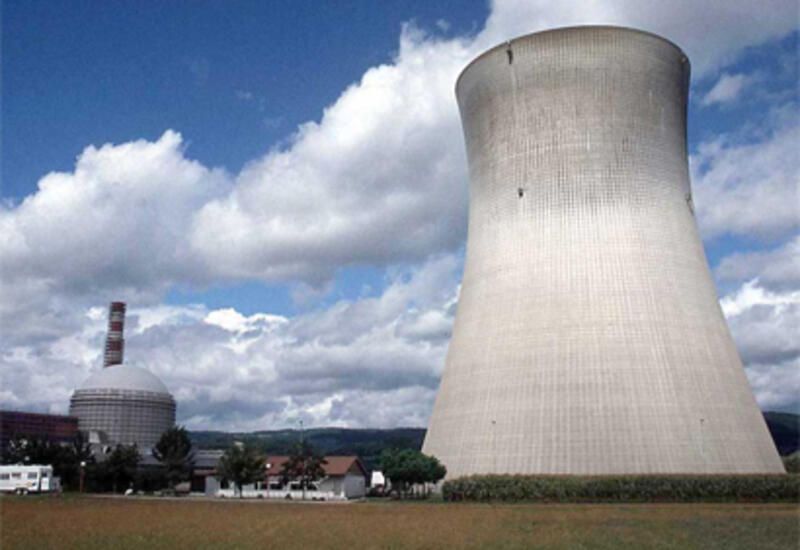
China plans to put into operation seven new nuclear reactors this year, boosting its already substantial fleet of nuclear generators, which is already the largest in the world.

Ground has been broken on two of the seven planned for commissioning before the end of the year.

Another 16 reactors have been approved for construction, and a total of 36 are under construction, Global Times reported, citing official data. There are 60 already operating nuclear reactors in the country with an installed capacity of 125 million kW.

China recently overtook the United States as the country with the biggest nuclear generator fleet in the world, after it added 34 GW in capacity over a decade. This year, the country also plans to launch the first small modular reactor in the world that received the stamp of approval of the International Atomic Energy Agency.

China will use the Linglong One reactors and other small reactors predominantly to meet power demand in places with weaker grids, China’s top nuclear energy official said last year.

Small modular reactors are believed to be simpler and cheaper to build and install. Because of their smaller size, it is possible to install SMRs on sites that are not suitable for bigger reactors. They are also significantly cheaper and faster to build than conventional reactors and can be constructed incrementally to meet the growing energy demand of a site.

Practical implementation of the technology, however, has been troubled. In the United States, NuScale, which was set to build the country’s first SMR, cancelled the project, citing a lack of interest amid rising electricity costs.

Big Tech’s foray into artificial intelligence could improve the economics of small modular reactors and boost the appeal of larger reactors as well, as a source of reliable baseload electricity supply.


China becomes world leader in nuclear power capacity

17 April 2026 20:44 (UTC+04:00)
China becomes world leader in nuclear power capacity

by Alimat Aliyeva

China has reached the world’s leading position in nuclear energy capacity, with a total installed nuclear power capacity of approximately 125 million kW, according to the “China Nuclear Energy Development Report 2026” (the so-called Blue Book), AzerNEWS reports.

The report states that 60 nuclear power units are currently in commercial operation across the country. In addition, 36 reactors are under construction, accounting for more than half of all nuclear reactors being built worldwide. Another 16 units have already received government approval and are awaiting the start of construction.

According to the document, China began construction of two new nuclear power units in 2026 and plans to bring seven reactors online by the end of the year. This reflects one of the fastest nuclear expansion programs in the world.

Interestingly, China’s rapid nuclear growth is closely linked to its broader energy transition strategy. While the country remains the world’s largest consumer of coal, it is also investing heavily in low-carbon energy sources such as nuclear, hydro, and renewables. Nuclear power is seen as a key “bridge technology” that can provide stable electricity while reducing carbon emissions and supporting the massive energy demand from rapidly growing industries such as electric vehicles, artificial intelligence, and data centers.

At the same time, analysts note that China’s scale gives it a unique advantage: it can build reactors faster and at lower cost than many other countries, partly due to standardized designs and strong state coordination. This is helping the country not only expand its domestic energy security but also strengthen its position as a potential exporter of nuclear technology in the future.


China has 'nearly erased' America's lead in AI—and the flow of tech experts moving to the US is slowing to a trickle, Stanford report says

Story by Sasha Rogelberg
1776471712978.png
China has taken a bite out of the U.S.’s lead in artificial intelligence.

The country has nearly closed its gap to the U.S. in AI bot performance, while continuing to best global competition in number of patents, publications, and rollout of robots, according to the Stanford University Institute for Human-Centered Artificial Intelligence (HAI) 2026 AI Index report released this week.

The report found a shrinking gap in Arena scores—a metric indicating relative performances of large language models—between the top AI bots in the U.S. and China. In May 2023, the U.S.’s top model, OpenAI’s GPT-4, led with more than 1,300 Arena points compared with China’s fewer than 1,000. By March 2026, that gulf shrank to just 39 Arena points, with the top U.S. model, Anthropic’s Claude Opus 4.6, leading China’s Dola-Seed 2.0 by just 2.7%.

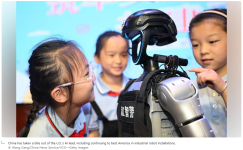
While the U.S. still beats China in the number of top AI models—50 compared with 30—China has more publication citations than the U.S., accounting for 20.6% of AI citations in 2024 compared with the U.S.’s 12.6%. China also has nearly nine times the volume of industrial robot installations, leading the world with more than 295,000, compared with the U.S.’s 34,200.

“For years, the U.S. outpaced all other global regions on AI—in model size, performance, artificial intelligence research, citations, and more,” said Stanford’s summary of the report. “But China emerged as an AI counterweight to the U.S., gradually gaining ground, and this year it appears to have nearly erased any U.S. lead.”

China’s AI surge

Despite fewer investment dollars and wider regulatory constraints, China has changed the narrative of its ability to compete against the U.S. in a broader tech war. Spurred by its 2025 “DeepSeek moment,” China has poured funding into AI startups, with IPOs in Hong Kong last quarter reaching a five-year high of $110 billion across 40 new listings.

China has also quietly invested in its electricity infrastructure, adding more electricity demand than the entire consumption of Germany every year, David Fishman, a China energy analyst with the Lantau Group, previously said in an interview with Fortune. The country’s reserve margin has never dipped below 80%, Fishman said, essentially giving it twice the necessary capacity to grow AI compute.

China’s compute capacity is a far cry from the U.S.’s own ability to sustain and grow AI infrastructure. The American power grid system is crumbling as a result of decades of underinvestment, making it vulnerable to extreme weather and natural disasters, and ultimately creating a bottleneck Goldman Sachs suggests would stymie AI growth in the U.S.

“We’ve actually reduced our exposure to U.S. tech,” Mohit Kumar, Jefferies global macro strategist, told Fortune at the bank’s Asia Forum in Hong Kong last month. “We believe that China is the big winner in this tech war for a number of reasons: valuation, wider adoption of AI, an advantage in power generation.”

American private investment in AI still far exceeds China’s, reaching $285.9 billion in 2025, more than 23 times China’s $12.4 billion. The U.S. funded 1,953 new AI companies last year, more than 10 times any other country, the Stanford report noted.

America’s slowing AI brain gain​

AI’s momentum swing in China’s favor may be contributing to a slowdown in tech talent entering the U.S. The Stanford report found the number of AI scholars moving to the U.S. dropped 89% since 2017, and that decline is happening precipitously, accelerating 80% in the past year alone. At this juncture, more researchers are still entering the U.S. than leaving it.


“The U.S. is home to the most AI researchers and developers of any country by far,” the report summary said. “But the flow of these experts into the country is dramatically slowing.”

Economists have warned a continued loss of expertise would further erode the edge the U.S. has over China in its talent pool. An April 2025 Hoover Institution report conducted in partnership with Stanford HAI found China has built a massive cohort of homegrown talent, with nearly all researchers behind DeepSeek’s five foundational papers educated or trained in China. Though about a quarter of DeekSeek researchers were educated in U.S. institutions, most returned to China, creating a “one-way knowledge transfer” in China’s favor, according to the report.

“These talent patterns represent a fundamental challenge to U.S. technological leadership that export controls and computing investments alone cannot address,” the authors wrote.

This story was originally featured on Fortune.com
 
Chinese technology and American technology are in a competitive relationship.

Arrogant Americans always label American technology as advanced and think that China is catching up to American technology, while ignoring the basic principles.

Take AI as an example; AI development requires a large amount of electricity. China accounts for 32.3% of global electricity generation, exceeding the total generation of countries ranked second to ninth. This electricity generation is the result of long-term construction. As early as 1992, China began selling electricity to foreign countries. The so-called secret construction mentioned by experts is not a fact.

The United States accounts for 14.3% of global electricity generation. On March 11, Elon Musk's artificial intelligence company xAI made significant progress: relevant authorities in Mississippi, USA, approved its permit to build a dedicated power plant, which will provide stable power support for the massive Colossus data center located in the state. This reflects the fact that AI development in the United States lacks sufficient electricity.

The section on the slowdown of the growth of the American artificial intelligence brain merely describes the situation, ignoring the basic facts.

Chinese technicians returning to China causing a slowdown in American AI development, does this prove that Chinese technicians made a huge contribution to American AI? It is normal for Chinese students to return to China. Their departure affecting AI development in the United States indicates that Americans are not as capable at learning as Chinese. If the United States had a large number of technical talents, what difference would it make if Chinese people left? Most foreigners who go to study in China also do not stay in China.

The departure of a large number of talents should be thanked to Trump. The Trump administration tightened visas, canceled visas for Chinese students, and investigated Chinese technical talents working in American companies.

I can only say, Trump is a good friend of China, and Trump made China great again.
 
The American AI is bubble, whereas the Chinese AI is integrating with the manufacturing sectors.
More precisely, behind any industry in the United States is a financial game. So Trump often makes a lot of profit in the U.S. stock market because he can control stock market fluctuations.
1776482276086.png
This is my understanding.
 
More precisely, behind any industry in the United States is a financial game. So Trump often makes a lot of profit in the U.S. stock market because he can control stock market fluctuations.
View attachment 192913
This is my understanding.

Many of their "rare earth companies" are also swindling the investors' money via the IPO.
 
Because every day i dont ask myself what can i do with claude but whst vsn i do with latest xinhao baidu model
 
Last edited:

The world’s first test flight of a water-powered airplane just took off in China

A 16-minute flight in Zhuzhou may reshape the global race to build hydrogen-powered aircraft.​

Published Apr 17, 2026 4:07 PM PDT

China’s state-owned aerospace manufacturer has completed the 36km maiden flight of a hydrogen turboprop airplane.

China’s state-owned aerospace manufacturer has completed the 36km maiden flight of a hydrogen turboprop airplane. (CREDIT: AECC)

An aircraft powered by a turboprop engine took off at Zhuzhou Airport. It flew for 16 minutes and attained an altitude of 300 meters, traveling at a speed of 220 km/h for a distance of 36 km before safely returning to the runway. This may seem like a short flight simply to complete a test, but in fact it is a significant achievement: the first successful flight of a megawatt-class hydrogen-powered turboprop engine.

The unmanned cargo aircraft weighed 7.5 tonnes and was outfitted with the AEP100 engine developed by the Aero Engine Corporation of China (AECC). In the test report, AECC indicated that the engine functioned as expected throughout the entire flight profile and performed steadily.

While many would say the fact that this flight utilized hydrogen was significant, what is even more important is how that hydrogen was used. The AEP100 does not utilize hydrogen fuel cells to power an electric motor. Rather, it burns liquid hydrogen in a turbine cycle, as you would do with conventional jet or turboprop engines that use kerosene for fuel.

With this approach, China has taken a different path than most of the Western aviation industry, where hydrogen has been largely viewed as a source of energy for hydrogen fuel cells.

To view this content we will need your consent to set third party cookies.
For more detailed information, see our cookies page.


The American AI is bubble, whereas the Chinese AI is integrating with the manufacturing sectors.
Just for fun:
To view this content we will need your consent to set third party cookies.
For more detailed information, see our cookies page.
 
Just for fun:
To view this content we will need your consent to set third party cookies.
For more detailed information, see our cookies page.


China has many robot companies, what's the point of showing a no top-tier one?

China's top-tier robot companies are still dominating the global market in both quantity and quality.
 
China has many robot companies, what's the point of showing a no top-tier one?

China's top-tier robot companies are still dominating the global market in both quantity and quality.
lOl, If one athlete died from a heart attack in a marathon race, all athletes in the race may die in it.
 
To view this content we will need your consent to set third party cookies.
For more detailed information, see our cookies page.
 
To view this content we will need your consent to set third party cookies.
For more detailed information, see our cookies page.
 

Users who are viewing this thread

Country Watch Latest

Latest Posts

Back
Top