China Science And Technology News

China reports 99% cost cut on military-grade infrared chips

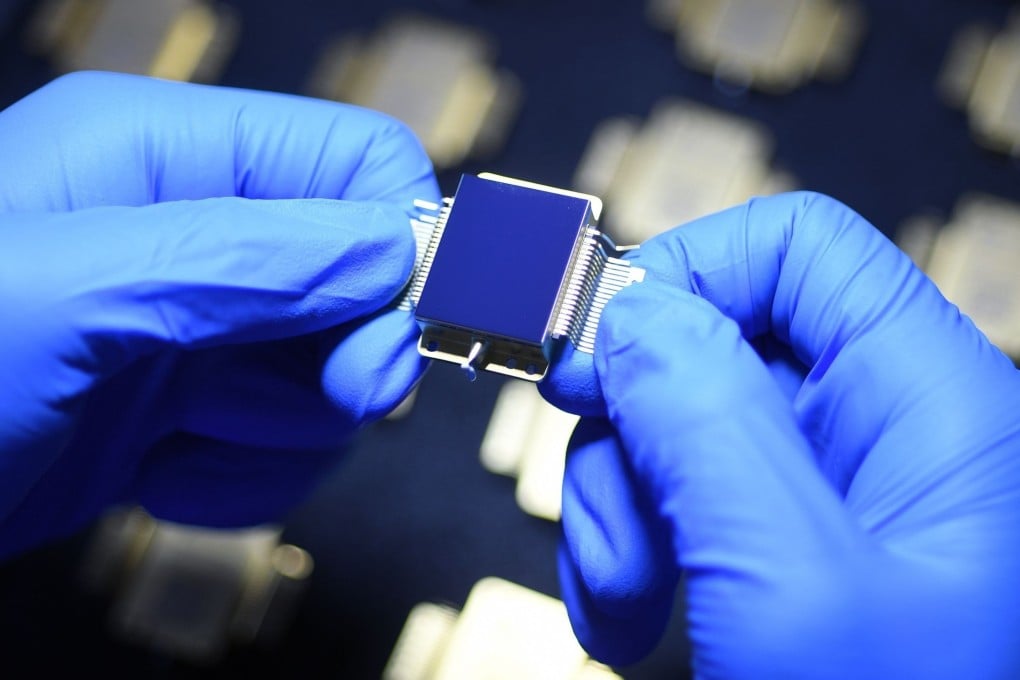
Infrared thermal imaging detector manufactured in China. Photo: Handout

Zhang Tongin Beijing
Published: 10:05am, 7 Apr 2026

A research team at a Chinese university has developed a new way to make high-end infrared chips that could slash their cost dramatically and improve the performance of smartphone cameras and self-driving cars.

The key breakthrough was finding a way to make the chips using conventional manufacturing techniques, rather than the exotic, costly materials that were relied on before.

Mass production is set to begin by the end of the year, according to a press release from Xidian University.

The chips detect short-wave infrared (SWIR), which is invisible to the human eye and can penetrate fog, haze and smoke. Cameras capable of detecting SWIR can take pictures in total darkness and even see through some materials.

This can allow self-driving cars to see through dense fog, let factory scanners spot faulty products through their packaging and stop humanoid robots from bumping into things in the dark.

But this technology carries a prohibitive price tag, which has limited its use to military applications and high-end scientific research – satellite reconnaissance, drone surveillance and missile guidance.

A single chip can cost anywhere from several hundred to several thousand US dollars.
 

China has just achieved an extraordinary feat: a laser with a power output of just 2 watts has transmitted data at a speed of 1 gigabit per second from a distance of 36,705 kilometers to Earth​


Published On: April 7, 2026 at 3:39 AM

china-2-watt-satellite-laser-gigabit-data-earth-1536x864.jpg

A Chinese satellite-to-ground test has shown that a laser using just 2 watts of power can push data at 1 gigabit per second from high orbit to a telescope on Earth. The signal traveled about 22,800 miles (36,705 kilometers), a distance linked to geostationary satellites that seem to stay put over the same region.

So how do you keep a laser link stable after that kind of trip? The big number grabs attention, but the real story is how the team dealt with atmospheric turbulence, the same wobble in air that makes distant objects shimmer on a hot day. If that problem can be managed reliably, low-power space lasers could become a high-capacity backbone for moving data around the planet.

A 2-watt beam that hit gigabit speeds​

The experiment used an optical transmitter rated at 2 watts, roughly the power draw of a small LED bulb. Yet the downlink still reached 1 gigabit per second, which equals 1,000 megabits per second.

The researchers compared that capability to moving an HD video file across the globe in a few seconds. Video sizes vary and real networks add overhead, but the point is that the link hit gigabit-class speed with very little onboard power.

Why the atmosphere is the real enemy​

In space, light travels cleanly, so the beam leaving the satellite is tightly focused. The trouble starts in the last part of the trip, when the laser drops into Earth’s lower atmosphere and hits layers of moving air with different temperatures and densities.

Those shifting layers bend and twist the light, smearing it out and making it flicker. It is like trying to keep a flashlight beam steady while someone shakes your arm and ripples the air in between.

Laser links are also sensitive to thick clouds, fog, and heavy rain. Even when the sky looks clear, turbulence alone can chop a smooth beam into patches that arrive out of shape.

The ground station that made it possible​

This was not a small dish on a roof. The receiver was built around a telescope about 5.9 feet (1.8 meters) across at the Lijiang Observatory in Yunnan, designed to collect as much faint laser light as possible after the long trip from orbit.

On top of that telescope sat an adaptive optics unit with 357 tiny actuators that can subtly reshape a mirror. Think of it as constantly updating “eyeglasses” for the incoming beam, tuned for the air above the site rather than for your eyesight.

The work was described in a peer-reviewed paper led by Wu Jian of the Beijing University of Posts and Telecommunications and Liu Chao of the Institute of Optics and Electronics at the Chinese Academy of Sciences. Their goal was not just to detect the laser, but to keep it stable enough for high-speed data decoding.

Turning a shaky beam into usable data​

Adaptive optics can sharpen a beam, but it cannot always make it perfect, especially when turbulence is strong. That is where mode diversity reception comes in, and it is easier to picture than it sounds.

Instead of betting everything on one “ideal” beam shape, the receiver accepts that the beam may arrive as a messy mix. A device called a multiplane light converter splits the light into eight channels, then the system picks the best three at that moment and combines them for decoding.

In the reported tests, that combination raised the share of clean, usable data from 72 percent to 91.1 percent under the same general conditions. For engineers, that jump can mean fewer dropouts and fewer retransmissions.

How this stacks up against Starlink​

The researchers said the measured 1 gigabit per second is about five times higher than typical throughput from Starlink, which is designed for consumer internet rather than a single lab-grade downlink. In its legal specifications, SpaceX says users typically experience download speeds between 25 and 220 megabits per second, with a majority of users over 100 megabits per second.

It is also not an apples-to-apples contest. Starlink works with thousands of low Earth orbit satellites a few hundred miles up, handing connections from one spacecraft to the next so people can use it from homes, boats, and planes.

A high-orbit laser link is closer to a point-to-point data pipe between a satellite and a major ground hub. That can be very useful for moving big chunks of data, but it is not the same as serving millions of users at once.

Who would actually use a link like this​

This kind of system is built for backbone jobs, not for browsing on a phone. One use is connecting high-orbit satellites to major ground hubs that then redistribute information over fiber networks.

Another is science missions that produce huge volumes of data. Faster downlinks mean less waiting for results, and more time doing the part that matters, the analysis.

The hard limits and the next tests​

Laser links come with sharp tradeoffs. They can carry lots of data in a narrow beam, but they demand precise pointing and expensive ground equipment.

Weather is the biggest wild card. A single station can be blinded by clouds or haze, so any real network would likely need multiple sites and smart routing that can switch paths as skies change.

Outside China, similar ideas are being tested by NASA through Deep Space Optical Communications and the Laser Communications Relay Demonstration, and by the European Space Agency through the European Data Relay System. The next question for all of these efforts is not just speed, but how often the link works when conditions are less than ideal.

The main study has been published in Acta Optica Sinica.


China to Deploy 100,000 Humanoid Robots—Will the West Ever Catch Up?​

April 8, 2026

china-to-deploy-100-000-humanoid-robots-will-the-west-ever-catch-up.webp


China is gearing up to roll out tens of thousands of humanoid robots in its factories, and this robotic wave might just leave Western rivals choking on its dust. So, will Europe and the US ever catch up—or is China simply too far ahead in the automation race?

A technological ecosystem like no other​

Thanks to an exceptionally dense and innovative technological ecosystem, Beijing is about to deploy an impressive number of new humanoid robots in its factories. And let’s not forget: the country already held a dominant position in automation! For nearly a decade now, robotics has played a major role in the Chinese economy—so much so that this technology is now a fully-fledged productive force.

From prototypes to mass production​

Relying on a network that includes 160 cutting-edge manufacturers, supported by 600 suppliers and 10,000 subcontracting companies, China is preparing to shift to large-scale production of humanoid robots. This makes it the first country to enter the era of massive industrialization of this type of machine. It’s safe to say that China has gained a decisive lead in this area.

The industrial strategy dubbed “Made in China 2025” has enabled its manufacturing infrastructure to ramp up humanoid robot production—especially when it comes to turning experimental prototypes into market-ready products with impressive speed. The numbers really do speak for themselves!

According to data from Omdia, global deliveries of these machines reached 13,318 units in 2025, and a whopping 87% of these came from Chinese companies. For comparison, American firms Tesla and Figure AI only managed to deliver about 150 units each. This significant gap can be traced back to radically different approaches on either side of the Pacific.

The race to 100,000 humanoids​

To quote Mao’s famous line, China is aiming for the large-scale manufacture and deployment of between 28,000 and 100,000 humanoid robots by the end of the year. That’s absolutely massive, an industrial feat we’ve simply never seen before—not even in science fiction.

Beyond automation: Robots that do more, with less (Supervision)​

This new wave of automation doesn’t just mean more robots, but smarter ones. These next-generation machines are meant to handle a wider range of tasks, at lower cost, and with greater autonomy—that means less need for human babysitters on the factory floor. These advances are made possible thanks to significant progress in embedded artificial intelligence systems.

While robots have already brought remarkable productivity gains to factories, it’s safe to expect China will continue to widen the gap, pulling decisively ahead of its European and American competitors. The West may have helped invent the robot—but for now, China seems determined to industrialize them by the hundreds of thousands.

 
The Long March 12A, Zhuque-3 and Tianlong-3 are expected to be used to build the country’s massive internet satellite constellations
Texas-based SpaceX achieved the world’s first such landing nearly a decade ago with its Falcon 9 rocket, which remains the only rocket that routinely returns and reuses its booster. Earlier this month, Blue Origin’s New Glenn became the second rocket capable of landing after an orbital mission.

China launches heavyweight rocket to challenge SpaceX’s Falcon 9. It fails

China’s attempt to launch its most powerful privately developed rocket failed on Friday after the vehicle suffered a flight anomaly.

The Tianlong-3 rocket is being developed in hopes of breaking a key bottleneck in the country’s roll-out of internet satellite megaconstellations to compete with SpaceX’s Starlink.
The Tianlong-3, built by Beijing-based start-up Space Pioneer and seen as China’s answer to the US company’s workhorse, the reusable Falcon 9, lifted off from the Jiuquan Satellite Launch Centre in the Gobi Desert at 12.17pm on Friday, according to a social media post by the company.

An anomaly occurred during the flight, resulting in a launch failure. In the post, Space Pioneer apologised to its partners and said the exact cause of the incident was being investigated.
 
To view this content we will need your consent to set third party cookies.
For more detailed information, see our cookies page.
 
Pfizer CEO Warns China Is Fast Catching Up in Biotech Innovation
April 10, 2026

Researcher working with microplate in the laboratory.

By Kritika Agarwal

At a recent Council on Foreign Relations event on United States-China relations, Pfizer CEO Albert Bourla warned that “for the first time in history or in recent decades … U.S. dominance in biotech technology is [being] challenged by a competitor, and that’s China.”

Bourla noted that China has “done all the right things over decades in a long-term strategic plan” that now threatens to leave the United States behind in biomedical innovation. If the United States is to maintain its edge, he argued, the country must strengthen its biotech innovation ecosystem, including by investing in science and university research.

What the United States Did Right in the Past

Bourla reminded the audience that the United States was not always the leader in biotech innovation. In the 1980s and 1990s, he said, “it was all in Europe” – in fact, Pfizer’s main research center back then was in the United Kingdom. Things changed in the early 2000s, Bourla said, when Congress doubled the budget of the National Institutes of Health.

“That created a situation that they were giving a lot of grants to universities” to conduct basic research, he said. Those universities then would “discover something new and interesting” and “spin it off into a separate company” that could raise venture capital to pursue “highly risky opportunities.” Eventually, Bourla noted, big pharmaceutical companies would acquire the smaller companies and close the loop by manufacturing and selling the discoveries. “So, this is what created the whole thing,” he said.

Later in the conversation, Bourla pointed out that the majority of the costs for pharmaceutical companies are in research and development, not manufacturing. “The cost of our medicine, it is the R&D,” he noted.

Bourla added that strong investments in the NIH and university research in the United States were complemented by a “stellar regulator” in the form of the FDA, which could be counted on to make decisions only based on good science, as well as strong intellectual property protections.

“Meteoric Rise” in China’s Scientific Capabilities

In recent years, however, China has strategically built up its biotech innovation ecosystem through long-term national planning, regulatory reform, and enormous investment in university research and talent. For the first time in decades, the United States faces a serious rival in biomedical research – and the gap is narrowing fast.

Bourla noted that China has seen a “meteoric rise of their scientific capabilities.” He pointed out that eight of the top 10 global research institutions on the 2025 Nature Index, which tracks “contributions to research articles published in high-quality natural-science and health-science journals,” are now Chinese. Harvard University, in second place, is the only American institution in the top 10, Bourla noted. (China has invested heavily in their research institutions, which has led to them surging in global rankings; in the United States, meanwhile, investments in basic research at universities have grown more slowly.)

In addition, Bourla said that China has been working to repatriate scientific talent, while U.S. visa policies have made it harder to attract global talent. Similarly, they have worked to improve regulations, which have made it easier for hospitals to run studies or to use AI to design and execute studies, and they have strengthened their IP system.

“So, this is where we need to become better,” Bourla noted, adding: “They operate in a very different league.

How the United States Can Catch Up

Instead of taking actions aimed at slowing down Chinese innovation, the United States needs to step up its investments in innovation, Bourla argued. The U.S. needs to become better if we want to compete, he said.

“Our biggest problem … is that we are watching a superpower developing super scientific capabilities and our whole effort is how to slow them down rather than how to become better than them,” he said. “And the only way to be able not to lose the edge that we have … [is to make] changes inside our American economy ecosystem of biotech, of science, of academia, of pharmaceuticals, of capital markets,” he added.

The United States, Bourla said, must “create the incentives here that will accelerate the investments, which is exactly what [the] Chinese did.” Given recent news that China has officially surpassed the United States in R&D spending, Bourla’s warning that the United States is losing ground in biotech innovation is a stark one.

The United States built the world’s most innovative biomedical sector by treating federal research funding as a down payment on future prosperity. Slowing the pace of investment, now, as Bourla’s comments suggest, risks surrendering that advantage just as global competition is intensifying.


China overtakes U.S. in top-tier research output

April 10, 2026

China has overtaken the United States in the Nature Index Research Leaders list, marking a decisive shift in global scientific dominance.

Once criticized for prioritizing quantity over quality, China now leads in high-impact publications, signaling a transformation in its research capabilities.

This scientific rise aligns with the country’s broader AI-driven innovation strategy, which could shape future global technology governance.

China’s decisive leap in global rankings​

China’s ascent became unmistakable in 2023 when it surpassed the U.S. in the Nature Index Research Leaders list for the first time.

By 2024, its Share reached 32,122 compared to America’s 22,083, multiplying its lead over the U.S. more than fourfold in just a year.

This surge reflects a strategic and systemic push to excel in high-impact science rather than merely increasing publication volume.

From quantity to quality in research​

For years, Western observers dismissed China’s scientific boom as quantity-driven, but 2024 data shows it now leads in top-tier journals.

The Nature Index, tracking 145 elite natural science publications, confirms China’s dominance, a reversal from 2020 when the U.S. led by half.

This change parallels the country’s coordinated innovation policies, including the AI+ Initiative that supports open-source and high-value research.

Strategic alignment with AI ambitions​

China’s research strength is reinforced by its AI+ Initiative, which promotes open-source AI development and state-backed innovation. Premier Li Qiang has emphasized openness as a tool for global influence, with over 90% of Chinese enterprises using open-source technologies.

This integration of scientific output and AI strategy positions China to set global technology standards and leverage its research ecosystem for geopolitical advantage

Future scenarios for global science leadership​

If current trends hold, China could consolidate its lead, setting norms for emerging tech and attracting top talent worldwide.

Alternatively, geopolitical frictions, technology access restrictions, or domestic policy shifts could slow its momentum, allowing rivals to regain ground. Either outcome will influence global innovation flows, regulatory frameworks, and strategic alliances in science and technology.

 
China launches heavyweight rocket to challenge SpaceX’s Falcon 9. It fails

China’s attempt to launch its most powerful privately developed rocket failed on Friday after the vehicle suffered a flight anomaly.

The Tianlong-3 rocket is being developed in hopes of breaking a key bottleneck in the country’s roll-out of internet satellite megaconstellations to compete with SpaceX’s Starlink.
The Tianlong-3, built by Beijing-based start-up Space Pioneer and seen as China’s answer to the US company’s workhorse, the reusable Falcon 9, lifted off from the Jiuquan Satellite Launch Centre in the Gobi Desert at 12.17pm on Friday, according to a social media post by the company.

An anomaly occurred during the flight, resulting in a launch failure. In the post, Space Pioneer apologised to its partners and said the exact cause of the incident was being investigated.

Kinetica 2

To view this content we will need your consent to set third party cookies.
For more detailed information, see our cookies page.
 

lol Why are you moving the goal posts from satellite launchers who can compete with SpaceX…to moon rockets? I mean is this 70,000 kg LEO supposed to be more impressive than the SLS block 1 (95,000 kg LEO) which just launched 4 people around the moon or Starship (250,000kg LEO) that has actually made it into space?
 
Last edited:
To view this content we will need your consent to set third party cookies.
For more detailed information, see our cookies page.
 
lol Why are you moving the goal posts from satellite launchers who can compete with SpaceX…to moon rockets? I mean is this 70,000 kg LEO supposed to be more impressive than the SLS block 1 (95,000 kg LEO) which just laSounched 4 people around the moon or Starship (250,000kg LEO) that has actually made it into space?
So how much did SLS cost ?
And how much risk with that heatshield?
 
So how much did SLS cost ?
And how much risk with that heatshield?

How about the unfinished Long March 10 moon rocket being only slightly more powerful than a SpaceX Falcon Heavy...a rocket first flown way back in 2018.
 

China has erased the US lead in AI, Stanford HAI’s 2026 AI index reveals

BY MIKE WHEATLEY
APRIL 13 2026
Screenshot-from-2026-04-13-09-24-38.png


Stanford University researchers today released their highly anticipated 2026 AI Index Report, revealing a global landscape where artificial intelligence technology is being adopted at record-breaking pace, even as public trust in AI oversight and transparency hits new lows.

The report by the Stanford Institute for Human-Centered Artificial Intelligence, known as Stanford HAI, is now into its ninth year. It’s a comprehensive annual study that tracks the dizzying evolution of the AI industry, documenting a world in which America’s lead over Chinese innovation has all but evaporated, and where the technology is already reshaping global workforces and changing the course of scientific discovery.

The race for global dominance​

One of the most striking – and potentially concerning – takeaways from this year’s report is the way China has reportedly erased the AI performance gap between itself and the U.S. In previous year’s reports, the U.S. had always held a solid lead over Chinese innovators, but now the countries are neck-and-neck, with U.S. and Chinese models constantly trading places at the top of benchmarks ranking AI performance.

Although the U.S. maintains a significant edge in terms of capital, infrastructure buildout and AI chips, China now holds sway in other key areas, such as patents, publications and autonomous robotics development, also known as “physical AI.”

However, the report notes that it’s no longer a two-horse race, with other nations also striving to be seen as “AI superpowers.” These include South Korea, which has emerged as the world’s leader in terms of “innovation density,” filing more patents per capita than any other country.

As these countries all scramble for AI supremacy, the issue of “sovereignty” has become a top policy priority for many governments. A number of European and Central Asian countries have invested significantly in their AI infrastructure over the last year, bringing the number of nations with “state-backed supercomputing clusters” to 44.

However, the push for sovereign AI is not universal. South American and Middle Eastern nations lag far behind. According to Stanford’s researchers, this could lead to a new kind of “digital divide,” where those nations that struggle to shape AI development are less likely to see the economic benefits.

Growing corporate influence as transparency erodes​

More than 90% of all notable AI models are now created by private companies, and Stanford’s researchers warn that this is leading to less transparency than before. Concerns about AI “black boxes” are nothing new, but the most powerful new models being released today are even more mysterious than their predecessors.

According to the report, AI leaders including Google LLC, Anthropic PBC and OpenAI Group PBC have all abandoned the practice of disclosing their latest model’s dataset sizes and training duration. Moreover, 80 of the 95 most notable models launched last year were released without their training code.

Meanwhile, these leading AI companies are now trying to flex their political muscles. AI industry representatives have become pervasive in AI congressional hearings, with their share of witnesses tripling since 2017, while the presence of neutral academics has plummeted.

This shift, perhaps unsurprisingly, comes at a time when public trust in AI hits a new low. The report found that just 31% of U.S. citizens now trust their government to regulate AI properly, which was the lowest score of all surveyed nations except China, where just 27% of people trust their government. EU citizens remain much more confident, with 53% of people voicing confidence.

There are also concerns about hardware supply chains, with almost the entire global AI industry still being dependent on a single chipmaking foundry operated by Taiwan Semiconductor Manufacturing Co. in Taiwan.

Adoption explodes, but friction ignites​

The adoption of generative AI has grown faster than any other technology in history, the report found. Some 53% of the world’s population now uses it regularly, outpacing the pace of innovations such as personal computers, the internet and smartphones. But opinions of the technology are mixed, with 59% saying it provides more benefits than drawbacks, and 52% saying it makes them nervous.

Of concern, perhaps, is that while the U.S. leads in AI development, it only ranks 24th globally in terms of adoption, with just 28.3% of Americans using generative AI regularly. That compares with China, Malaysia, Thailand, Indonesia and Singapore, where more than 80% of people expect AI to have a profound impact on their lives within the next three to five years.

The economic impact of AI is staggering too: Since 2013, corporate investment has increased by 40-fold, while the consumer surplus associated with generative AI in the U.S. rose to $172 billion this year.

Another highlight of the report is the growing “vibe shift” between experts and the general public. While 73% of AI experts are optimistic about the technology’s impact on jobs, just 23% of the public shares that belief. The skepticism of average citizens does seem justified, though, as the report notes that employment among younger workers in “AI-exposed fields” has already started to decline.

In addition, the report touches on the physical costs of AI’s incredible growth. The industry’s energy and water demands are becoming worryingly excessive. For instance, xAI Corp. is estimated to have created more than 72,000 tons of CO2 just to train its latest model, Grok 4. Meanwhile, the amount of water required for GPT-4o inference workloads is said to be enough to sustain 12 million people.

Finally, there are concerns about AI’s impact on science, particularly in terms of its scope. Though AI tools have helped to make individual scientists three times more productive, this appears to be happening at the expense of the scope of AI research, which increasingly favors data-rich topics, meaning less diversity than before.


Users who are viewing this thread

Pakistan Defence Latest

Back
Top