ChillVein
Registered Member

Recently I had this vujà dé—the opposite of déjà vu—where familiar sights suddenly offer a new perspective.
We’ve seen Jensen Huang and Lisa Su all over the media. But when you zoom out to look at other critical chip companies in the world, a pattern emerges: these firms are helmed by people of Chinese ethnicity. Collectively, they manage companies worth $8.5 trillion in market cap.
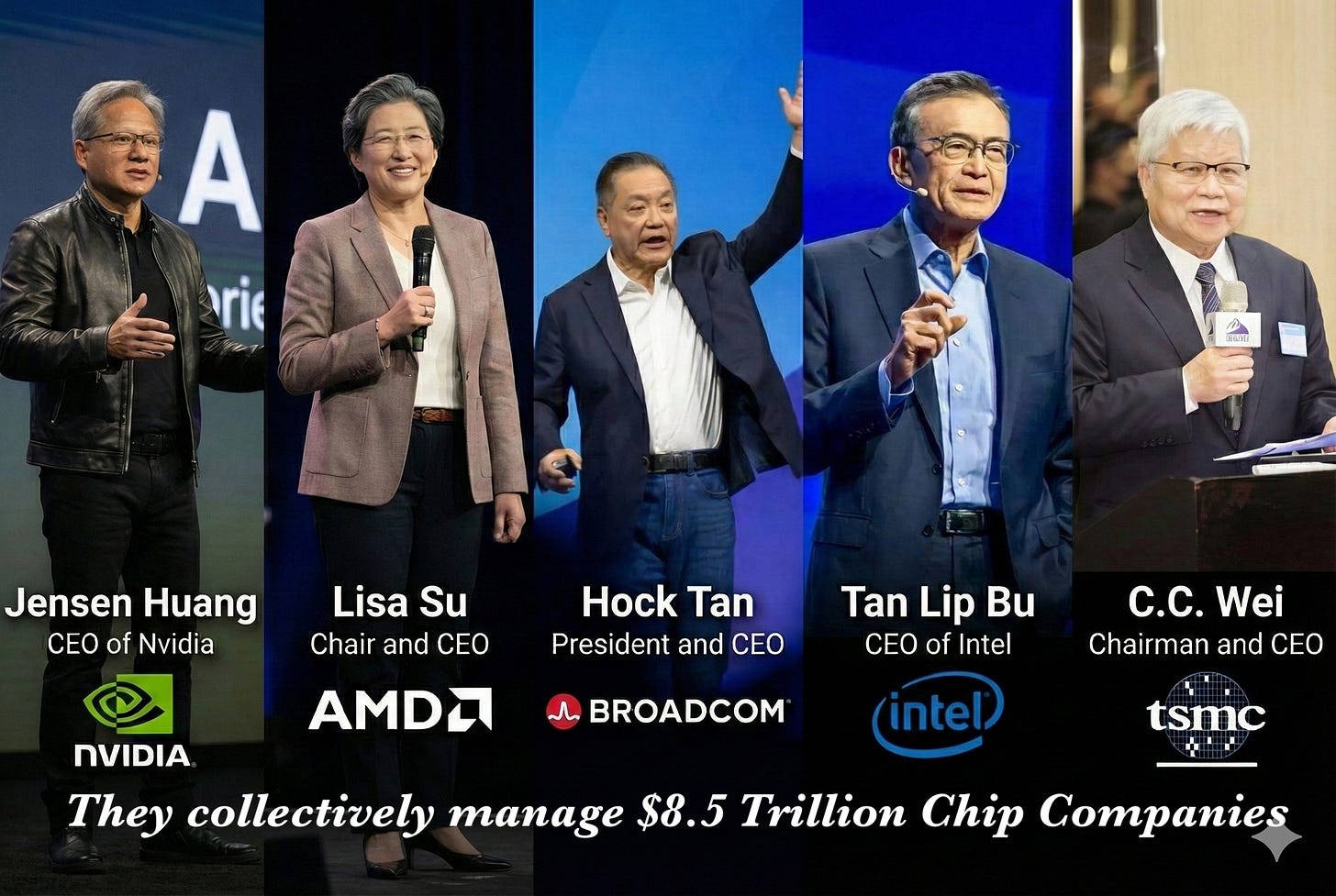
Though of Chinese ethnicity, they’re not from China. In fact, Jensen, Lisa, Hock, and Lip-Bu are American citizens. Wei is Taiwanese. Jensen and Lisa were born in Taiwan, while Hock and Lip-Bu were born in Malaysia.
So no, this isn’t some claim that “the Chinese are controlling the chip industry.” Far from it—their allegiance is with the U.S.
I just find it more than coincidence that there’s such clear overrepresentation of ethnic Chinese at the helm of these companies.
But Asian representation at these four U.S. companies (excluding TSMC, which is Taiwanese) is way above average, according to DiversIQ:
First, Asians are well-trained in STEM, and many graduates have flowed into these technical jobs. The talent pool is there.
Second, TSMC is a Taiwanese company with many ethnic Chinese employees. As the most important foundry manufacturing what the Americans design, it might be easier to build trust and deep business relationships if American companies’ top echelons are also ethnic Chinese.
The differences are in the details. So let’s look at the story of each of these five ethnic Chinese chip bosses.
We’ve seen Jensen Huang and Lisa Su all over the media. But when you zoom out to look at other critical chip companies in the world, a pattern emerges: these firms are helmed by people of Chinese ethnicity. Collectively, they manage companies worth $8.5 trillion in market cap.
- Jensen Huang, Nvidia (market cap: $4.569T)
- Lisa Su, AMD ($422.76B)
- Hock Eng Tan, Broadcom ($1.517T)
- Lip-Bu Tan, Intel ($214.98B)
- C.C. Wei, TSMC ($1.736T)
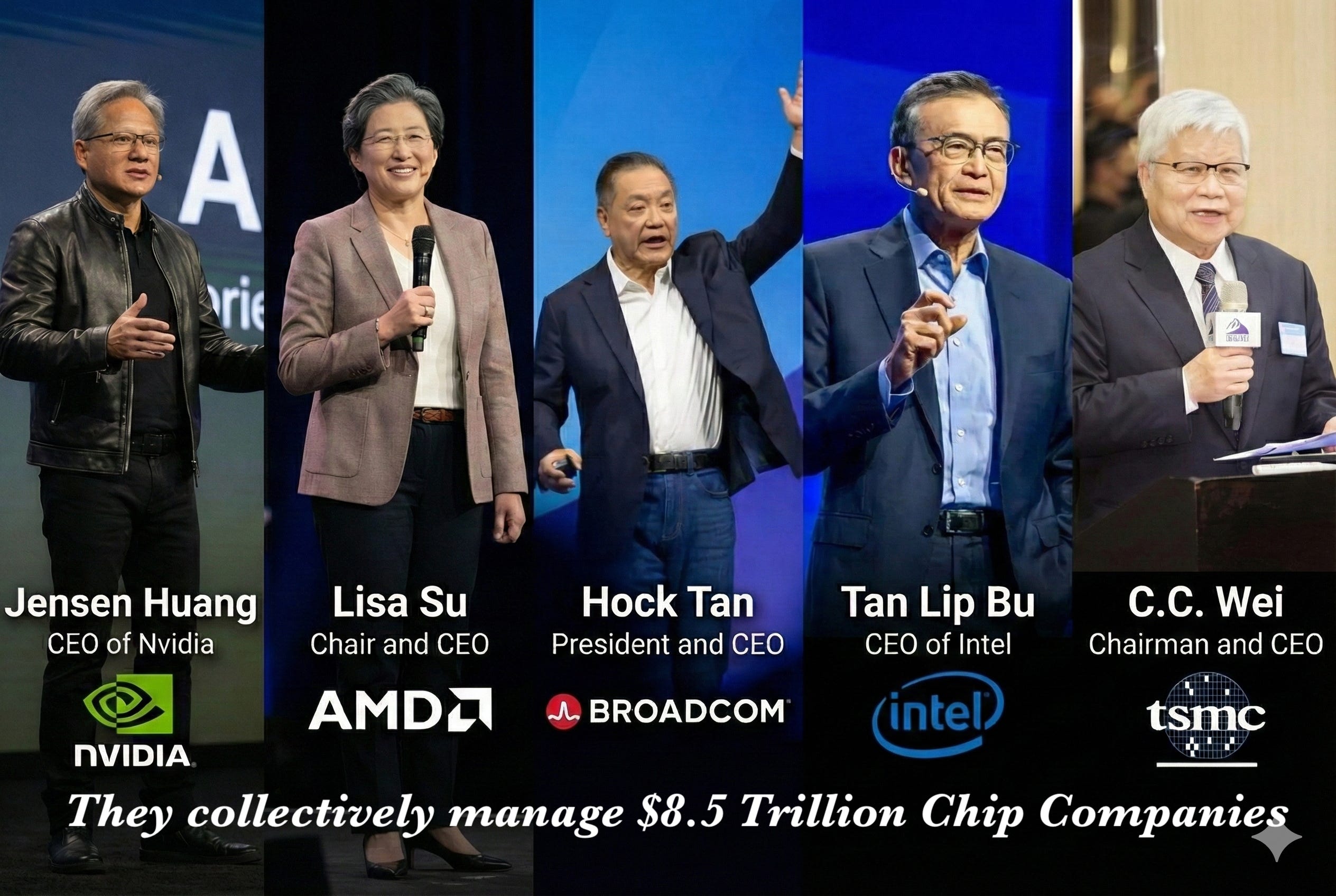
Though of Chinese ethnicity, they’re not from China. In fact, Jensen, Lisa, Hock, and Lip-Bu are American citizens. Wei is Taiwanese. Jensen and Lisa were born in Taiwan, while Hock and Lip-Bu were born in Malaysia.
So no, this isn’t some claim that “the Chinese are controlling the chip industry.” Far from it—their allegiance is with the U.S.
I just find it more than coincidence that there’s such clear overrepresentation of ethnic Chinese at the helm of these companies.
Why So Many Asians?
One factor: these companies have an overwhelming number of Asians (not necessarily ethnic Chinese) compared to a typical U.S. company. About 6.5% of the total U.S. workforce is Asian, and in tech, that figure rises to 18.1% (2022, Equal Employment Opportunity Commission).But Asian representation at these four U.S. companies (excluding TSMC, which is Taiwanese) is way above average, according to DiversIQ:
- NVIDIA: ~52.4% Asian
- AMD: ~48.3% Asian
- Broadcom: ~42.3% Asian
- Intel: ~37% Asian
First, Asians are well-trained in STEM, and many graduates have flowed into these technical jobs. The talent pool is there.
Second, TSMC is a Taiwanese company with many ethnic Chinese employees. As the most important foundry manufacturing what the Americans design, it might be easier to build trust and deep business relationships if American companies’ top echelons are also ethnic Chinese.
The differences are in the details. So let’s look at the story of each of these five ethnic Chinese chip bosses.




 FE) 's Chief International Commercial Officer, Alexandre de Germay, said China has moved ahead of Europe in pharmaceutical innovation and drug development.