China Science And Technology News

Recently I had this vujà dé—the opposite of déjà vu—where familiar sights suddenly offer a new perspective.

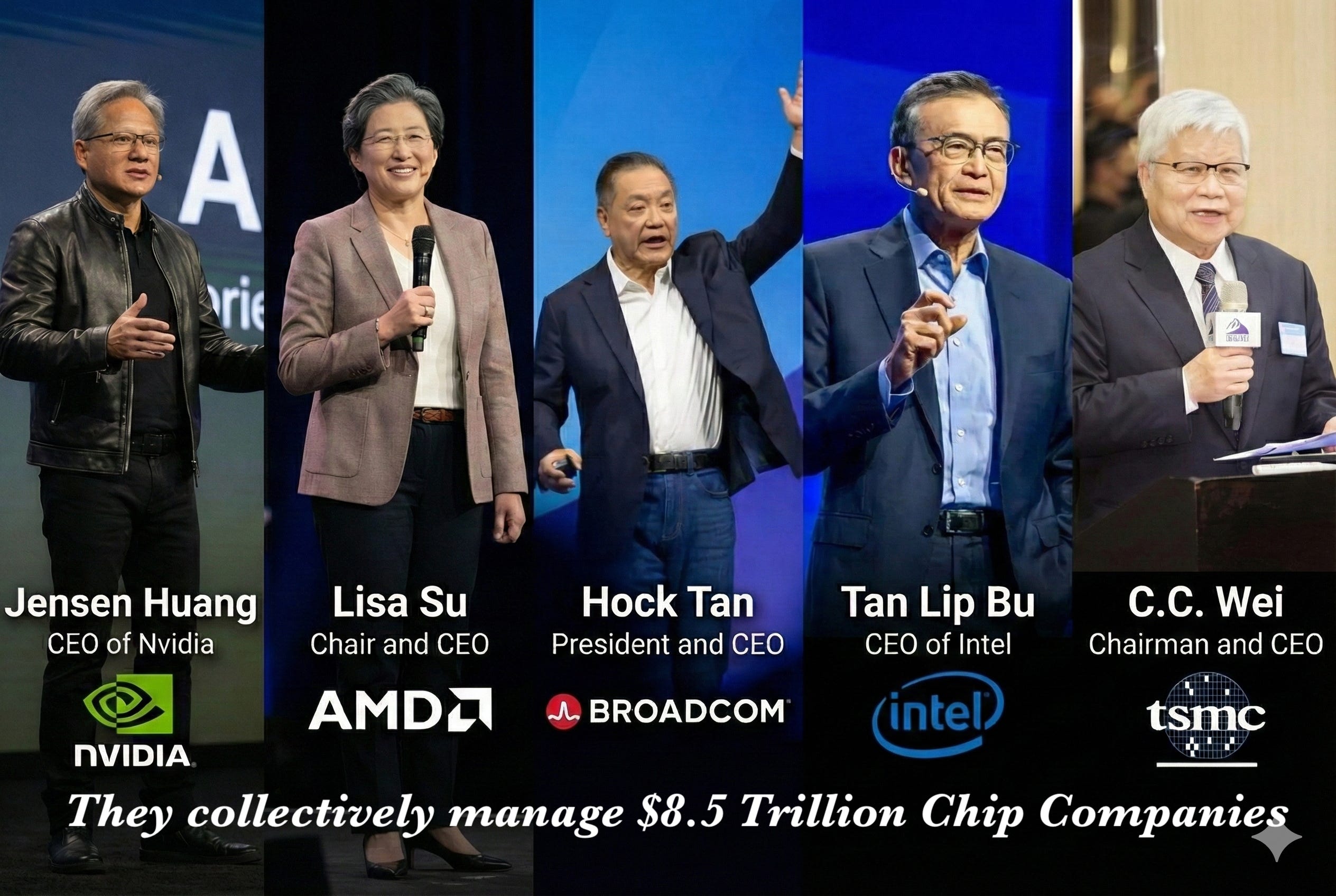
We’ve seen Jensen Huang and Lisa Su all over the media. But when you zoom out to look at other critical chip companies in the world, a pattern emerges: these firms are helmed by people of Chinese ethnicity. Collectively, they manage companies worth $8.5 trillion in market cap.
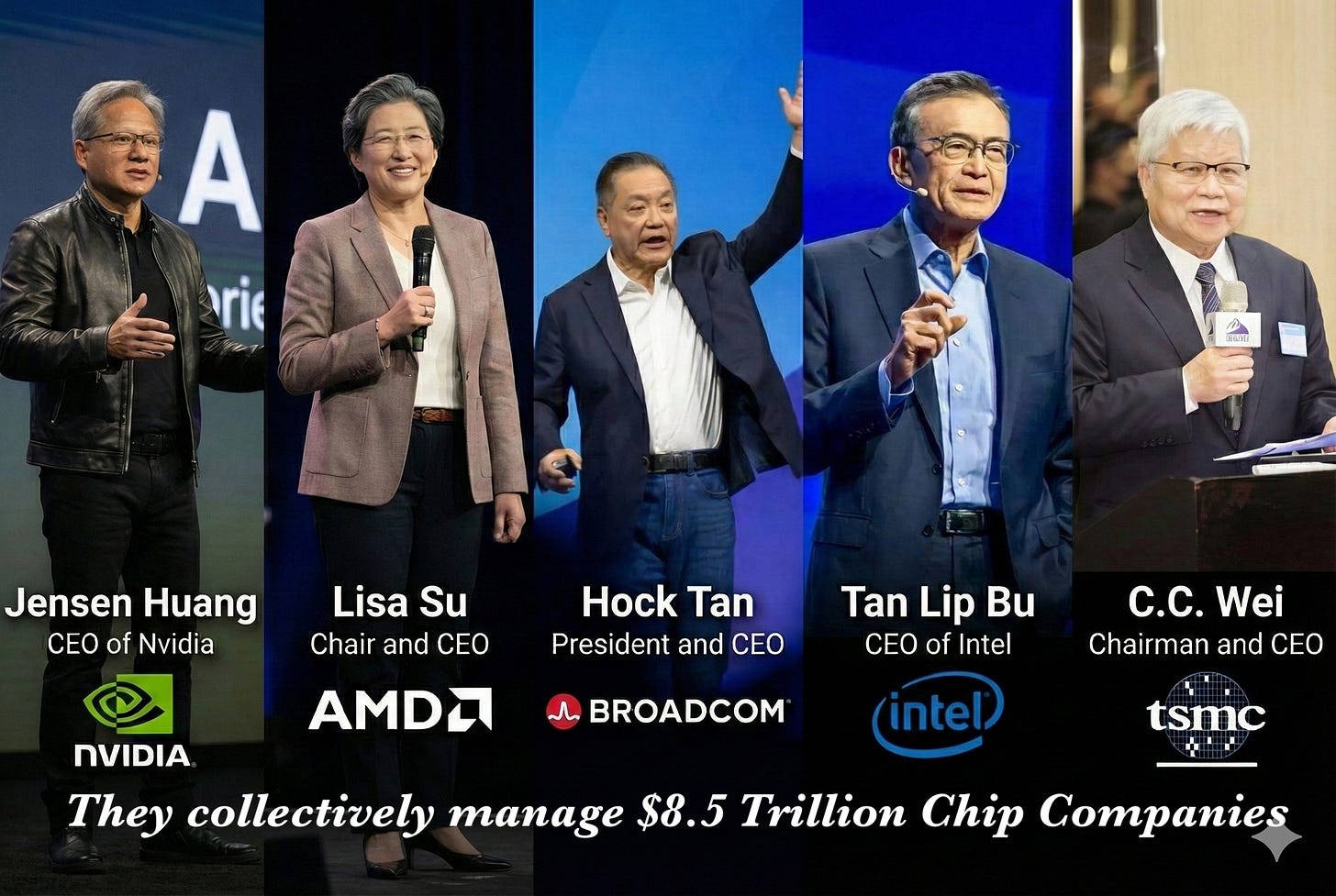
  1. Jensen Huang, Nvidia (market cap: $4.569T)
  2. Lisa Su, AMD ($422.76B)
  3. Hock Eng Tan, Broadcom ($1.517T)
  4. Lip-Bu Tan, Intel ($214.98B)
  5. C.C. Wei, TSMC ($1.736T)


Though of Chinese ethnicity, they’re not from China. In fact, Jensen, Lisa, Hock, and Lip-Bu are American citizens. Wei is Taiwanese. Jensen and Lisa were born in Taiwan, while Hock and Lip-Bu were born in Malaysia.

So no, this isn’t some claim that “the Chinese are controlling the chip industry.” Far from it—their allegiance is with the U.S.

I just find it more than coincidence that there’s such clear overrepresentation of ethnic Chinese at the helm of these companies.

Why So Many Asians?​

One factor: these companies have an overwhelming number of Asians (not necessarily ethnic Chinese) compared to a typical U.S. company. About 6.5% of the total U.S. workforce is Asian, and in tech, that figure rises to 18.1% (2022, Equal Employment Opportunity Commission).

But Asian representation at these four U.S. companies (excluding TSMC, which is Taiwanese) is way above average, according to DiversIQ:

  • NVIDIA: ~52.4% Asian
  • AMD: ~48.3% Asian
  • Broadcom: ~42.3% Asian
  • Intel: ~37% Asian
So it’s more likely an Asian would get promoted from within. The next question: why is there more Asian representation in these companies?

First, Asians are well-trained in STEM, and many graduates have flowed into these technical jobs. The talent pool is there.

Second, TSMC is a Taiwanese company with many ethnic Chinese employees. As the most important foundry manufacturing what the Americans design, it might be easier to build trust and deep business relationships if American companies’ top echelons are also ethnic Chinese.

The differences are in the details. So let’s look at the story of each of these five ethnic Chinese chip bosses.
 
Marvell technology, lam research, Kingston technology and many more are founded by ethnic Chinese.
 

China fires up world’s biggest superconducting magnet for nuclear fusion project​

The device, part of the CRAFT artificial sun reactor, sets new international benchmark in push for clean energy​

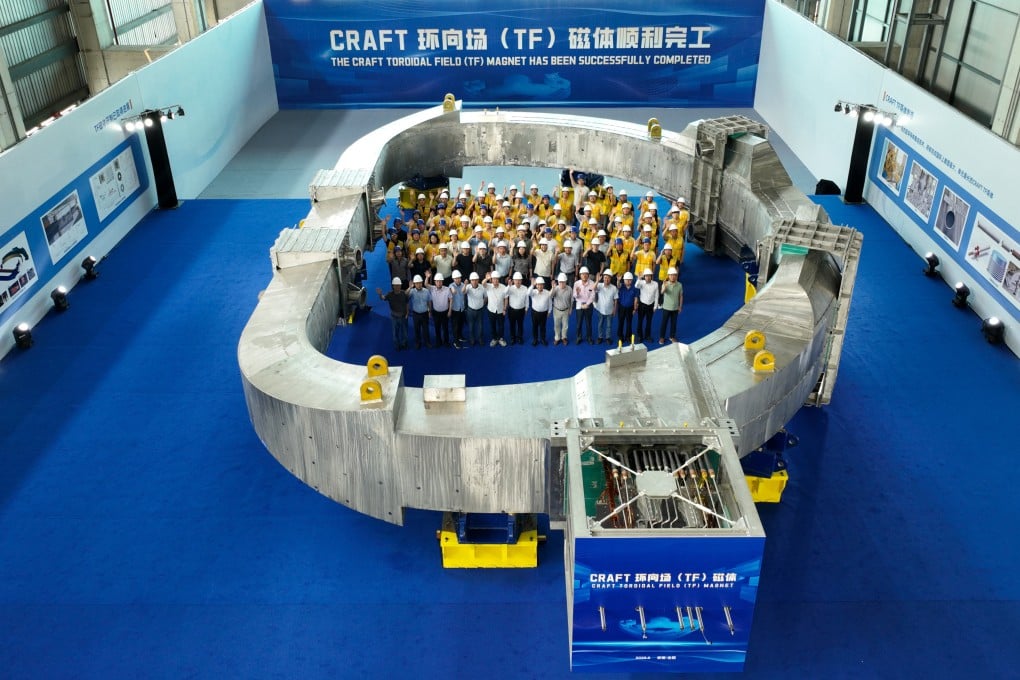
The team behind the superconducting magnet project celebrate the success of their tests on Saturday, capping years of work. Photo: Xinhua

Zhang Tongin Beijing
Published: 6:00pm, 28 Jun 2026

The world’s biggest superconducting magnet for a nuclear fusion reactor has passed final tests as part of China’s CRAFT “artificial sun” project, eclipsing international performance benchmarks.

The assembly comprises two coils: a toroidal-field magnet that acts as a magnetic cage, and a central solenoid that serves as the igniter.

The results, achieved by researchers with the Institute of Plasma Physics, Chinese Academy of Sciences, clear a major engineering hurdle on the path to confining a plasma hotter than the sun’s core, state news agency Xinhua reported on Saturday.

The project – the Comprehensive Research Facility for Fusion Technology – aims to create a miniature sun at over 100 million degrees Celsius (over 180 million Fahrenheit) and trap it inside a doughnut-shaped metal cage to generate electricity.

The magnetic cage, known as the CRAFT toroidal field coil, is a core component of the reactor.

It uses a strong magnetic field to prevent the container of the miniature sun from melting as the plasma inside reaches hundreds of millions of degrees.

 
China takes US crown for world’s fastest supercomputer


China has displaced the United States on an influential ranking of the world’s fastest supercomputers, underscoring Beijing’s growing capability to compete with the world’s leading superpower in cutting-edge technology.

China’s LineShine is the most powerful system on the planet, overtaking the US-based El Capitan, according to the biannual ranking announced in Hamburg, Germany, on Tuesday.

culations per second – a 20 percent lead over El Capitan, according to the latest TOP500 list.

LineShine’s position marks the first time a Chinese system has topped the list since Sunway TaihuLight did so in 2017.

El Capitan, based at Lawrence Livermore National Laboratory in Livermore, California, had ranked as the top-performing system since November 2024.

Frontier at the Oak Ridge National Laboratory in Oak Ridge, Tennessee, ranked third, followed by Aurora at the Argonne National Laboratory in Downers Grove Township, Illinois, and Jupiter at the Julich Supercomputing Centre in Julich, Germany.

Other countries represented in the top 20 included the United Kingdom, Japan, South Korea, Italy, the Netherlands and Switzerland.

Jack Dongarra, an emeritus professor of computer science at the University of Tennessee who is one of the organisers of the TOP500 list, said LineShine’s performance showed China to be capable of holding its own in advanced computing despite US export restrictions on the most advanced chips.

“Export controls may slow China’s access to certain advanced components, but they also provide a strong incentive to develop domestic alternatives,” Dongarra told Al Jazeera, adding that he was “not entirely surprised” that China had taken the lead.

“LineShine suggests that China has responded through large-scale investment and hardware-software codesign,” Dongarra said.

“In the longer term, controls may both constrain China and accelerate its efforts to become technologically self-sufficient.”

Chinese supercomputer powered by homegrown chips tops US models in global ranking
cnn
 

China surpassing Europe in Drug Innovation and Development, Pfizer Inc. (PFE) Executive says​

Fatima Gulzar
Mon, June 29, 2026 at 3:58 AM GMT

On June 23, Reuters reported that Pfizer Inc. (NYSE:PFE) 's Chief International Commercial Officer, Alexandre de Germay, said China has moved ahead of Europe in pharmaceutical innovation and drug development.
De Germay commented that China now has "40% of all clinical studies in oncology" globally. He pointed out that the biopharma firm believes clinical development can move three times faster in China and at roughly half the cost compared with Europe.

De Germay said that back in 2024, China produced 28 innovative medicines, while Europe produced 18. "We have to compete with the U.S., but we also have to compete with China," he said, and "the threat of China is reality."


China’s first AI-powered cancer vaccine production line set to launch in Beijing​

Likang Life Sciences says it has developed a personalised vaccine using advanced tech to identify tumour-specific mutations​


The project reflects a global shift in the pharmaceutical sector towards harnessing artificial intelligence. Photo: Shutterstock


Julie Zhang
Published: 11:00am, 29 Jun 2026

China has broken ground on what developers say is the country’s first production line for AI-assisted personalised tumour vaccines, raising hopes for millions of new cancer patients every year – a disease that ranks as the nation’s second-leading cause of death.

By October, Beijing-based Likang Life Sciences is expected to complete a new drug research and manufacturing centre in the Beijing Economic and Technological Development Zone, with a total investment of about 110 million yuan (US$16.1 million), according to the district government.
The facility will house cell therapy research laboratories together with a production line of the company’s flagship product, LK101, a personalised cancer vaccine that analyses each patient’s tumour DNA to pinpoint the specific genetic mutations driving the disease. With AI, the company said the procedure could be completed in a day.

The project reflects a global shift in the pharmaceutical sector towards harnessing artificial intelligence. The technology was widely used in drug discovery and clinical trials, as well as areas such as data analysis, data monitoring and medical writing, said Grace Wang, a partner based in L.E.K. Consulting’s Shanghai office, in a video posted in early June.

The global AI healthcare market could exceed US$1 trillion by 2035, according to Bank of America, highlighting the commercial potential of such technologies.

“AI offers a compelling solution by automating manual workflows, improving diagnostic accuracy and enabling personalised treatment strategies,” said Alec Stranahan, senior research analyst of small- and mid-cap biotechnology at Bank of America, in a note on January 21. “Current adoption, however, is still in its early stages.”


Chinese tech makes desalinating seawater cheaper than producing bottled water

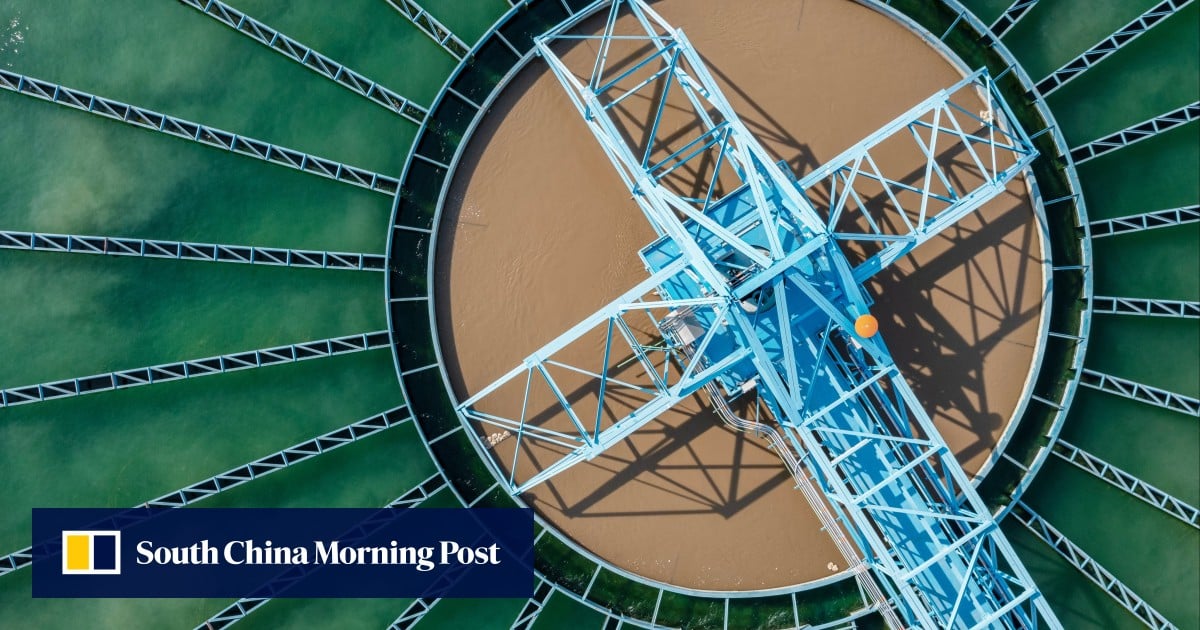
Solar-powered innovation has shown year-long stability with zero utility energy costs, thanks to a new type of photothermal material​


The researchers developed a method to weave nanoparticles into a three-dimensional photothermal evaporation material, significantly boosting the efficiency of converting solar energy to drive desalination. Photo: Shutterstock


Dannie Pengin Beijing
Published: 1:00pm, 29 Jun 2026Updated: 3:20pm, 29 Jun 2026

Desalination has always been an energy-hungry way of turning salt water into fresh water, making it largely the preserve of wealthy countries with abundant fossil fuel reserves.

Yet, an outdoor demonstration prototype in China has managed to exhibit year-long stability with zero utility energy costs, thanks to a new type of photothermal material.

The researchers developed an innovative method to weave nanoparticles into a three-dimensional photothermal evaporation material, significantly boosting the efficiency of converting solar energy to drive desalination.

Experiments showed that the structure achieved a solar absorption rate of as much as 90.2 per cent, while cutting the energy needed to evaporate the same volume of seawater by 45.7 per cent.

At a small trial site, the device was successfully used for desalination, helping to irrigate 5 square metres (nearly 54 square feet) of farmland for a full growth cycle using only natural sunlight and requiring no external power grid infrastructure.

Based on a projected two years of operation, the team noted that the cost of producing water would fall below that of bottled water and that the economic advantage “would become even more pronounced if the system were scaled up or used over the long term”.


Nvidia’s AI chip sales in China stall, as local chipmakers like Huawei take the lead

Jun 28, 2026, 9:39 PM
BY ASSOCIATED PRESS

HONG KONG (AP) — In the race between the U.S. and China to develop artificial intelligence, the battle over hardware and computing power is heating up as Chinese companies like Huawei overtake global industry leaders like Nvidia in their home market.

Jensen Huang, the CEO of computer chip giant Nvidia, was mobbed by onlookers as he hit the streets for the “zhajiangmian” noodles while visiting Beijing during U.S. President Donald Trump’s May summit with Chinese leader Xi Jinping. But his celebrity status has not translated into success in selling Nvidia’s advanced chips in China.


Chinese AI’s Sputnik Moment

china-chip.jpg
(hh5800/iStock/Getty Images)
By Peter Yared
June 29, 2026 6:30 AM
This time, the great leap forward had Washington’s help.
It’s not just that U.S. export controls have failed to stop China’s ascent in AI. Our restrictions have accelerated China’s rise by compelling the country’s entire developer ecosystem to rely on domestically produced chips — thus forcing its chipmakers to rise to the challenge.


China's tech rise reshapes the global space race

July 1 2026

China is pulling ahead in global research rankings and expanding its ambitions in space. With growing technological leadership, Beijing is positioning itself as a rival to the United States on a global scale.

55844094_1004.webp

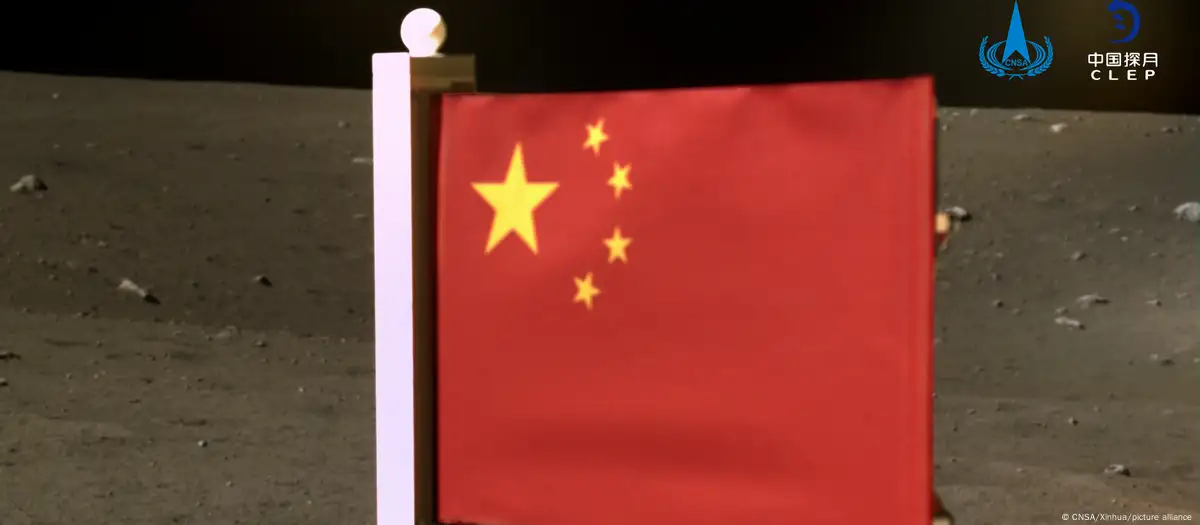
China plans to establish a permanent lunar base as a stepping stone for future missions into deep spaceImage: CNSA/Xinhua/picture alliance

Lai Kai-ying, the first female Chinese civilian to reach outer space, is currently on board China's crewed Tiangong space station, where she orbits the Earth 16 times a day, alongside two other Chinese astronauts.

Tiangong is a unique microgravity laboratory for scientific experiments, designed to provide new insights into humanity's future.

Today, aviation and spaceflight are once again shaped by ideological rivalry, echoing the mid-20th-century space race between the United States and the Soviet Union. In the 21st century, however, Washington's primary competitor is no longer Moscow, but Beijing.

US space agency NASA intends to retire its landmark research outpost, the International Space Station (ISS), by 2032. When that happens, China will be the only country operating a permanently crewed orbital station.

China dominates cutting-edge research​

Space travel is just one of many fields worldwide in which China now holds a technological lead, according to Nature.

The journal's latest index of research leaders, which reveals the leading institutions and countries/territories, puts China in first place — well ahead of the United States and Germany.

Nine of the Top 10 research institutions were from China, with the US' Harvard ranking third. Germany's Max Planck Society (MPG), Germany's preeminent research organization, ranked in 13th place.

"It is now almost irrelevant which global rankings you consult. Universities and research institutions in China lead in many fields," observed Christina Beck, spokesperson for theMPG.

The Nature Index also shows that Chinese research institutions are the clear leaders in biology, chemistry and physics, as well as in other applied sciences. Only in health sciences and the social sciences have they been surpassed by US institutions.

Strong investment underpins success​

China's rise has taken place steadily over the past two decades, said Richard Heidler, director of information management at the German Research Foundation (DFG), Germany's largest research funding organization.

"While in the early 2000s it was primarily the volume of publications that increased significantly, bibliometric analyses over the past decade have also shown growing gains in impact-related indicators, such as the share and number of highly cited publications," Heidler said.

In other words, China is not only publishing more, but is becoming increasingly better and more visible, which the MPG's Beck said is based on a long-term development process.

"Key to this has been sustained, systematic funding for scientific institutions and universities in China sustained over many years — particularly through the international training of researchers and through substantial investments in large-scale research infrastructure," he added.

China's leaders have long recognized that technology is the key to its success. The country's 15th Five-Year Plan, its economic and political road map for 2026–2030, calls for a continued expansion of its innovation capabilities.

Central to Beijing's strategy is the development of "new productive forces" — innovation-driven growth engines based on advanced technologies and industrial transformation.

The plan highlights a range of key future industries, including artificial intelligence, quantum technology, nuclear fusion, biotechnology and life sciences, brain-computer interfaces as well as deep-sea and space exploration.

Ideology shapes research cooperation​

China and the US are locked in an intense competition over next-generation lunar missions. The push comes as China pledges to have a crewed mission ready by 2030.

Whether NASA can successfully carry out its Artemis mission to land near the lunar south pole in 2028 remains to be seen. The lunar lander programs and next-generation spacesuits are already behind schedule.

China also plans to establish a permanent lunar base as a stepping stone for future missions into deep space.

It has already taken a major step toward this goal as the only country to retrieve rock fragments from the moon's far side. The samples are now being studied for their potential use in building the planned settlement.

'Political constraints'​

NASA is prohibited from cooperating with China's space agency under the 2011 Wolf Amendment, a sign of the intesity of geopolitical and ideological rivalry between the two powers.

The European Space Agency (ESA) has likewise scaled back cooperation with Beijing, even though ESA astronauts have had to learn Chinese vocabulary, and have carried out joint exercises with Chinese taikonauts — the name for Chinese astronauts.

Germany's Federal Ministry of Research, Technology and Space has also drawn clear boundaries, particularly in sensitive areas with potential military applications.

"This applies, for example, to cooperation on topics that could be used for both civil or military purposes (dual-use) or for cooperation related to artificial intelligence which could be misused for surveillance purposes and human rights violations," according to the ministry's website.

European states increasingly consider China to be a systemic rival. Risks and benefits in scientific cooperation must therefore be carefully weighed.

"We want to maintain cooperation in research fields where there are no dual-use concerns," said Beck.

The FAST radio telescope in China

China's FAST radio telescope took five years to completeImage: Ou Dongqu/Xinhua News Agency/picture alliance

One example is the "Five-hundred-meter Aperture Spherical Radio Telescope" (FAST) in China's southwestern province of Guizhou, which has a diameter of 500 meters — roughly the length of five football fields.

"This collaboration gives us access to unique infrastructure," Beck noted.

Ingrid Krüssmann from the Sino-German Center for Research Promotion (SGC) argues along similar lines.

"The DFG aims to create as much certainty as possible for researchers in Germany, so that excellent collaborative projects with Chinese partners can, in principle, continue to be possible," she said.

Cooperation with caution​

Beck noted that German research organizations face mounting challenges in cooperation with Chinese partners due to political developments in China, rising geopolitical tensions and, above all, the close intertwining of civilian and military research.

The Max Planck Society aims to shape its collaboration with partners in China "in an informed, responsible and strategic manner," she added.

Meanwhile, China continues to pursue its foreign policy agenda through technological means.

After Hong Kong native Lai Kai‑ying completes her mission on board the Tiangong space station, China is set to host its first foreign astronaut, who is expected to spend a short stay in orbit from October.

Two Pakistani candidates, one of whom will be selected for the flight, are already in training for the mission.

The move highlights how geopolitical alliances are increasingly extending into space, with China involving key partner countries in its expanding space program.


China’s EV fleet is world’s most underestimated AI asset

What began as China’s energy security strategy is quietly transforming tech-rich cars into the backbone of its AI ambitions
July 2, 2026

Chinese-EVs-BYD.jpg
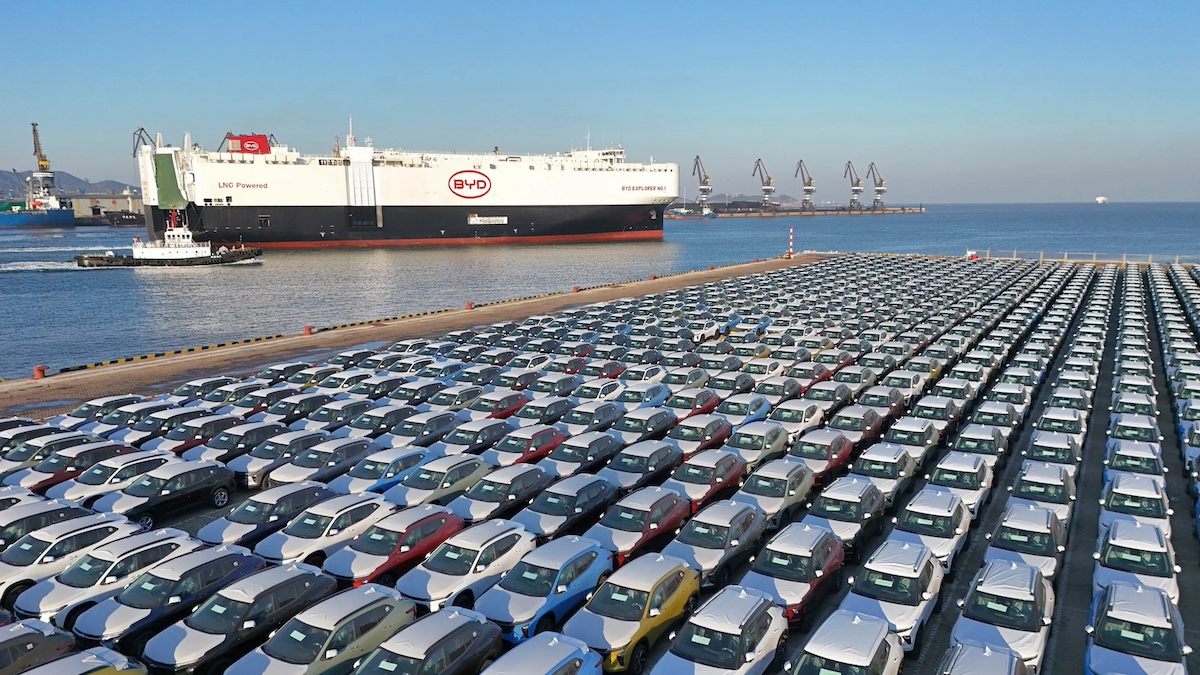
EVs are the front edge of China's AI revolution. Image: X Screengrab

History has a habit of concealing its most consequential turning points inside the mundane. The invention of the shipping container did not announce itself as a revolution in global trade. The rise of the mobile phone was initially dismissed as an expensive novelty for businessmen.

Today, something similarly quiet and similarly transformative is unfolding across the parking lots, highways, and residential streets of China’s sprawling cities. Forty million EVs, each sitting idle for roughly 23 hours a day, are poised to become something the world has not yet named: the most distributed artificial intelligence infrastructure ever assembled.

The observation did not come from a futurist or a technology journalist. It came from Robin Zeng, the founder and chairman of CATL, the world’s largest EV battery maker, speaking at the World Economic Forum’s Summer Davos in Dalian last week.

China’s vast EV fleet, Zeng argued, could be reimagined as distributed token factories: computing infrastructure that uses onboard batteries and AI chips to produce the outputs feeding large language models at scale.

It was arguably the week’s most underreported remark. It deserves to be the most studied.

Misread story from the start

For the better part of a decade, the global conversation about China’s EV industry has been dominated by a single, reductive framing of it as a trade threat. Western governments have debated tariffs, imposed import duties and commissioned studies on the industrial displacement that Chinese EVs might cause.

The European Union levied additional duties. The United States raised its own. The underlying assumption, almost universally shared, was that China’s EV success was a manufacturing story with trade consequences.

A dispassionate reading of the evidence, however, suggests this framing has always been incomplete. China’s drive to electrify its transport system was not, at its core, a plan to conquer foreign car markets. Rather, it was a national energy security calculation.

A country that imports the majority of its crude oil and has watched energy supply chains weaponized amid geopolitical rivalry wanted a transport fleet that ran on electricity it could generate domestically.

What that imperative produced, as an elegant byproduct, was the world’s largest networked fleet of mobile energy storage assets: 40 million batteries on wheels, all connected to an increasingly intelligent charging infrastructure.


Clean energy sectors drove more than a third of China’s GDP growth in 2025. The “new three,” meaning EVs, batteries and solar panels, generated two-thirds of the value added across the entire clean energy sector.

Battery exports grew 41% year-on-year. These numbers have been reported widely, but almost exclusively through a trade-and-competition lens. What has been missed is the deeper infrastructure logic that the fleet represents.

Platform as much as product

Modern electric vehicles in China, whether built by BYD, Nio, Xpeng or dozens of other domestic manufacturers, carry substantial onboard processing capability. Their chips handle navigation, driver assistance, over-the-air software updates, and increasingly sophisticated AI functions.

For roughly 23 hours every day, that capability sits dormant. Zeng’s insight is that this dormant compute capacity, aggregated across tens of millions of vehicles simultaneously, constitutes a distributed AI processing layer that already exists, costs nothing additional to build and requires no new land, no new permits and no new centralized data centers to operate.

The technical mechanism that makes this vision coherent is vehicle-to-grid technology, or V2G, which allows parked EVs to discharge stored electricity back into the grid during peak demand. China has been building the regulatory and physical architecture for V2G since 2024.

By the end of 2027, the country plans to have 28 million charging facilities and 5,000 bidirectional stations operational. Chinese officials project that a fleet of 100 million EVs by 2030, if networked bidirectionally, could unlock one billion kilowatts of flexible energy capacity.

Zeng’s token factory vision extends that logic one critical step further: the vehicle gives back not only electricity but compute.

This is not the first time China has extracted multiple economic functions from the same fixed investment. Its high-speed rail network was built for passengers and became a logistics and regional integration tool.

Its renewable energy infrastructure was designed for energy security and became a globally dominant export industry. The pattern is consistent and deliberate: absorb the capital cost once, then extract value across multiple domains across time.

Capital follows the vision

What elevates Zeng’s Dalian remarks from visionary speculation to credible industrial strategy is the investment trail CATL has left in the preceding months.

In April 2026, CATL invested approximately $600 million for a 49% stake in Zhongheng Electric’s controlling shareholder, one of China’s primary providers of high-voltage direct-current power systems for AI data centers.

In May, a CATL-affiliated fund committed up to $942 million to acquire 38.1% of VNET Group, a major data center operator. In June, TechNode reported that CATL committed approximately $740 million to DeepSeek’s $7.4 billion first external funding round, making the battery giant one of the two largest outside investors in China’s most consequential AI laboratory.

These three transactions, totaling roughly $1.5 billion across two months, form a vertical chain: battery storage upstream, power conversion in the midstream, data center operations downstream and AI model development at the end.

CATL told Reuters in June 2026 that it expects energy storage to account for half of its global sales by 2030, up from roughly a quarter today. The company is already using AI to auto-bid for low-cost electricity from China’s grid, a capability that has reduced its own manufacturing energy costs by approximately 30%.

Taken together, these moves describe a company that spent 15 years mastering energy storage for transport and is now systematically applying the same supply chain discipline and capital patience to AI energy storage.


The broader implication

There is a temptation, particularly in Western policy circles, to interpret every Chinese industrial advance primarily through the lens of competition and strategic risk. That temptation, understandable as it is, tends to obscure the structural significance of what is actually being built.

What China is constructing, through its EV fleet, its V2G infrastructure, its sodium-ion battery development and now its AI data center investments, is a layered, multi-purpose energy and compute system in which the same physical assets serve transport, grid stability and digital intelligence simultaneously.

CATL’s Zeng captured the spirit of this at Summer Davos with characteristic brevity: “Less geopolitical calculation, more cooperation will bring a better future for all.”

That is a call for a particular kind of global engagement, one grounded in the recognition that the infrastructure being built in China will, one way or another, shape the digital economy that the entire world eventually inhabits.


Users who are viewing this thread

Pakistan Defence Latest

Back
Top