Navigation
Install the app
How to install the app on iOS
Follow along with the video below to see how to install our site as a web app on your home screen.
Note: This feature may not be available in some browsers.
More options
Style variation
You are using an out of date browser. It may not display this or other websites correctly.
You should upgrade or use an alternative browser.
You should upgrade or use an alternative browser.
China space program
- Thread starter FHN
- Start date
More options
Who Replied?





Michael
VIP Member
This launch vehicle is attracting a great deal of attention.
Aziqbal
Elite Member


China 2026 Launch Plan
- China will launch two crewed Shenzhou missions to support the Tiangong space station in 2026.
- China will launch one Tianzhou cargo mission to resupply the Tiangong space station in 2026.
- China plans to launch the Chang’e-7 mission in 2026 to explore the Moon’s south pole and search for water ice.
- China is expected to conduct a test flight of the Long March-10 rocket in 2026 for its future crewed Moon program.
- China will carry out multiple satellite launches in 2026, including military, Earth observation, and internet constellation satellites.
- China will test new rockets like Long March-12 and commercial launch vehicles as part of its next-generation launch development in 2026.
- China plans to launch the Xuntian space telescope in 2026, a Hubble-class observatory designed to work alongside its Tiangong space station.
- Shenzhou-23 (crewed) → June 2026 (China usually launches mid-year crew missions)
- Shenzhou-24 (crewed) → November 2026 (typical 6-month rotation)
- Tianzhou cargo mission → May 2026 (usually just before crew rotation)
- Chang’e-7 (Moon mission) → August–September 2026 (fits lunar window timing)
- Xuntian Space Telescope → October–December 2026 (often delayed to late year)
- Long March-10A test → November–December 2026 (late-year demo typical)
- Long March-12B test → Q3 2026 (July–September) (mid-year testing window)
- Pallas-1 demo → Q3–Q4 2026 (commercial rockets often slip to later)
- Hyperbola-3 demo → Q4 2026 (reusable rockets usually late-year tests)
- Satellite launches (Yaogan / Guowang) → Throughout year (monthly cadence)

Beijingwalker
VIP Member
China Will Bring Back Samples of Mars Before the U.S., Tianwen 3 Mission Goes Up in 2028
The China National Space Administration (CNSA) announced the Tianwen 3, a daring Mars sample return mission to launch in 2028.Published: 27 Apr 2026, 10:21 UTC• By:
Daniel Patrascu

For several years now the biggest space agencies in the Western world have been struggling to get going the Mars Sample Return mission, perhaps the most ambitious robotic space mission ever undertaken. But, while the West struggles, China has just declared its intention to be the first to bring back samples of the alien planet.
America’s and Europe’s Mars Sample Return is so tricky to pull off that it doesn’t even have an official launch date anymore. On the table since the late 2000s, it has been postponed time and again, to the point where no one is hopeful anymore that it will get going before the 2040s.
The last time NASA said anything about this project was at the beginning of last year, when it gave us a look into the different approaches it would need to follow to be successful. No matter the path forward, it relies on several key elements being developed and working in perfect sync: a vehicle on the surface to collect the samples, another one to pick them up, an ascent vehicle to deliver them to Martian orbit, and a spacecraft to bring them back to Earth.
Of all that, only the vehicle tasked with collecting samples is already on Mars, and that’s only because NASA recently repurposed its newest rover, the Perseverance, to perform this duty. All the others are still on the drawing board, with no start of construction in sight.
China, on the other hand, is so close to realizing all the hardware it needs for a sample return mission that it announced at the end of last week it should be ready to get going as soon as 2028, with the return of the first samples of the Red Planet possible as soon as 2031 – that’s about a decade before the West’s mission even departs!

The Asians’ effort is called the Tianwen 3, and it is not a walk in the park either, as it too includes a number of elements that have to work perfectly. More to the point, we’re dealing with five distinct bits of hardware: a lander, an ascender, a service capsule, an orbiter, and a reentry module.
As you can see, the China National Space Administration (CNSA) says nothing about a robot meant to actually collect the samples, meaning that either they keep it a secret for the moment, or the lander itself will be tasked with collecting them from its landing site – in which case we will be faced with an entirely different approach from that of the Americans, and potentially much less rewarding in terms of potential finds.
At the end of last week, China marked its 11th Space Day, and, during an event held in Chengdu, we were given a glimpse at some of the instruments the Tianwen 3 mission will carry with it to Mars. There are five of them, made both in China and by international partners.

The Tianwen 3 orbiter, which is the element that stays in orbit around planet Mars as all the excitement unfolds on the ground, will be equipped with four of the five instruments that were announced.
The first is the Mars PEX Spectrometer developed by the Panel on Exploration of the international science organization Committee on Space Research, which will be used to search from high up traces of life on the surface, but also to detect the composition of surface minerals.
The second instrument on the orbiter is the Mars Molecular Ion Composition Analyzer, the work of the Macao University of Science and Technology, which has been designed to monitor the escape process of the Martian atmosphere.
Up next is the Laser Heterodyne Spectrometer from the Chinese University of Hong Kong, which will “detect the vertical profile distribution of water isotopes in the Martian atmosphere and measure Martian wind fields.”
Last but not least, the Mars Terrestrial Hyperspectral Imaging Spectrometer, imagined by the same peeps over at the University of Hong Kong, will be used to detect life traces, water-bearing minerals, and conduct general resource surveys.
Finally, the lander will bring down to the surface a laser retroreflector array developed by Italy's National Institute for Nuclear Physics, the National Laboratory of Frascati, which will deploy precise reference points on the Martian surface.
The CNSA says the Tianwen 3 mission will lift off two years from now, aided by no less than two Long March 5 heavy-lift carrier rockets that will take off from the Wenchang Space Launch Center in Hainan province. Three years after that, the Martian samples are expected to be returned to Earth by means of the re-entry module, marking the first time in the history of space exploration that China beats the U.S. at something that truly matters.

China Will Bring Back Samples of Mars Before the U.S., Tianwen 3 Mission Goes Up in 2028
The China National Space Administration (CNSA) announced the Tianwen 3, a daring Mars sample return mission to launch in 2028.
 www.autoevolution.com
Nan Yang
Registered Member

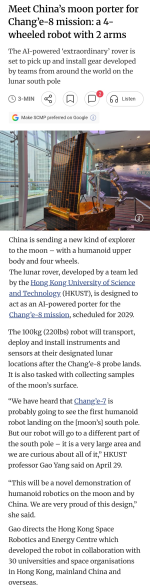
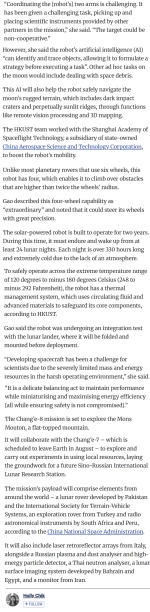
Source

Meet China’s moon porter for Chang’e-8 mission: a 4-wheeled robot with 2 arms
The AI-powered ‘extraordinary’ rover is set to pick up and install gear developed by teams from around the world on the lunar south pole.
 www.scmp.com
Beijingwalker
VIP Member
Aerospace assets details from China's homegrown sci-fi IP Nantianmen Project revealed; cutting-edge concepts point way for future aviation, aerospace development
Global Times
By Liang Rui
Published: Jun 02, 2026 02:32 PM

Animated demonstration of the fighter jets in China's homegrown sci-fi aerospace intellectual property Nantianmen Project Photo: Screenshot from the CCTV News
Recent updates on China's homegrown sci-fi aerospace intellectual property, the Nantianmen Project, have revealed details of multiple aerospace assets, according to the Xinhua News Agency on Tuesday. A Chinese military affairs expert said that the concepts and equipment envisioned in the project align with the key direction of future air warfare, which is the integration of air and space.
Per the revealed information of the Nantianmen Project, the Baidi aerospace fighter features full-spectrum stealth, manned-unmanned dual-mode operation, and a variable-sweep wing configuration that allows real-time aerodynamic adjustments. The 100,000-ton class Luanniao aerospace carrier measures 242 meters in length with a wingspan of 684 meters, has a maximum takeoff weight of 120,000 tons, and can carry 88 Xuannyu fighters, reported the Xinhua.
The Xuannyu unmanned air-superiority fighter is capable of operating beyond the atmosphere, armed with particle acceleration cannons, hypersonic missiles, and other weapons. The Zihuo multi-purpose vertical takeoff and landing platform has a projected speed of 700 to 800 kilometers per hour, can adapt to various environments including low gravity and thin atmosphere, and is designed for rescue missions in hazardous areas, said the report.
China Central Television (CCTV) News reported in October 2025 that the Nantianmen Project is a domestically developed aviation-themed sci-fi intellectual property. Its core concept is to build a global comprehensive strategic defense system comprising large strategic aerospace carrier platforms, aerospace fighters, and tactical mechs.
Launched in 2017, the project has so far produced 500,000 words of text and nearly 100 weapon and equipment design blueprints that can be displayed as models, reported CCTV News.
Xinhua reported on April 13 that the Nantianmen Project builds an imaginative world that integrates technology, equipment and character narratives from a Chinese perspective. The project weaves together multiple cutting-edge technologies - including hypersonic flight, dual-mode aerospace propulsion, metamaterial stealth, directed-energy weapons and AI-assisted decision-making - into a conceptual system centered on sci-fi fighter jets.
The entire equipment system of the Nantianmen Project is named after Chinese mythological figures and measured against real combat standards. The four core assets form a complete offensive-defensive closed loop, highlighting the forward-looking nature of these new-concept weapons, Song Zhongping, a Chinese military affairs expert, told the Global Times on Tuesday.
Though these imaginative designs in the Nantianmen Project remain at the conceptual stage, the cutting-edge concepts embedded in them, such as adaptive morphing and air-space integration, are providing important direction for the future development of aviation and aerospace technologies, Xinhua reported.
Song noted that as technology continues to advance, air-space integration can be seen as a key direction for future air warfare. The creativity and equipment concepts in the Nantianmen Project align with this broad trend.
Aerospace fighters like Baidi and Xuannyu can operate both within and beyond the atmosphere, and with the aerospace carrier serving as a space platform, the entire concept essentially extends the traditional notion of air superiority into "air superiority plus space superiority," Song said.
The expert said that cutting-edge technologies have a basis in research, and sci-fi designs are rooted in real-world science. Many of these seemingly far-fetched advanced technologies: adaptive morphing, full-spectrum stealth, air-space adaptive engines, ion acceleration cannons, and other core technologies, are all within China's domestic research and development pipeline. Although the complete systems have not yet been realized, related foundational technologies have made breakthrough progress one after another.
These hardcore concepts might eventually evolve into real combat assets safeguarding national security, Song said.
Global Times
By Liang Rui
Published: Jun 02, 2026 02:32 PM
Animated demonstration of the fighter jets in China's homegrown sci-fi aerospace intellectual property Nantianmen Project Photo: Screenshot from the CCTV News
Recent updates on China's homegrown sci-fi aerospace intellectual property, the Nantianmen Project, have revealed details of multiple aerospace assets, according to the Xinhua News Agency on Tuesday. A Chinese military affairs expert said that the concepts and equipment envisioned in the project align with the key direction of future air warfare, which is the integration of air and space.
Per the revealed information of the Nantianmen Project, the Baidi aerospace fighter features full-spectrum stealth, manned-unmanned dual-mode operation, and a variable-sweep wing configuration that allows real-time aerodynamic adjustments. The 100,000-ton class Luanniao aerospace carrier measures 242 meters in length with a wingspan of 684 meters, has a maximum takeoff weight of 120,000 tons, and can carry 88 Xuannyu fighters, reported the Xinhua.
The Xuannyu unmanned air-superiority fighter is capable of operating beyond the atmosphere, armed with particle acceleration cannons, hypersonic missiles, and other weapons. The Zihuo multi-purpose vertical takeoff and landing platform has a projected speed of 700 to 800 kilometers per hour, can adapt to various environments including low gravity and thin atmosphere, and is designed for rescue missions in hazardous areas, said the report.
China Central Television (CCTV) News reported in October 2025 that the Nantianmen Project is a domestically developed aviation-themed sci-fi intellectual property. Its core concept is to build a global comprehensive strategic defense system comprising large strategic aerospace carrier platforms, aerospace fighters, and tactical mechs.
Launched in 2017, the project has so far produced 500,000 words of text and nearly 100 weapon and equipment design blueprints that can be displayed as models, reported CCTV News.
Xinhua reported on April 13 that the Nantianmen Project builds an imaginative world that integrates technology, equipment and character narratives from a Chinese perspective. The project weaves together multiple cutting-edge technologies - including hypersonic flight, dual-mode aerospace propulsion, metamaterial stealth, directed-energy weapons and AI-assisted decision-making - into a conceptual system centered on sci-fi fighter jets.
The entire equipment system of the Nantianmen Project is named after Chinese mythological figures and measured against real combat standards. The four core assets form a complete offensive-defensive closed loop, highlighting the forward-looking nature of these new-concept weapons, Song Zhongping, a Chinese military affairs expert, told the Global Times on Tuesday.
Though these imaginative designs in the Nantianmen Project remain at the conceptual stage, the cutting-edge concepts embedded in them, such as adaptive morphing and air-space integration, are providing important direction for the future development of aviation and aerospace technologies, Xinhua reported.
Song noted that as technology continues to advance, air-space integration can be seen as a key direction for future air warfare. The creativity and equipment concepts in the Nantianmen Project align with this broad trend.
Aerospace fighters like Baidi and Xuannyu can operate both within and beyond the atmosphere, and with the aerospace carrier serving as a space platform, the entire concept essentially extends the traditional notion of air superiority into "air superiority plus space superiority," Song said.
The expert said that cutting-edge technologies have a basis in research, and sci-fi designs are rooted in real-world science. Many of these seemingly far-fetched advanced technologies: adaptive morphing, full-spectrum stealth, air-space adaptive engines, ion acceleration cannons, and other core technologies, are all within China's domestic research and development pipeline. Although the complete systems have not yet been realized, related foundational technologies have made breakthrough progress one after another.
These hardcore concepts might eventually evolve into real combat assets safeguarding national security, Song said.
Beijingwalker
VIP Member
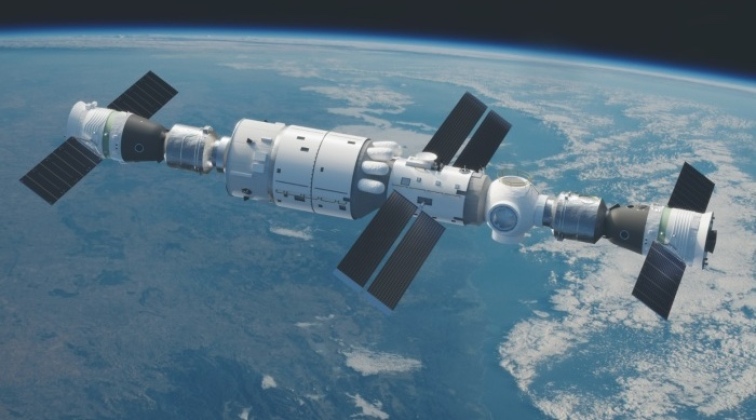
China plans to double the size of its Tiangong space station while the ISS nears its end
By Andrew Jones published 12 hours agoChina plans to add three new modules to Tiangong along with a co-orbiting space telescope, as the ISS approaches a Pacific splashdown.
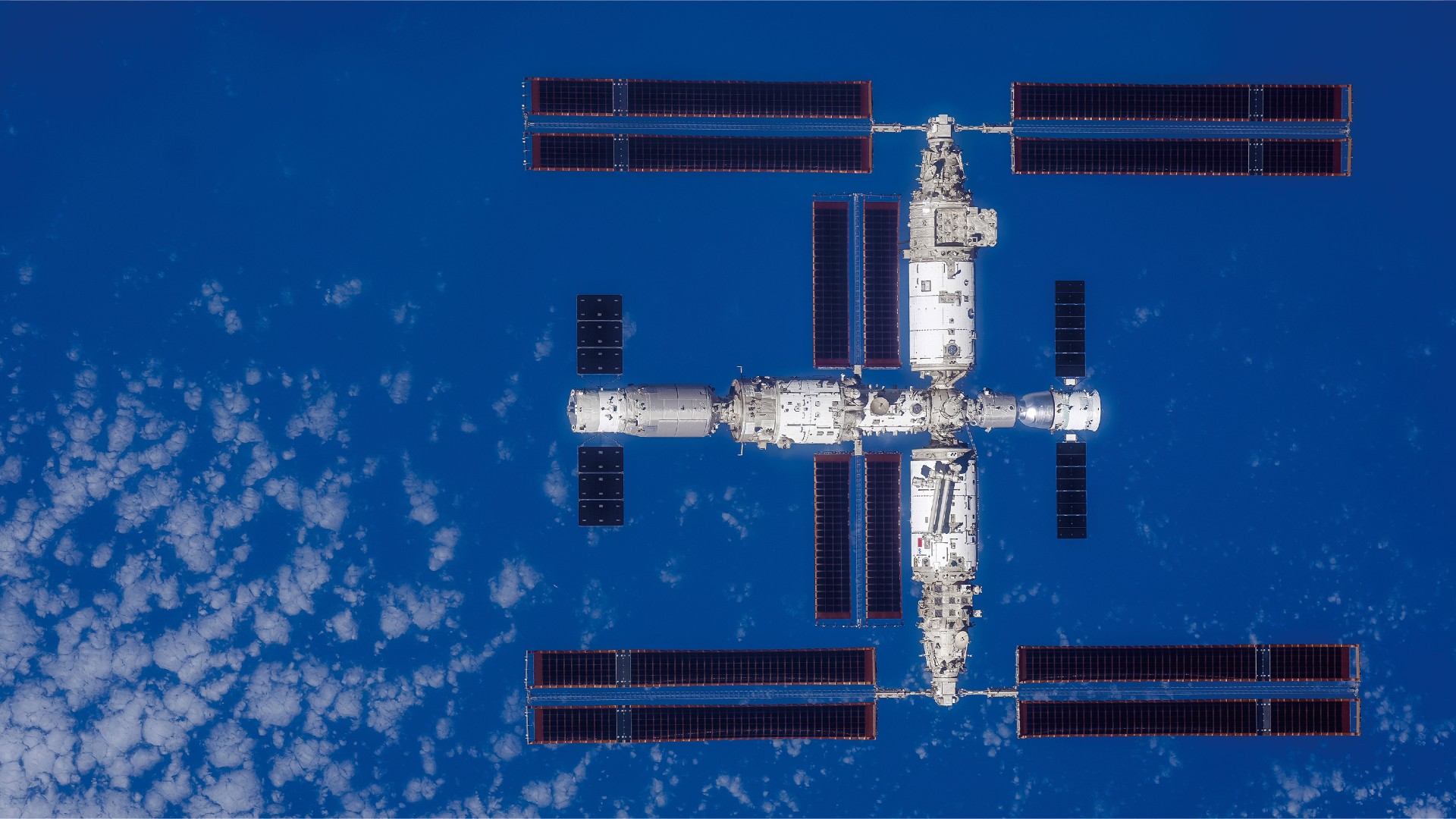
China is set to expand its space station from three to six modules in the coming years and add a co-orbiting Hubble-class space observatory, even as the International Space Station approaches the end of its lifetime.
The three-module, T-shaped Tiangong space station was assembled in orbit across 2021 and 2022 and has hosted numerous three-astronaut Shenzhou crews, but China is now set to expand the orbital outpost with new modules, citing growing research demands and more frequent crew and cargo missions. As previously reported by Space.com, the planned expansion will see Tiangong grow into a "double-T" shape, with the addition of the multipurpose module and two new experiment modules, and allow China to extend the scale of operations aboard the station.
"This expansion has always been part of the original plan," Qian Hang, a researcher with China Aerospace Science and Technology Corporation (CASC), told Chinese media. State media Xinhua reported that the first phase of the expansion will see the launch of a new 20-ton-class multifunctional module, which will dock with Tiangong's Tianhe core module.
Additional docking ports on the new modules will allow Tiangong to welcome more spacecraft and provide greater operational flexibility when needed. "If the missions get more intensive, we risk 'queuing' for docking ports and lack sufficient emergency buffer space," Qian said.
China is developing new, low-cost cargo options for Tiangong, while its new Mengzhou spacecraft, which could debut later this year, can carry seven astronauts to low Earth orbit. The Shenzhou spacecraft, which is currently used for China's crewed missions, can carry three astronauts to Tiangong.
Before the arrival of a new module, however, the first new addition to Tiangong is expected to be Xuntian, a bus-sized space observatory with a 2-meter (6.6 feet) diameter primary mirror, slightly smaller than that of the Hubble Space Telescope.
Xuntian is scheduled for launch in 2027 and boasts a field of view around 300 times larger than that of Hubble, meaning it will be able to study and map around 40% of the heavens during its planned 10-year lifetime using its 2.5-billion-pixel camera. Xuntian will share a similar orbit with Tiangong, meaning it will be able to dock with the space station for maintenance, refueling, repairs and potentially upgrades.
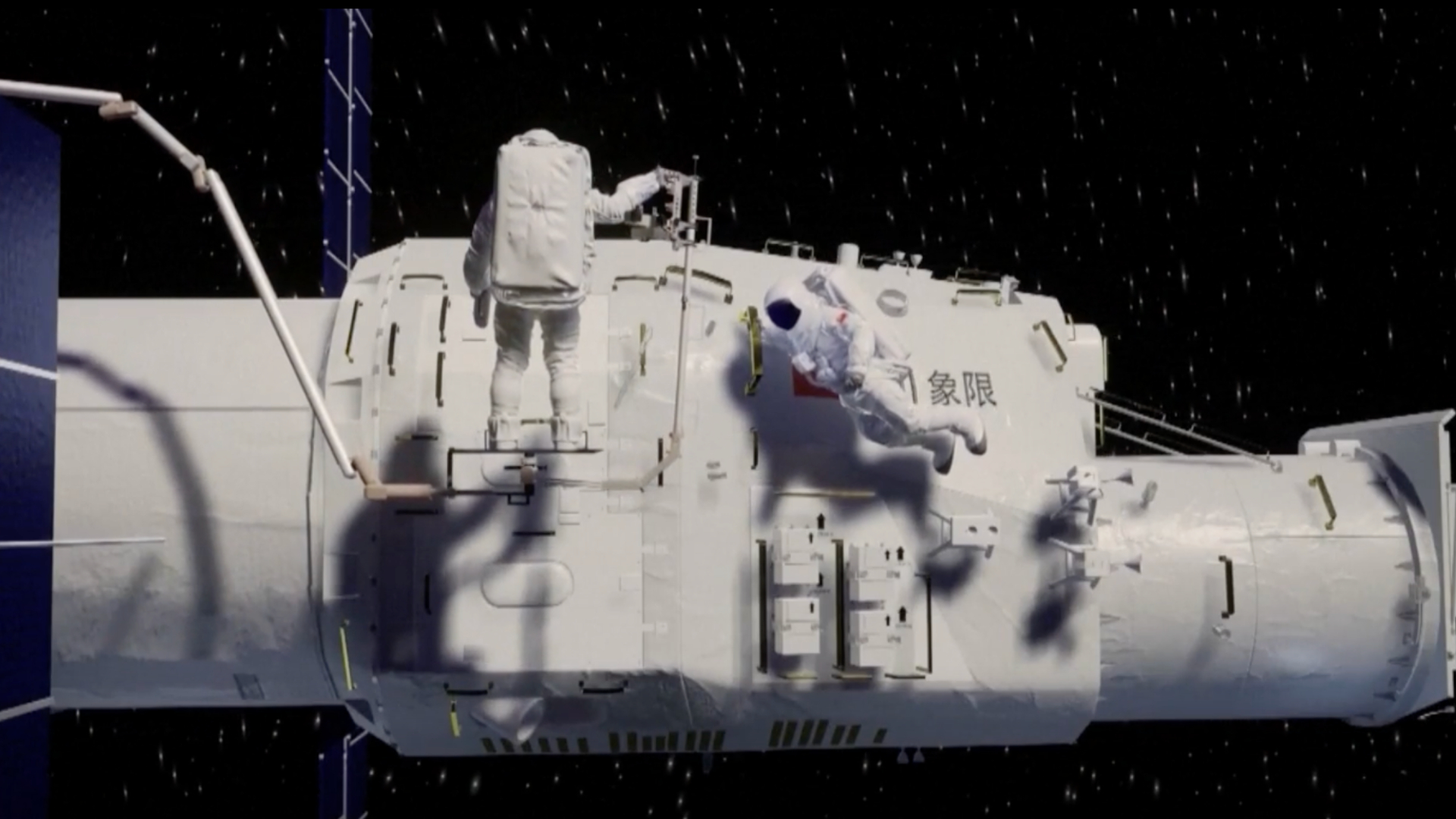
Screenshot from an animation showing Chinese astronauts servicing the Xuntian Space Telescope outside the Tiangong Space Station. (Image credit: CCTV)
China's plans to expand Tiangong are coming at the same time as NASA is planning for the end of life of the much larger International Space Station (ISS).
The agency plans to launch the SpaceX-developed U.S. Deorbit Vehicle (USDV) in the coming years, and drag the ISS into the atmosphere over the Pacific Ocean in late 2030 or early 2031.
While the U.S. is mulling a variety of plans for commercial stations that host astronauts in orbit after the ISS is retired, China would have the largest permanent outpost in orbit with Tiangong. According to Yang Hong, chief designer of the space station system, the planned expansion would take Tiangong from a mass of 90 tons to 180 tons.
冖_冖
Registered Member
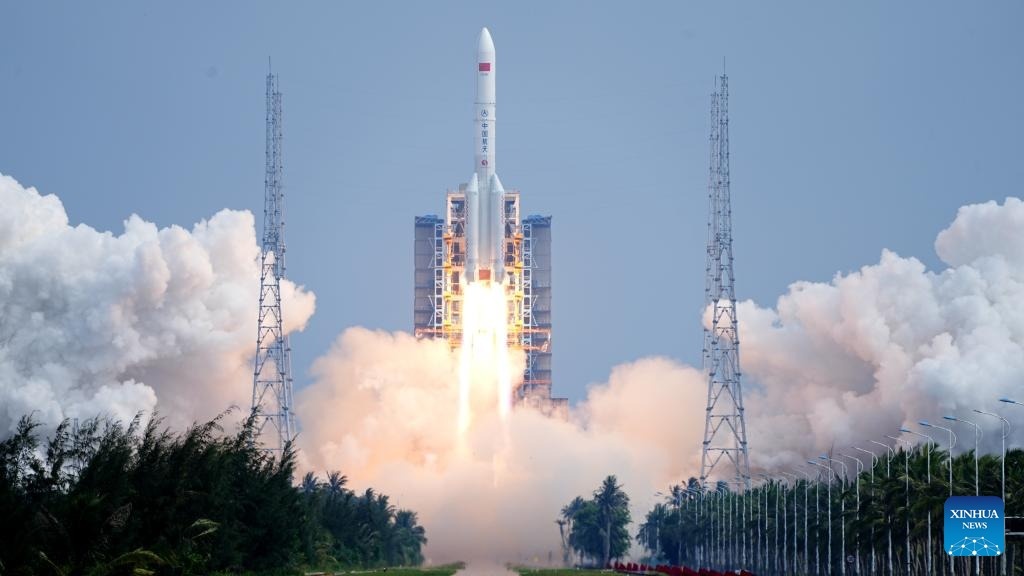
Central Asian countries, China to develop joint satellite system for disaster monitoring
China and several Central Asian countries plan to develop a joint satellite constellation to monitor natural disasters and share remote-sensing data across the region, Qazinform News Agency reports, citing Xinhua.
 qazinform.com
Central Asian countries, China to develop joint satellite system for disaster monitoring
China and several Central Asian countries plan to develop a joint satellite constellation to monitor natural disasters and share remote-sensing data across the region, Qazinform News Agency reports, citing Xinhua.
The system will focus on monitoring common regional threats such as earthquakes, landslides, agricultural pests and floods caused by glacial melt. Scientists say countries in Central Asia and China’s Xinjiang region face similar environmental challenges, making joint monitoring more effective.
The project will combine satellite observations with ground-based infrastructure and artificial intelligence. Data collected by the satellites will be processed at a computing center in Xinjiang, where AI models will be used to analyze environmental changes and improve early warning systems.
Experts note that glaciers in the region have already shrunk by 20–40% in recent years. More precise monitoring is expected to support water resource management and strengthen regional water security.
Representatives from Kazakhstan, Uzbekistan and Tajikistan took part in the signing ceremony and expressed confidence that the initiative would enhance scientific cooperation and improve decision-making in environmental protection.
The project is also expected to expand the use of advanced technologies, including satellite networks and artificial intelligence, enabling real-time monitoring of key indicators and helping countries respond more effectively to natural risks.
Beijingwalker
VIP Member
China’s Latest Satellite Engine Sets Global Record: High Performance Allows For Larger, Faster and More Manoeuvrable Spacecraft
July-4th-2026China has achieved a significant milestone in electric propulsion for satellites by successfully demonstrating a new 750-newton Hall-effect thruster, which completed a record-breaking orbital transfer mission and surpassed the performance of all comparable preceding systems.
The engine powered Communications Technology Experiment Satellite 26A from its initial transfer orbit to geostationary orbit through five orbit-raising manoeuvres, firing for a cumulative 11,617 seconds (approximately 3.2 hours) during its maiden mission. The engine was developed after Chinese researchers were unable to obtain required technologies from abroad because of Western Bloc states’ export restrictions. It is intended primarily for large communications satellites operating in geostationary orbit.
The military implications of a significant Chinese lead in developing Hall-effect thrusters extends well beyond communications satellites. Although these thrusters are primarily used for station keeping and orbit raising, higher-thrust electric propulsion expands what military spacecraft can do throughout their operational lives. One of the most important implications is faster deployment of military satellites. Conventional Hall-effect thrusters often require weeks or even months to raise a satellite from a transfer orbit into its final operational orbit because of their relatively low thrust. A substantially more powerful engine shortens this process, allowing reconnaissance, early warning, communications, and navigation satellites to become operational much sooner following launch. More powerful electric propulsion also enables the development of larger and heavier military satellites, and provides greater orbital manoeuvrability.
The development of heat- and oxidation-resistant protective coating were primary factors allowing the new engine to run continuously for extended periods of over 14 hours, far surpassing the program’s targets. At 750 newtons, the engine's unusually high thrust allows satellites to complete orbit-raising manoeuvres more quickly after launch, reducing the time required to reach operational orbit while still retaining the fuel-efficiency advantages of electric propulsion. Electric propulsion has become increasingly important because it consumes far less propellant than conventional chemical engines, allowing satellites either to carry larger payloads or remain operational for longer service lives.
China has invested heavily in developing indigenous satellite and space rocket technologies across propulsion, launch vehicles, and spacecraft manufacturing, and emerged in a league of its own alongside the U.S. as one of the two global leaders in the field. The successful demonstration of a domestically developed high-thrust Hall-effect engine is one of multiple recent technical and strategic breakthroughs in the country’s rise as a space power. China launched its first reusable methane-fuelled rocket in December, ZhuQue-3, closely following the first ever emergency space launch on November 25 which sent the Shenzhou-22 spacecraft to the Tiangong space station. Other notable achievements have ranged from the creation of the world’s first Quantium satellite network from the late 2010s, which has continued to be expanded rapidly, to the launch of the world's largest and most powerful solid-fuel carrier rocket the Gravity 1 in October 2025.
China’s Latest Satellite Engine Sets Global Record: High Performance Allows For Larger, Faster and More Manoeuvrable Spacecraft
China has achieved a significant milestone in electric propulsion for satellites by successfully demonstrating a new 750-newton Hall-effect thruster, which completed a
 militarywatchmagazine.com
Beijingwalker
VIP Member
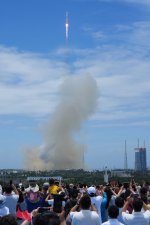
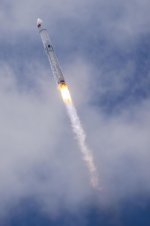
Xinhua News | China's Long March-10B rocket makes maiden flight, achieving controlled first-stage recovery for first time
Source: Xinhua2026-07-10 13:36:15
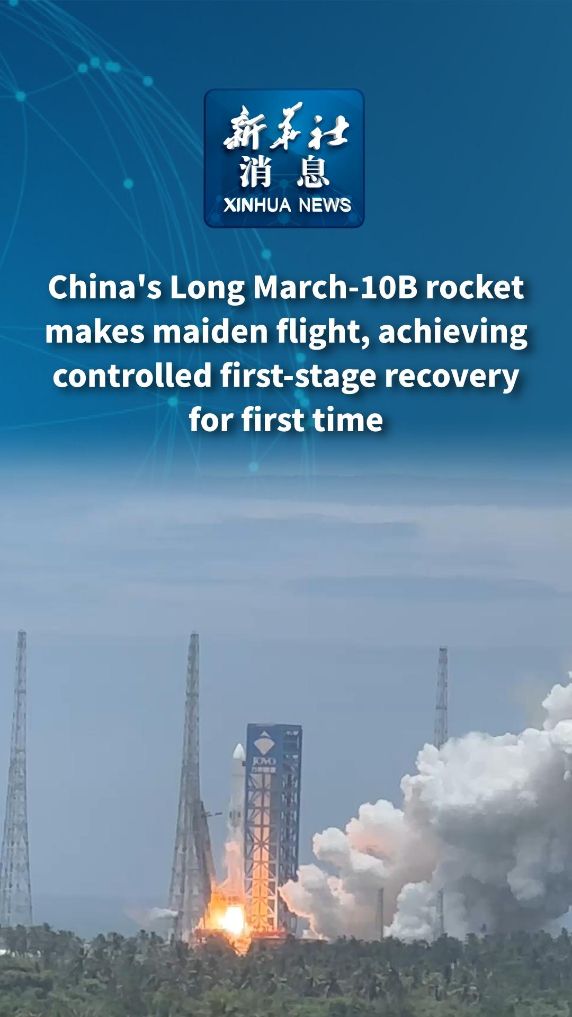
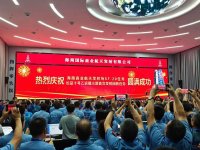
China successfully launched the Long March-10B carrier rocket at the Wenchang Spacecraft Launch Site in south China's Hainan Province on Friday, achieving its first controlled recovery of a carrier rocket's first stage. #XinhuaNews
Xinhua News | China's Long March-10B rocket makes maiden flight, achieving controlled first-stage recovery for first time
Xinhua News | China's Long March-10B rocket makes maiden flight, achieving controlled first-stage recovery for first time-
english.news.cn
Beijingwalker
VIP Member
China successfully tests sea-based rocket booster recovery system
By ReutersJuly 10, 202612:43 PM GMT+8Updated 24 mins ago
- Summary
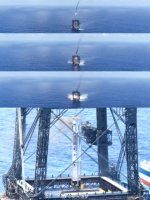
- Booster returned vertically to an offshore platform about six minutes after stage separation, CCTV reported
- Test marked China's first successful retrieval of an orbital-class rocket, state media said
- Long March 10B can carry at least 16 metric tons to low-Earth orbit
The Long March 10B rocket lifted off from the Hainan commercial space launch site in southern China at 12:15 p.m. (0415 GMT) and, about six minutes after separation of its booster and upper stage, the booster returned vertically and was recovered on an offshore platform, state broadcaster CCTV reported.
The test marks China's first successful retrieval of an orbital-class rocket, putting the country closer to developing reusable rockets.
Shares in Chinese aerospace firms jumped on the news, with China Spacesat (600118.SS), opens new tab and China Satellite Communications (601698.SS), opens new tab hitting their daily limits.
The Long March 10B has been compared to the Falcon 9, SpaceX's (SPCX.O), opens new tab widely used medium-lift rocket. It was developed for commercial aerospace by the country's main state rocket developer, the China Academy of Launch Vehicle Technology, and is capable of carrying a payload of at least 16 metric tons to low-Earth orbit.
Beijingwalker
VIP Member
Users who are viewing this thread
Total: 2 (members: 0, guests: 2)
Pakistan Defence Latest


Country Watch Latest


Latest Posts
-
 Breaking News: Yemen's Houthis strike Saudi Arabia's Abha airport with missiles and drones in a sharp escalation (24 Viewers)
- Latest: Pak Defender
-

-
 Makkah Defence Alliance: Turkey, Saudi Arabia, and Pakistan, news & updates (33 Viewers)
- Latest: F.O.X
-

-
