China's tech rise reshapes the global space race
07/05/2026July 5, 2026
China is pulling ahead in global research rankings and expanding its ambitions in space. With growing technological leadership, Beijing is positioning itself as a rival to the United States on a global scale.
China plans to establish a permanent lunar base as a stepping stone for future missions into deep space
Lai Kai-ying, the first female Chinese civilian to reach outer space, is currently on board China's crewed
Tiangong space station, where she orbits the Earth 16 times a day, alongside two other Chinese astronauts.
Tiangong is a unique microgravity laboratory for scientific experiments, designed to provide new insights into humanity's future.
Today,
aviation and
spaceflight are once again shaped by ideological rivalry, echoing the mid-20th-century space race between the United States and the Soviet Union. In the 21st century, however, the US's primary competitor is no longer Russia, but China.
US space agency
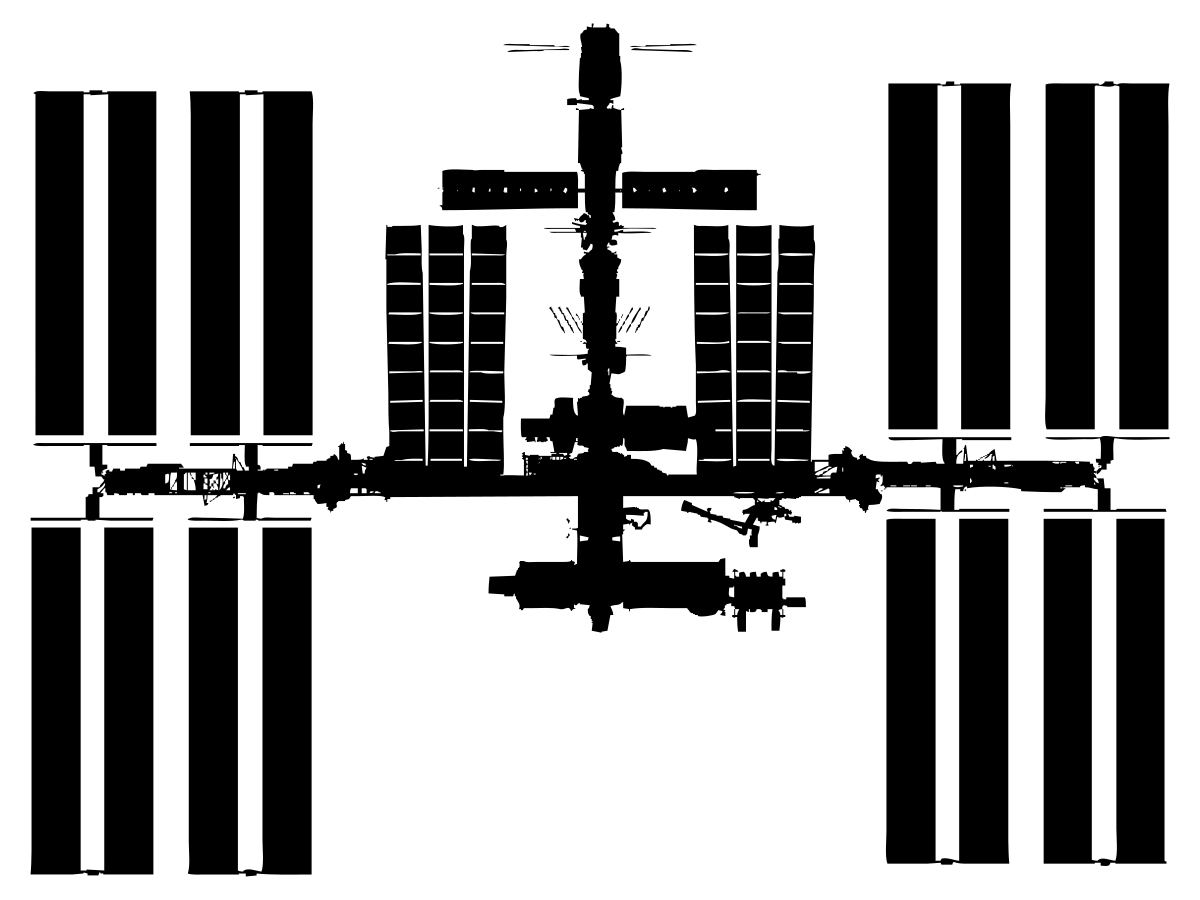
NASA intends to retire its landmark research outpost, the International Space Station (ISS), by 2032. When that happens,
China will be the only country operating a permanently crewed orbital station.
China dominates cutting-edge research
Space travel is just one of many fields worldwide in which China now holds a technological lead, according to
Nature.
The journal's latest
index of research leaders, which reveals the leading institutions and countries/territories, puts China in first place — well ahead of the
United States and
Germany.
Nine of the
Top 10 research institutions were from China, with the US' Harvard ranking third. Germany's Max Planck Society (MPG), Germany's preeminent research organization, ranked in 13th place.
"It is now almost irrelevant which global rankings you consult. Universities and research institutions in China lead in many fields," observed Christina Beck, spokesperson for the MPG.
The Nature Index also shows that Chinese research institutions are the clear leaders in biology, chemistry and physics, as well as in other applied sciences. Only in health sciences and the social sciences have they been surpassed by US institutions.
Strong investment underpins China's success
China's rise has taken place steadily over the past two decades, said Richard Heidler, director of information management at the German Research Foundation (DFG), Germany's largest research funding organization.
"While in the early 2000s it was primarily the volume of publications that increased significantly, bibliometric analyses over the past decade have also shown growing gains in impact-related indicators, such as the share and number of highly cited publications," Heidler said.
In other words, China is not only publishing more but also becoming increasingly better and more visible, which, as the MPG's Beck said, is based on a long-term development process.
"Key to this has been sustained, systematic funding for scientific institutions and universities in China sustained over many years — particularly through the international training of researchers and through substantial investments in large-scale research infrastructure," he added.
China's leaders have long recognized that
technology is the key to its success. The country's
15th Five-Year Plan, its economic and political road map for 2026–2030, calls for a continued expansion of its innovation capabilities.
Central to Beijing's strategy is the development of "new productive forces," innovation-driven growth engines based on advanced technologies and industrial transformation.
The plan highlights a range of key future industries, including
artificial intelligence, quantum technology, nuclear fusion, biotechnology and life sciences, brain-computer interfaces as well as deep-sea and space exploration.
China, US compete over the moon
China and the US are locked in an intense competition over
next-generation lunar missions. The push comes as China pledges to have a crewed mission ready by 2030.
Whether NASA can successfully carry out its
Artemis mission to land near the lunar south pole in 2028 remains to be seen. The lunar lander programs and next-generation spacesuits are already
behind schedule.
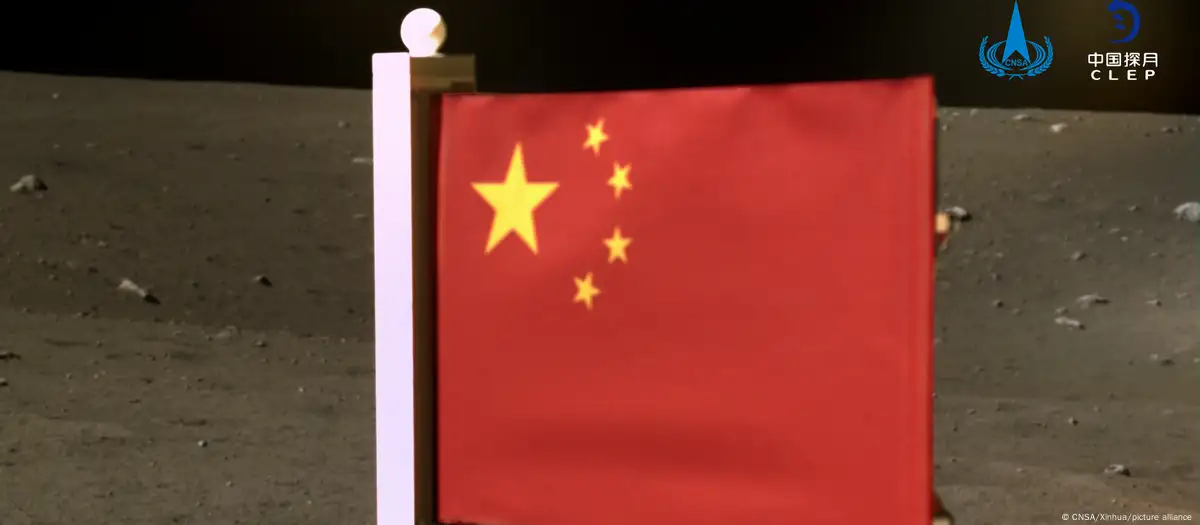
China also plans to establish a permanent lunar base as a stepping stone for future missions into deep space.
It has already taken a major step toward this goal as the only country to retrieve rock fragments from
the moon's far side. The samples are now being studied for their potential use in building the planned settlement.
US, Europe draw boundaries with China over space
NASA is prohibited from cooperating with China's space agency under the 2011 Wolf Amendment, a sign of the intensity of geopolitical and ideological rivalry between the two powers.
The European Space Agency (ESA) has likewise scaled back cooperation with Beijing, even though ESA astronauts have had to learn Chinese vocabulary and have carried out joint exercises with Chinese taikonauts — the name for Chinese astronauts.
Germany's Federal Ministry of Research, Technology and Space has also drawn clear boundaries, particularly in sensitive areas with potential military applications.
"This applies, for example, to cooperation on topics that could be used for both civil or military purposes (dual-use) or for cooperation related to artificial intelligence which could be misused for surveillance purposes and human rights violations," according to the ministry's
website.
European states increasingly consider China to be a systemic rival. Risks and benefits in scientific cooperation must therefore be carefully weighed.
"We want to maintain cooperation in research fields where there are no dual-use concerns," said Beck.
One example is the "Five-hundred-meter Aperture Spherical Radio Telescope" (FAST) in China's southwestern province of Guizhou, which has a diameter of 500 meters — roughly the length of five football fields.
"This collaboration gives us access to unique infrastructure," Beck noted.
Ingrid Krüssmann from the Sino-German Center for Research Promotion (SGC) argues along similar lines.
"The DFG aims to create as much certainty as possible for researchers in Germany, so that excellent collaborative projects with Chinese partners can, in principle, continue to be possible," she said.
How China's growing influence affects space research
Beck noted that German research organizations face mounting challenges in cooperation with Chinese partners due to political developments in China, rising geopolitical tensions and, above all, the close intertwining of civilian and military research.
The Max Planck Society aims to shape its collaboration with partners in China "in an informed, responsible and strategic manner," she added.
Meanwhile, China continues to pursue its foreign policy agenda through technological means.
After Hong Kong native Lai Kai‑ying completes her mission on board the Tiangong space station, China is set to host its first foreign astronaut, who is expected to spend a short stay in orbit from October.
Two
Pakistani candidates, one of whom will be selected for the flight, are already in training for the mission.
The move highlights how geopolitical alliances are increasingly extending into space, with China involving
key partner countries in its expanding space program.
China is pulling ahead in global research rankings and expanding its ambitions in space. With growing technological leadership, Beijing is positioning itself as a rival to the United States on a global scale.

www.dw.com