Bro, we all agree with the theory you presented, and most likely you are right to some extent.
The limitation of DSI is true, but we still don't have solid proof that J-20 can't fly at speed higher than Mach 2.0.
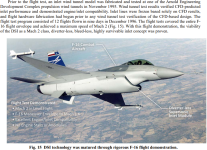
The J-20 has a Diverterless Supersonic Inlet, also known as DSI, it has the advantages of simpler manufacturing process, less need for larger amounts of Radar absorbing material than conventional inlets, no need for bleed systems, a diverter cavitiy and mechanical Variation, however all of this limits too the speed to Speeds below Mach 2.
The high pressure Gradient generated by the bump becomes a wall for the lower pressure boundary layer, but by the bump having no mechanical variation it limits the Mach number it is designed to operate.
The Bump can not change its size and position with respect the inlet cowl, thus limiting the speed range it can operate.
Pressure recovery tends to decrease at supersonic speed at all conditions. This is due to the fact that the shock waves at the inlet in supersonic condition causes additional pressure loss and hence it results in lower pressure recovery as compared (Goldsmith and Seddon 1993, Mattingly 2002). This phenomena is quite similar in fixed intakes (Ibrahim, Ng et al. 2011).
The results revealed that Boundary Layer Diverter Intake (BLD intake) configuration is more effective in subsonic regime as compared to DSI configuration, whereas at supersonic speeds DSI configurations gave superior performance.
Comparative Flow Field Analysis of Boundary Layer Diverter Intake and Diverterless Supersonic Intake Configuration I. Arif† , S. Salamat, M. Ahmed, F. Qureshi and S. Shah

mikoyanmig29.wixsite.com
View attachment 109121