Despite the renewed investments, the trend may be difficult to sustain as China remains under US export controls, say analysts.
www.scmp.com
Samsung, SK Hynix step up China investments to combat global AI memory shortage
Published: 8:00am, 29 Mar 2026
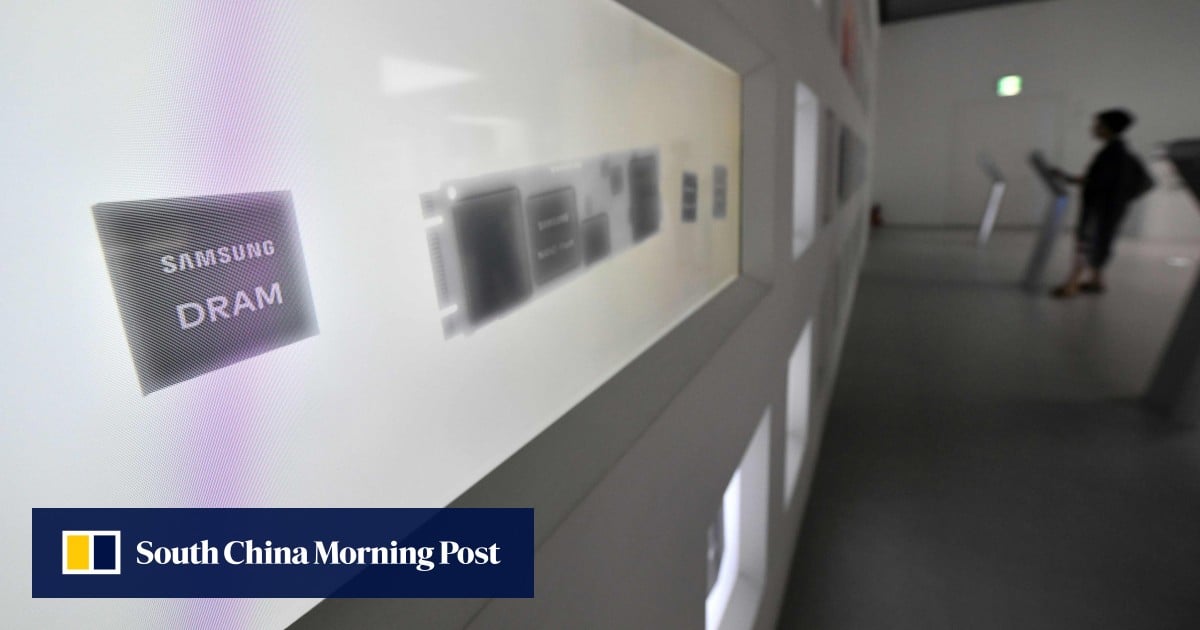
Samsung Electronics and SK Hynix are stepping up investments in their China wafer fabs as they race to boost supply amid a tightening memory chip market driven by demand for artificial intelligence computing, underscoring China’s continued role in semiconductor production despite US restrictions.
Samsung Electronics invested 465.4 billion won (US$308.8 million) in its Xian chip plant in 2025, a 67.5 per cent increase from a year earlier, according to an annual report filed with South Korea’s Financial Supervisory Service on March 10.
SK Hynix also ramped up spending, investing 581.1 billion won in its Wuxi chip plant, up 102 per cent year on year, and 440.6 billion won in its Dalian facility, a 52 per cent increase from 2024, according to its March 17 annual report.
“Since building new plants typically takes three to five years, optimising operations at existing production bases in China enables a much faster supply response,” said Lee Byung-chul, a visiting research fellow at the Sejong Institute and a former Samsung Electronics executive vice-president who worked at its China subsidiary for 15 years.
Samsung’s Xian facility, its only overseas memory chip fab, accounts for about 40 per cent of its NAND output. The company had previously invested 698.4 billion won in the plant in 2019, but there was a pause in spending at the facility between 2020 and 2023, local news agency Seoul Economic Daily reported. Investment resumed in 2024 at 277.8 billion won.
SK Hynix’s Wuxi plant accounts for more than 30 per cent of its total DRAM output, while the Dalian facility serves as its NAND production base. Notably, the company had made no investments in either facility in 2023 before increasing its spending over the past two years.
Troy Stangarone, a non-resident fellow at the Carnegie Mellon Institute for Strategy & Technology, said the investments point to a need to respond to the global shortage of AI memory, with both DRAM and NAND supply effectively sold out this year.
In a report last month, Goldman Sachs raised its 2026 DRAM supply shortfall estimate to 4.9 per cent of total demand, up from 3.3 per cent, and said it expected the market to see its most severe shortage in 15 years. It also lifted its NAND supply shortfall forecast to 4.2 per cent, up from 2.5 per cent.
China was also a significant end market for both companies, given its substantial share of the global personal computer and smartphone chip markets, said Park Jun-hong, a director at S&P Global Ratings.
Against this backdrop of tightening supply and strong demand, China is seeking to position itself as a key partner for chipmakers.
China's 2025 Current Account Surplus Hits Record Annual High
According to data from Trading Economics, China's current account surplus reached an unprecedented level in the final quarter of 2025. The surplus surged compared to the same period a year earlier and exceeded an earlier preliminary estimate.
The record quarterly surplus was driven by a historic goods surplus. Exports rose significantly, while import growth was more modest. This occurred despite trade measures implemented by the United States.
Other components of the current account also shifted. The secondary income surplus increased year-on-year. Concurrently, the services deficit and the primary income deficit both contracted compared to the fourth quarter of 2024.
For the entire year of 2025, the nation's current account surplus climbed to a new annual record, showing substantial growth from the previous year's total.
Data shows China's current account surplus surged to a record high in Q4 and for the full year 2025, driven by strong exports and a historic goods trade surplus.
The move is widely seen as a landmark step in China's ongoing efforts to promote free trade and expand high-standard opening-up at a time of rising protectionism worldwide.
www.chinadailyasia.com
Published: 10:47, December 18, 2025 | Updated: 11:00, December 18, 2025 China launches island-wide special customs operations in Hainan FTP
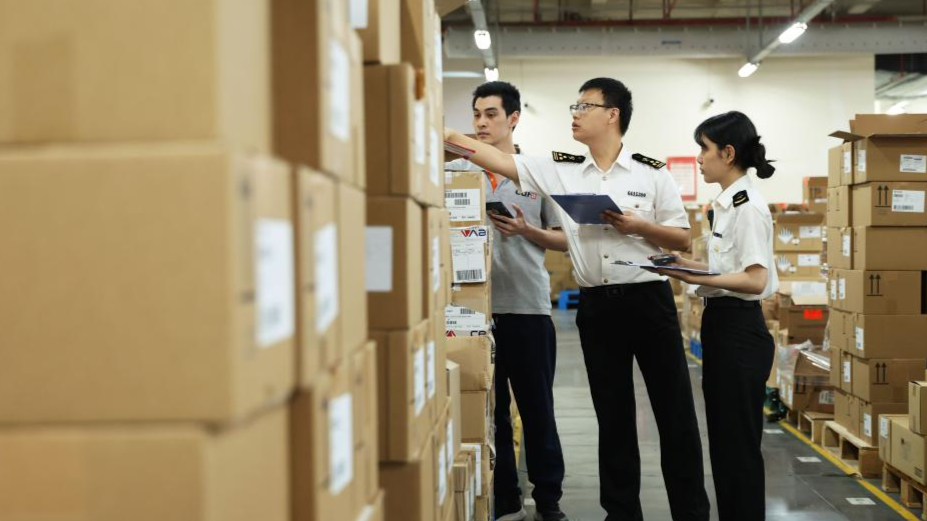
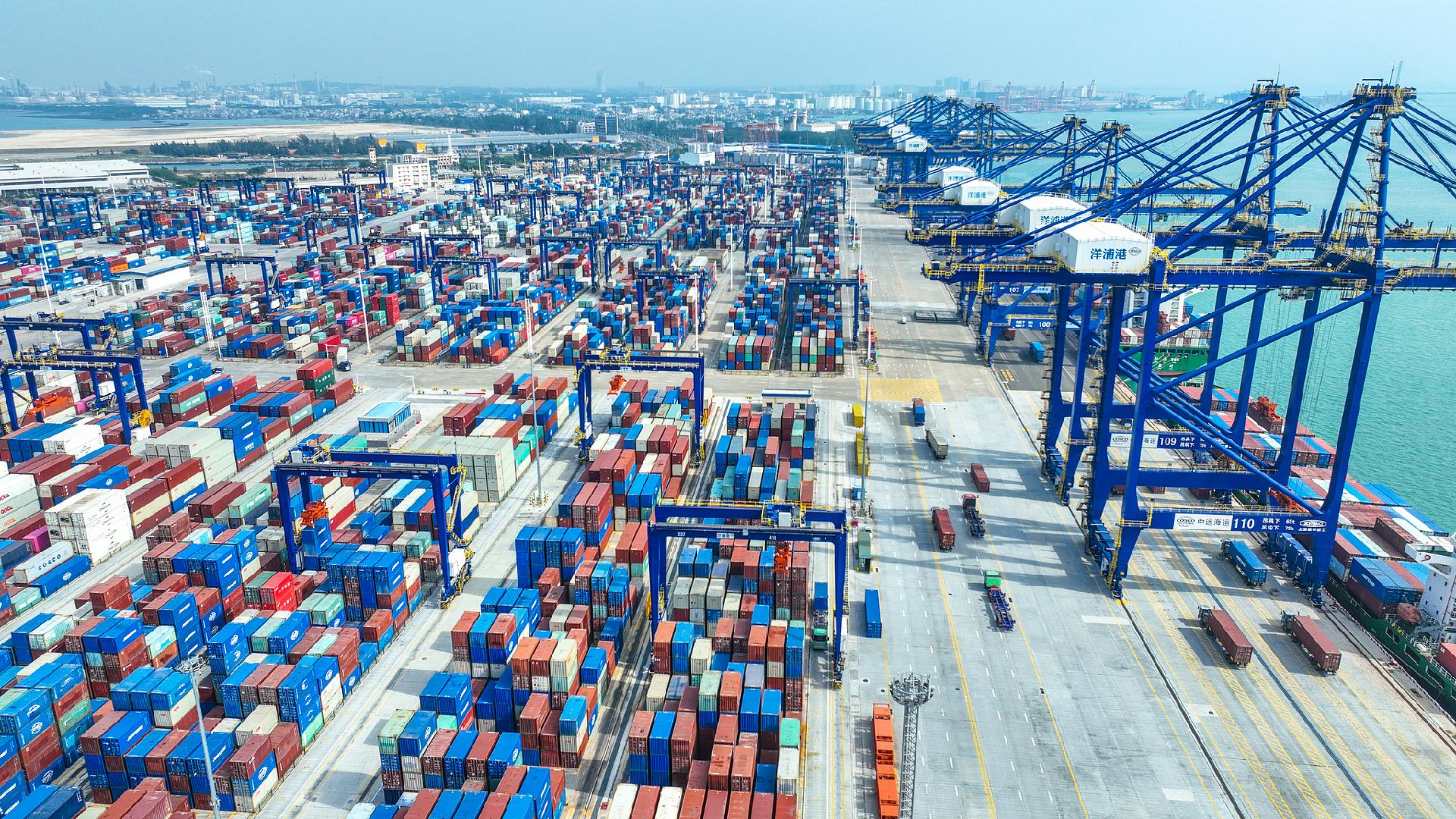
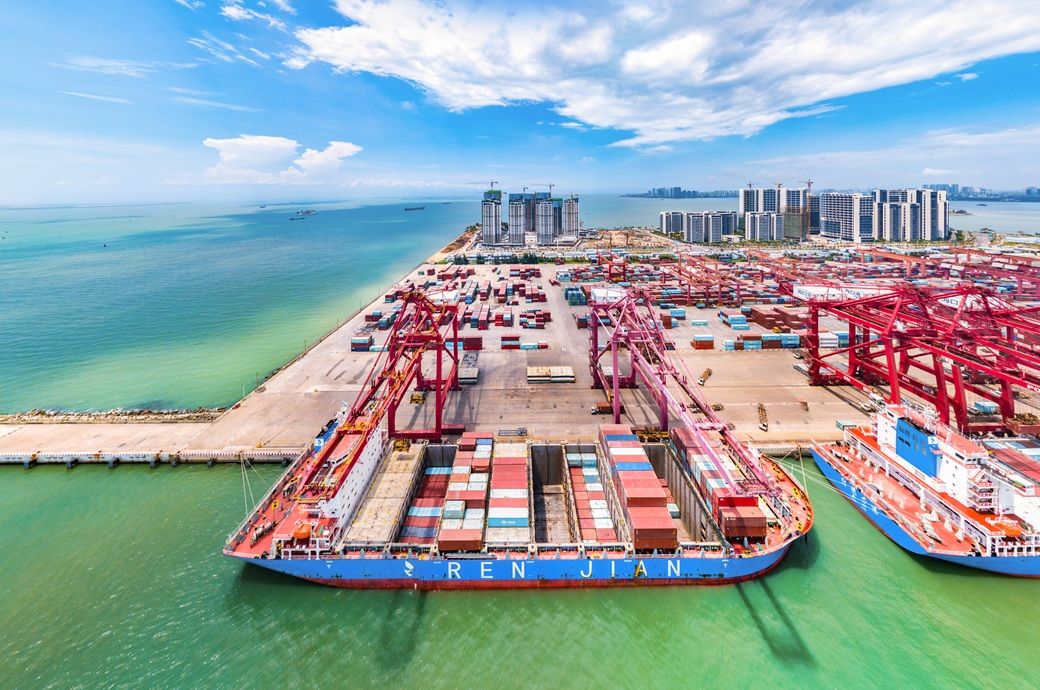
HAIKOU - China on Thursday launched island-wide special customs operations in the Hainan Free Trade Port (FTP), the world's largest FTP by area, allowing freer entry of overseas goods, expanded zero-tariff coverage and more business-friendly measures.
The move is widely seen as a landmark step in China's ongoing efforts to promote free trade and expand high-standard opening-up at a time of rising protectionism worldwide.
Under the new arrangements, the tropical island of more than 30,000 square km has been designated as a special customs supervision zone. This marks a new stage in the development of the Hainan FTP, which enables freer flows of goods, capital, personnel and data, supported by zero tariffs, low tax rates and a simplified tax system.
The Hainan Free Trade Port (FTP) in south China's Hainan Province saw a surge in transactions involving zero-tariff goods during the first 100 days of its island-wide special customs operations, according to official data released on Thursday.
Hainan Free Trade Port recorded trade exceeding ¥80 billion (~$11.6 billion) in its first 100 days of special customs operations, up 32.9 per cent YoY. A total of 186 zero-tariff...
www.fibre2fashion.com
Hainan free trade port crosses $11.6 bn trade in 100 days
27 Mar '26
Pic: DreamArchitect / Shutterstock.com
Insights
Hainan Free Trade Port recorded trade exceeding ¥80 billion (~$11.6 billion) in its first 100 days of special customs operations, up 32.9 per cent YoY.
A total of 186 zero-tariff transactions were completed, covering goods worth ¥1.7 billion (~$236 million), while duties worth ¥271 million (~$37.6 million) were exempted, reflecting strong early momentum.
The Hainan Free Trade Port (FTP) in south China's Hainan Province saw a surge in transactions involving zero-tariff goods during the first 100 days of its island-wide special customs operations, according to official data released on Thursday.
Since the landmark move, the FTP's total import and export value has exceeded a combined 80 billion yuan (about $11.6 billion), representing a 32.9% increase year on year. Under the zero-tariff policy, 186 transactions were completed, with goods totaling nearly 1.7 billion yuan, an increase of 146% over the previous year. These zero-tariff transactions resulted in 271 million yuan in customs duties being exempted.
The data was released at a press conference a day before the 100-day mark.
On December 18 last year, China launched island-wide special customs operations in the Hainan FTP, the world's largest FTP by area, allowing freer entry of overseas goods, expanding zero-tariff coverage, and introducing more business-friendly measures.
The Hainan Free Trade Port (FTP) marked the 100th day of the island-wide special customs operations on March 27.
news.cgtn.com
100 days of Hainan Free Trade Port: Visa-free foreign arrivals jump 54%
China17:57, 28-Mar-2026
CGTN
The Hainan Free Trade Port (FTP) marked the 100th day of the island-wide special customs operations on March 27. Driven by a range of visa-free policies, Hainan has become a key destination and transit hub for business and leisure travelers from around the world.
The number of foreign visitors entering the island under the visa-free policy has increased by 54% compared to last year, according to the Haikou General Station of Exit and Entry Frontier Inspection.
The Hainan FTP has maintained the most favorable visa exemption policy in China since the special customs operations began including both bilateral and unilateral visa-free arrangements.
Citizens from 59 countries can enter Hainan for up to 30 days without a visa, with an additional 240-hour visa-free transit option. Currently, 86 countries benefit from the visa exemption policy, covering various purposes such as family visits, business and medical needs. Meanwhile, Hainan is rapidly expanding its air network, with routes to regions including Northeast Asia, Southeast Asia, Europe and Oceania.
The Haikou General Station of Exit and Entry Frontier Inspection has processed over 975,000 entry and exit visits, a 36.8% increase year-on-year, since launching the island-wide special customs operations on December 18, 2025. Of these, 518,000 were foreign national visits, a 44.5% rise, accounting for 53% of the total.
EU demands 'serious reform' of the WTO to stop flood of Chinese exports
Maroš Šefčovič to demand “new balance” of international trade rules to rein in Beijing
Mar 27, 2026 - 07:52
European Commissioner for Trade Maroš Šefčovič. (Photo by Omar Havana/Getty Images)
European fears over the impact of a surge in imports from China on the bloc’s faltering industrial base will be raised during World Trade Organisation (WTO) talks in the coming days.
“Overcapacity and non-market policies must be better tackled than in the past,” Maroš Šefčovič, the EU’s trade chief said on Monday.
Šefčovič will demand “serious reform” of the WTO during a meeting in Cameroon this Thursday and make it “crystal clear” that China’s economic rise has meant the global trade environment has “dramatically changed” in recent decades.
“We very much [will] be insisting on serious reform of the WTO, where level playing field, overcapacity, and non-market policies must be better tackled than in the past,” he told journalists.
China, the world’s second-largest economy and the EU’s third-largest trading partner, joined the WTO in 2001, six years after the Geneva-based international trade organisation was created.
Šefčovič’s case is that “a new balance” is now required with the rise of China to adjust the “rights and obligations” of WTO members, which he said is necessary to combat the “overcapacities” that “are creating a lot of problems in the European economy”.
The Slovak commissioner’s remarks come amid a surge of Chinese exports to the EU, at a time when US President Donald Trump’s sweeping tariffs are already hurting the bloc’s exporters and causing vast quantities of cheap Chinese manufactured goods to be re-directed toward Europe.
Brussels’ trade deficit with Beijing surged from $335 billion in 2024 to $375 billion in 2025, according to data collected by Bruegel, an EU policy think tank. Beijing’s global trade surplus also hit a record $1.2 trillion last year – a figure it is set to far surpass in 2026.
In addition to confronting China, Šefčovič also called for “new governance models” to facilitate trade disputes between member states. The US has long hobbled the WTO court system by blocking the appointment of judges to its appellate body – thus allowing WTO members to effectively obviate court rulings by ‘appealing into the void’.
Šefčovič said Brussels will invite more countries to join the Multi-Party Interim Appeal Arbitration Arrangement, a 2020 mechanism involving more than 60 of the WTO’s 166 members that have pledged respect for the rulings of an alternative dispute settlement mechanism.
“We are all for multilateralism,” Šefčovič said. “But if we see that in certain areas like the dispute settlement mechanism, this is not possible, we will be also proposing this plurilateral approach.”
WTO members spanning 70 percent of global trade — including Australia, China, Britain and the EU — will implement the agreement among themselves in their domestic legislation.
www.politico.eu
Countries sidestep WTO deadlock to implement e-commerce deal
WTO members spanning 70 percent of global trade — including Australia, China, Britain and the EU — will implement the agreement among themselves in their domestic legislation.
March 28, 2026 4:20 pm CET
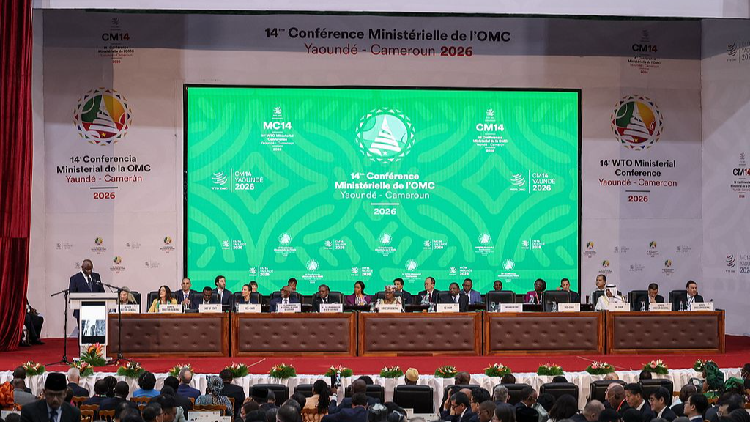
YAOUNDE, Cameroon — Sixty-six members of the World Trade Organization have decided to forge ahead with a new path to bring an e-commerce agreement into force, with consensus among all WTO members still to be reached.
The plurilateral Joint Statement Initiative (JSI) on e-commerce includes provisions on digital flows, electronic contracts and privacy and consumer protection. India has consistently blocked the plurilateral deal from being adopted into the WTO framework, arguing that such arrangements undermine consensus.
Now, members spanning 70 percent of global trade — including Australia, China, Britain and the European Union — will implement the agreement among themselves in their domestic legislation.
“Today, ministers decided to, let’s just move on,” South Korean Trade Minister Yeo Han-koo told POLITICO. “Don’t wait until everybody agrees on everything. Because time is of the essence.”
Han-koo labeled it a “practical approach,” under which “when the time comes more members join … and consensus is formed to integrate this into the WTO.” Meanwhile, however, the deal should be implemented “as soon as possible [where] members can reap the benefit,” he said.
WTO Director-General Ngozi Okonjo-Iweala said: "By moving forward with the E-commerce Agreement, participating economies are ... demonstrating that the multilateral trading system can respond, and is responding, to new challenges."
However, many delegates on the ground are not convinced.
“This is effectively an admission that the WTO is not capable of delivering multilateral or plurilateral agreements for the foreseeable future,” said Chris Southworth, Secretary General of the International Chamber of Commerce UK. “Countries and blocs will have to negotiate large scale deals on their own.”
WTO members "have tried six times for integration of the [JSI] in the WTO. … It's not possible anymore,” said Pascal Kerneis, managing director of the European Services Forum.
“So [members] looked for alternatives with a legal expert to say what about an international treaty which would use the WTO Secretariat as a depository of the signature,” he added. “And then hopefully, we will use a dispute settlement system of the WTO when a dispute occurs.”
Members will now proceed with their respective domestic procedures to implement the legislation.
YAOUNDE, March 28 (Reuters) - A group of World Trade Organization members agreed on Saturday to sidestep adoption hurdles for the world's first baseline on digital trade rules, opting to bring the agreement into force among consenting participants, the WTO said.
In recent years, efforts by a group of countries to fold the E-Commerce Agreement into the WTO rulebook were twice blocked by dissenting members. The pact aims to foster an open environment for digital trade.
The push to accelerate entry into force, among members who represent 70% of global trade, stems from mounting frustration over those obstructions, a senior diplomat told Reuters. Under WTO rules, plurilateral agreements among subsets of members require consensus.
At the 14th WTO Ministerial Conference in Cameroon, 66 members settled on an interim arrangement to activate the deal within their countries while pursuing broader incorporation into the WTO framework.
Japan's State Minister of Economy, Trade and Industry, Yamada Kenji, hailed it as a "historic step" toward global digital trade rules.
UK Business and Trade Secretary Peter Kyle also hailed the move.
"As the first global digital trade deal, this will make trade cheaper, faster and more secure for businesses around the world," Kyle said.
India has been one of the main countries blocking a deal, arguing that trade agreements should be adopted multilaterally by consensus.
The United States is not among the 66 countries to sign up for the agreement, with the issue currently under review by the U.S. administration.
Sixty-six members, covering approximately 70% of global trade, have adopted a pathway to bring into force the WTO Agreement on Electronic Commerce through interim arrangements while continuing to work towards its incorporation into the WTO legal framework of rules, co-convenors announced on 28...
www.wto.org
Members adopt a pathway to bring E‑Commerce Agreement into force via interim arrangements
Sixty-six members, covering approximately 70% of global trade, have adopted a pathway to bring into force the WTO Agreement on Electronic Commerce through interim arrangements while continuing to work towards its incorporation into the WTO legal framework of rules, co-convenors announced on 28 March at the 14th Ministerial Conference taking place in Yaoundé, Cameroon. The joint press release is below.
JOINT PRESS RELEASE
ADOPTION OF THE WTO AGREEMENT ON E-COMMERCE WITH INTERIM ARRANGEMENTS
Jointly issued by the Department of Foreign Affairs and Trade, Australia; Ministry of Foreign Affairs, Japan; Ministry of Economy, Trade and Industry, Japan; and Ministry of Trade and Industry, Singapore
Chinese Commerce Minister Wang Wentao has expressed support for the adoption of the WTO agreement on e-commerce with interim arrangements announced on Saturday.

news.cgtn.com
Chinese commerce minister: China welcomes WTO interim arrangements on e-commerce agreement
China09:11, 29-Mar-2026
CGTN
Chinese Commerce Minister Wang Wentao has expressed support for the adoption of the World Trade Organization (WTO) agreement on e-commerce with interim arrangements announced on Saturday.
In his written remarks, Wang highlighted that the WTO Agreement on Electronic Commerce (E-Commerce Agreement) establishes global rules for digital trade, which will effectively promote more inclusive and sustainable digital growth.
China supports the timely implementation of the agreement and hopes the WTO can play a greater role in shaping digital trade rules in the future, Wang added.
On Saturday, the co-conveners of the WTO negotiations on e-commerce – Australia, Japan and Singapore – issued a joint statement in Yaounde, the capital of Cameroon, announcing the establishment of interim arrangements for the E-Commerce Agreement.
At the 14th WTO Ministerial Conference (MC14), 66 WTO members, including China, announced that the interim arrangements would provide a pathway to bring the E-Commerce Agreement into force, while continuing to work towards its incorporation into the WTO legal framework of rules.
The E-Commerce Agreement, a significant milestone for the WTO in recent years, will enter into force for those members that have accepted it, after 45 members have deposited their instruments of acceptance, according to the joint statement.
‘Sunshine Women’s Choir’ becomes Taiwan’s biggest ever local film at box office
Source: Star Generation Culture & Entertainment
‘Sunshine Women’s Choir’ Gavin Lin’s Sunshine Women’s Choir has risen to the top of Taiwan’s box office, scoring a new all-time record for local films.
The heartfelt prison drama hit $17.4m (NT$545m) on Saturday (February 14), making it the highest grossing local film ever. It has shattered the long-standing record held by Wei Te-sheng’s Cape No.7 since 2008 and outperformed 2011’s Warriors Of The Rainbow: Seediq Bale, also directed by Wei, and Giddens Ko’s You Are The Apple Of My Eye, also from 2011.
This new record was achieved after 51 days on release, including five days of preview screenings over Christmas before its opening on December 31. It ranks 21st at the overall box office including international titles.
Shot in a prison in Yilan in northeastern Taiwan, the film is about a group of female inmates who find warmth, hope and redemption through music. It gained solid traction through strong word of mouth from the second week of release onwards.
The film reteams director Lin with actress Ivy Chen and scriptwriter Henry Lu (previously known as Hermes Lu) following their 2018 pan-Asia hit More Than Blue. Taiwan-Japan superstar Judy Ongg – in her first Taiwanese film in 47 years – also heads the ensemble cast.
Among the major backers are Lin’s new production company Star Generation Culture & Entertainment, 16cc Company, Taiwan Mobile, Dawning Jade Entertainment, and Long Shong Times Group.
It is produced by veteran Liu Weijan whose credits include GFBF* (2012), The Bold, The Corrupt, And The Beautiful (2017) and Coo-Coo 043 (2022).
The film has opened in Singapore and Malaysia and will next roll out in Hong Kong on March 5, following special screenings since January 17. North America, Australia, New Zealand and Cambodia aim to open in March.
Taiwan-based 66cc Company (previously known as Distribution Workshop) handles international sales. Its sister company, 11cc Films, is the Taiwanese distributor.
Taiwan’s box office is set to flare up further through a pair of Lunar New Year offerings. Giddens Ko’s latest big-budget action fantasy adventure Kung Fu opened on February 13, followed by Joseph Chen-Chieh Hsu’s wedding comedy drama Double Happiness on February 17, the first day of Lunar New Year.
The "Sunshine Women's Choir" shockingly claims to represent "China Taiwan"
Mar 29, 2026
[FTV Instant News] Lifestyle Center / Chen Yao-chi, Chen Bo-han, Taipei Report The film "Sunshine Girls Choir" has surpassed NT$750 million at the Taiwanese box office, breaking the record for domestic films.
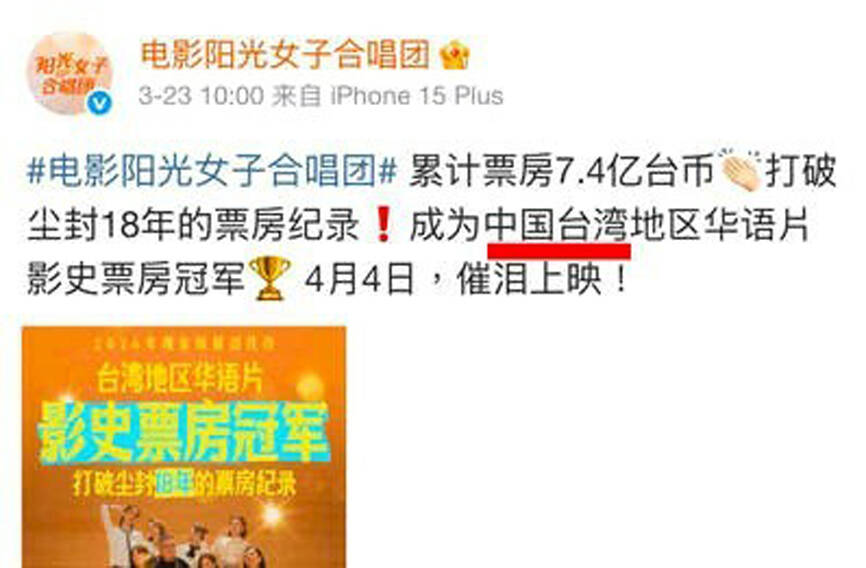
However, its official Weibo account recently referred to it as "the highest-grossing Chinese-language film in Taiwan's history.
Democratic Progressive Party Legislator Ngalim Tiunn (張雅琳) yesterday criticized Sunshine Women’s Choir (陽光女子合唱團), a Taiwanese production that received a government subsidy, for calling itself the “all-time box office champion for Chinese-language films from the China-Taiwan region.”
In a post on the film’s official social media account on Monday last week, it boasted a cumulative box office of NT$740 million (US$23.2 million), saying it broke an 18-year record for “Chinese-language films in the China-Taiwan region.”
The film, set to premiere in China next Saturday, received more than NT$18 million in Taiwanese government subsidies from the Ministry of Culture, as well as the Taipei and Taoyuan city governments, Tiunn said in a post on social media yesterday.
A post on the film “Sunshine Women’s Choir” Sina Weibo account is pictured in an undated photograph.
Photo: Screen grab from the film’s Sina Weibo account
“This is taxpayers’ money, and yet the film went along with China’s cultural ‘united front’ rhetoric,” she said, accusing it of hurting the feelings of Taiwanese people and undermining the subjectivity of Taiwanese culture.
It is understandable that Taiwanese movies face significant pressure when entering the Chinese market, she said.
She asked, “Does the film, which reached an NT$740 million box office with support from Taiwanese audiences and government subsidies, have to become a production from ‘China’s Taiwan region’ .
Taiwan, Hong kong, Macau should have seperate collective threads, they are speical administrations of China, having their own administrations and even currencies.
In all international statistics, they are all listed seperately from the mainland China and they even join the Olympic games with their own delegations.
China’s factory activity returns to growth, expanding at its sharpest pace in a year
Published Mon, Mar 30 20269:37 PM EDT
Key Points
China’s official gauge for manufacturing activity pointed to a better-than-expected expansion in March.
The Manufacturing Purchasing Managers’ Index for March rose to 50.4, according to the National Bureau of Statistics on Tuesday.
PMI rebounded after two months of contraction.
China’s official gauge for manufacturing activity climbed more than expected in March to mark its best performance in a year and snapping two months of declines, as export orders showed strong momentum.
The Manufacturing Purchasing Managers’ Index for March rose to 50.4, according to the National Bureau of Statistics on Tuesday, beating economists’ expectations for 50.1 in a Reuters poll. A reading below 50 indicates contraction, while levels above that threshold signal expansion.
That expansion marked a notable rebound after two months of contraction, with the official figure standing at 49.3 and 49.0 in January and February, respectively. In March last year, the reading was 50.5.
and new orders expanded while the measures on raw materials inventory, employment, and delivery time remained in contraction.
Manufacturing activity in March gathered momentum as factories rushed to resume production after an extended national holiday in mid-February, said Huo Lihui, chief statistician at NBS.
The non-manufacturing PMI, which measures activity in the services sector such as tourism, rose to 50.1 from 49.5 in February.
Higher shipping fees and costs for imported commodities, including crude oil and chemicals — triggered by the ongoing Middle East conflict — have weighed more on NBS-surveyed companies, Huo said. Price indexes tracking raw material inputs and factory-gate prices rose 63.9% and 55.4%, respectively.
Many factory owners in China expected the disruption to be short-lived as U.S. President Donald Trump has planned a visit to China in May to meet with Chinese leader Xi Jinping, said Cameron Johnson, Shanghai-based senior partner at consulting firm Tidalwave Solution, leaving a period of roughly six weeks of elevated prices and supply challenges.
Inquiries for Chinese-made solar panels and batteries from overseas buyers have picked up in recent weeks, particularly from Europe, India, and East Africa, Johnson said, as China appears somewhat insulated from the supply shock due to its massive stockpiles.
″[But] if we’re talking about the same [disruption] into May, that’s going to be a really big problem,” Johnson noted.
In the first two months of this year, China’s exports surged 21.8% from a year earlier, sharply beating expectations, as robust demand from Southeast Asia and Europe more than offset the slump in U.S.-bound shipments.
A separate private-survey PMI conducted by RatingDog and S&P Global is set to be released on Wednesday and is expected to drop to 51.6 in March from a 5-year high of 52.1 in February, according to a Reuters poll.
Kazakhstan and Russia are in talks to increase Russian oil transit to China to 12.5 million metric tons per year from 10 mmt, Kazakh pipeline company Kaztransoil said on Tuesday. ...
www.marketscreener.com
Kazakhstan, Russia discuss boosting Russian oil transit to China to 12.5 mln t per year, Kaztransoil says
Published on 03/17/2026 at 02:49 am EDT
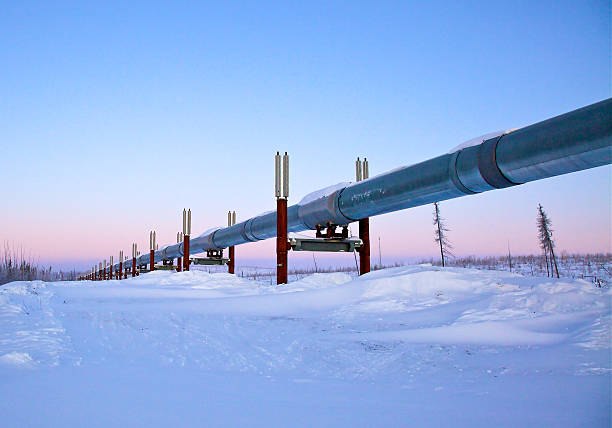
Kazakhstan and Russia are in talks to increase Russian oil transit to China to 12.5 million metric tons per year from 10 mmt, Kazakh pipeline company Kaztransoil said on Tuesday.
The United States has extended a sanctions exemption allowing the transit of Russian oil to China through Kazakhstan until March 2027, according to
timesca.com
1 April 2026
U.S. Extends Sanctions Exemption for Transit of Russian Oil Through Kazakhstan
The United States has extended a sanctions exemption allowing the transit of Russian oil to China through Kazakhstan until March 2027, according to Kazakhstan’s Ministry of Energy.
The license was issued by the Office of Foreign Assets Control under the U.S. Department of the Treasury and is valid until March 19, 2027.
“Following negotiations with OFAC, the term of the license for the transit of Russian oil to China has been extended. Cooperation on this issue will continue,” the ministry said in a statement.
The ministry added that Kazakhstan and Russia are discussing the possibility of increasing supply volumes. At present, transit continues under existing sanctions exemptions. Kazakhstan transports approximately 10 million tons of Russian oil to China annually under an intergovernmental agreement valid until 2034.
Earlier, Islamdaut Akubaev, a representative of KazTransOil, said Kazakhstan had received notification from OFAC regarding an extension of the transit permit until April 2026.
The United States has extended a sanctions exemption allowing the transit of Russian oil to China through Kazakhstan until March 2027, according to
timesca.com
1 April 2026
U.S. Extends Sanctions Exemption for Transit of Russian Oil Through Kazakhstan
The United States has extended a sanctions exemption allowing the transit of Russian oil to China through Kazakhstan until March 2027, according to Kazakhstan’s Ministry of Energy.
The license was issued by the Office of Foreign Assets Control under the U.S. Department of the Treasury and is valid until March 19, 2027.
“Following negotiations with OFAC, the term of the license for the transit of Russian oil to China has been extended. Cooperation on this issue will continue,” the ministry said in a statement.
The ministry added that Kazakhstan and Russia are discussing the possibility of increasing supply volumes. At present, transit continues under existing sanctions exemptions. Kazakhstan transports approximately 10 million tons of Russian oil to China annually under an intergovernmental agreement valid until 2034.
Earlier, Islamdaut Akubaev, a representative of KazTransOil, said Kazakhstan had received notification from OFAC regarding an extension of the transit permit until April 2026.
Lol, does China needs permission from US to import oil from Russia via Kazakhstan ? What the world mafia boss the US thinks it is, giving out orders and permissions to all sorts of things as it pleases, lol.
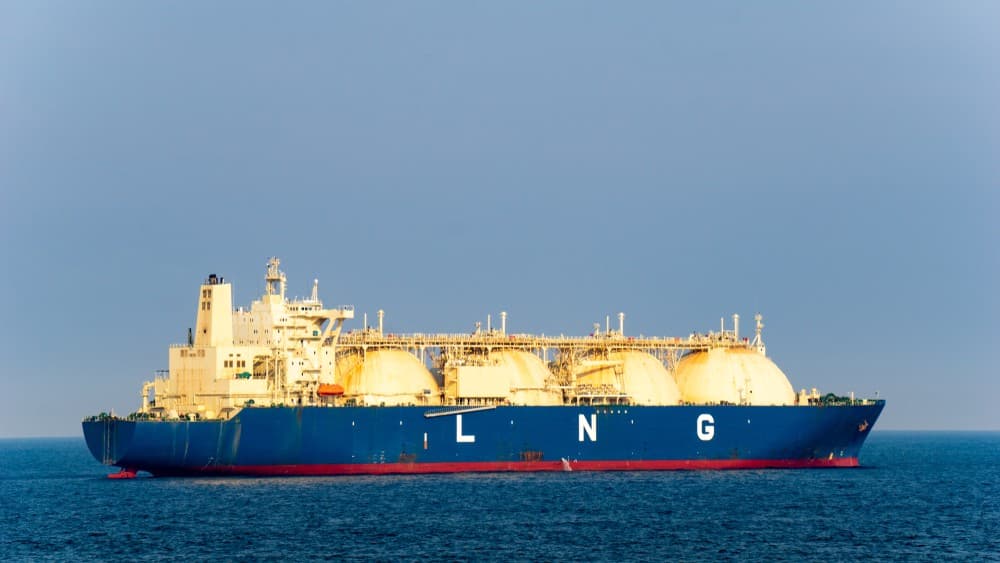
Since the start of the Middle East war, China has been reselling record volumes of LNG to other Asian buyers as its own demand has been tepid and stocks and gas supplies sufficient.
In March alone, China resold up to 10 cargoes of LNG—a record-high for any month ever, according to data from energy analytics firms Vortexa, Kpler, and ICIS cited by Reuters.
Year to date, China has also resold record volumes of LNG, an estimated 1.31 million tons, shipped to South Korea, Thailand, Japan, India, and the Philippines, per data from Kpler. This is the highest on record, too, and more than all volumes Chinese companies resold for the entire 2025 or 2023.
China has some buffer to allow itself not to spend too much on costly LNG imports amid the global LNG crunch due to the de facto closed Strait of Hormuz and the outage at Qatar’s LNG complex hit by Iranian missiles.
China’s LNG storage was estimated by Kpler at about 51% by end-March, and this buffer allows Beijing to draw on existing inventories.
In addition, China has boosted domestic gas supply and supply via pipeline from Russia, further easing the need to tap the spot LNG market, where prices hit a three-year high and have rallied by more than 80% since the war in the Middle East began.
The surging LNG prices led to the lowest monthly LNG imports into China in eight years as Qatari and UAE supply is off the market, resulting in huge price spikes.
China was on track to import about 3.7 million tons of LNG in March, per tanker-tracking data by Kpler cited by Bloomberg. That would be the lowest monthly import level in the world’s top LNG importer since the spring of 2018, as well as a 25% slump compared to March 2025, according to Bloomberg data and analysis.
With a somewhat adequate buffer to withstand the current LNG market turmoil, China is unlikely to touch the expensive spot supply, analysts say.
“China will not enter the market and fight for cargoes with other countries at all,” ICIS analyst Wang Yuanda told Reuters.