Chinese Economy: General News, Updates and Discussions

If we extend this process a little longer, after the efforts of two or three generations, maybe there will be no such problem.

What 'problem' do you mean?

It's empty! Where are the tourists?🤷‍♂️

It's winter, so it's pretty cold in the mountains. I was lucky that most shots I took had little to no tourists hehe.

IMG_20260113_151403.jpg
 

Canada–China strike initial deal to cut EV and Canola tariffs


Canada and China have reached a preliminary trade agreement that would sharply reduce tariffs on Chinese electric vehicles and Canadian canola, marking a reset in relations after months of trade friction. Prime Minister Mark Carney said Canada would initially allow up to 49,000 Chinese EVs at a 6.1 per cent tariff, down from 100 per cent, while China is expected to cut its canola seed duties to about 15 per cent by March 1. Ottawa also expects discriminatory tariffs on canola meal, lobsters, crabs and peas to be lifted, potentially unlocking nearly $3 billion in export orders. The two countries pledged to restart high-level economic dialogue and deepen cooperation in agriculture, energy and green technologies. Carney framed the deal as a step toward rebuilding ties with China while Canada faces ongoing trade tensions with the United States.


To view this content we will need your consent to set third party cookies.
For more detailed information, see our cookies page.
 
Last edited:
What 'problem' do you mean?
Or I can replace "problems" with another word "complaints." China's tremendous technological progress and the teaching materials in schools cannot be well updated. Many people often cannot adapt to the tremendous updates brought by technology after entering society. He needs to work and fumble, which is shortening the change in thirty years. If his learning ability cannot keep up with industrial upgrading, he will be eliminated. China is not short of talent. If we extend the period of thirty years to one or two hundred years, and the progress of science and technology gradually gives the people a period of adaptation, after several generations of people participate in and systematically learn the corresponding knowledge, then the voice of such complaints will be much less, after all, everyone has undergone systematic training. And the progress of technology has not been too far apart from the capabilities of each generation.

Can you understand the question I expressed? We have caught up with the industrial revolution of the West for hundreds of years in 30 or 40 years. The time is too short to give everyone enough time to adapt. This is the "neijuan" you mentioned
 
Last edited:

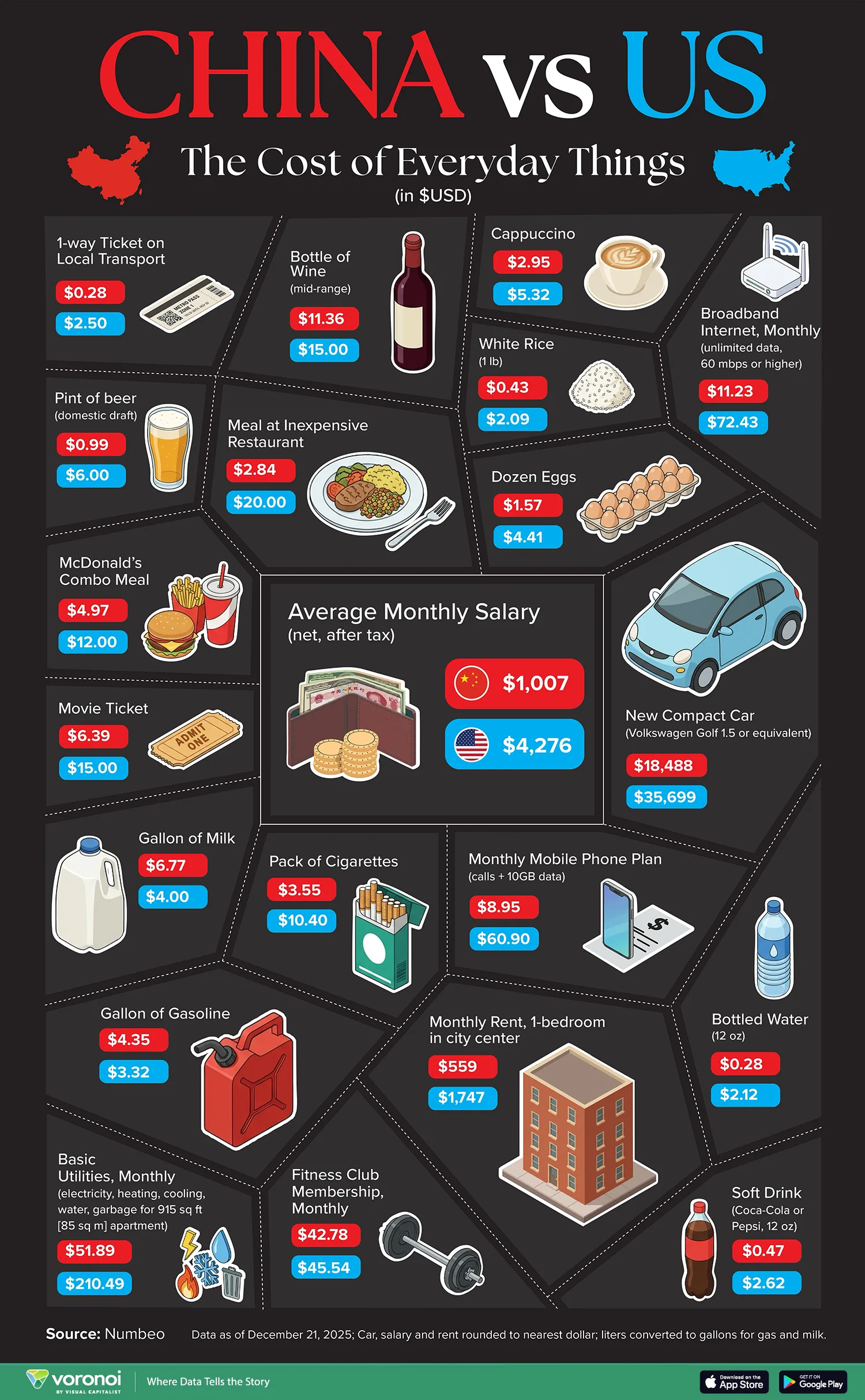
Visualized: The Cost of Everyday Things in China vs. the U.S.​

January 16, 2026

cost-of-things-china-us-WEB.webp

Key Takeaways​

  • As a developing economy, China has drastically lower prices for most daily goods and services, but also a much lower average monthly salary.
  • Basic utilities, internet, and rent are more than 3x cheaper in China compared to the U.S., easing overall cost of living.
  • Surprisingly, items like milk, gasoline, and wine are more expensive in China despite its overall lower cost structure.
From broadband to Big Macs, the price of everyday essentials can vary dramatically depending on where you live.

This visual, by Julie Peasley, compares the cost of 20+ common items in China and the United States using data from Numbeo, the world’s largest crowdsourced cost-of-living database.

The chart offers a direct side-by-side view of consumer prices in U.S. dollars, giving insight into which country is more affordable across key spending categories. While the U.S. boasts higher average salaries, China’s everyday living expenses are very low.

The biggest shock? Broadband internet in the U.S. costs over $72/month, compared to just $11 in China. Yet for some essentials, the tables turn: milk and gasoline are both more expensive in China, despite its typical cost structure.

Housing, Utilities, and Connectivity: Cheap in China​

When it comes to fixed monthly costs, China is significantly cheaper. Renting a one-bedroom apartment in a city center costs $559 in China versus $1,747 in the U.S., a nearly 70% discount.

Likewise, basic utilities like electricity, heating, and garbage removal for an 85 m² apartment are just $52 per month in China, while Americans shell out over $210 on average. This massive difference is partly due to government subsidies and lower energy costs in China’s urban centers.

Food and Dining: Affordable Meals, but Not Always Cheaper Groceries​

In China, an inexpensive restaurant meal costs just $2.84, versus $20 in the U.S., while a McDonald’s combo meal is less than half the price.

However, grocery items tell a more nuanced story. A gallon of milk in China costs $6.77, which is well above the U.S. average of $4. Meanwhile, a dozen eggs are $1.57 in China compared to $4.41 in the United States. Pricing discrepancies like this often stem from differing production models and import dependencies.

Salaries vs. Spending Power​

The U.S. may be more expensive, but it also pays more: the average monthly salary after tax in the U.S. is $4,276, compared to just $1,007 in China. While this gap is significant, lower prices in China offset much of the income disparity, offering residents stronger local purchasing power for basic needs.

Still, U.S. consumers benefit from better affordability in certain categories like cigarettes, gasoline, and even gym memberships, which suggests the cost balance isn’t universally tilted.
 
What about property tax and home insurance?

Typical linked house in Malaysia.
Tax - Cukai Tanah - RM50/Yr
Tax - Cukai Taksiran - RM647.50/yr
Home insurance - RM334.36/yr
Sewage - Indah Water - RM144/yr
Electricity - Tenaga - RM4200/yr
Water - Air Selangor - RM120/yr

Total = RM5,500 or US$1,350
 

Thousands of Chinese Fishing Boats Quietly Form Vast Sea Barriers

By Chris Buckley, Agnes Chang and Amy Chang Chien
updated 10:30 p.m. ET


1768627055836.png
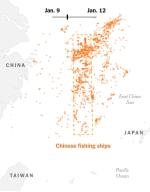
Note: Animation shows movements of ships from 8 a.m. on Jan. 9 to midnight on Jan. 12 local time.

China quietly mobilized thousands of fishing boats twice in recent weeks to form massive floating barriers of at least 200 miles long, showing a new level of coordination that could give Beijing more ways to impose control in contested seas.

The two recent operations unfolded largely unnoticed. An analysis of ship-tracking data by The New York Times reveals the scale and complexity of the maneuvers for the first time.

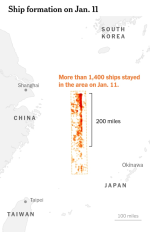
Last week, about 1,400 Chinese vessels abruptly dropped their usual fishing activities or sailed out of their home ports and congregated in the East China Sea. By Jan. 11, they had assembled into a rectangle stretching more than 200 miles. The formation was so dense that some approaching cargo ships appeared to skirt around them or had to zigzag through, ship-tracking data showed.

1768626736609.png

Note: Ships are represented by their last known positions on 2 p.m. on Jan. 11 local time.


Maritime and military experts said the maneuvers suggested that China was strengthening its maritime militia, which is made up of civilian fishing boats trained to join in military operations. They said the maneuvers show that Beijing can rapidly muster large numbers of the boats in disputed seas.

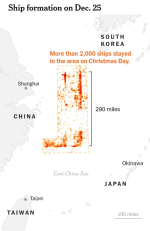
The Jan. 11 maneuver followed a similar operation last month, when about 2,000 Chinese fishing boats assembled in two long, parallel formations on Christmas Day in the East China Sea. Each stretched 290 miles long, about the distance from New York City to Buffalo, forming a reverse L shape, ship-position data indicates. The two gatherings, weeks apart in the same waters, suggested a coordinated effort, analysts said.

1768626837731.png
Note: Ships are represented by their last known positions on at 10 p.m. on Dec. 25 local time.

The unusual formations were spotted by Jason Wang, the chief operating officer of ingeniSPACE, a company that analyzes data, and were independently confirmed by The Times using ship-location data provided by Starboard Maritime Intelligence.

“I was thinking to myself, ‘This is not right’,” he said, describing his response when he spotted the fishing boats on Christmas Day. “I mean I’ve seen like a couple hundred — let’s say high hundreds,” he said, referring to Chinese boats he has previously tracked, “but nothing of this scale or of this distinctive formation.”

In a conflict or crisis, for instance over Taiwan, China could mobilize tens of thousands of civilian ships, including fishing boats, to clog sea lanes and complicate military and supply operations of its opponents.

Chinese fishing boats would be too small to effectively enforce a blockade. But they could possibly obstruct movement by American warships, said Lonnie Henley, a former U.S. intelligence officer who has studied China’s maritime militia.

The masses of the smaller boats could also act “as missile and torpedo decoys, overwhelming radars or drone sensors with too many targets,” said Thomas Shugart, a former U.S. naval officer now at the Center for a New American Security.

Satellite imagery from Jan. 10, the day before the formation, shows fishing vessels sailing toward the area.

satimg-375.jpg

Note: Image was captured around 11 a.m. on Jan. 10 local time. Some ships may not be Chinese fishing vessels. Source: Satellite image by Planet Labs


Analysts tracking the ships were struck by the scale of the maneuvers, even given China’s record of mobilizing civilian boats, which has involved anchoring boats for weeks on contested reefs, for instance, to project Beijing’s claims in territorial disputes.

“The sight of that many vessels operating in concert is staggering,” said Mark Douglas, an analyst at Starboard, a company with offices in New Zealand and the United States. Mr. Douglas said that he and his colleagues had “never seen a formation of this size and discipline before.”

“The level of coordination to get that many vessels into a formation like this is significant,” he said.

The assembled boats held relatively steady positions, rather than sailing in patterns typical of fishing, such as paths that loop or go back and forth, analysts said. The ship-location data draws on navigation signals broadcast by the vessels.

1768626959839.png
Note: Ship paths are estimated from position data over 30 hours starting Jan. 10, 2026 10 p.m. local time.

The operations appeared to mark a bold step in China’s efforts to train fishing boats to gather en masse, in order to impede or monitor other countries’ ships, or to help Beijing assert its territorial claims by establishing a perimeter, said Mr. Wang of ingeniSPACE.

“They’re scaling up, and that scaling indicates their ability to do better command and control of civilian ships,” he said.

The Chinese government has not said anything publicly about the fishing boats’ activities. The ship-signals data appeared to be reliable and not “spoofed” — that is, manipulated to create false impressions of the boats’ locations — Mr. Wang and Mr. Douglas both said.

Researchers at the Center for Strategic and International Studies in Washington, when approached by The Times with these findings, confirmed that they had observed the same packs of boats with their own ship-location analysis.

“They are almost certainly not fishing, and I can’t think of any explanation that isn’t state-directed,” Gregory Poling, the director of the Asia Maritime Transparency Initiative at C.S.I.S., wrote in emailed comments.

The fishing boats assembled in the East China Sea, near major shipping lanes that branch out from Shanghai, among the world’s busiest ports. Cargo ships crisscross the sea daily, including ones carrying Chinese exports to the United States.

These are maritime arteries that China would seek to control in a clash with the United States or its Asian allies, including in a possible crisis over Taiwan, the island-democracy that Beijing claims as its territory.

“My best guess is this was an exercise to see how the civilians would do if told to muster at scale in a future contingency, perhaps in support of quarantine, blockade, or other pressure tactics against Taiwan,” Mr. Poling wrote. A “quarantine” means a sea operation to seal off an area that is meant to fall short of an act of war.

The boat maneuvers in January took place shortly after Beijing held two days of military exercises around Taiwan, including practicing naval maneuvers to blockade the island. Beijing is also in a bitter dispute with Japan over its support for Taiwan.

The fishing boat operations could have been held to signal “opposition to Japan” or practice for possible confrontations with Japan or Taiwan, said Andrew S. Erickson, a professor at the U.S. Naval War College who studies China’s maritime activities. He noted that he spoke for himself, not for his college or the navy.

Japan’s Ministry of Defense and coast guard both declined to comment on the Chinese fishing boats, citing the need to protect their information-gathering capabilities.

Some of the fishing boats had taken part in previous maritime militia activities or belonged to fishing fleets known to be involved in militia activities, based on a scan of Chinese state media reports. China does not publish the names of most vessels in its maritime militia, making it difficult to identify the status of the boats involved.

But the tight coordination of the boats showed it was probably “an at-sea mobilization and exercise of maritime militia forces,” Professor Erickson said.

china-ships-fvgt-mobileMasterAt3x-v3.jpg

Chinese-flagged ships anchored in contested waters of the South China Sea in 2023. Jes Aznar for The New York Times

China has in recent years used maritime militia fishing boats in dozens or even hundreds to support its navy, sometimes by swarming, maneuvering dangerously close, and physically bumping other boats in disputes with other countries.

The recent massing of boats appeared to show that maritime militia units are becoming more organized and better equipped with navigation and communications technology.

“It does mark an improvement in their ability to marshal and control a large number of militia vessels,” said Mr. Henley, the former U.S. intelligence officer, who is now a non-resident senior fellow at the Foreign Policy Research Institute in Philadelphia. “That’s one of the main challenges to making the maritime militia a useful tool for either combat support or sovereignty protection.”

Choe Sang-Hun contributed reporting from Seoul and Javier C. Hernández and Kiuko Notoya contributed reporting from Tokyo.


Data source: Starboard Maritime Intelligence.

About the data: We analyzed automatic identification systems (AIS) data of ships that broadcast positions near the formation in the 24-hour periods of Dec. 25, 2025 and Jan. 11, 2026 that either follow China’s fishing ship naming convention or are registered as China-flagged fishing vessels. Ships do not always transmit information and may transmit incorrect information. The positions shown in maps are last known positions at the specific times.
 
Last edited:

Published: 12:59, December 24, 2025

Power use rose 6.2 percent year on year in November to 835.6 billion kilowatt-hours, according to the National Energy Administration.

Power consumed by the primary and secondary industries rose 7.9 percent and 4.4 percent year on year, respectively, while the tertiary sector saw a 10.3 percent increase.

Residents’ electricity consumption totaled 105.7 billion kilowatt-hours, up 9.8 percent year on year.

During the first 11 months of the year, China’s total power use climbed 5.2 percent to about 9.46 trillion kilowatt-hours.


China's power consumption hits 10-trln-kWh milestone in 2025​

2026-01-17 11:44:15

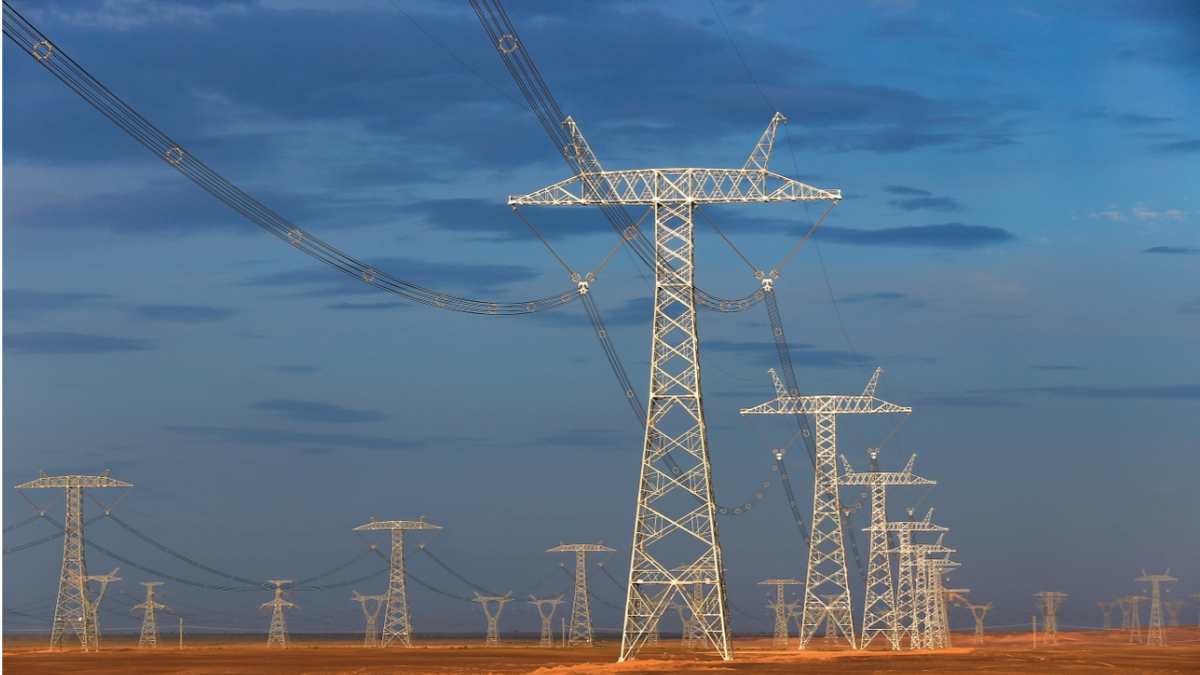
BEIJING, Jan. 17 (Xinhua) -- China's total electricity consumption reached a milestone in 2025, surpassing 10 trillion kilowatt-hours for the first time, the National Energy Administration (NEA) announced on Saturday.

Total power use in China hit 10.4 trillion kilowatt-hours last year, representing a year-on-year increase of 5 percent, according to NEA data.

This volume also makes China the first country to surpass the 10-trillion-kWh mark in annual power use, more than doubling that of the United States and exceeding the combined power consumption of the EU, Russia, India and Japan, said the NEA.
 

China’s record trade surplus is as big as the economies of most countries

China’s $1.19 trillion trade surplus for 2025 is the largest on record for any economy.​

By Jules Rimmer
Jan. 14, 2026 at 5:37 a.m. ET

As the world becomes more protectionist, China will have to adapt its export-driven growth model and seek to develop its domestic economy

Despite the start of a Sino-American trade war proper in April last year, China still managed to generate the biggest trade surplus in history.

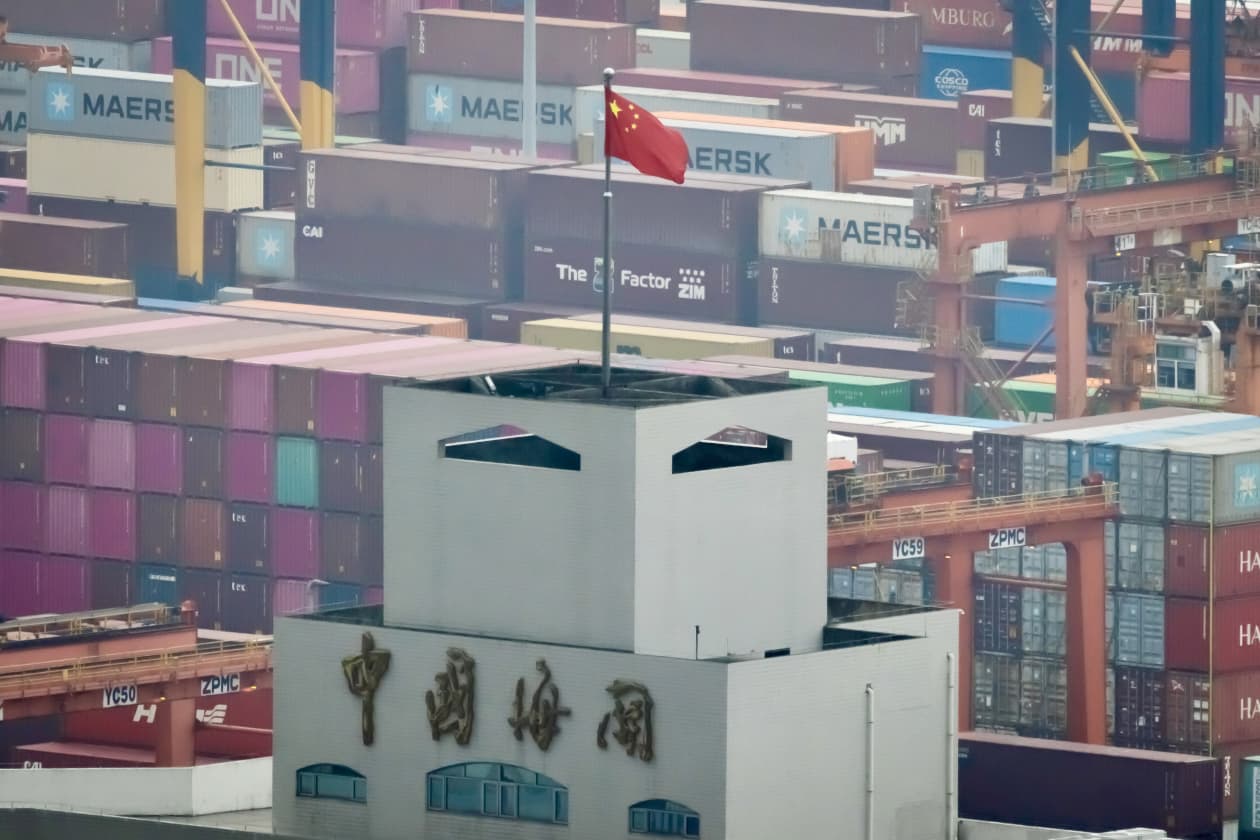
The Chinese government on Wednesday said its exports exceeded imports by $1.19 trillion, up almost 20% on a year-over-year basis and demonstrating China’s ability to realign its export markets.

The full-year trade surplus came in at $1.189tn – a figure on par with the GDP of a top-20 economy globally like Saudi Arabia – customs data showed on Wednesday, having broken the trillion-dollar ceiling for the first time in November.


Russia-China Trade Dips as Global Challenges Mount​

  • 14 Jan, 22:09
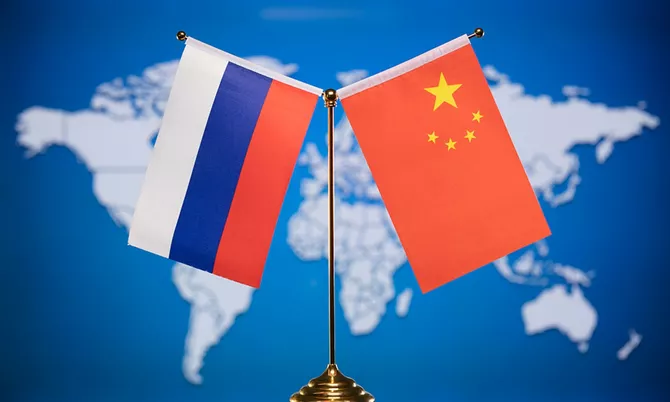
Trade turnover between Russia and China declined by 6.9% year-on-year in 2025, reaching $228.105 billion, Alexey Dakhnovsky, Russia’s Trade Representative to China, announced, citing Chinese customs data.

“The reasons for this decline are quite clear. I’ll just name a few: unprecedented external pressure from the West, falling prices for goods that form the core of Russian exports to China, high borrowing costs in Russia, slowing growth in certain sectors of the Chinese economy, and the supply of the Russian market with Chinese products. Beyond specific factors, it is also important to recognize the rapid dynamics of current changes in global politics, economics, and other areas,” Dakhnovsky said, The Caspian Post reports, citing TASS.

Despite the decline, he emphasized that Russia remains among China’s top five trading partners.

Dakhnovsky noted that Russia-China relations must be understood in context. The rapid growth in bilateral trade turnover between 2022 and 2024 was largely driven by Chinese products filling niches left in Russia after the withdrawal of Western companies. That period of accelerated growth has now ended, as objective conditions have shifted.

“Some volatility in trade is therefore inevitable. While overall indicators declined last year, we observed gradual improvement during specific months, and Russian exports to China remained consistently positive during each of the last four months,” he added.

The official highlighted that, despite multiple challenges, Russia and China have strengthened trade and economic ties and developed new formats of cooperation.

“If we assess the past year in terms of trade and economic cooperation, it is notable that, despite the significant impact of various negative factors, the countries managed to maintain stability in bilateral trade, strengthen relations, and develop new models of cooperation,” Dakhnovsky said.

He further emphasized that Russia and China have fully transitioned to using national currencies in mutual trade. Industrial and technological cooperation has also expanded, with both sides steadily increasing contacts in these sectors. A key factor in mitigating negative scenarios has been the creativity, activity, and flexibility of businesses, which facilitated the growth of joint projects and exchange intensity. Dakhnovsky particularly commended small and medium-sized companies for showing entrepreneurial courage and initiative, opening new niches and regions despite difficulties.


The End of Easy Growth: Structural Lessons from the 2025 Russia-China Trade Decline​

January 17, 2026

This article was written by KP Mazumdar, a geostrategic and geo economics analyst whose work has been widely published by prestigious international news organizations and publications.

In 2025, Russia-China trade entered a new and more complex phase. After four consecutive years of uninterrupted expansion, bilateral trade turnover declined for the first time since the covid pandemic in 2020. According to Chinese customs data cited by Russia’s Trade Representative to China Alexey Dakhnovsky, two-way trade fell by 6.9% year-on-year, reaching US$228.105 billion. In yuan terms, trade decreased by 6.5%, from a record 1.74 trillion yuan in 2024 to approximately 1.63 trillion yuan in 2025.

At first glance, the decline appears modest. In absolute terms, trade volumes remain historically high. Yet for policymakers and business leaders in both Moscow and Beijing, the symbolic meaning is far more significant than the numerical drop. The slowdown has raised fundamental questions about the sustainability, structure, and future direction of the Russia-China economic partnership at a time when both countries are navigating prolonged geopolitical pressure, global economic fragmentation, and structural transformation of their domestic economies.

The 2025 figures do not indicate a political weakening of bilateral relations. Instead, they reveal deeper economic and structural frictions that have accumulated beneath the surface of rapid trade growth since 2022. Understanding these underlying dynamics is essential if Russia and China are to move from a phase of emergency-driven trade expansion toward a more balanced, resilient, and innovation-oriented economic partnership.

From Sanctions Shock to Structural Plateau​

Following the escalation of Western sanctions in 2022, China became Russia’s principal economic stabilizer. Energy exports were redirected eastward at unprecedented speed. Chinese manufacturers filled gaps left by Western suppliers. Bilateral trade surged from US $147 billion in 2021 to over US $240 billion in 2024, transforming China into Russia’s largest trading partner by a wide margin. However, this rapid expansion was largely quantitative rather than qualitative. Trade growth was driven overwhelmingly by three factors: discounted Russian energy exports, surging Chinese vehicle and machinery supplies, and emergency substitution of Western imports. By 2024, this model had largely exhausted its immediate momentum. In 2025, the partnership encountered what economists describe as a “structural plateau”-a phase where further growth cannot be achieved simply by increasing volumes under existing trade patterns.

Commodity Price Dynamics​


Value Declines Without Volume Collapse​

One of the most important-yet often misunderstood-contributors to the 2025 decline was commodity pricing rather than physical trade disruption. Chinese customs data for the first eleven months of 2025 show that the value of crude oil imports from Russia fell by nearly 19.6% year-on-year to 328.5 billion yuan. This decline occurred despite relatively stable shipment volumes. The explanation lies in global oil price dynamics. Compared with the elevated price environment of 2023–2024, benchmark crude prices softened throughout much of 2025 due to weaker global demand growth, increased supply, and cautious energy consumption in major economies.

Russia is in negotiations with Beijing to potentially resume power supply to China, the Russian Energy Ministry stated on January 16, after a Russian media report said that China halted electricity imports from Russia due to high prices. On January 16, Russia reported that China had stopped buying electricity from Russia.

The Chinese refusal to buy Russian electricity was the result of high Russian export prices, which in 2026 topped the domestic power prices in China for the first time. For Russia, this created a paradoxical situation: energy exports to China remained strategically vital and physically robust yet generated lower export revenues in nominal terms. As energy still constitutes a dominant share of Russian exports to China, price movements translated directly into headline trade statistics. This highlights a core vulnerability of the bilateral trade structure: excessive dependence on price-sensitive raw materials rather than value-added products.

Automotive Rebalancing​

Another major factor behind the decline was the sharp contraction in Chinese vehicle exports to Russia. Between 2022 and 2024, Chinese automobile manufacturers rapidly captured market share in Russia following the withdrawal of Western and Japanese brands. By mid-2024, Chinese brands accounted for more than half of new car sales in the Russian market. However, by 2025, the phase of rapid substitution had ended.

According to data from the China Passenger Car Association, Chinese vehicle exports to Russia in volume terms fell by approximately 46% year-on-year during January-November 2025. This was not the result of political friction, but of deliberate Russian industrial policy adjustments. Moscow introduced higher recycling fees and localization incentives aimed at protecting domestic production and encouraging joint manufacturing rather than pure imports. The policy reflects Russia’s broader strategy of avoiding long-term dependence on finished imports and instead rebuilding domestic industrial capacity. While economically rational from Russia’s perspective, the transition inevitably reduced short-term trade volumes and exposed the limits of an import-driven trade expansion model.

Electricity​

The suspension of electricity imports by China from January 2026 further illustrates the increasingly economic rather than political nature of bilateral trade decisions. China halted power imports from Russia, including even minimal contracted volumes of around 12 megawatts. This decision was influenced by three practical considerations.

First, rising domestic electricity demand in Russia’s Far East constrained available export capacity. Second, export prices exceeded China’s domestic electricity tariffs, making imports commercially unattractive. Third, China’s own power generation capacity particularly renewables and coal-based generation continued to expand, reducing reliance on imported electricity. While electricity represents a small share of total trade, the episode carries symbolic importance. It demonstrates that the Russia–China economic relationship is increasingly governed by market logic rather than political symbolism- a sign of maturity, but also of rising competitive pressure.

Russia and China should adjust the electricity price formula in order that exports remain cheaper than China’s domestic power. Russia must first secure enough electricity for the Far East before resuming large-scale exports. Electricity trade should be flexible and based on real demand rather than fixed volumes. Both sides need closer coordination on regional energy planning to avoid supply disruptions. Cooperation should expand beyond power exports to joint energy infrastructure projects.

Settlement Mechanisms​

Significant progress has been made in de-dollarization. By late 2025, more than 95% of bilateral trade settlements were conducted in rubles and yuan. This represents a major institutional achievement. The Bank of Russia sold yuan on the domestic market with settlement on January 15, 2026, totaling ₽10.2 billion (US$130.9 million), according to data published on the regulator’s website. The volume of currency sales on the domestic market with settlement on January 14, 2026, also amounted to ₽10.2 billion. Yet settlement challenges remain.

Russian companies frequently face difficulties repatriating yuan revenues or deploying them efficiently within domestic financial markets. Chinese banks, while active, continue to apply heightened compliance scrutiny due to secondary sanctions risks. Liquidity depth in ruble-yuan instruments remains insufficient for large-scale corporate hedging. These frictions do not halt trade, but they slow transaction cycles, raise costs, and discourage small and medium-sized enterprises from entering bilateral commerce. As trade matures, financial infrastructure not political alignment is becoming the principal bottleneck.

Demand Shifts Inside China​

Another underappreciated factor behind the 2025 slowdown is changing demand composition within China itself. China’s economy in 2025 operated under conditions of moderate growth, subdued consumer confidence, and ongoing industrial upgrading. Demand increasingly shifted toward high-tech inputs, advanced materials, and specialized components-areas where Russian exports remain limited. While China continues to import Russian oil, gas, coal, and agricultural products, its long-term demand growth lies increasingly in sectors such as semiconductors, advanced manufacturing equipment, digital infrastructure, and green technologies. This structural divergence highlights a critical challenge: Russia’s export profile to China has not yet evolved at the same pace as China’s economic transformation.

10 Structural Lessons from the 2025 Russia-China Trade Decline​

By identifying ten key structural lessons from the 2025 Russia-China trade decline, policymakers can better understand existing constraints and design measures to support sustainable bilateral trade growth

1.Emergency-driven trade expansion has natural limits

The rapid growth of Russia-China trade after 2022 was largely driven by geopolitical shock and forced market redirection. Once substitution demand was satisfied, growth inevitably slowed. Sustainable trade cannot rely indefinitely on crisis conditions.

2.Commodity dependence amplifies price volatility risks

Even stable export volumes failed to prevent trade value decline in 2025. This confirms that excessive reliance on oil, gas, and coal exposes bilateral trade to global price cycles beyond the control of either side.

3.Trade volume does not equal trade resilience

Record figures in 2024 masked underlying fragility. Without diversification, high nominal trade turnover offers limited protection against external shocks, price corrections, and demand shifts.

4.Import substitution policies reshape trade flows

Russia’s industrial protection measures particularly in the automotive sector reduced short-term imports but serve longer-term goals of localization and technological sovereignty. Trade growth and industrial policy do not always move in parallel.

5.Market economics increasingly outweigh political symbolism

China’s suspension of electricity imports demonstrates that bilateral trade decisions are now guided primarily by pricing, efficiency, and domestic supply conditions, not political alignment.

6.Financial infrastructure lags behind trade ambitions

While national-currency settlements expanded rapidly, insufficient liquidity depth, compliance caution, and limited hedging tools continue to constrain transaction efficiency and corporate participation.

7.China’s demand structure is evolving faster than Russia’s export profile

As China advances toward high-tech and advanced manufacturing, demand growth increasingly favors sophisticated inputs -an area where Russian exports remain underdeveloped.

8.Logistics and eastern infrastructure remain structural bottlenecks

Rail capacity limits, port congestion, and uneven development in Russia’s Far East restrict the scalability of trade expansion, especially for non-energy goods.

9.Trade growth without investment integration is unsustainable

Pure export–import expansion has reached its ceiling. Future growth depends on joint ventures, localized production, and shared industrial ecosystems rather than cross-border shipments alone.

10.The partnership is entering a maturity phase, not a decline

The 2025 slowdown reflects normalization rather than deterioration. Strategic relations remain strong, but economic cooperation must transition from quantitative acceleration to qualitative deepening.

Why the Russia-China Trade Decline Should Not Be Overinterpreted​

Despite the negative headline figures, the 2025 decline does not signal a strategic weakening of Russia-China economic relations. On the contrary, several indicators suggest underlying resilience.

In December 2025, Chinese exports to Russia rose by 2.2%, ending an eight-month contraction, while imports from Russia surged by over 17%. This rebound suggests stabilization rather than deterioration. Moreover, during President Vladimir Putin’s visit to Beijing in September, the two countries signed more than 20 cooperation agreements spanning energy, aerospace, artificial intelligence, agriculture, and industrial technology. The endorsement of the Power of Siberia-2 gas pipeline with a potential capacity of 50 billion cubic meters annually underscores long-term strategic commitment. The challenge, therefore, is not political alignment, but economic modernization of the partnership.

Toward a Second Phase of Integration​

The post-2022 phase of Russia-China trade was largely reactive shaped by sanctions, urgency, and rapid substitution. The next phase must be proactive, structured, and investment-driven. For policymakers in both countries, several strategic directions are becoming increasingly clear.

First, trade diversification is no longer optional. Expanding exports beyond hydrocarbons and basic commodities is essential for stabilizing trade value against price cycles. This includes petrochemicals, fertilizers with higher processing depth, advanced agricultural products, nuclear technology services, and industrial equipment.

Second, joint industrial production must replace pure trade flows. Localized manufacturing of Chinese machinery and vehicles in Russia through joint ventures would reduce volatility while aligning with Russia’s industrial policy goals and China’s overseas production strategy.

Third, energy cooperation must shift from volume-centric to system-centric models. Long-term contracts, flexible pricing formulas, gas-to-chemicals projects, LNG cooperation, and cross-border energy infrastructure offer more stability than spot-price-dependent exports.

Fourth, settlement infrastructure requires institutional deepening. Expanding direct ruble–yuan liquidity pools, enhancing clearing mechanisms, and creating dedicated bilateral financial platforms would reduce friction and improve trade efficiency.

Fifth, regional integration frameworks deserve greater operational coordination. Aligning the Eurasian Economic Union with China’s Belt and Road Initiative not rhetorically but institutionally could unlock logistics, customs harmonization, and industrial corridor development across Central Eurasia.

Strategic Implications for Eurasia​

The 2025 trade slowdown also reflects a broader reality: Russia-China economic relations are entering a normalization phase. Emergency growth driven by geopolitical rupture has given way to strategic calculation. This transition is inevitable and, if managed correctly, healthy. For Russia, the task is to avoid remaining a commodity appendage and instead integrate into Asian value chains at higher levels. For China, the challenge lies in balancing economic pragmatism with strategic partnership amid complex global pressures. Neither objective can be achieved through trade volume alone. The future of Russia-China economic cooperation will be determined less by customs statistics and more by investment quality, industrial depth, financial architecture, and technological cooperation.

Summary​

The decline of Russia–China trade during 2025 should not be viewed as a failure, but as a signal. It marks the end of the first, rapid-expansion phase of bilateral economic realignment and the beginning of a more demanding second phase- one that requires structural reform, policy coordination, and long-term vision. If policymakers respond with strategic patience rather than alarm, the temporary contraction may ultimately serve as a catalyst for a more balanced, resilient, and future-oriented partnership. In this sense, the most important outcome of the 2025 trade figures is not what they reveal about the past – but what they demand for the future.
 
What 'problem' do you mean?


It's winter, so it's pretty cold in the mountains. I was lucky that most shots I took had little to no tourists hehe.

View attachment 172720
It is friggin cold, nobody goes out. Malls being empty? Depends on which mall, the good ones will survive, same as the US and Singapore. The rest are turned into education malls, or storage malls. Anyway, the real reason it is quiet is due to winter. Pessimissm? Chinese are always pessimistic, ever since 2016, it has been 10 years my man.

Try going to the South now and see if you see people. I went to the great wall last year not during holidays but on a typical weekend, it was jam packed. Neijuan is real because of intense competition due to population size. That's why I sau any Chinese going out will kill the local populace. One average smart Chinese kid going to SIngapore can essentially be the top student there. Imagine hundreds going to SIngapore, Raffles Institution will be monopolized by mainlanders.
 
Last edited:

The End of Easy Growth: Structural Lessons from the 2025 Russia-China Trade Decline​

January 17, 2026

This article was written by KP Mazumdar, a geostrategic and geo economics analyst whose work has been widely published by prestigious international news organizations and publications.

In 2025, Russia-China trade entered a new and more complex phase. After four consecutive years of uninterrupted expansion, bilateral trade turnover declined for the first time since the covid pandemic in 2020. According to Chinese customs data cited by Russia’s Trade Representative to China Alexey Dakhnovsky, two-way trade fell by 6.9% year-on-year, reaching US$228.105 billion. In yuan terms, trade decreased by 6.5%, from a record 1.74 trillion yuan in 2024 to approximately 1.63 trillion yuan in 2025.

At first glance, the decline appears modest. In absolute terms, trade volumes remain historically high. Yet for policymakers and business leaders in both Moscow and Beijing, the symbolic meaning is far more significant than the numerical drop. The slowdown has raised fundamental questions about the sustainability, structure, and future direction of the Russia-China economic partnership at a time when both countries are navigating prolonged geopolitical pressure, global economic fragmentation, and structural transformation of their domestic economies.

The 2025 figures do not indicate a political weakening of bilateral relations. Instead, they reveal deeper economic and structural frictions that have accumulated beneath the surface of rapid trade growth since 2022. Understanding these underlying dynamics is essential if Russia and China are to move from a phase of emergency-driven trade expansion toward a more balanced, resilient, and innovation-oriented economic partnership.

From Sanctions Shock to Structural Plateau​

Following the escalation of Western sanctions in 2022, China became Russia’s principal economic stabilizer. Energy exports were redirected eastward at unprecedented speed. Chinese manufacturers filled gaps left by Western suppliers. Bilateral trade surged from US $147 billion in 2021 to over US $240 billion in 2024, transforming China into Russia’s largest trading partner by a wide margin. However, this rapid expansion was largely quantitative rather than qualitative. Trade growth was driven overwhelmingly by three factors: discounted Russian energy exports, surging Chinese vehicle and machinery supplies, and emergency substitution of Western imports. By 2024, this model had largely exhausted its immediate momentum. In 2025, the partnership encountered what economists describe as a “structural plateau”-a phase where further growth cannot be achieved simply by increasing volumes under existing trade patterns.

Commodity Price Dynamics​


Value Declines Without Volume Collapse​

One of the most important-yet often misunderstood-contributors to the 2025 decline was commodity pricing rather than physical trade disruption. Chinese customs data for the first eleven months of 2025 show that the value of crude oil imports from Russia fell by nearly 19.6% year-on-year to 328.5 billion yuan. This decline occurred despite relatively stable shipment volumes. The explanation lies in global oil price dynamics. Compared with the elevated price environment of 2023–2024, benchmark crude prices softened throughout much of 2025 due to weaker global demand growth, increased supply, and cautious energy consumption in major economies.

Russia is in negotiations with Beijing to potentially resume power supply to China, the Russian Energy Ministry stated on January 16, after a Russian media report said that China halted electricity imports from Russia due to high prices. On January 16, Russia reported that China had stopped buying electricity from Russia.

The Chinese refusal to buy Russian electricity was the result of high Russian export prices, which in 2026 topped the domestic power prices in China for the first time. For Russia, this created a paradoxical situation: energy exports to China remained strategically vital and physically robust yet generated lower export revenues in nominal terms. As energy still constitutes a dominant share of Russian exports to China, price movements translated directly into headline trade statistics. This highlights a core vulnerability of the bilateral trade structure: excessive dependence on price-sensitive raw materials rather than value-added products.

Automotive Rebalancing​

Another major factor behind the decline was the sharp contraction in Chinese vehicle exports to Russia. Between 2022 and 2024, Chinese automobile manufacturers rapidly captured market share in Russia following the withdrawal of Western and Japanese brands. By mid-2024, Chinese brands accounted for more than half of new car sales in the Russian market. However, by 2025, the phase of rapid substitution had ended.

According to data from the China Passenger Car Association, Chinese vehicle exports to Russia in volume terms fell by approximately 46% year-on-year during January-November 2025. This was not the result of political friction, but of deliberate Russian industrial policy adjustments. Moscow introduced higher recycling fees and localization incentives aimed at protecting domestic production and encouraging joint manufacturing rather than pure imports. The policy reflects Russia’s broader strategy of avoiding long-term dependence on finished imports and instead rebuilding domestic industrial capacity. While economically rational from Russia’s perspective, the transition inevitably reduced short-term trade volumes and exposed the limits of an import-driven trade expansion model.

Electricity​

The suspension of electricity imports by China from January 2026 further illustrates the increasingly economic rather than political nature of bilateral trade decisions. China halted power imports from Russia, including even minimal contracted volumes of around 12 megawatts. This decision was influenced by three practical considerations.

First, rising domestic electricity demand in Russia’s Far East constrained available export capacity. Second, export prices exceeded China’s domestic electricity tariffs, making imports commercially unattractive. Third, China’s own power generation capacity particularly renewables and coal-based generation continued to expand, reducing reliance on imported electricity. While electricity represents a small share of total trade, the episode carries symbolic importance. It demonstrates that the Russia–China economic relationship is increasingly governed by market logic rather than political symbolism- a sign of maturity, but also of rising competitive pressure.

Russia and China should adjust the electricity price formula in order that exports remain cheaper than China’s domestic power. Russia must first secure enough electricity for the Far East before resuming large-scale exports. Electricity trade should be flexible and based on real demand rather than fixed volumes. Both sides need closer coordination on regional energy planning to avoid supply disruptions. Cooperation should expand beyond power exports to joint energy infrastructure projects.

Settlement Mechanisms​

Significant progress has been made in de-dollarization. By late 2025, more than 95% of bilateral trade settlements were conducted in rubles and yuan. This represents a major institutional achievement. The Bank of Russia sold yuan on the domestic market with settlement on January 15, 2026, totaling ₽10.2 billion (US$130.9 million), according to data published on the regulator’s website. The volume of currency sales on the domestic market with settlement on January 14, 2026, also amounted to ₽10.2 billion. Yet settlement challenges remain.

Russian companies frequently face difficulties repatriating yuan revenues or deploying them efficiently within domestic financial markets. Chinese banks, while active, continue to apply heightened compliance scrutiny due to secondary sanctions risks. Liquidity depth in ruble-yuan instruments remains insufficient for large-scale corporate hedging. These frictions do not halt trade, but they slow transaction cycles, raise costs, and discourage small and medium-sized enterprises from entering bilateral commerce. As trade matures, financial infrastructure not political alignment is becoming the principal bottleneck.

Demand Shifts Inside China​

Another underappreciated factor behind the 2025 slowdown is changing demand composition within China itself. China’s economy in 2025 operated under conditions of moderate growth, subdued consumer confidence, and ongoing industrial upgrading. Demand increasingly shifted toward high-tech inputs, advanced materials, and specialized components-areas where Russian exports remain limited. While China continues to import Russian oil, gas, coal, and agricultural products, its long-term demand growth lies increasingly in sectors such as semiconductors, advanced manufacturing equipment, digital infrastructure, and green technologies. This structural divergence highlights a critical challenge: Russia’s export profile to China has not yet evolved at the same pace as China’s economic transformation.

10 Structural Lessons from the 2025 Russia-China Trade Decline​

By identifying ten key structural lessons from the 2025 Russia-China trade decline, policymakers can better understand existing constraints and design measures to support sustainable bilateral trade growth

1.Emergency-driven trade expansion has natural limits

The rapid growth of Russia-China trade after 2022 was largely driven by geopolitical shock and forced market redirection. Once substitution demand was satisfied, growth inevitably slowed. Sustainable trade cannot rely indefinitely on crisis conditions.

2.Commodity dependence amplifies price volatility risks

Even stable export volumes failed to prevent trade value decline in 2025. This confirms that excessive reliance on oil, gas, and coal exposes bilateral trade to global price cycles beyond the control of either side.

3.Trade volume does not equal trade resilience

Record figures in 2024 masked underlying fragility. Without diversification, high nominal trade turnover offers limited protection against external shocks, price corrections, and demand shifts.

4.Import substitution policies reshape trade flows

Russia’s industrial protection measures particularly in the automotive sector reduced short-term imports but serve longer-term goals of localization and technological sovereignty. Trade growth and industrial policy do not always move in parallel.

5.Market economics increasingly outweigh political symbolism

China’s suspension of electricity imports demonstrates that bilateral trade decisions are now guided primarily by pricing, efficiency, and domestic supply conditions, not political alignment.

6.Financial infrastructure lags behind trade ambitions

While national-currency settlements expanded rapidly, insufficient liquidity depth, compliance caution, and limited hedging tools continue to constrain transaction efficiency and corporate participation.

7.China’s demand structure is evolving faster than Russia’s export profile

As China advances toward high-tech and advanced manufacturing, demand growth increasingly favors sophisticated inputs -an area where Russian exports remain underdeveloped.

8.Logistics and eastern infrastructure remain structural bottlenecks

Rail capacity limits, port congestion, and uneven development in Russia’s Far East restrict the scalability of trade expansion, especially for non-energy goods.

9.Trade growth without investment integration is unsustainable

Pure export–import expansion has reached its ceiling. Future growth depends on joint ventures, localized production, and shared industrial ecosystems rather than cross-border shipments alone.

10.The partnership is entering a maturity phase, not a decline

The 2025 slowdown reflects normalization rather than deterioration. Strategic relations remain strong, but economic cooperation must transition from quantitative acceleration to qualitative deepening.

Why the Russia-China Trade Decline Should Not Be Overinterpreted​

Despite the negative headline figures, the 2025 decline does not signal a strategic weakening of Russia-China economic relations. On the contrary, several indicators suggest underlying resilience.

In December 2025, Chinese exports to Russia rose by 2.2%, ending an eight-month contraction, while imports from Russia surged by over 17%. This rebound suggests stabilization rather than deterioration. Moreover, during President Vladimir Putin’s visit to Beijing in September, the two countries signed more than 20 cooperation agreements spanning energy, aerospace, artificial intelligence, agriculture, and industrial technology. The endorsement of the Power of Siberia-2 gas pipeline with a potential capacity of 50 billion cubic meters annually underscores long-term strategic commitment. The challenge, therefore, is not political alignment, but economic modernization of the partnership.

Toward a Second Phase of Integration​

The post-2022 phase of Russia-China trade was largely reactive shaped by sanctions, urgency, and rapid substitution. The next phase must be proactive, structured, and investment-driven. For policymakers in both countries, several strategic directions are becoming increasingly clear.

First, trade diversification is no longer optional. Expanding exports beyond hydrocarbons and basic commodities is essential for stabilizing trade value against price cycles. This includes petrochemicals, fertilizers with higher processing depth, advanced agricultural products, nuclear technology services, and industrial equipment.

Second, joint industrial production must replace pure trade flows. Localized manufacturing of Chinese machinery and vehicles in Russia through joint ventures would reduce volatility while aligning with Russia’s industrial policy goals and China’s overseas production strategy.

Third, energy cooperation must shift from volume-centric to system-centric models. Long-term contracts, flexible pricing formulas, gas-to-chemicals projects, LNG cooperation, and cross-border energy infrastructure offer more stability than spot-price-dependent exports.

Fourth, settlement infrastructure requires institutional deepening. Expanding direct ruble–yuan liquidity pools, enhancing clearing mechanisms, and creating dedicated bilateral financial platforms would reduce friction and improve trade efficiency.

Fifth, regional integration frameworks deserve greater operational coordination. Aligning the Eurasian Economic Union with China’s Belt and Road Initiative not rhetorically but institutionally could unlock logistics, customs harmonization, and industrial corridor development across Central Eurasia.

Strategic Implications for Eurasia​

The 2025 trade slowdown also reflects a broader reality: Russia-China economic relations are entering a normalization phase. Emergency growth driven by geopolitical rupture has given way to strategic calculation. This transition is inevitable and, if managed correctly, healthy. For Russia, the task is to avoid remaining a commodity appendage and instead integrate into Asian value chains at higher levels. For China, the challenge lies in balancing economic pragmatism with strategic partnership amid complex global pressures. Neither objective can be achieved through trade volume alone. The future of Russia-China economic cooperation will be determined less by customs statistics and more by investment quality, industrial depth, financial architecture, and technological cooperation.

Summary​

The decline of Russia–China trade during 2025 should not be viewed as a failure, but as a signal. It marks the end of the first, rapid-expansion phase of bilateral economic realignment and the beginning of a more demanding second phase- one that requires structural reform, policy coordination, and long-term vision. If policymakers respond with strategic patience rather than alarm, the temporary contraction may ultimately serve as a catalyst for a more balanced, resilient, and future-oriented partnership. In this sense, the most important outcome of the 2025 trade figures is not what they reveal about the past – but what they demand for the future.
The expansion of trades were driven by the war against Ukraine. Oil, gas became expensive Putin war machine got flooded by cash. He feels rich. Now things return to normal level.
That will only get worse from here for the Russians. There are plenty of oil and gas on the market. Trump will pump oil without tomorrow out of Venezuela.
 
Easy fix, awarding parents a free house for each new born baby, all low income couples will quit their jobs right away and focus on making babies. An easy shortcut to get rich.
That option was tried by both the Soviet Union and later Russia but without success. Russia is in an irreversible demographic extinction mode.

By the way Pakistan needs China's help to lower birth rates. One child policy for Pakistan.
 

Users who are viewing this thread

Pakistan Defence Latest

Latest Posts

Back
Top