Chinese Economy: General News, Updates and Discussions

Chinas GDP declined to $17.7T, and population decline of 2 million

In nominal dollar terms, it appears true:
https://www.imf.org/en/Publications...H,NGDP,NGDPD,PPPGDP,NGDP_D,NGDPRPC,NGDPRPPPPC, NGDPPC,NGDPDPC,PPPPC,PPPSH,PPPEX,NID_NGDP,NGSD_NGDP,PCPI,PCPIPCH,PCPIE,PCPIEPCH,TM_RPCH,TMG_RPCH,TX_RPCH,TXG_RPCH,LUR,LP,GGR,GGR_NGDP,GGX,GGX_NGDP,GGXCNL,GGXCNL_NGDP,GGSB,GGSB_NPGDP, GGXONLB,GGXONLB_NGDP,GGXWDG,GGXWDG_NGDP,NGDP_FY,BCA,BCA_NGDPD,&sy=2021&ey=2028&ssm=0&scsm=1&scc=0&ssd=1&ssc=0&sic=0&sort=country&ds=.&br=1
1.JPG
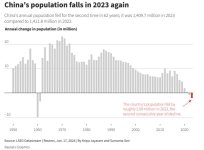
The issue of demographics seems increasingly worse:
2.JPG
 

China’s economy is now a staggering 22% bigger than America’s, but for differing reasons, neither nation wants to acknowledge this fact​

And why is the European Union passing up the opportunity to increase its share of this growing pie?​

Dec 14, 2023

1*lHNOKrvwhiz557g75BBijA.png

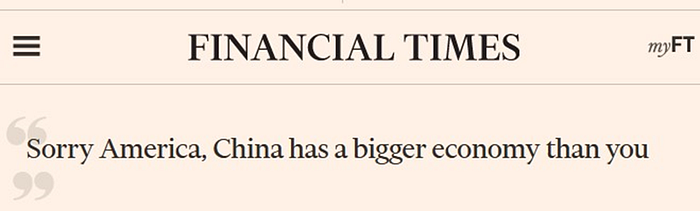
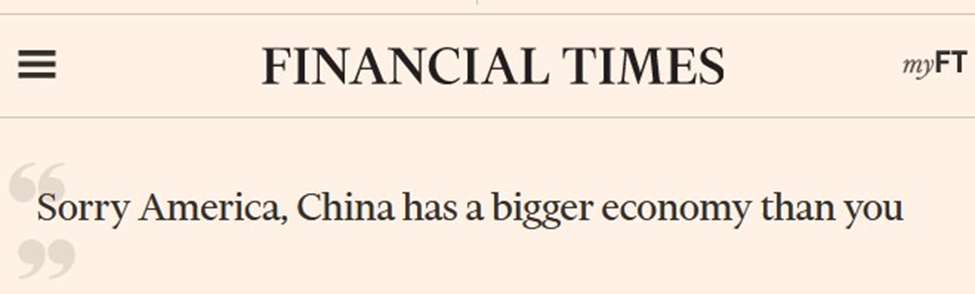
In a December 2023 article titled “Sorry America, China has a bigger economy than you” (see screenshot above), the Financial Times notes that China’s economy is bigger than America’s in real terms, or in the only terms that matter, purchasing power parity, based on the latest IMF data.

Its economy had already exceeded the size of America’s during the time President Trump tried to “make America great again.” Not even Trump’s and his successor Biden’s all-out economic war against China, which ranges from cotton and tomatoes to services and high-tech products, has been able to halt, let alone reverse, the ever-growing inequality. And now the Chinese economy is a remarkable 22% larger.

In 2010, China surpassed the United States in the generation of electricity. During the period from 2016–2022, the Chinese economy was supposedly making no progress compared with the U.S. but in reality, throughout that time, it saw a 45% increase in power generation, while the US saw essentially stagnant growth. In view of the proven positive correlation between energy production and economic growth, this is a further indication of the increasing discrepancies between the two economies.

0*DLOQ-TrGLIZnemgV

The American Scheer Post explains that the real “threat” from China is that it is better at capitalism than America (Screenshot Scheer Post)
The focus of every recent item in the mainstream Western media in China was its economic issues. As things stand, China’s economy is still growing — and expanding more quickly than that of the US and the rest of the West. As with any economy, China undoubtedly faces its fair share of challenges, but the balance of economic power is still moving in its favor.
0*w-zlve__hYSzGR3x

The treatment of the socially weak and the impoverished is one aspect in which American and Chinese capitalism clearly differ.
Neither China nor the U.S. acknowledge this shift in global economic power. The author of the article in Britain’s leading economic and financial newspaper wrote: “Coming from the United Kingdom which lost its economic gold status in the late 19th century which still has some delusions of grandeur I can understand American denialism. For China, it is also easier to avoid responsibilities for climate change, debt relief, and other global goods” if it still can keep a lesser status.

He concludes that false comparisons lead to flawed decisions which ultimately will be made at the expense of America (and the rest of the West).

It is the rise of China over the last 30 years that has changed the global economic landscape and captivated other economies. The US-led collective West cannot reverse this, no matter how many resources it wastes on efforts to do so.

1*yTUsMtMBkpeVYnTUkHpt7Q.png

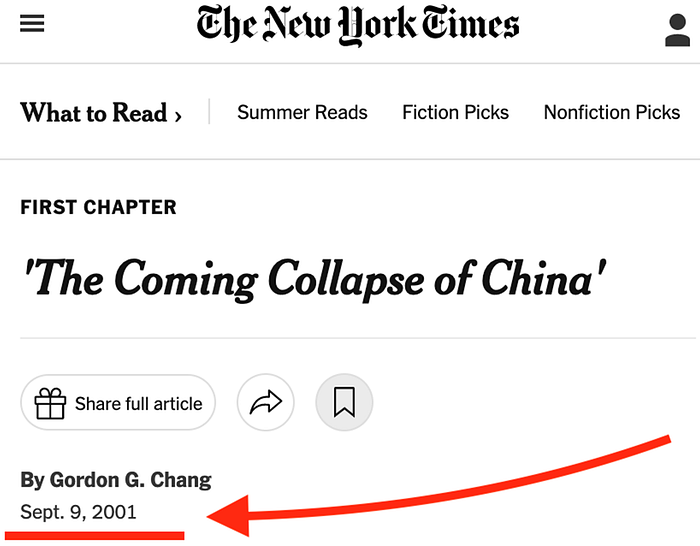
Gordon G. Chang is often portrayed in the American mainstream media as a preeminent “expert” on China. China must rejoice at his lack of judgment, for it confirms Sun Tzu’s strategic principle of pretending to be inferior (卑則驕之) or allowing others to pretend to be inferior while fueling the hubris of US adversaries at their expense. (Screenshot New York Times)
The worst is still to come for the misguided Americans who have spent decades being brainwashed into thinking they live in God’s own country, the best country in the world, and that they and their nation are unique.

Given that Chinese per capita income is currently far lower than that of Americans, the country’s economy has enormous unrealized potential to grow to be far larger than America’s.

The average disposable income of the Chinese in 2022 was 36,883 yuan (USD 5,153), compared to the average disposable income of Americans of USD 15,126, i.e. only nominally, not in real terms, already around three times as high.

Apart from the considerable risks arising from the high level of debt and other structural weaknesses in the US economy, it is largely saturated. China already has the world’s largest middle class, which, as in India, will continue to grow strongly. In addition, the income of a Chinese middle-class family is still far below the average of an American middle-class family, even if the trend there is going in the opposite direction, i.e. downwards.

So unlike the US, China’s economy can still take a big leap forward, or rather, upward, thanks in part to its solid public finances and the lack of need to finance expensive wars and maintain 800 military bases around the world. And in order to get a grip on and solve the real estate crisis, which it is tackling proactively, the Chinese government does not have to fire up the inflationary money printing presses but can dig deep into its pockets.

1*_nYVtwCo4M3mumeE5YmrAQ.png
 
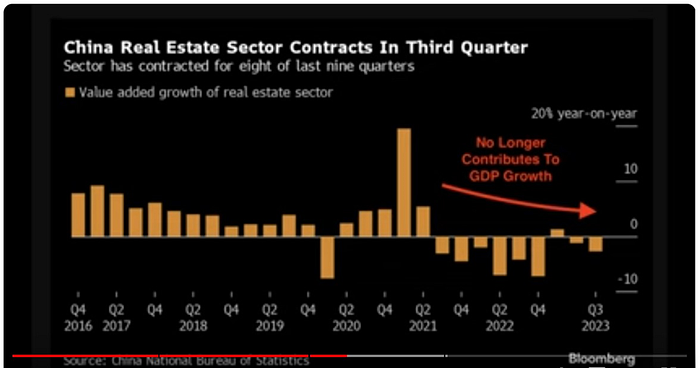
The real estate sector no longer plays an important role in the Chinese economy and no longer has the potential to drag it into the abyss. (Source: Bloomberg)
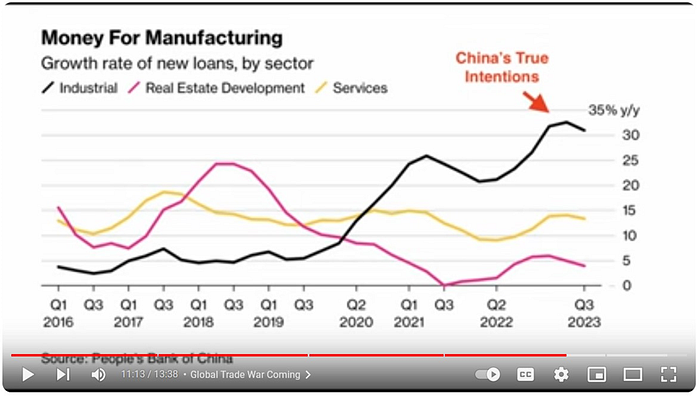
Let’s stay with the real estate crisis for a moment. The real estate bubble and the associated shadow banking system as well as ever more “sanctions” against their technology sector have taught the Chinese a lesson: Leave the real estate sector behind, go full throttle into the technologies of the future. Propping up the real estate market forever is a losing battle. In other words, it drags down the economy as a whole. If you keep propping up the real estate market, it’s almost guaranteed that more bubbles will form and there will be a bigger crash because people are speculating; it’s just human nature.

1*5ON1gRB1fvfQAA_nOuVlIA.png

Instead of investing in real estate, which is a zombie economy, China is now investing in the future. Real estate lending is in sharp decline, as can be seen in this chart. The real estate crisis has been used by China as an opportunity to destroy the old economy and replace it with a more sustainable, future-oriented economy. (Source: People’s Bank of China)

Bloomberg News confirmed this when they reported on January 8, 2024 about “China’s shift to high value-added manufacturing” (to which the West would once again respond with an intensified trade war).

It is understandable that the Americans are struggling with the loss of their global dominance and are hardly able or willing to adapt.

However, it is difficult to understand why the hardliners in Brussels and Berlin are planning an all-out trade war with China. Because this is about ideology and vassalage to the US, to which the common sense of the people of Europe is being subordinated and their prosperity blindly sacrificed.

1*aV3KVd8s3_hp1dsRlnQKmw.png

(Screenshot Euro News/yahoo news)
Part of the EU’s trade war is the import ban on vehicles from China, which it is trying to enforce. To this end, Brussels has launched an anti-dumping investigation into Chinese electric vehicles. As expected, this was welcomed by the German Minister for Economic Affairs. The Middle Kingdom exports battery-powered vehicles worth 12.7 billion US dollars to the EU.

China responded with an anti-dumping investigation in a much smaller market segment, namely spirits. The country produces its own brandy while importing 1.6 billion US dollars worth of this alcoholic beverage from the EU. Instead of using bigger, comparable weapons, China has so far been relatively restrained in making it clear that a trade war is not in Europe’s interests.

1*CJVjlLWCiTka6xgq0YOInw.png

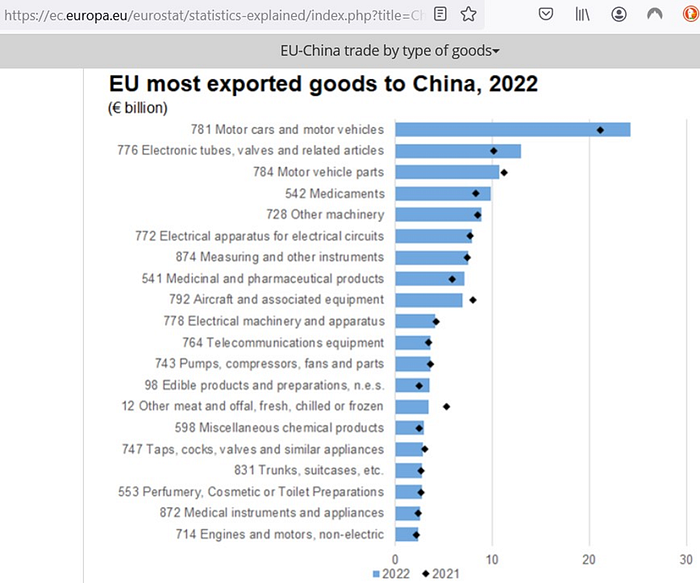
China currently imports around twice as many vehicles from the EU as the EU imports electric vehicles from China (this does not take into account the large number of vehicle components that European vehicle manufacturers export to China). (Screenshot ec.europa.eu/Eurostat)
Economists know that large countries such as India, China or the USA have sufficiently large domestic markets and are therefore not necessarily dependent on exports. Smaller economies such as Germany, France or Italy, on the other hand, are doomed to export in order to maintain employment and prosperity. If the EU leadership now ensures that Europe turns away from China (for which the euphemistic term “derisking” has been chosen), this is likely to harm Europe first and foremost: The displacement of Chinese products will drive up prices for European consumers (a Chinese electric car, for example, costs only half as much as a European one), and China, for its part, will pursue a “derisking” policy and import fewer and fewer European products, forcing European companies to forego the world’s largest market and further driving progressive deindustrialization, resulting in a significant loss of prosperity for Europeans. This will hardly hurt China as it already does the lion’s share of its trade with the global south or the global majority. It will only accelerate the trend of shifting its own economy even more towards qualitative growth, and consumers will buy more and more domestically produced, high-quality and inexpensive products.

1*M3jfaOQMddeTWD6vTpoOXw.png

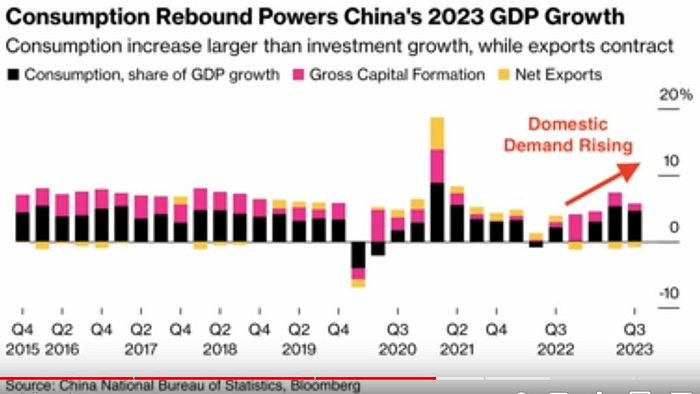
The latest trend in the Chinese economy: fewer imports (from the West) and rising domestic consumption. In other words, economic growth is no longer being fueled by imports (which are now in the red), but by domestic consumption (Bloomberg chart)
What do Asians think of “derisking”, which is practiced in Europe with almost the same religious fervor as in the United States?


0*JadDFcZqtzmHvxXi

A pragmatic Asian approach in the interests of its citizens as opposed to a rigid ideological European approach in the interests of Washington: Headline of the online newspaper Vietnam+ of the official Vietnamese News Agency
Let’s take Vietnam as an example: the Vietnamese have had a lot of trouble with their big neighbors in their history, but China is now their biggest trading partner and the two want to greatly expand their trade and other relations. So there are no signs of “derisking”.

When I first visited the country thirty years ago, I was amazed at how many young Vietnamese were learning French at the Alliance française and German at the Goethe Institutes in Hanoi, Danang, and Hochiminh City. In the meantime, interest in these two languages has waned considerably, and more and more young Vietnamese are learning Chinese as well as English. This does not mean that the Vietnamese today are less nationalistic and critical of China, but they are simply more pragmatic and not as stupid as the Europeans to allow their prosperity to be destroyed for ideological reasons or in the interests of a foreign power. Of course, this won’t bother the politicians in Berlin and Paris, who are detached from the reality of their citizens.

 
You are my favorite ccp bot on internet.
 
5% growth is "limping", while whatever piddling growth America had that inflation didn't demolish is soaring.

If China's such a non-factor, why's it living in your head rent free?
 
5% growth is "limping", while whatever piddling growth America had that inflation didn't demolish is soaring.

If China's such a non-factor, why's it living in your head rent free?

5% growth from a low 2022 base. In reality, growth was sub 3%.

Meanwhile the US is growing 2.5-3%, inflation being murdered, unemployment at record lows, stock market at record highs.

Chinas growth rates are steadily declining, and window to catch the US is closing.
 
@Chinabrief
Retail sales of consumer goods in China, a key indicator of the country's consumption level, grew 7.2% year-on-year in 2023 - China National Bureau of Statistics

Total retail sales of consumer goods reached 47.15 trillion yuan (about 6.63 trillion U.S. dollars).
In 2023, China's per capita disposable income was 39,218 yuan (about 5,511 US dollars), an increase of 6.3% from last year in nominal terms - China National Bureau of Statistics
The average urban unemployment rate in China was 5.2% in 2023, 0.4 percentage points lower than that in 2022 - National Bureau of Statistics of China

In 2023, value-added industrial production, an important economic indicator, grew by 4.6% year on year - China National Bureau of Statistics

China's fixed capital investment grows 3% year-on-year in 2023 - National Bureau of Statistics of China

Total investment during this period amounted to 50.3 billion yuan (about 7.07 billion US dollars).

Investment in infrastructure construction and the industrial sector increased by 5.9% and 6.5%, respectively, compared to the previous year, while investment in real estate development decreased by 9.6%.

High-tech industries recorded growth, with investment increasing by 10.3% year on year. In particular, investment in the high-tech manufacturing industry and the high-tech services sector increased by 9.9% and 11.4%, respectively.

China's population at the end of 2023 (excluding residents of Hong Kong, Macau and Taiwan, as well as foreigners living in 31 provinces, autonomous regions and municipalities directly under the central government) was 1,409.67 million people, an increase of 2.08 million less than at the end of 2023. end of 2022. 9.02 million people were born in the year, the number of deaths reached 11.1 million.

China's gross domestic product reached 126,058.2 billion yuan in 2023, an increase of 5.2% over the previous year

How did China manage to surpass its 5% GDP growth target?

China's GDP grew 5.2% in 2023, totaling 17.8 trillion dollars (126 trillion yuan); in 2022, the country's GDP increased by 3% to 121 trillion yuan.

Electric vehicles, lithium-ion batteries and solar panels are becoming new engines of economic growth in China.

The solar panel industry grew by 54%. China's annual automobile production and sales surpassed 30 million units for the first time. Electric vehicles accounted for 24% of new car sales in China in 2023, up from 12% in 2021. Considering hybrid cars, the share of cars using new energy sources in total sales reached 36%.

China is one of the largest battery manufacturers. Two major Chinese manufacturers, BYD and CATL, control about half of the global market.
 
To view this content we will need your consent to set third party cookies.
For more detailed information, see our cookies page.
 
5% growth from a low 2022 base.
No. 2022 was the year China's economy was the largest its been in its history, and then 2023 came along. And then 2024 will come along, 2025, etc. Every year China's economy will grow larger than the year before it.
Meanwhile the US is growing 2.5-3%
The real growth rate of America's OnlyFans economy is a fraction of that. Actual economic utility, real productivity minus parasitic sectors like FIRE and 90% of what gets called the "service economy" is much lower still.
inflation being murdered
Ayy lmao. Tell that to your countrymen who have to choose between eating dinner and paying the rent.
unemployment at record lows
Sure. People now have to work 3 jobs to make ends meet. Isn't that great?
stock market at record highs.
Stonks only go up, Up, UP!
Chinas growth rates are steadily declining, and window to catch the US is closing.
Math's really not your strong suit, is it?
 
5% growth from a low 2022 base. In reality, growth was sub 3%.

Meanwhile the US is growing 2.5-3%, inflation being murdered, unemployment at record lows, stock market at record highs.

Chinas growth rates are steadily declining, and window to catch the US is closing.
This is far from the truth, the American economy is plummeting, the numbers you bring do not match reality:

The -43.7 print was a stunning 10 standard deviations below expectations of a bounce to -5.0...

Even Pixar is laying off people:

About 93% of household wealth in the US stock market is held by the richest 10%.

The nonprofit Second Harvest Food Bank of Orange County, which provides food for 400,000 people a month in Orange County, has seen a nearly 60 percent increase in demand since before the pandemic.

The shelves at a Bronx food pantry have been bare for the past two weeks as hungry New Yorkers face heightened food insecurity at the beginning of the New Year.

The Albanian American Open Hand Association (AAOHA), located in Pelham Parkway, fed around 800 weekly before the pandemic, but that has since doubled to 1,600.

For the first time in 10 years, the pantry has been forced to turn people away.

Homelessness is on the rise in the United States, and it’s growing at a rate never seen before, according to data released Friday by the U.S. Department of Housing and Urban Development.

The 2023 Annual Homeless Assessment Report shows that more than 653,000 people were experiencing homelessness in the U.S. — marking a 12% increase from 2022. The report uses compiled Point-In-Time Count data — a method that attempts to count every person living homeless one day out of the year — from across the nation to track the ebbs and flows of the nation's homelessness crisis.

About unemployment and why it is so disconnected from your reality:
Inside The Catastrophic Jobs Report: Record 1.5 Million Crash In Full-Time Jobs, Multiple Jobholders Soar To Record, Native Born Workers Plunge And Much More

The BLS told us that the Establishment Survey indicated that the US economy added 216,000 jobs last month, but historically the Household Survey has been much more accurate, and showed that the US economy actually lost 683,000 jobs last month .

Additionally, the private sector has been hemorrhaging full-time jobs, but government hiring has helped mitigate the damage. It is clear that the level of government hiring we have seen is simply not sustainable. The federal government, state governments, and local governments are all drowning in debt, and therefore belts will have to be tightened at some point. If you can believe it, the federal government actually ran a $129 billion deficit during the month of December alone:

More Americans are buckling under the weight of mounting credit card debt.

All stages of credit card delinquency (30, 60 and 90 days past due) jumped higher during the third quarter of last year, surpassing pre-pandemic levels for the first time, according to a report released Thursday by the Federal Reserve Bank of Philadelphia.

The number of bankruptcy filings in the United States in 2023 was 18% higher than in 2022:

One of our “too big to fail” banks just announced that it will eliminate 20,000 high-paying jobs:

Do you want me to continue the list of posts with the reality of the American economy?
 
PLEASE STAY ON TOPIC: CHINA'S ECONOMY.
 

Users who are viewing this thread

Back
Top