Chinese Missile Development News

What developments are planned for China's future generation Hypersonic Anti-Ship Missiles? Any new innovative exotic propulsions or warheads? (Note: When I mean "future gen" I meant like 3rd, 4th or 5th gen Hypersonic Anti-Ship Missiles) and not the current gen 1st and 2nd gen)
 
To view this content we will need your consent to set third party cookies.
For more detailed information, see our cookies page.
 
To view this content we will need your consent to set third party cookies.
For more detailed information, see our cookies page.
 
WHat kind of explosion is this?
Shaped charge ?

To view this content we will need your consent to set third party cookies.
For more detailed information, see our cookies page.
 
WHat kind of explosion is this?
Shaped charge ?

To view this content we will need your consent to set third party cookies.
For more detailed information, see our cookies page.

Looks like a thermobaric warhead.
 

Another new Chinese capability​

February 21, 2026

The mainstay of Chinese carrier air wings was seen with a new anti-ship missile potentially capable of striking targets more than 1,000 kilometers away at supersonic speeds, according to recent media reports, US Naval Institute News reports.

A People’s Liberation Army Navy (PLAN) J-15 was spotted fielding two YJ-15s, one of Beijing’s latest anti-ship missiles, in images circulated last week. Revealed during China’s 2025 military parade, the missile joins China’s existing stockpiles of subsonic YJ-83 and supersonic YJ-12 anti-ship cruise missiles, which have been deployed by Chinese fighters and bombers exercising for contingencies around Japan, the Philippines and Taiwan.

While China has yet to release the missile’s specifications, Janes’ analysis claimed that new air-launched anti-ship missiles can strike targets at ranges of 1,200 to 1,800 kilometers away and achieve speeds in excess of Mach 5 – a significant increase from the preceding 500-kilometer range of the YJ-12.

Equipping PLAN’s heavy carrier fighter with these missiles can increase the striking power of Beijing’s naval aviation and complement existing strike capabilities. According to Chinese military media, the J-15 has been equipped with YJ-12s and AKF-98A land attack cruise missiles.

PLAN fighters will be able to launch with heavier payloads on the service’s latest carrier, Fujian (18). Compared to the PLAN’s previous short take-off but arrested recovery (STOBAR) carriers Liaoning (16) and Shandong (17), the 80,000-ton Type 003-class is capable of conducting catapult-assisted take-off but arrested recovery (CATOBAR) operations.

Fujian’s launch and recovery capabilities have also enabled the service to acquire the carrier-based KJ-600 airborne early warning and control aircraft.

“Utilizing onboard radar and electro-optical systems to search for and track airborne and maritime targets, [the KJ-600] provides critical intelligence on enemy situations and directs the carrier-based aircraft in air defense and anti-ship warfare,” reads a Chinese military media release.

This is the latest instance of Beijing highlighting its long-range precision strike developments and capabilities. China touted several new hypersonic missiles shown at the 2025 military parade and launched from a 10,000-ton Type 055-class destroyer.

In its 2025 China military power report, the Pentagon claimed that Beijing plans to have a nine-carrier fleet by 2035 – just two shy of the U.S. Navy’s 11-carrier fleet – and a regional naval aviation hegemony in the Western Pacific.


How China overtook the US in hypersonic arms and may leave air defences ‘powerless’​


Saturday, 21 Feb 2026 | 6:40 PM MYT
3777774.webp

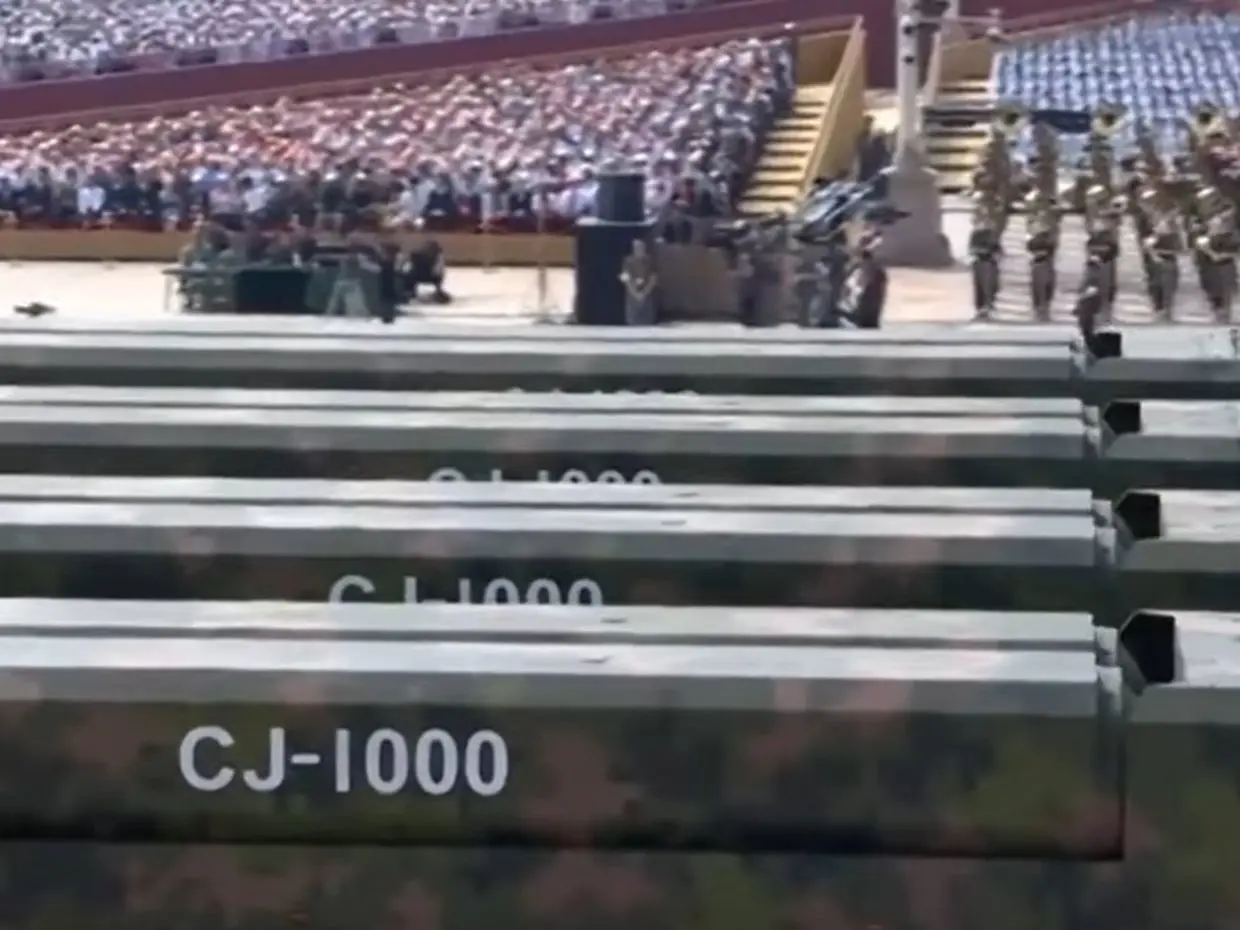
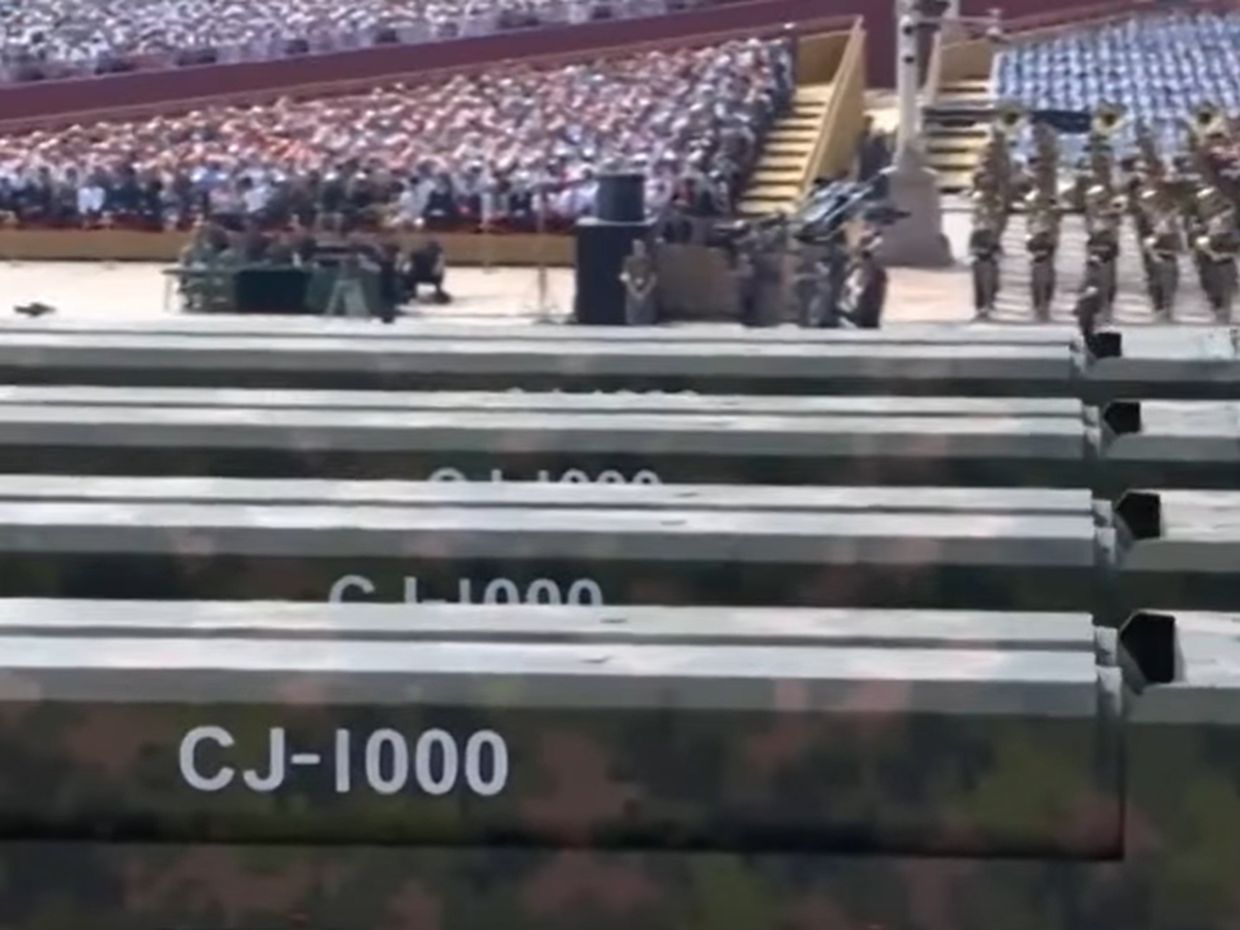
With the unveiling of the long-range hypersonic CJ-1000 missiles, China has surpassed the United States in the critical race to field practical scramjet propulsion systems, according to a mainland military magazine.

Alongside the ship-launched YJ-19, the CJ-1000 road-mobile cruise missile was one of two hypersonic missiles powered by advanced air-breathing scramjet engines on show during the Victory Day military parade in Beijing in September last year.

They are the world’s only two operational scramjet-driven hypersonic missiles besides Russia’s ship-based 3M22 “Zircon”. The CJ-1000 is therefore the first and to date only land-based variant of its kind.

According to an analysis in the February issue of Shipborne Weapons magazine, scramjet engines represent a technologically superior – yet more difficult – development path for hypersonic missiles compared with glider vehicles such as China’s DF-17 and Russia’s Avangard.

“The emergence of the CJ-1000 missile marks China’s transition from closely following to taking a leading position in the most advanced aerospace domains,” the article said.

The scramjet missiles’ cruise altitude of 20km to 30km (12.4 miles to 18.6 miles) is much lower than that of glider vehicles, which is about 60km to 80km. And for enemy air defence radar, the lower the missile flies, the more difficult it is to detect and respond.

Moreover, with the scramjet engine working throughout the cruise and terminal phases, it offers greater manoeuvrability and precision against targets than unpowered glider vehicles relying on inertia during their final approach.

The US was the first country in the world to demonstrate scramjet-powered flight in real flight, as early as 1998, and the first to achieve sustained 240-second operation of a hydrocarbon-fuelled scramjet engine in flight in 2013.

But America’s Hypersonic Attack Cruise Missile project was now lagging, the article noted.

“[The US] has fallen behind China in the weaponisation and operational deployment of scramjet-powered hypersonic systems,” it said.

It attributed the delay to “poorly structured project planning, disorganised management and a lack of firm conviction among senior leadership regarding the technology’s potential”.

“Meanwhile, China’s massive investment in scramjet development, more scientifically sound testing methodologies, strong integration of industry-academic-research collaboration and resolute national-level support have all been critical factors enabling its eventual leap ahead,” it added.

Among the active hypersonic missiles with scramjet engines, the CJ-1000 is believed to have the longest range and most destructive warheads.

Owing to its land-based nature, it faces fewer constraints in size and weight and can thus carry more fuel and explosives compared with the YJ-19 or the Zircon, both of which have limited dimensions in their ship-based launch systems.

Mounted on a highly mobile 10-wheel diesel-electric hybrid transporter-erector-launcher, the CJ-1000 is estimated to have a range of at least 2,500km.

During the parade in September, it was officially described as a weapon for “long-distance strikes”. For reference, the CJ-10, classified as a “medium- to long-distance” cruise missile, has a range of 1,500km to 2,500km, according to the article.

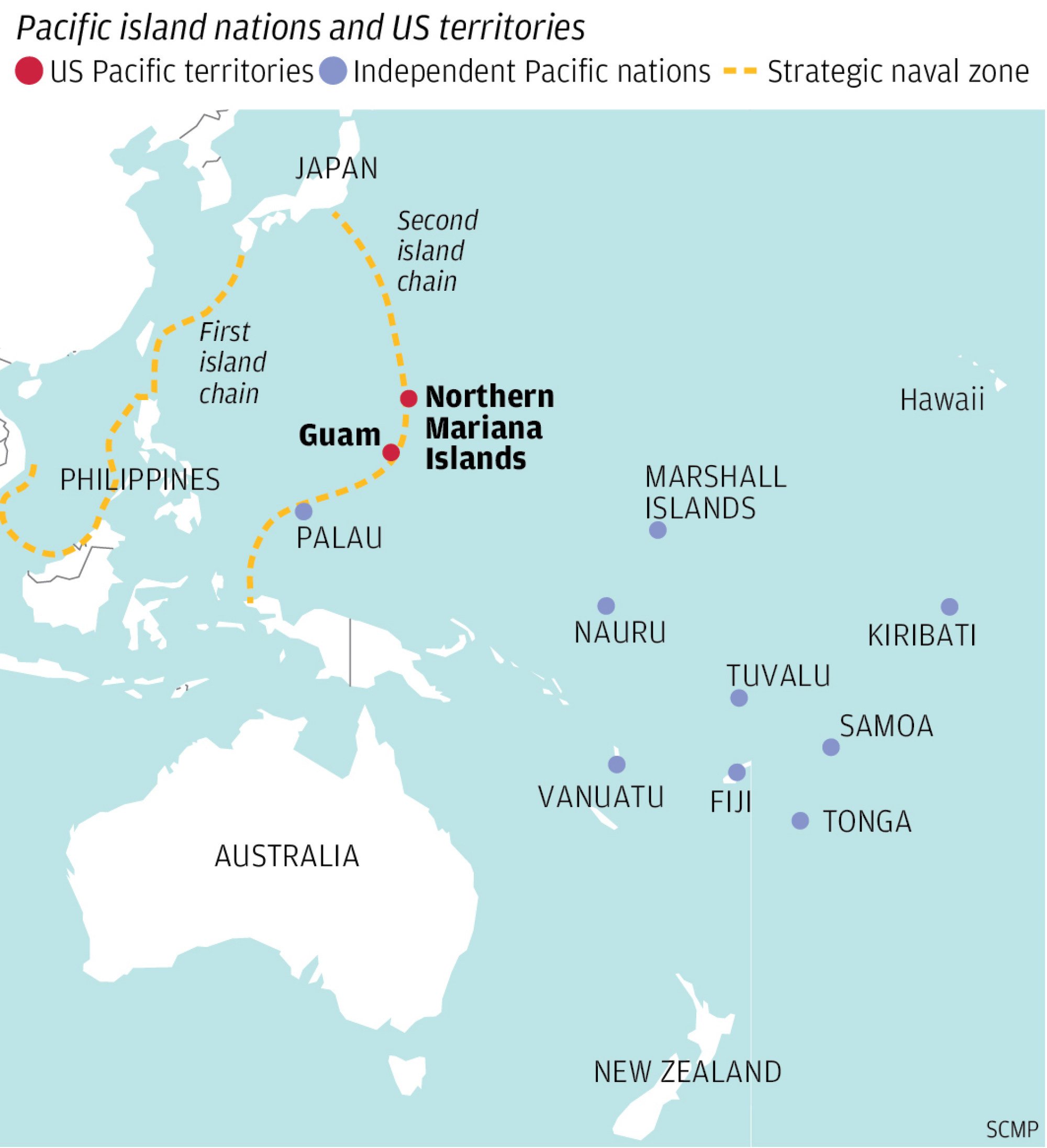
This could cover most critical ground targets in Japan and the Philippines, as well as the vast waters of the Pacific Ocean between the first and second island chains.

The first island chain runs along East Asia’s coastline, from the Kuril Islands through Japan, Taiwan and the Philippines down to Borneo. The second island chain is further east and includes the US territory Guam, home to American military installations.

baf5b5fe-e551-498b-bd31-614e757292d2_ff4373cd.jpg

In a vertical “cold launch”, a solid rocket booster accelerates the missile to Mach 4 at 20km altitude; after stage separation, the scramjet ignites and propels it to Mach 6 at 28km for sustained cruise, it said.

With its hypersonic speed plus the advantages provided by scramjets, the CJ-1000 could render any conventional air defence systems “powerless”, according to the article, which added that the Terminal High Altitude Area Defence was likely to be the only anti-ballistic missile defence system in the existing US arsenal with even a limited ability to intercept scramjet-powered hypersonic missiles.

America might improve its detection ability for scramjet hypersonic missiles through space-based sensors under the “Golden Dome” project, the article said, noting the US was developing the advanced Glide Phase Interceptor – a missile defence programme with Japan – against the cruising phase scramjets. But these could take years.

“By the time potential adversaries field countermeasures several years from now, China’s air-breathing hypersonic missiles may have already evolved to a new level, and its defensive capabilities could be significantly more robust as well,” the article said.

Success in hypersonic weapons would also effectively help the development of defensive systems, it added.

 
008wO4eXgy1iakc31kxv3j30u01h0n6n.jpg
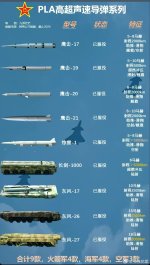
PLA Hypersonic Missile Series

Data source: Public online data, as of 2026

Chart by: Jiupai Mangmang
Total 9 models, 4 for the Rocket Force, 4 for the Navy, and 3 for the Air Force.

YJ-17In serviceBoost-glideMach 5-82000 kmShipborne/Air-launched
YJ-19In serviceScramjetMach 5-10500 kmSubmarine/Shipborne
YJ-20In serviceBoost-glideMach 6-92000 kmShipborne
YJ-21In serviceBoost-glideMach 6-102000 kmAir-launched/Shipborne
JL-1In serviceBoost-glideMach 5-8>5000 kmAir-launched
CJ-1000In serviceScramjetMach 6>5000 kmGround-launched
(Changjian-1000)
DF-17In serviceBoost-glideMach 102500 kmGround-launched
DF-26In serviceBoost-glideMach 154500 kmGround-launched
DF-27In serviceBoost-glideMach 188000 kmGround-launched
[th]
Model​
[/th][th]
Status​
[/th][th]
Characteristics​
[/th][th]
Speed​
[/th][th]
Range​
[/th][th]
Launch Platform​
[/th]​
 
View attachment 180484
PLA Hypersonic Missile Series

Data source: Public online data, as of 2026

Chart by: Jiupai Mangmang
Total 9 models, 4 for the Rocket Force, 4 for the Navy, and 3 for the Air Force.


YJ-17In serviceBoost-glideMach 5-82000 kmShipborne/Air-launched
YJ-19In serviceScramjetMach 5-10500 kmSubmarine/Shipborne
YJ-20In serviceBoost-glideMach 6-92000 kmShipborne
YJ-21In serviceBoost-glideMach 6-102000 kmAir-launched/Shipborne
JL-1In serviceBoost-glideMach 5-8>5000 kmAir-launched
CJ-1000In serviceScramjetMach 6>5000 kmGround-launched
(Changjian-1000)
DF-17In serviceBoost-glideMach 102500 kmGround-launched
DF-26In serviceBoost-glideMach 154500 kmGround-launched
DF-27In serviceBoost-glideMach 188000 kmGround-launched

[th]
Model

[/th][th]
Status

[/th][th]
Characteristics

[/th][th]
Speed

[/th][th]
Range

[/th][th]
Launch Platform

[/th]​
Are DF 41 ad DF 61 also hypersonic ? I think I read some article says so.
 
WHat kind of explosion is this?
Shaped charge ?

To view this content we will need your consent to set third party cookies.
For more detailed information, see our cookies page.

Blast fragmentation ?
 
View attachment 180484
PLA Hypersonic Missile Series

Data source: Public online data, as of 2026

Chart by: Jiupai Mangmang
Total 9 models, 4 for the Rocket Force, 4 for the Navy, and 3 for the Air Force.


YJ-17In serviceBoost-glideMach 5-82000 kmShipborne/Air-launched
YJ-19In serviceScramjetMach 5-10500 kmSubmarine/Shipborne
YJ-20In serviceBoost-glideMach 6-92000 kmShipborne
YJ-21In serviceBoost-glideMach 6-102000 kmAir-launched/Shipborne
JL-1In serviceBoost-glideMach 5-8>5000 kmAir-launched
CJ-1000In serviceScramjetMach 6>5000 kmGround-launched
(Changjian-1000)
DF-17In serviceBoost-glideMach 102500 kmGround-launched
DF-26In serviceBoost-glideMach 154500 kmGround-launched
DF-27In serviceBoost-glideMach 188000 kmGround-launched

[th]
Model

[/th][th]
Status

[/th][th]
Characteristics

[/th][th]
Speed

[/th][th]
Range

[/th][th]
Launch Platform

[/th]​
The tip of the iceberg

All of the above are the so-called "first-generation hypersonic missiles" referred to by the Chinese military industry and the PLA.
 
Are DF 41 ad DF 61 also hypersonic ? I think I read some article says so.
These two missiles are not hypersonic missiles.

Chinese official agencies have a strict definition of "hypersonic".

高超音速导弹是指能够在临近空间或大气层内,以超过5倍音速(5马赫) 进行持续可控飞行,并可做大范围不规则机动的导弹。
A hypersonic missile is operationally defined as a missile capable of sustained controllable flight at speeds exceeding Mach 5 (five times the speed of sound) within the atmosphere or near-space, while also being able to conduct substantial and unpredictable maneuvers.

DF41/DF61 clearly do not meet these standards.
 

Users who are viewing this thread

Pakistan Defence Latest

Back
Top