@Michael
dont you think the PLARF has quite less inventory, as in terms of numbers of missile?
The PLARF has only about more or less3500 missiles , which in my view is quite small for a service with that big of a budget and strong hold?
Iranians seem to have more , but we can argue on the complexity of the missiles and dependence on other things .
Can you explain like how are they not more , or are they but just hiding in some place for years.
More like in depth analysis. also plz dont try to spin the wheel and answer way of the topic.
I had read around 2-3 reports by CASI and other long time ago , they had similar numbers.
"SIPRI estimates that China had more ICBM launchers (i.e. land-based launchers) than either Russia or the USA as of January 2026 and could potentially have at least as many ICBMs as either country by the turn of the decade. However, despite this extensive build-up of launchers and ICBMs, China’s stockpile of nuclear warheads is expected to remain much smaller than the stockpiles of Russia or the USA."
They are claiming close to 900 ICBMs.
https://www.sipri.org/sites/default/files/YB26 08 World Nuclear Forces.pdf
Just adding to Michael's post, SIPRI itself estimates that China has more ICBMs than Russia or the US. These include the silo based and TEL/rail/tunnel mobile ICBMs but not SLBMs and any newer potential surface ship based ICBMs.
Nuclear warheads are probably in the 1000 range today since it was 300 range in the 1980s. And China has shifted policy to major build up to warheads around 10 years ago. Real numbers for warheads much more likely number greater than 1500 and aims to get to similar levels to Russia and USA's 3000 and >1000 active.
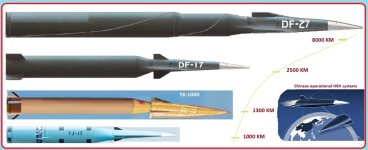
China has largely started shifting towards very long ranged HGV (so not DF-17 or YJ-17, but DF-27 and above in range) and HCM (not YJ-19 but CJ-1000 HCM) for MRBM to IRBM roles. Indeed, potentially also ICBM ranged because there are two separate weapons that are manoeuverable hypersonic and intercontinental ranged that are beyond the DF-5C in terms of capability and technology. This was all revealed officially and semi-officially in the 2025 parade.
As for SRBM, like Michael said, there are only DF-15 new variants servicing special roles rather than traditional hit ground targets role which has been relegated to many different forms of rocket long range artillery. The number of long range artillery with range >250km China possesses comfortably exceed the entire world's SRBM inventory. Despite China outproducing the world in drone swarms/suicide drones that have similar range (and similar range limits), long range artillery and shorter ranged artillery are still
the military field that China emphasises! No one can pound targets harder within 350km range than China (and indeed also beyond 350km range). The aim of the rest of PLA within such scenarios is to keep these war machines firing safely while opposition aims to destroy them.
Beyond the SRBM range, DF-16 and above MRBM -> ICBM -> FOBS weapons come into play. HGV payloads on MRBM or IRBM boosters and above (ICBM boosters and FOBS) honestly extend the range so much.
China definitely has more than 3500 combined missiles from SRBM to ICBM type. I mean it already has close to 900 ICBM alone by western estimates. US claims China fires more ballistic missiles every year in training and exercises than rest of world combined. Old stock also fired off for training and interception practise. The number of SRBM and MRBM fired in training every year is around 200 from China's own military channel in the past.
3500 missiles is a joke. The main factories produce several hundred SRBM - ICBM missiles every month. The satellite photos showing the field of just
one of DF-26 factories have for a long time shown numbers above 25 every month. There are so many DF-x missile types from SRBM to ICBM, it would take an hour to accumulate them all. Same with the TEL producers for missiles using TELs. DF-26 is a IRBM which is several times more costly and harder to produce than SRBM or even MRBM. If one factory can make 25 or so every month during peacetime and this is but 10% or so of China's entire ballistic missile type and proportion since it's IRBM, imagine how many ballistic missiles are produced a year. The stockpiles are so large, they fire them off in practise shots on moving aircraft carrier targets in the desert very frequently.
If I were a betting man, I'd bet China's current SRBM + MRBM + IRBM inventory > Russia + USA inventory of the same missile types.
One of China's demands from PLA for actual war is to use any single one of its main strategic kinetic and non-kinetic options to win. That means PLARF needs to win major conventional war basically on its own, similar to Iran basically relying entirely on ballistic missiles to force negotiations and end to a war.
PLA (including PLAAF and PLAN) needs to win a war with symmetric development against US over at least up to second island chain.
Cyber and EW capabilities alone needs to win a war (or at least force a stop to a war) with its own efforts.
PLARF needs to be able to have enough capability and magazine depth to win a war in the region on its own with precision missile attacks alone.
All strategic option lines need to be able to at least force a stop to a war by making it too costly for opponent. On its own. In reality, all act together.
China's PLARF critical mission isn't only MAD and effective nuclear second strike but also now to conventionally hit critical targets at intercontinental range. Single missiles rather than all out nuclear strike so it doesn't look like nuclear strike. Basically during war, PLARF needs to destroy all critical US MIC centres with conventional strikes and of course communicate these are conventional strikes. US tries to do the same. Only smaller numbers to avoid opposing side interpreting as an all out nuclear strike.
Intercontinental ranged conventional missile strikes are done by HGVs and FOBS. Maybe CJ-1000 HCM has the range for it too since Mach 10 + engine powered hypersonic flight gives quite a long range particularly when the booster stage is already MRBM sized. Total range with the scramjet/whatever new engine it has should be above IRBM range.