What the rest of the world sees as China's rise, Xi sees as its resurgence.
He has touted the value of a "strong navy to safeguard national security". He cites 470 invasions between 1840 and 1949 that brought "untold suffering" - as the once-powerful Qing empire cracked, China plunged into turmoil, revolution and civil war.
And he has vowed that his country will never again be "humiliated" or relive those "bitter memories of foreign assaults".
Where China has an undeniable edge is the dual use of shipyards. Many of those that support commercial production can also help produce warships for the navy.
Military and civilian shipyards work hand in hand in some places, which state media describes as "military-civilian fusion", a concept Xi has pushed hard.
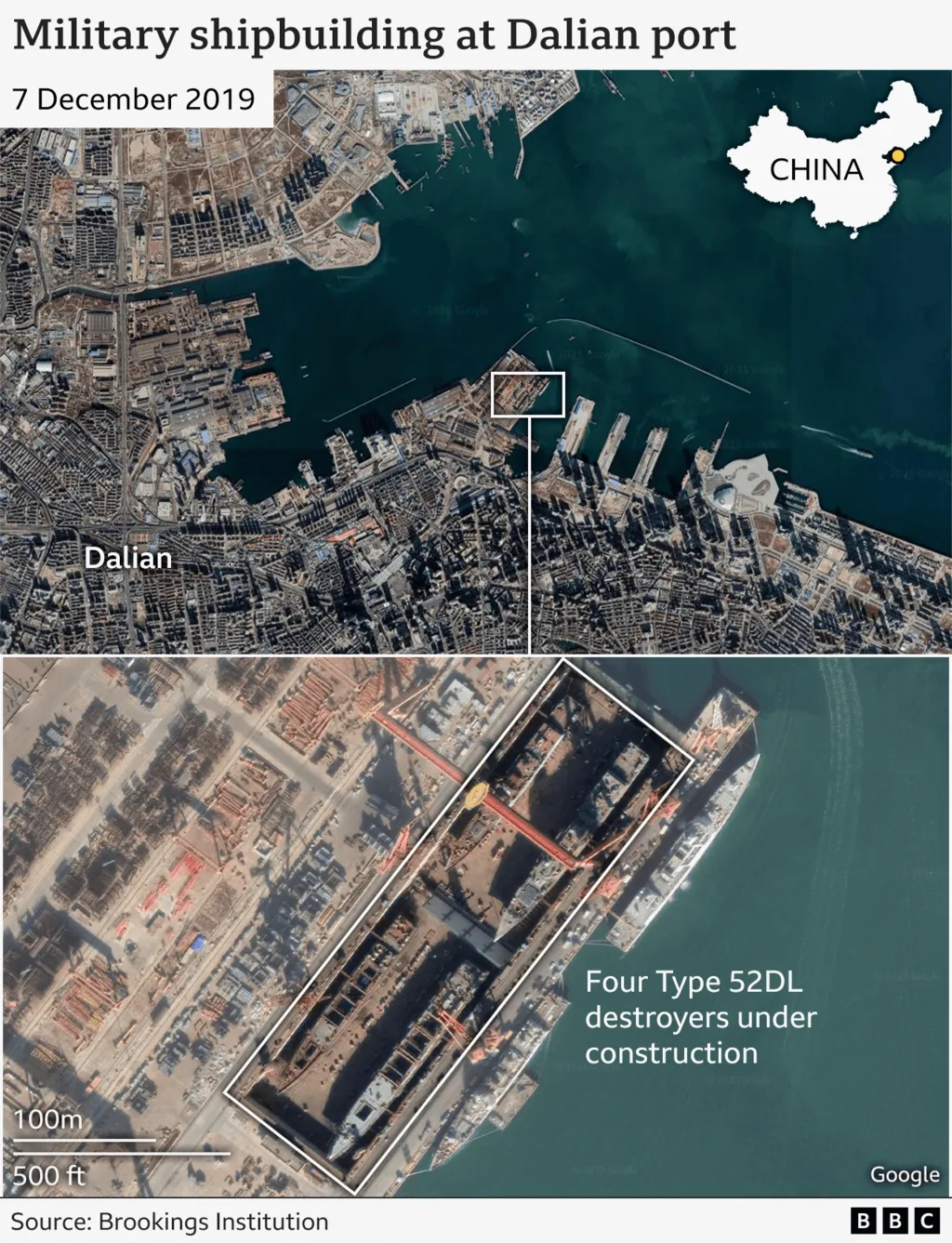
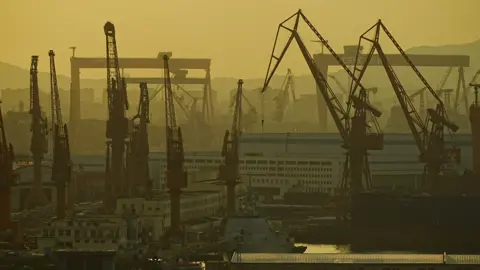
Dalian, which Beijing calls a "flagship shipyard", plays a big part in this.
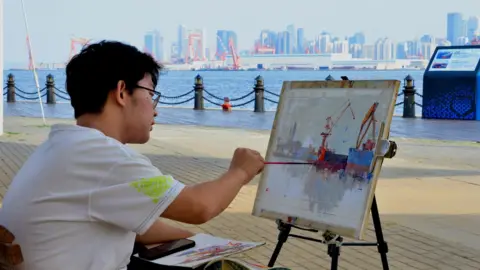
The shipyard and the areas in Dalian with clear views of it are popular with locals
In full view of the picnicking pensioners waving karaoke mics are huge commercial ships, some as long as three football fields.
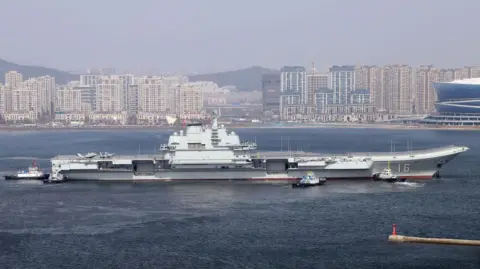
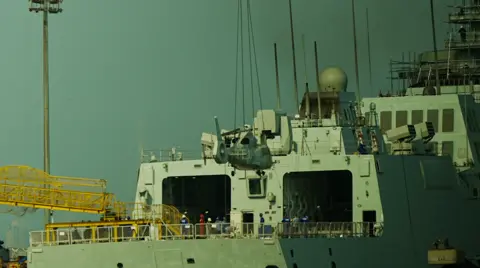
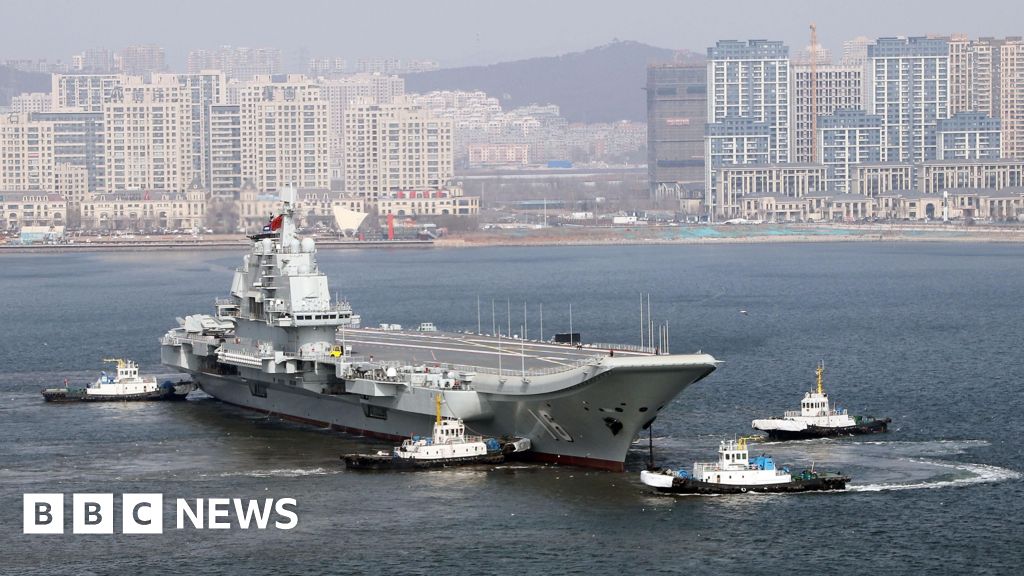
But just around the corner, berthed where no-one can take pictures, is a group of military vessels. There, a crane is lowering a helicopter onto the huge deck of a ship, as a marching band bellows in Suoyuwan park.
"This is a politically motivated agenda to merge both the commercial and military entities together," Mr Funaiole says. "There are efforts to bring the technology needed to build both into a centralised location – Dalian is one of them."
That is why even without powerful aircraft carriers or submarines, China's commercial fleet and its expertise in building ships quickly can be key during a crisis, he adds.
A helicopter is lowered onto a military vessel docked in Dalian
"In any protracted conflict, if you have shipyards that quickly produce new ships, this is a huge strategic advantage," Mr Funaiole says. "Commercial ships can transport food etc into any conflict zone. Without this, the US is in a position where it might not be able to sustain a prolonged war effort."
It boils down to a straight question, he says: "Who can put more assets into the water more quickly and readily?"
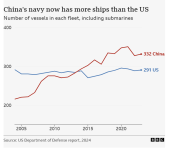
The answer, at the moment, is China.
'Hide your strength, bide your time'
But the world should not worry, says Prof Hu Bo, director of the Center for Maritime Strategy Studies at Peking University.
"We have no interest in interfering in the business of other countries, especially militarily," he adds. His message is that China is building big ships because it can, not because it wants to take over the world.
There is one island which China does not see as another country: Taiwan.
Beijing has long vowed to "reunify" with the democratic island and has not ruled out the use of force. In recent years, high-ranking US officials have declared that China will invade Taiwan by 2027, but Beijing denies there is a deadline.
"China already has the capacity to take Taiwan back," Prof Hu Bo says, "but China doesn't do that because we have patience. China has never given up on the prospect of peaceful unification. We can wait."
The bigger concern is that any attack on Taiwan could trigger a wider war, and involve the US. Washington is bound by law to provide arms to help Taiwan defend itself - support which is unacceptable to Beijing for what is considers a breakaway province that will eventually be part of China.
Earlier this year US Defence Secretary Pete Hegseth warned that China posed an "imminent" threat to Taiwan, and urged Asian countries to boost defence spending and work with the US to deter war.
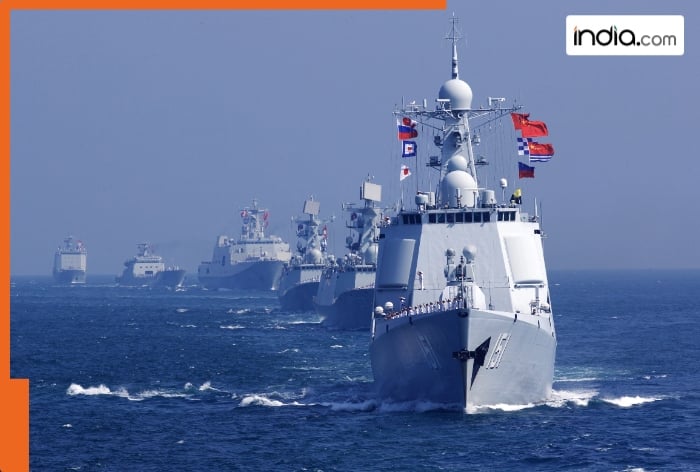
So despite Prof Hu Bo's assurances, it is hard to ignore the fact that China's warships are beginning to sail further from the country's shores.
In February, they were seen circumnavigating Australia's coastline for more than three weeks where they staged unprecedented live-fire drills.
More recently Chinese aircraft carriers conducted naval drills near Japan, sparking concern - although it was in international waters, the move was unprecedented.
China's shipbuilding expertise should not worry the world, Prof Hu Bo says
As Beijing grows bolder in its attempts to project power in the Pacific, China's neighbours, from Taiwan to Australia, are worried that its famous mantra is paying off: "hide your strength and bide your time".
But Prof Hu Bo believes that fears of a conflict between the US, whose allies in the region - Japan, South Korea and Australia - are often at odds with China, are overblown, because they all know it could be catastrophic.
"In the last three years, I think the signal is very clear that both sides don't want to fight," he says. "We are prepared for that, but we don't want to fight with each other."
'We defend our ocean dream'
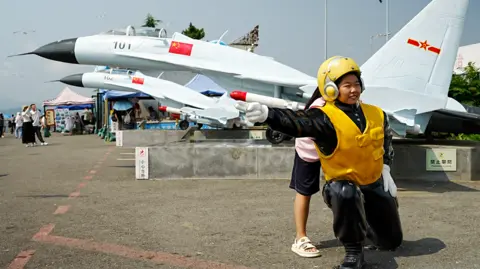
Back in Dalian, around an hour's drive from the vibrant city, tourists are arriving by the coach load in the naval fortress town of Lushunkou, which also has a military theme park in the shape of an aircraft carrier.
Guides on loud microphones lead their groups into the park, pointing to the official notices warning visitors not to photograph the military vessels moored in the crescent-shaped harbour and to report any behaviour that might be construed as spying "to help defend the Motherland".
More military notices on bridges and walls declare, "united as one, we defend our ocean dream".
China has fostered pride in its shipbuilding prowess, especially here in Dalian.
The military theme park near Dalian is a huge tourist draw
At the theme park, which also overlooks the shipyard, a 50-year-old blogger dressed in the local fashion - a floral pattern shirt - is giving his followers their daily rundown of the latest ships being built in the port.
"I am very proud – really, look at what this city gives us," he announces to his followers. A mother and her seven-year-old daughter, on holiday from the neighbouring province, marvel at the ships. "I was amazed. It's huge. How does it sail, I wonder?"
The key question for the US and its allies is how far can China's war fleet sail, and how far from its shores is Beijing prepared to venture.
"At what point will they will break out and be able to really show influence further afield, for example, in the Indian Ocean and beyond, will be a key thing to look at," Nick Childs says.
"They still have a significant way to go, but they are certainly pushing the boundaries."
Beijing's shipbuilding capacity is 200 times that of the US, an expert says, calling the scale "extraordinary".

www.bbc.com