China’s new Type 100 tank marks shift towards ‘information-driven and uncrewed’ warfare
Military mouthpiece says the next-generation tanks and their support vehicles will ‘totally revolutionise future land battles’
Liu Zhen
Published: 10:00pm, 9 Sep 2025
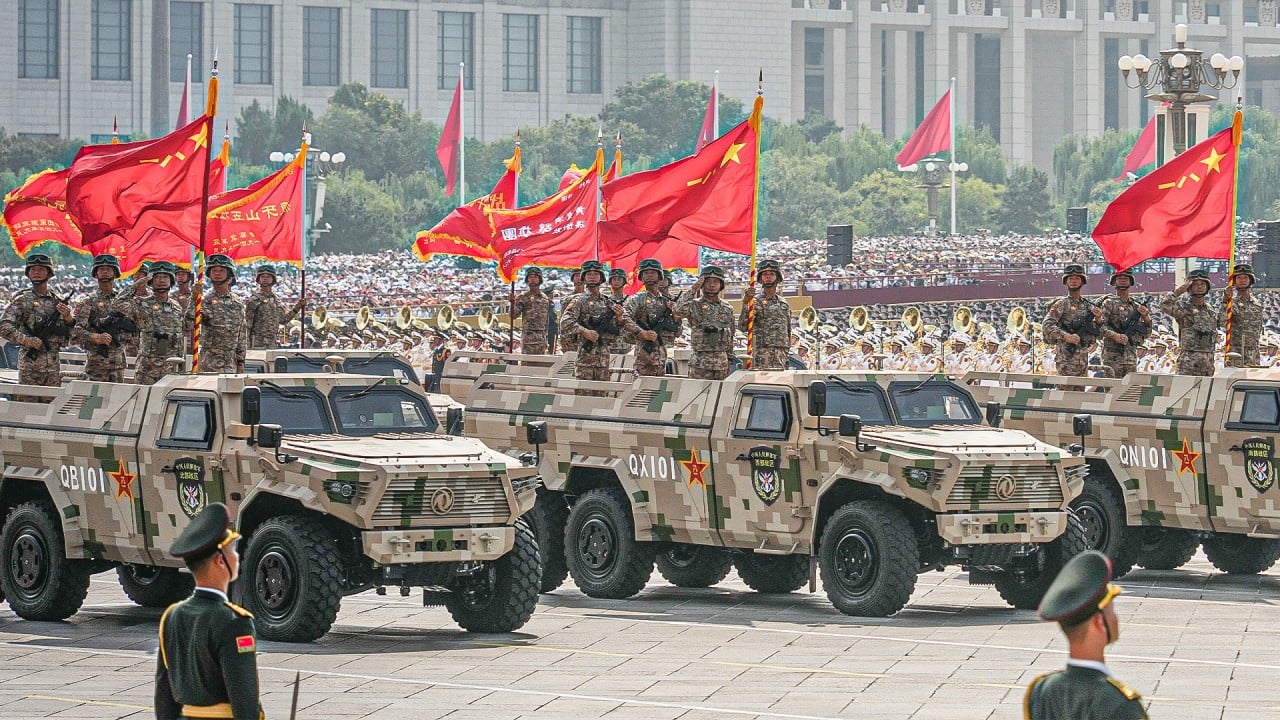
The Chinese military’s new Type 100 tank – unveiled at last week’s
Victory Day parade in Beijing – marks a fundamental shift towards “intelligent, information-driven and unmanned” warfare, according to state media.
The lightweight tank is a departure from traditional armoured vehicle design that emphasises the race between thicker armour and stronger penetration. Instead, the
People’s Liberation Army has reportedly prioritised the integration of intelligent systems in response to developments in armoured warfare in recent years, as seen in the
war in Ukraine, where tanks have been targeted by drones.
By combining crewed and uncrewed systems, and integrating weapons platforms, information networks, reconnaissance and situational awareness, the Type 100 tanks and their combat support vehicles will “totally revolutionise future land battles”, military mouthpiece PLA Daily said on Thursday.
The new tank is smaller and lighter than the Type 99 main battle tanks that entered service in 2001. The Type 100 is driven by a diesel-electric hybrid power system that has improved mobility, all-terrain manoeuvrability and reduced noise.
“[They] are capable of approaching the enemy in silence in specific environments,” Wang Qun, a crew member of one of the new tanks in the parade, told state broadcaster CCTV after the event last Wednesday.
The Type 100 tank is equipped with a 105mm main gun rather than the more common 125mm guns. Despite its smaller calibre, the tank’s unmanned turret with advanced fire control system and diverse ammunition options still delivers significant firepower, and can be operated safely from inside the vehicle.
There were more substantial design changes to the tank’s protection. The Type 100 does not rely on thick armour but a mix of passive and active protection. Its turret has an irregular, multi-faceted design that makes it harder to achieve a critical hit with incoming shells. And its radars, infrared and laser warning systems can instantly detect incoming threats and deploy interceptor rockets, jammer grenades or laser beams to counter them.
But the biggest change is the high degree of informationisation, which allows for better situational awareness and networked firepower coordination.