China’s J-16 “Missile Truck” Unleashes 8× PL-15 Beast Mode: New PLAAF Air Combat Doctrine Could Redefine Taiwan Strait And Indo-Pacific Air Superiority
New imagery showing a PLAAF J-16 carrying eight PL-15 beyond-visual-range missiles and two PL-10 dogfight weapons is fueling new debate over whether Beijing is reshaping future Indo-Pacific
ENGLISHINTERNATIONALMILITARY TECHNOLOGY
May 24, 2026
Freshly surfaced imagery depicting a People's Liberation Army
Air Force J-16 operating in an unusually dense air-superiority configuration is generating substantial attention across defence and intelligence communities, as military planners increasingly assess whether Beijing is accelerating a transition toward high-volume, networked long-range aerial fires designed to reshape engagement geometry and challenge long-standing assumptions underpinning Western air dominance across the Indo-Pacific theatre.
(DEFENCE SECURITY ASIA) — Freshly surfaced imagery depicting a People’s Liberation Army Air Force J-16 operating in an unusually dense air-superiority configuration is generating substantial attention across defence and intelligence communities, as military planners increasingly assess whether Beijing is accelerating a transition toward high-volume, networked long-range aerial fires designed to reshape engagement geometry and challenge long-standing assumptions underpinning Western air dominance across the Indo-Pacific theatre.
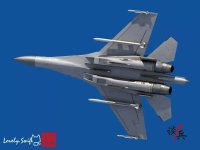
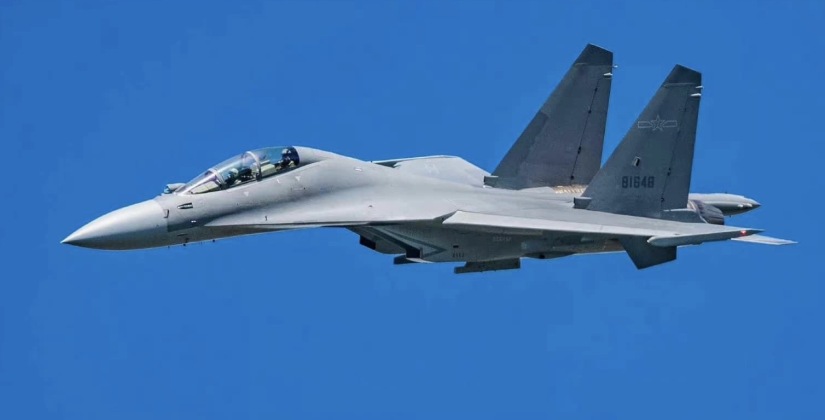
The image, believed to have originated from Chinese aviation spotting circles before rapidly proliferating through international open-source intelligence ecosystems, appears to show a PLAAF J-16 carrying eight PL-15 beyond-visual-range missiles and two PL-10 high-off-boresight short-range weapons in what may represent one of the heaviest publicly observed air-to-air configurations associated with China’s expanding air combat doctrine.
Although the missile count itself immediately attracts attention, the broader significance lies in what such a configuration may reveal regarding evolving PLAAF operational thinking, where future air superiority may increasingly be determined by missile magazine depth, sensor networking, datalink integration and coordinated saturation attacks rather than by traditional platform-centric measurements of fighter capability.
The Shenyang J-16 is a twin-engine, twin-seat 4.5-generation multirole fighter operated by the People’s Liberation Army Air Force (PLAAF), developed by China as a heavily upgraded and indigenous evolution of the Russian Su-30 Flanker family.
Dokumen Rahsia Rusia
No official PLAAF statement has accompanied the imagery, yet defence observers and aviation analysts have broadly treated the sighting as authentic because no credible contradictory assessments, technical anomalies or substantive debunking efforts have emerged despite widespread scrutiny across international open-source intelligence communities.
The aircraft itself appears configured in an unusually clean profile lacking external fuel tanks, strike ordnance or auxiliary stores, creating a specialized combat posture optimized almost exclusively around maximizing missile density and long-range air-to-air lethality rather than preserving multirole flexibility or extended operational endurance.
Such distinctions increasingly matter because assumptions governing future aerial warfare across the Western Pacific are shifting away from isolated fighter-versus-fighter engagements toward highly networked battlespaces where survivability may depend less on maneuverability and increasingly upon which force achieves target detection, engagement quality and missile launch opportunities first.
For military planners examining future Taiwan Strait contingencies or South China Sea confrontation scenarios, heavily armed airborne missile carriers increasingly represent force multipliers capable of shaping battlespace conditions and influencing combat outcomes before opposing formations even approach visual engagement ranges.
Newly surfaced imagery of a Chinese PLAAF J-16 armed with eight PL-15 long-range missiles is raising fresh questions about Beijing’s evolving air combat doctrine, missile truck strategy and future Taiwan Strait or Indo-Pacific conflict scenarios.

defencesecurityasia.com