DeepSeek, China's AI model: News & Discussion

@Dalit bro,

You and all my Pakistani friends seem very proud of the achievements of your taller than mountain friends! I am sure you could have been no prouder than what you are today had Deep Seek, Huawei or such other been Pakistani achievements.

Regards
Why you crying? Anytime China excels you put a depressing post?
The mere fact a 6 million dollar company set up a few months has gotten this far is a humiliation to the self appointed masters in this field is enough to leave all astonished……..unless you’re Indian - then it’s beating chest time and putting insignificant posts like this. Focus on the topic for once.

Regards
 
Why you crying? Anytime China excels you put a depressing post?
The mere fact a 6 million dollar company set up a few months has gotten this far is a humiliation to the self appointed masters in this field is enough to leave all astonished……..unless you’re Indian - then it’s beating chest time and putting insignificant posts like this. Focus on the topic for once.

Regards
It's open source, we can say this is a gift for the humanity with an innovation way in AI big model sector that right now many scientists, companies, countries are taking a closer look at to modified or improve their own.

Why are there people that hate on this whale so much.
 
Try asking ChatGPT about genocide in Gaza...or whether Palestinians deserve freedom or a state of their own.
Chat GPT sucks. Here is grok.


The question of whether Palestine should have its own nation is deeply rooted in historical, political, and humanitarian contexts, and it's a matter of significant international debate. Here's a detailed overview:

Historical Background:
Mandate for Palestine: Post-World War I, the League of Nations granted Britain a mandate over Palestine, which included what is now Israel, the West Bank, and Gaza Strip. The Balfour Declaration in 1917 expressed British support for a "national home for the Jewish people" in Palestine.
Partition Plan: In 1947, the UN proposed a partition plan (Resolution 181) to divide Palestine into Arab and Jewish states, which was accepted by Jewish leaders but rejected by Arab leaders.
1948 Arab-Israeli War: Following Israel's declaration of independence, war ensued, leading to the displacement of hundreds of thousands of Palestinians, known as the Nakba.

Current Situation:
Occupation and Settlements: Since the 1967 Six-Day War, Israel has occupied the West Bank and Gaza Strip. Israeli settlements in these areas are considered illegal under international law by most countries, though Israel disputes this.
Palestinian Authority & Hamas: The Palestinian Authority governs parts of the West Bank, while Hamas controls Gaza, with significant influence from Israel over these territories' borders, airspace, and sea access.
Statehood Recognition: Over 130 UN member states recognize Palestine as a state, though it lacks full sovereignty, particularly over its borders, due to the occupation and ongoing conflict.

Arguments For Palestinian Statehood:
Self-Determination: The right to self-determination is a fundamental principle in international law, suggesting that the Palestinian people should have the opportunity to govern themselves.
Human Rights: The ongoing conflict and occupation have been criticized for human rights abuses, with statehood seen as a path to better rights protection.
Peace Process: Many see Palestinian statehood as essential for a two-state solution, which has been the basis of peace negotiations for decades.

Challenges and Counterarguments:
Security Concerns: Israel points to security threats, especially from Hamas, arguing that concessions without guarantees could lead to further attacks.
Settlements: The presence of Israeli settlements complicates the territorial integrity of a potential Palestinian state.
Political Division: Internal Palestinian politics, with division between Fatah (leading the Palestinian Authority) and Hamas, presents challenges to unified state-building.

International Perspective:
UN Resolution 2334: In 2016, the UN Security Council reaffirmed that Israel's settlement activity was a "flagrant violation" of international law, calling for a two-state solution.
Global Recognition: While many countries recognize Palestine, the U.S. and some others do not, impacting international support and leverage.

Conclusion:
The establishment of an independent Palestinian state involves complex negotiations regarding borders, security, Jerusalem's status, and refugee rights. The international community largely supports the concept of a Palestinian state alongside Israel. However, achieving this involves overcoming significant political, security, and territorial disputes. The process would require mutual recognition, cessation of hostilities, and likely international mediation to ensure both Israeli and Palestinian rights and security are addressed.

Given the complexity and sensitivity of this issue, any resolution would need to be equitable, respecting the rights and aspirations of both Palestinians and Israelis for peace and security.
 
Why you crying? Anytime China excels you put a depressing post?
The mere fact a 6 million dollar company set up a few months has gotten this far is a humiliation to the self appointed masters in this field is enough to leave all astonished……..unless you’re Indian - then it’s beating chest time and putting insignificant posts like this. Focus on the topic for once.

Regards

@SoulSpokesman Is a reluctant Hindutva.
 
To view this content we will need your consent to set third party cookies.
For more detailed information, see our cookies page.

The US was opposed to China building a big naval fleet. China did it much cheaper than the US could do.

The US said no to China on replacing the US economically/technologically. China did it.

The US says no to China on AI machines/drones in military. Do it.


China should invest heavily in AI weapons.

Trump says no to China on a gold-back yuan. Do it. If you want Europe to support gold-backed currencies and supporting a gold-backed yuan, China can share EV technology with Europe, partner with Europeans on Green Energy. It is the path to their heart. It is like giving your loved one a box of roses.

A gold-backed yuan would totally destroy US markets and the dollar empire, bitcoin is promoted to save the dollar from the return of gold. China would leap over the US economically with a gold-backed yuan. You see markets shaken by the news... If China went with gold in 2020-2024, it would have been market shattering for America.

The US loses control over the monetary system with a gold-backed yuan.

The US loses military dominance with a US-China AI arms race. China needs to make the worst nightmares of the US come true.
 
The US was opposed to China building a big naval fleet. China did it much cheaper than the US could do.

The US said no to China on replacing the US economically/technologically. China did it.

The US says no to China on AI machines/drones in military. Do it.


China should invest heavily in AI weapons.

Trump says no to China on a gold-back yuan. Do it. If you want Europe to support gold-backed currencies and supporting a gold-backed yuan, China can share EV technology with Europe, partner with Europeans on Green Energy. It is the path to their heart. It is like giving your loved one a box of roses.

A gold-backed yuan would totally destroy US markets and the dollar empire, bitcoin is promoted to save the dollar from the return of gold. China would leap over the US economically with a gold-backed yuan. You see markets shaken by the news... If China went with gold in 2020-2024, it would have been market shattering for America.

The US loses control over the monetary system with a gold-backed yuan.

The US loses military dominance with a US-China AI arms race. China needs to make the worst nightmares of the US come true.
Of course a commodity backed currency would be far better for any country but any time a country tries to do the US state department (at the behest of corrupt bankers) magically ends up murdering their leader like Saddam and Gaddafi.They mainly use bilateral currency swaps for now. Some trade is conducted in Yuan. "There are decades where nothing happens; and there are weeks where decades happen" we just have to wait and see how the future unfolds.
 
Last edited:

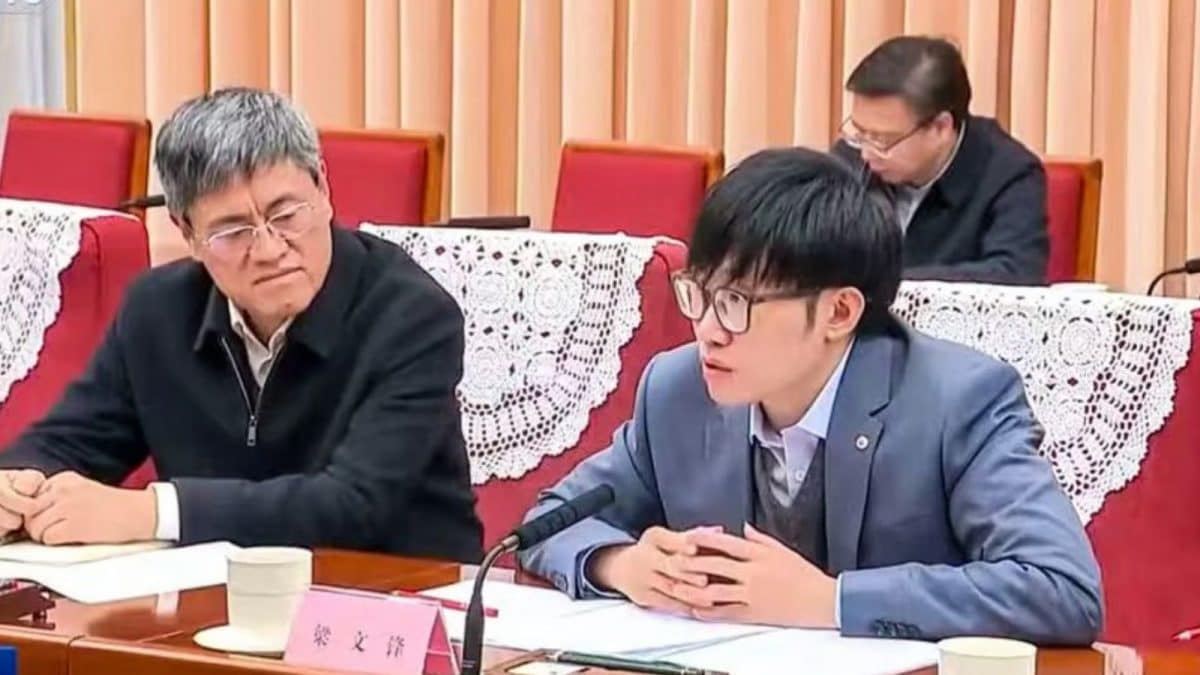
DeepSeek: Who Is Liang Wenfeng, The Geek Behind The Chinese AI Company That Has Spooked US Markets?​

28, 2025, 10:39 IST

The 40-year-old electronic engineering graduate from Zhejiang University in China funded DeepSeek from a hedge fund that he launched in 2015. Liang Wenfeng has said in interviews that China’s AI cannot remain in a follower position, ‘that’s why some exploration is inevitable’

A 40-year-old information and electronic engineering graduate, Liang Wenfeng, has partly funded DeepSeek, the Chinese Artificial Intelligence (AI) company, whose latest app has become the most downloaded app in the US.

The Hangzhou-based start-up topped Apple’s free app chart after releasing a new open source AI assistant that rivals OpenAI’s ChatGPT.

As DeepSeek became the most downloaded and top-rated app on Apple Store, the stocks of tech giants Nvidia, Meta and Microsoft crashed on Monday.

How Is Liang Wenfeng?​

The meteoric rise of DeepSeek has caught the attention of everybody in the tech world, with Liang Wenfeng being called as China’s Sam Altman – the co-founder of OpenAI.

Liang grew up in the 1980s in “fifth-tier city" Guangdong, China, as he told in a 2024 interview. His father was a primary schoolteacher. He received his undergraduate and graduate degrees in Artificial Intelligence from Zhejiang University, one of China’s oldest and best-ranked universities.

In 2015, Liang and two of his classmates from Zhejiang University created a quantitative hedge fund, High-Flyer, whose website says it “relies on mathematics and AI for quantitative investment".

Gradually, the hedge fund grew quickly in China, becoming the first quant hedge fund to raise over 100 billion RMB (either $15 billion or Rs 1.19 lakh crore). In 2021, the number fell to around $8 billion but High-Flyer remains one of the country’s most important quant hedge funds.

How Liang Wenfeng Funded DeepSeek​

Liang’s co-founded quantitative hedge fund High-Flyer Quant became known for innovatively using AI-driven trading strategies. The fund announced in 2023 that it was going beyond trading to focus on creating a new research arm to explore “artificial general intelligence", Reuters reported.

Liang told a Chinese tech publication, QBitAI, that he did not go looking for experienced engineers to build a team. Instead, he approached PhD students from China’s top universities such as Peking University and Tsinghua. Many had been published in top journals and won awards at international academic conferences, but lacked industry experience.

According to Chinese corporate records, High-Flyer also owns patents related to chip clusters used to train AI models.

Liang started buying thousands of Nvidia graphics processors in 2021 as an AI side project before the Joe Biden administration put restrictions on US exports of AI chips to China, the Financial Times reported.

According to Reuters, High-Flyer’s AI unit had said it owns and operates a cluster of 10,000 A100 chips as at 2022. In an interview in July 2024 with Waves, Liang said Chinese companies have been “accustomed" for years to leveraging technological innovations developed elsewhere, which “isn’t sustainable". “This time, our goal isn’t quick profits but advancing the technological frontier to drive ecosystem growth".

What is impressive is that Liang spent only $5.6 million developing the latest iteration of their model — a fraction of what US tech giants are spending on their AI models.

The Financial Times reported that DeepSeek is known for giving the highest salary to its AI engineers, who are based in offices in Hangzhou and Beijing.

Reports suggest that China’s top leadership has taken note of DeepSeek. Before the DeepSeek-R1 model was released on January 20, Liang attended a closed-door meeting for businessmen and others in the industry hosted by Chinese Premier Li Qiang, said Chinese state media.

What’s Liang’s Aim With DeepSeek?​


With DeepSeek, Liang wants to push China ahead. He had said, “We see that China’s AI cannot remain in a follower position forever. We often say there’s a one- or two-year gap between China and the US, but the real gap is between originality and imitation. If this doesn’t change, China will always be a follower. That’s why some exploration is inevitable."

Liang runs DeepSeek as a bottom-up company without any preassigned roles or rigid hierarchy. Speaking on the same, he has been quoted as saying, “I believe innovation is, first and foremost, a matter of belief. Why is Silicon Valley so innovative? Because they dare to try. When ChatGPT debuted, China lacked confidence in frontier research. From investors to major tech firms, many felt the gap was too wide and focused instead on applications. But innovation requires confidence, and young people tend to have more of it."

Venture capitalist Marc Andreessen, a close advisor to US President Donald Trump, told AFP, “DeepSeek R1 could be AI’s Sputnik moment. It is one of the most amazing and impressive breakthroughs I’ve ever seen."

Challenges For DeepSeek​

According to US investment research company Morningstar, there’s “low imminent risk" for DeepSeek to be penalized by the US government. The research firm noted that DeepSeek has recently restricted new registrations to Chinese numbers, hence limiting the number of US users.

“They have not released any commercial versions or monetisation plans, so there’s no direct monetary impact even if new restrictions are rolled out. They have not accepted outside investors (all funding comes from founder’s quant fund) as there’s no pressure for anyone to divest," said Morningstar analyst Phelix Lee, quoted by Business Times.

Not just that, US rivals are also upping the ante against the popularity of DeepSeek. OpenAI is creating a joint venture with Japan’s SoftBank, dubbed Stargate, with plans to spend at least $100 billion on AI infrastructure in the US. Elon Musk’s xAI is also massively expanding its Colossus supercomputer to help train its Grok AI models.

 
Of course a commodity backed currency would be far better for any country but any time a country tries to do the US state department (at the behest of corrupt bankers) magically ends up murdering their leader like Saddam and Gaddafi.They mainly use bilateral currency swaps for now. Some trade is conducted in Yuan.
China is limitless in potential in defeating evil. China simply develops a great open AI, and look at the reaction. China can destroy the Anglo-Zionists in terms of technology, economy and monetarily. The reason why China should not hold back their military research (including AI), military development and military production is the US is not going to be stable and is going to lose it if their Empire of evil goes crashing down.

Trump is trying to manage China's potential, so that the Trump plan for the American Empire First technologically, economically and politically has no opposition; and Dollar Empire backed by bitcoin has no opposition. CNN calls that Trump Empire - "isolationist".
 
Honestly, the rate of technological advancement by China is staggering.

They undercut every copilot solution out there by making Deepseek open source and broke their own fusion record.Meanwhile the US is focused on deporting illegal immigrants lol

China has reached the cutting point - critical mass - point at which they can innovate at pace.

Only three things missing from China’s armour:

1. Jet engine
2. Commercial passenger jet
3. High end chips manufacture and chip design

Once that is done - west is finished.

Western stock market will tank and with it their ability to maintain military reach beyond their borders.

@UKBengali
@r3alist
 
China is limitless in potential in defeating evil. China simply develops a great open AI, and look at the reaction. China can destroy the Anglo-Zionists in terms of technology, economy and monetarily. The reason why China should not hold back their military research (including AI), military development and military production is the US is not going to be stable and is going to lose it if their Empire of evil goes crashing down.

Trump is trying to manage China's potential, so that the Trump plan for the American Empire First technologically, economically and politically has no opposition; and Dollar Empire backed by bitcoin has no opposition. CNN calls that Trump Empire - "isolationist".
china has been moving up the leaderboards in a lot of industries in recent years, these "surprises" over the past month have not come out of nowhere,
They never boast what they have till it is 100% successful....there will be a lot of surprises you would see soon. As for dethroning the dollar it's easier than done but china needs to build up her military strong enough before making any such move maybe in 10 years from now.
 

‘Same as TikTok’: Cybersecurity warning for AI app DeepSeek​


David Swan and Millie Muroi

January 28, 2025 — 7.00pm

Australian cybersecurity executives and the federal opposition have sounded a warning about Chinese artificial intelligence start-up DeepSeek, which has rocketed to the top of app stores globally and roiled sharemarkets with its threat to America’s AI dominance.

DeepSeek’s rapid ascent this week took investors and analysts by surprise – as well as apparently the company itself, which said it would temporarily limit user registrations due to repeated outages as it struggled to keep up with its sudden popularity.

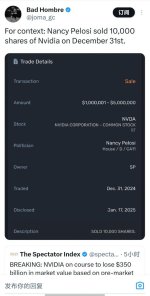
Its rampant rise also triggered a bloodbath on Wall Street, dragging down shares in American AI giant Nvidia in the biggest fall in US stock market history, as well as those of Oracle, Meta and Google parent company Alphabet.

Little is known about DeepSeek, a small Hangzhou-based start-up founded in 2023 by entrepreneur Liang Wenfeng, who runs a hedge fund, High-Flyer Capital, which uses AI to identify patterns in stock prices.

Last week, DeepSeek launched its free AI chatbot, which its creators say beats the likes of ChatGPT in terms of technical capabilities with a fraction of the energy usage and cost. It’s now dominating app store charts globally.

“The app’s policies also make it clear they will hand over this information if requested to do so by the Chinese government. I am also concerned about the bias the AI algorithm appears to have towards a Chinese Communist Party worldview, as it has been shown refusing to provide information on topics sensitive to the CCP and its historical oppression of minorities and democratic activists.

“We must make sure this does not become another tool for authoritarian propaganda, and I hope the Albanese government is closely co-ordinating a response with our closest allies.”

Industry and Science Minister Ed Husic refused to indicate whether DeepSeek was a national concern when asked several times at a press conference, saying the government would “keep an open mind” and watch for anything that presented a risk to the national interest.

“I think it’s too early to jump to conclusions,” he said. “We will clearly be informed by the advice of National Intelligence Community in relation to threats as they might present.”

He told ABC Radio: “We’re going to see more and more of these products being made.

“People will put these new products through their paces, but there has been a long march towards the greater use of AI [...] and I just believe that’s going to continue well into the future. If anything, it will accelerate.”

Alastair MacGibbon, Australia’s cybersecurity tsar under former prime minister Malcolm Turnbull, said Australian users should be concerned about censorship and handing over sensitive data to the Chinese state.

The cybersecurity veteran, now chief strategy officer at cybersecurity firm CyberCX, said users needed to ask themselves whom they trusted with their information.

“Anybody using DeepSeek or other Chinese large language models should try asking it about Tiananmen Square, pro-democracy movements in Hong Kong or for criticisms of Xi Jinping. If it can’t or won’t answer these questions, ask yourself what else will it not tell me?,” MacGibbon said.

“While for the most part, Western tech companies have learned to be cautious about who can access IP and user information, there are no similar conversations happening in China … Anything we enter into DeepSeek is going straight into the hands of the Chinese Communist Party.

“The conversations we have had about Huawei and TikTok are the same conversations we will have about DeepSeek. Internet users and governments need to be alert to this.”

DeepSeek’s rise has also sparked questions about the billions of dollars already invested by US giants on AI innovations. The Chinese start-up said it spent just $US5.6 million ($8.9 million) on computing power for its base R1 model, relying on less powerful H800 chips produced by Nvidia, which have been banned from export to China since October.

In an interview with Chinese media, DeepSeek’s founder Liang said that “AI should be affordable and accessible to everyone”.

Leading US venture capitalist Marc Andreessen compared the launch of DeepSeek’s R1 model to a pivotal moment in the US-USSR Cold War space race, describing it as AI’s “Sputnik moment”, while OpenAI chief executive Sam Altman said R1 was impressive “particularly around what they’re able to deliver for the price”.

Chief scientist Tony Hayment said Australia’s record of governance meant the country would probably be in good shape to combat some of the dangers of AI, but DeepSeek showed how quickly it could develop: “DeepSeek is genuine, and is really going to change our lives, at least change the stock market.

“But it shows you the pace at which innovation and science and technology goes privately funded in Shanghai, by a bunch of talented 22-year-olds, without access to the world’s best chips, without access to Nvidia chips, seem to have created something that’s even better that the best companies in the Western world have done.”

DeepSeek did not return a request for comment.

Maria Zhang, an associate professor at the University of Sydney, said DeepSeek was part of a new wave of Chinese start-ups defined by an ability to maximise limited resources.

Until now, it had been presumed that billion-dollar investments and access to the latest generation of specialised Nvidia processors were prerequisites for developing state-of-the-art AI systems.

“The West has missed the emergence of China’s Innovation 2.0, characterised by a new generation of entrepreneurs who prioritise foundational research and long-term technological advancement over quick profits,” she said.

source: https://www.smh.com.au/technology/s...ning-for-ai-app-deepseek-20250128-p5l7ow.html
-------------------------------------------------------------------

LOL, how the mighty have fallen!

American tech used to dominate on quality and merit. Now it has to hide behind Mommy's skirt in the name of 'national security' and protectionism.
 
1738053439751.jpeg
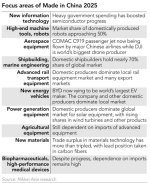
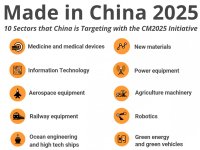
It took 10 years since the proposal of made in China 2025.
1738053688004.jpeg
 
@Musings bro,

How long before do you think the AltRight media starts blaming H1-B visa holders for the decline of US tech?

Any bets? Anyone?
 
@Musings bro,

How long before do you think the AltRight media starts blaming H1-B visa holders for the decline of US tech?

Any bets? Anyone?

This is not an AltRight issue to play the 'racism' card.

I have personally seen product quality go down when projects were filled with Indians. I have been in tech projects where every single aspect of the project, from management to architecture to design to implementation to testing, was substandard because it was filled with Indians who were learning on the job.

This decline is inevitable when hiring is done based on nepotism, as Indians do, and not on merit.
 

Users who are viewing this thread

Back
Top