Navigation
Install the app
How to install the app on iOS
Follow along with the video below to see how to install our site as a web app on your home screen.
Note: This feature may not be available in some browsers.
More options
Style variation
You are using an out of date browser. It may not display this or other websites correctly.
You should upgrade or use an alternative browser.
You should upgrade or use an alternative browser.
Egyptian Armed Forces
- Thread starter The SC
- Start date
More options
Who Replied?
Pak-Warrior
Registered Member


Egypt needs to buy CM302s in bulk from China.
CM-302 Supersonic cruise missiles with 300 km range.
Algeria has those already.
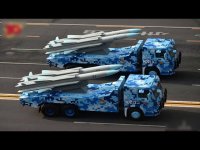
CM-302 Supersonic cruise missiles with 300 km range.
Algeria has those already.
Ramses Akhenaten Ahmose
Registered Member


Egypt does maintain the supply of Kp 300 bastion missile systems. I’m going to assume EN has the yakhont variant and thus fires up to 300-400 kilometersEgypt needs to buy CM302s in bulk from China.
CM-302 Supersonic cruise missiles with 300 km range.
Algeria has those already.
View attachment 148275

The SC
INT'L MOD
- Thread starter
- #1,864
Netanyahu is afraid of the Egyptian army's movements and calls on Trump to intervene immediately

The American "Axius" website revealed, on Saturday, that Israeli Prime Minister Benjamin Netanyahu asked the administration of US President Donald Trump to pressure Egypt to reduce its last military crowd in Sinai.
Israeli officials say that "the Egyptian military crowd in the Sinai has become another important point of tension between the two countries with the continuation of the war in Gaza," according to Axius.
Two Israeli officials told Axius that "the Egyptians are establishing a military infrastructure - some of which can be used for offensive purposes - in areas where only light weapons are allowed under the 1979 peace treaty with Israel."
The American website revealed that "Netanyahu presented to US Secretary of State Marco Rubio during their meeting in Jerusalem on Monday, a list of Egypt's activities in Sinai."
The two Israeli officials claimed that "Egypt has expanded the runways of the air bases in the Sinai so that the fighting aircraft can use them, and they built underground facilities that Israeli intelligence believes that they can be used to store missiles," noting that "there is no evidence that the Egyptians are already storing missiles in those facilities," but they made it clear that the Egyptian authorities "did not provide a reasonable explanation when Israel provided inquiries through channels Diplomacy and military.
They added: "Israel decided to ask the Trump administration to intervene after direct talks with the Egyptians failed to make any progress."
An Egyptian official denied in his interview with "Axios" the Israeli allegations, and said that the Trump administration had not raised this issue with Egypt recently.
https://www.maannews.net/news/2147359.html
Last edited:

MMM-E
Elite Member

Egypt needs to buy CM302s in bulk from China.
CM-302 Supersonic cruise missiles with 300 km range.
Egypt needs to buy hypersonic Ballistic Missiles from Turkiye
TAYFUN Block1 with speed of mach 5,2 and TAYFUN Block4 with speed of mach 10
also 500+ km 300-ER air launched Ballistic Missile with speed of mach 4
Turkiye can arm Egypt with deadly weapons that could give Israel nightmares

iblini
Trusted Member


lol, you are like the salesman of Turkey.Egypt needs to buy hypersonic Ballistic Missiles from Turkiye
TAYFUN Block1 with speed of mach 5,2 and TAYFUN Block4 with speed of mach 10
also 500+ km 300-ER air launched Ballistic Missile with speed of mach 4
Turkiye can arm Egypt with deadly weapons that could give Israel nightmares
Pak-Warrior
Registered Member
Egypt needs to buy hypersonic Ballistic Missiles from Turkiye
TAYFUN Block1 with speed of mach 5,2 and TAYFUN Block4 with speed of mach 10
also 500+ km 300-ER air launched Ballistic Missile with speed of mach 4
Turkiye can arm Egypt with deadly weapons that could give Israel nightmares
Either from Turkey or China. Or even Pakistan's Fatah GMLRS series.
Egypt do not need long range missiles as Israel is its immediate neighbor and shares the border. 300 to 400 KM range would be more than enough. Fatahs are perfect for this to overwhelm enemy air-defense and within MTCR compliance range. One mobile truck carries multiple missiles.
Egypt eventually has to start its own program for mass production. But I think US has not allowed Egypt to start its own ballistic missile program. You have to take a stand for your defense. Ofcourse US wants to keep Egypt's offensive capability to bare minimum so Israel do not have to worry about Egypt at all. US will stop the aid and may put some sanctions too. But that is okay, if Israel can have so many missiles and even nukes then why can't Egypt do anything for its own deterrence.
Sami_1
Registered Member
Egypt needs to buy hypersonic Ballistic Missiles from Turkiye
TAYFUN Block1 with speed of mach 5,2 and TAYFUN Block4 with speed of mach 10
also 500+ km 300-ER air launched Ballistic Missile with speed of mach 4
Turkiye can arm Egypt with deadly weapons that could give Israel nightmares

First, Egypt has obtained DF-15 missiles since 1992, and several copies of it, the DF-15A/B/C/D, were produced under license in Egypt, along with derivatives of the DF-12 missile, whether the CM-401 or anti-radar versions. The SCUD B missile replacement program began in 2013 with the acquisition of the first batch of Russian Iskander missiles, and Egypt’s stockpile of SCUD B/C/D missiles exceeded 900 missiles. Egypt, in cooperation with Russia, developed Iskander missiles to produce extended-range versions of 500/1000/1500 kilometers. There are rumors of cooperation with Pakistan and Turkey in one of the missile programs, especially with the halt in the production and modification programs of the DF-15 missile in Egypt and China in favor of newer missile systems. There are even plans for cooperation between Egypt and North Korea for a new generation of missiles to replace the Nodong missiles, which were manufactured in Egypt. That is, the basis of the development programs with the Russians, Chinese and North Korea. It is believed that cooperation with the Turks is in specific details. For guidance systems, while the more complex components, such as separate heads and multiple warheads, are with countries that have a long history of cooperation in the Egyptian missile program. The Turks are innovating their missile program, starting with the Chinese DF-12/M20 missiles. Cooperation with the Turks is related to attracting Turkish investments in the Egyptian civilian and military industrial base by exploiting the comparative advantages of the larger market size, cheaper labor costs, preferential trade agreements between Egypt and countries with a population exceeding 3 billion people, lower energy costs, and lower inflation than Turkey, which makes the migration of Turkish factories to Egypt the basis. Nasr is exploiting Turkish propaganda for its weapons to close them from local production lines and one of the tools to pressure other weapons suppliers to provide better technology because there is competition, such as the story of the J-35A and the Turkish KAAN fighter. The Chinese are the ones who offered to transfer better technology and better prices than the Turks immediately after Egypt announced its interest in them, so Egypt would benefit better. Last week, Egypt informed the Turks of infiltration operations and plans to overthrow the ruling regime there, and they were overthrown. Some military leaders involved in Turkey immediately after the information from Egyptian intelligence reached Turkey, as Egypt does not want the fall of Turkey or Iran currently, nor their regimes, to strike at the plans of America and Israel to re-engineer the Middle East and to assign the small artificial states of Israel and the Gulf to manage the region. Therefore, cooperation is necessary between Egypt, Iran and Turkey to unite the current enemy. Some do not understand that military cooperation programs are carried out over many years and plans. In Egypt with the Russians, the goal was to replace the Soviet weapons of the sixties and seventies in 2013 to replace the MiG-21, AT-3, SA-2/3, SCUD B, P-15 Termit and T-55 aircraft. These deals are carried out over many years, and the same story is with China to replace the F-7 aircraft and the HQ-2 and HY-2/4 systems. All of this is done quietly and without noise so as not to be thwarted.
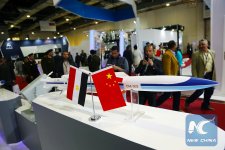
https://www.defense-arabic.com/2025/09/17/هل-حصلت-مصر-على-صواريخ-فرط-صوتية-من-روسي/
The SC
INT'L MOD
- Thread starter
- #1,871
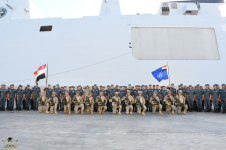
The arrival of elements of the Egyptian navy to Türkiye to participate in the Egyptian -Turkish joint training "Bahr Al -Siddiqa - 2025" ...
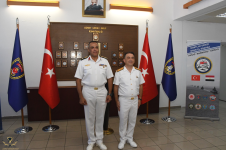
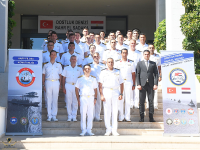
Elements of the Naval Special Units Brigade
Türkiye is a rising industrial power
- If the current orientations of the Turkish leadership are to ally with Egypt, this is certainly due to the arrival of information about the imminent attack on Türkiye and the disruption of its industrial renaissance
In clearer terms, if Türkiye requests, it has made its decision regarding NATO.
Elements of the Naval Special Units Brigade
Türkiye is a rising industrial power
- If the current orientations of the Turkish leadership are to ally with Egypt, this is certainly due to the arrival of information about the imminent attack on Türkiye and the disruption of its industrial renaissance
In clearer terms, if Türkiye requests, it has made its decision regarding NATO.
The SC
INT'L MOD
- Thread starter
- #1,873
Egypt is in negotiations with Sweden to purchase advanced GlobalEye early warning aircraft
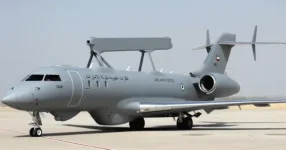
Egypt is negotiating with Swedish company Saab to acquire Global Eye early warning aircraft, in a move aimed at enhancing air and sea surveillance capabilities, amid challenges related to integration with air defenses, financing, and establishing a local maintenance center.
Arab Defense Website - September 23, 2025:
An intelligence report published on the Tactical Report website revealed serious Egyptian military talks and interest during the Paris International Air Show in June 2025. According to the report, the Swedish company Saab's pavilion witnessed a visit from an Egyptian military delegation examining early warning system technologies and linking them to reconnaissance and surveillance capabilities over large geographical areas.
The most important thing that emerged during the visit was the Egyptian delegation's focus on the modified Global Express platform, which was equipped with an Ericsson Microwave System radar with a range of 450 kilometers; It is an advanced radar promoted by the company with its ability to detect relatively small air and sea targets, including drones and cruise missiles, over a range of hundreds of kilometers in some descriptions. Practical experience has shown that integrating this type of radar onto a modified private civilian aircraft - the Global Express 6000 - has enabled the creation of an air early warning platform capable of carrying out long-range missions and withstanding diverse operational conditions, while using auxiliary radars to monitor land and sea targets with high accuracy.
The report's sources reported that Egypt expressed a desire to acquire three platforms of this type after an initial experiment was launched on other aircraft to no avail, due to the proven success of the Global Express platform. Three major technical, logistical, and political issues emerged during the negotiations:
First, the integration of the early warning system with Egypt's diverse air defense network. Egyptian forces have defense systems of American, Russian, Chinese and European origins coexisting, and therefore the ability of an early warning platform to communicate effectively and exchange threat data with these networks is a basic condition for the success of any deal.
Second: The cost of the deal and the issue of financing it. The report indicated that the negotiations included proposals to schedule payments in spaced installments as a mechanism to reduce the financial burden, and the details of this aspect are still under discussion.
Third: Transferring maintenance technology and the possibility of establishing a local capacity to maintain and operate these aircraft in Egypt. The Egyptian side has expressed a strong desire to establish a local maintenance center and enable its technicians to have full access to the aircraft's systems, while knowledge transfer proposals are a sensitive point for manufacturers.
The report places this step within a broader context of the diversification of arms sources in countries in the region and the replacement of some American systems with European ones in the wake of regional geopolitical changes. According to Tactical Report, Egypt's desire to modernize its early warning system comes not only as a direct target for a neighboring country, but also in response to regional security challenges that include maritime threats in the Red Sea, especially with the growth of irregular armed activities from Yemen, and the aspirations of some regional countries (Ethiopia) to expand their maritime capabilities and secure regional bases.
The report also indicated that the American E-2C Hawkeye aircraft, which served in Egypt for a long time, will soon stop being manufactured, which puts pressure on the issue of replacing or updating early warning capabilities before relying on worn-out or limited-manufacturing parts becomes inevitable.
Saab confirmed that the GlobalEye aircraft represents the pinnacle of multi-field early warning and air control solutions, as it is equipped with an integrated set of active and passive sensors capable of monitoring threats at long distances, whether in the air, over the seas, or on land. This advanced system allows military units to be provided with immediate intelligence information, which enhances situational awareness and ensures early warning against various risks, thus supporting the security of the countries operating them.
In this context, Poland is in advanced talks to acquire the Swedish GlobalEye aircraft, which combines long-range surveillance capabilities with high flight endurance. The platform is capable of operating at an altitude of 35,000 feet, with the ability to detect low targets at an altitude of 200 feet from a distance exceeding 458 kilometers. It also carries a ten-metre-long Erieye Extended Range radar antenna mounted on its top, which is the essential component of long-range sensing missions.
The system relies on the Bombardier Global 6500 aircraft, which has a carrying capacity exceeding 11 hours of continuous flight, in addition to its ability to take off and land from small airports with a take-off distance not exceeding 1,941 metres. The aircraft's radar is highly sensitive, allowing it to detect a small commercial drone the size of a laptop from a distance of 100 kilometers, while it can detect large fighters or drones from a distance of up to 550 kilometers. It can also monitor helicopters by tracking the speed of rotation of their blades, and even monitor cars speeding inside cities when flying at an appropriate altitude.
Overall, the report paints a picture that Cairo is seriously looking for new early warning solutions capable of providing broader coverage and better integration with its diverse defense systems, taking into account budget constraints and the desire to build local maintenance capacity. This development is presented as part of a broader policy to modernize Egypt's military arsenal with the aim of maintaining a level of deterrence that contributes to regional stability.

Watandar
Banned
In case of a conflict with Israel, no matter how long it lasts, Egypt will need supplies of fuel, ammunition and spare parts. The Israelis will get everything for free from America, sadly, but where will Egypt get it from ?
Users who are viewing this thread
Total: 6 (members: 0, guests: 6)
Pakistan Defence Latest
-
 Federal cabinet gives nod to imposition of emergency in KP; summary sent to president (19 Viewers)
- Latest: flyingorca
-
-

-

-

Country Watch Latest


Latest Posts
-
Federal cabinet gives nod to imposition of emergency in KP; summary sent to president (19 Viewers)
- Latest: flyingorca
-

-

-
-
