Sweden sells two Global Eye early warning aircraft to an unknown customer in the Middle East
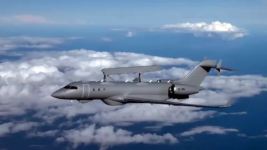
According to reports, the company has seven of these aircraft under contract, including three for the Swedish Air Force, two for France, and two for an unidentified Middle Eastern customer.
The CEO of Saab confirmed that the Middle Eastern order came from a new customer, ruling out previous speculation that the deal might be linked to additional orders from the United Arab Emirates, which already operates this model.
Given the lack of transparency regarding the Middle Eastern customer, Egypt stands out as a likely candidate, especially since the intelligence website Tactical Report previously mentioned Egyptian negotiations to acquire a Swedish early warning aircraft.
The GlobalEye aircraft provide airborne early warning and control capabilities through advanced surveillance radar and sensor systems that enable the detection of air, sea, and land targets, as well as intelligence gathering and coordination of military operations from the air.
If Egypt's acquisition of these aircraft is confirmed, it will add a new capability to the Egyptian Air Force's reconnaissance and early warning system, supporting air and sea surveillance and coordination of operations with fighter jets and air defense systems.
Specifications of the GlobalEye Airborne Early Warning and Control Aircraft
The GlobalEye aircraft, developed by the Swedish company Saab, is an integrated air, sea, and land early warning and surveillance system. It is based on a modified Bombardier Global 6000/6500 long-range business jet equipped with radars, sensors, and command and control systems. The system allows for the collection and integration of information from these three domains into a unified operational picture to support military decision-making.
The aircraft utilizes the Erieye ER active electronically scanned array (AESA) radar, which features an antenna approximately 10 meters long and incorporates gallium nitride (GaN) technology. Saab states that the system's declared range exceeds 350 nautical miles (approximately 650 kilometers), and it can detect low-flying threats at distances exceeding 400 kilometers when the aircraft is operating at an altitude of approximately 35,000 feet (10.7 kilometers). Actual detection ranges may vary depending on the target's altitude, radar signature, terrain, weather conditions, and electronic jamming.
The GlobalEye's capabilities extend beyond the airspace. It includes a dedicated maritime surveillance radar, an Automatic Identification System (AIS), electro-optical/thermal (EO/IR) sensors, and ISAR (Image of Target Aircraft) technology. This equipment enables the detection of ships and small boats, with a reported capability to detect objects the size of a submarine's periscope. The system also includes a dedicated ground-based movement radar capable of detecting moving targets across wide areas using GMTI (Ground Motion Interface) technology.
According to Saab's published specifications, the aircraft has an endurance of over 12 hours and an operating altitude exceeding 35,000 feet (approximately 10.7 kilometers). The sensors have a declared range of approximately 650 kilometers, while company data indicates they can utilize runways up to 6,500 feet (approximately 1,981 meters) long, enabling operation from a wider range of airports.
The GlobalEye system includes a command and control (C2) suite to integrate and distribute information from various sensors to command centers and friendly units via data links, voice communications, and satellite communications. It also incorporates electronic warfare and electronic reconnaissance (ESM/ELINT) equipment, a self-protection system, and IFF (Identification Friend or Foe) systems. These capabilities allow the aircraft to function as an airborne information management center, coordinating operations between fighter, air defense, naval, and ground forces.
Saab states that the system is designed to detect targets with a low radar signature, drones, and hypersonic ballistic missiles, while maintaining radar performance in electronic jamming or target-congested environments.