
Navigation
Install the app
How to install the app on iOS
Follow along with the video below to see how to install our site as a web app on your home screen.
Note: This feature may not be available in some browsers.
More options
Style variation
You are using an out of date browser. It may not display this or other websites correctly.
You should upgrade or use an alternative browser.
You should upgrade or use an alternative browser.
Energy Sectors / Industries / Projects
- Thread starter ghazi52
- Start date
More options
Who Replied?
SoulSpokesman
Trusted Member

@hydrabadi_arab
Hydra bro,
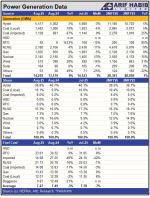
Looks like grid generation is stagnating. Possibly it is being offset by off grid solar plants?
Regards
Hydra bro,
Looks like grid generation is stagnating. Possibly it is being offset by off grid solar plants?
Regards
hydrabadi_arab
Trusted Member
@hydrabadi_arab
Hydra bro,
Looks like grid generation is stagnating. Possibly it is being offset by off grid solar plants?
Regards
8% increase YoY is thanks to forcing industry to use grid instead of captive power. Otherwise it would have been down quite a bit because of solar.
Grid will still have a role to play if Pakistan GDP growth pick up in coming years. Along with reducing price by 30-40% in couple of years.

ghazi52
THINK TANK: CONSULTANT

- Thread starter
- #94
‘Pakistan produced record 21.7TWh nuclear energy in 2024’
Khaleeq Kiani
September 25, 2025
• Yearly report on nuclear energy criticises Chashma-5 for high cost, precedence over renewable energy projects
• World Nuclear Industry Status Report says solar outshone nuclear in terms of efficiency, cost; reveals Pakistan’s renewable energy, including hydro, rose to 15.2GW from 14.2GW in 2023
ISLAMABAD: Pakistan’s net nuclear energy generation touched a record 21.7 terawatt-hours (TWh) in 2024, even though overall electricity costs and inefficiencies reached a systematic tipping point, forcing consumers to switch to renewables, particularly solar, said the World Nuclear Industry Status Report (WNISR) 2025.
“Pakistan operates six nuclear reactors with a combined (net) capacity of 3.3 gigawatts (GW). Nuclear electricity production has increased from 21.3TWh in 2023 to a new all-time high of 21.7TWh (net) in 2024,” it said, adding Pakistan started developing another 1200MW plant in December 2024 with Chinese support.
The share of electricity from nuclear power plants to the commercial grid increased from the 16.2pc peak in 2023 to a record 17pc in 2024, it said, adding all operating reactors were built by the China National Nuclear Corporation (CNNC). This includes two Hualong One reactors (Kanupp-2 and Kanupp-3) outside Karachi and four CNP-300 nuclear reactors in Chashma.
CNNC was also building another 1200-MW Hualong One reactor in Chashma (Unit 5). The agreement to build this reactor dates back to 2017, but it took over seven years to progress to the formal construction start, i.e. first pour of concrete for the base slab of the reactor building, which occurred on December 30, 2024.
It is China’s only ongoing nuclear newbuild project abroad and represents the first non-Russian construction start anywhere in the world in the past five years.
In January this year, the National Electric Power Regulatory Authority published an estimated overnight cost of Rs966 billion ($3.4bn) for the Chashma-5 project and the total cost (including financing and other costs) of Rs1.125 trillion ($4 billion).
The majority of the cost is planned to be covered by credit from China for the project to start production by 2030, the report said, adding the project had been criticised for its high cost of power, and shelving renewable energy projects to make way for it.
The report said India had 21 operational nuclear power reactors, with a total net generating capacity of 7.4GW, more than double that of Pakistan (3.3GW), and New Delhi planned to add another 100GW by 2047, a target unlikely to be met.
Renewables vs nuclear
Talking about global trends, the report said solar energy added hundreds of gigawatts globally while nuclear remained irrelevant in market development in 2024. “As storage passed a trigger point, there are first signs of a revolution behind the meter and low-income countries are starting to leapfrog,” it said.
In 2024, total investment in non-hydro renewable electricity capacity reached a record $728bn, 21 times the reported global investment in nuclear energy. “Solar and wind power capacities grew by 32 per cent and 11 per cent, respectively, resulting in 565GW of combined new capacity, over 100 times the 5.4 GW of net nuclear capacity addition. Global wind and solar facilities generated 70 per cent more electricity than nuclear plants”.
Not only this, as challenges of integrating nuclear power into the energy system remain, new energy technologies disrupt markets and systems. Photovoltaics directly produce electricity from solar radiation in harmless nanometre-thin semiconductor junctions, allowing for ongoing steep cost reductions and performance increases. This is complemented by similar advances in power electronics and batteries.
Together these new technologies are evolving towards a highly flexible fully electrified energy system with a decentralised control logic outcompeting traditional centralised fossil and nuclear systems. “Nuclear energy increasingly has difficulties to survive in this context. 2024 has been a pivotal year as battery storage costs have dropped by 40pc.”
As behind-the-meter installations continue to scale, their capacity is becoming increasingly important. This was recently illustrated in Pakistan, the report noted.
hydrabadi_arab
Trusted Member
ISLAMABAD:
The Ministry of Energy (Power Division) has said that the revised Indicative Generation Capacity Expansion Plan (IGCEP) has achieved an estimated $17 billion in savings by cutting about 7,000 megawatts (MW) of committed projects.
Compared to earlier plans, the revised IGCEP secures $17 billion in savings by excluding around 7,000 MW of projects from the previous version. This translates into prevention of a Rs4.96 per unit (kWh) increase in future power costs, according to the Power Division. The ministry said candidate projects have been selected on the basis of least-cost optimisation, with the central aim of providing reliable and affordable electricity to the public.
Responding to criticism from the All Pakistan Textile Mills Association (APTMA), a Power Division spokesperson described its comments on IGCEP as "flawed and devoid of complete visibility of facts and data." He said the ministry welcomed open debate and constructive criticism, as transparency is essential for improving the system.
However, he added, some claims did not reflect the facts and may create a wrong impression about how future planning of the power system is being carried out.
The spokesperson said IGCEP 2025-2035 marks a major shift in Pakistan's power planning, with focus on affordability, transparency, and long-term sustainability.
On the critique of demand forecasts utilised in the IGCEP, he said the methodology behind demand forecasting is time-tested and vetted by international consultants.
The Global Forecast is based on regression modelling, with GDP growth and electricity price as the key independent variables, as these best capture economic activity and consumer demand. Contrary to claims, population growth is not used as a driver in the model. Multiple scenarios are developed, with statistical tests ensuring spurious results are discarded. The spokesperson added that the global demand forecast is also verified against a separate "bottom-up" forecast. Under the Grid Code 2023, every distribution company (DISCO) prepares a bottom-up forecast using feeder-level data and planned load from homes, industries, and other consumer categories.
These bottom-up forecasts also include rooftop solar, captive generation, energy efficiency programmes, and emerging trends. The System Operator consolidates them at the system level from all DISCOs and compares them with the regression-based global forecast. The results from both approaches usually fall within an acceptable range under the Grid Code. He stressed that distributed solar and substitution effects are explicitly considered in the current IGCEP, making contrary claims inaccurate.
The Power Division said the IGCEP 2025-2035 also moves the power sector toward greater transparency and economic efficiency. Expensive projects not required under present conditions have been excluded, while emphasis is placed on indigenous resources such as hydro, solar, wind, and nuclear. This shift reduces reliance on imported fuels like coal and RLNG, saving billions in foreign exchange and improving energy security.
The ministry added that strategic projects beyond least-cost selection are subject to the "Least Cost Violation" methodology, which requires excess costs to be borne by the sponsoring agency. On claims about higher capacity costs, the spokesperson said Pakistan has recently added nuclear and local coal projects to achieve least-cost and energy security objectives. These projects carry higher fixed costs but much lower energy costs. The IGCEP evaluates total costs, ensuring consumers benefit from lower tariffs while energy security improves and fuel imports decline. Over time, with renewables coming online and older thermal plants retiring, capacity payments will moderate, creating a more affordable and sustainable power mix.
The spokesperson noted that electricity planning cannot be based only on current demand. IGCEP must look 10 to 20 years ahead, factoring in the growth of cities, industries, electric transport, cooling needs, and new technologies. The Grid Code, he said, provides a transparent, consultative, and evidence-based framework for demand forecasting. The ministry, he added, remains committed to ensuring that future electricity plans are realistic, reliable, and affordable, while supporting Pakistan's long-term economic growth and energy security.
The Ministry of Energy (Power Division) has said that the revised Indicative Generation Capacity Expansion Plan (IGCEP) has achieved an estimated $17 billion in savings by cutting about 7,000 megawatts (MW) of committed projects.
Compared to earlier plans, the revised IGCEP secures $17 billion in savings by excluding around 7,000 MW of projects from the previous version. This translates into prevention of a Rs4.96 per unit (kWh) increase in future power costs, according to the Power Division. The ministry said candidate projects have been selected on the basis of least-cost optimisation, with the central aim of providing reliable and affordable electricity to the public.
Responding to criticism from the All Pakistan Textile Mills Association (APTMA), a Power Division spokesperson described its comments on IGCEP as "flawed and devoid of complete visibility of facts and data." He said the ministry welcomed open debate and constructive criticism, as transparency is essential for improving the system.
However, he added, some claims did not reflect the facts and may create a wrong impression about how future planning of the power system is being carried out.
The spokesperson said IGCEP 2025-2035 marks a major shift in Pakistan's power planning, with focus on affordability, transparency, and long-term sustainability.
On the critique of demand forecasts utilised in the IGCEP, he said the methodology behind demand forecasting is time-tested and vetted by international consultants.
The Global Forecast is based on regression modelling, with GDP growth and electricity price as the key independent variables, as these best capture economic activity and consumer demand. Contrary to claims, population growth is not used as a driver in the model. Multiple scenarios are developed, with statistical tests ensuring spurious results are discarded. The spokesperson added that the global demand forecast is also verified against a separate "bottom-up" forecast. Under the Grid Code 2023, every distribution company (DISCO) prepares a bottom-up forecast using feeder-level data and planned load from homes, industries, and other consumer categories.
These bottom-up forecasts also include rooftop solar, captive generation, energy efficiency programmes, and emerging trends. The System Operator consolidates them at the system level from all DISCOs and compares them with the regression-based global forecast. The results from both approaches usually fall within an acceptable range under the Grid Code. He stressed that distributed solar and substitution effects are explicitly considered in the current IGCEP, making contrary claims inaccurate.
The Power Division said the IGCEP 2025-2035 also moves the power sector toward greater transparency and economic efficiency. Expensive projects not required under present conditions have been excluded, while emphasis is placed on indigenous resources such as hydro, solar, wind, and nuclear. This shift reduces reliance on imported fuels like coal and RLNG, saving billions in foreign exchange and improving energy security.
The ministry added that strategic projects beyond least-cost selection are subject to the "Least Cost Violation" methodology, which requires excess costs to be borne by the sponsoring agency. On claims about higher capacity costs, the spokesperson said Pakistan has recently added nuclear and local coal projects to achieve least-cost and energy security objectives. These projects carry higher fixed costs but much lower energy costs. The IGCEP evaluates total costs, ensuring consumers benefit from lower tariffs while energy security improves and fuel imports decline. Over time, with renewables coming online and older thermal plants retiring, capacity payments will moderate, creating a more affordable and sustainable power mix.
The spokesperson noted that electricity planning cannot be based only on current demand. IGCEP must look 10 to 20 years ahead, factoring in the growth of cities, industries, electric transport, cooling needs, and new technologies. The Grid Code, he said, provides a transparent, consultative, and evidence-based framework for demand forecasting. The ministry, he added, remains committed to ensuring that future electricity plans are realistic, reliable, and affordable, while supporting Pakistan's long-term economic growth and energy security.

Fatman17
THINK TANK: CONSULTANT
Savings on paper only. What a achievementISLAMABAD:
The Ministry of Energy (Power Division) has said that the revised Indicative Generation Capacity Expansion Plan (IGCEP) has achieved an estimated $17 billion in savings by cutting about 7,000 megawatts (MW) of committed projects.
Compared to earlier plans, the revised IGCEP secures $17 billion in savings by excluding around 7,000 MW of projects from the previous version. This translates into prevention of a Rs4.96 per unit (kWh) increase in future power costs, according to the Power Division. The ministry said candidate projects have been selected on the basis of least-cost optimisation, with the central aim of providing reliable and affordable electricity to the public.
Responding to criticism from the All Pakistan Textile Mills Association (APTMA), a Power Division spokesperson described its comments on IGCEP as "flawed and devoid of complete visibility of facts and data." He said the ministry welcomed open debate and constructive criticism, as transparency is essential for improving the system.
However, he added, some claims did not reflect the facts and may create a wrong impression about how future planning of the power system is being carried out.
The spokesperson said IGCEP 2025-2035 marks a major shift in Pakistan's power planning, with focus on affordability, transparency, and long-term sustainability.
On the critique of demand forecasts utilised in the IGCEP, he said the methodology behind demand forecasting is time-tested and vetted by international consultants.
The Global Forecast is based on regression modelling, with GDP growth and electricity price as the key independent variables, as these best capture economic activity and consumer demand. Contrary to claims, population growth is not used as a driver in the model. Multiple scenarios are developed, with statistical tests ensuring spurious results are discarded. The spokesperson added that the global demand forecast is also verified against a separate "bottom-up" forecast. Under the Grid Code 2023, every distribution company (DISCO) prepares a bottom-up forecast using feeder-level data and planned load from homes, industries, and other consumer categories.
These bottom-up forecasts also include rooftop solar, captive generation, energy efficiency programmes, and emerging trends. The System Operator consolidates them at the system level from all DISCOs and compares them with the regression-based global forecast. The results from both approaches usually fall within an acceptable range under the Grid Code. He stressed that distributed solar and substitution effects are explicitly considered in the current IGCEP, making contrary claims inaccurate.
The Power Division said the IGCEP 2025-2035 also moves the power sector toward greater transparency and economic efficiency. Expensive projects not required under present conditions have been excluded, while emphasis is placed on indigenous resources such as hydro, solar, wind, and nuclear. This shift reduces reliance on imported fuels like coal and RLNG, saving billions in foreign exchange and improving energy security.
The ministry added that strategic projects beyond least-cost selection are subject to the "Least Cost Violation" methodology, which requires excess costs to be borne by the sponsoring agency. On claims about higher capacity costs, the spokesperson said Pakistan has recently added nuclear and local coal projects to achieve least-cost and energy security objectives. These projects carry higher fixed costs but much lower energy costs. The IGCEP evaluates total costs, ensuring consumers benefit from lower tariffs while energy security improves and fuel imports decline. Over time, with renewables coming online and older thermal plants retiring, capacity payments will moderate, creating a more affordable and sustainable power mix.
The spokesperson noted that electricity planning cannot be based only on current demand. IGCEP must look 10 to 20 years ahead, factoring in the growth of cities, industries, electric transport, cooling needs, and new technologies. The Grid Code, he said, provides a transparent, consultative, and evidence-based framework for demand forecasting. The ministry, he added, remains committed to ensuring that future electricity plans are realistic, reliable, and affordable, while supporting Pakistan's long-term economic growth and energy security.
ghazi52
THINK TANK: CONSULTANT
- Thread starter
- #98
KE row resolved paving way for Saudi takeover
Sheharyar Chishti steps down, transfers shares to Saudi investor; KE spokesperson says no official notice received
ZAFAR BHUTTA
October 10, 2025
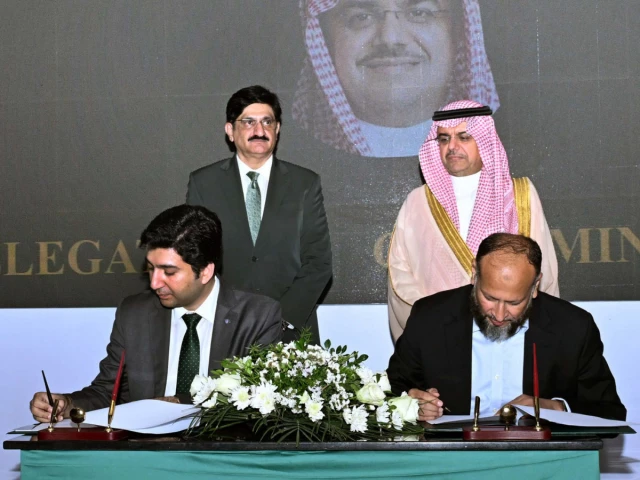
CEO of Trident Energy Pvt Ltd, Habil Ahmed Khan, and K-Electric CEO Moonis Abdullah Alvi sign an MoU to establish hybrid solar and wind power plants, as Sindh Chief Minister Syed Murad Ali Shah and Prince Mansour bin Mohammad bin Saad Al Saud, Chairman of the Saudi-Pak Joint Business Council, look on during a ceremony at the CM House on Thursday. Photo: INP
The government has managed to settle a row between Pakistani investor Sheharyar Chishti and Saudi shareholders in K-Electric (KE), as the latter steps down by giving majority stakes to a Saudi investor.
In a major boost to Saudi-Pakistan investment relations, Prince Mansour Bin Mohammed Al Saud has signed a Memorandum of Understanding (MoU) with Chishti for the acquisition of a majority shareholding in KES Power Ltd, the parent company that owns 66.4% of K-Electric.
Sources told The Express Tribune that Chishti had earlier acquired shares in K-Electric and attempted to take over the company, leading to a legal battle in the Sindh High Court between him and the Saudi shareholders.
According to the sources, the Saudi shareholders had raised the matter several times with the Pakistani government, including during Prime Minister Shehbaz Sharif’s recent visit to the Kingdom. They had also demanded that Chishti disclose the source of funding used to purchase KE shares. Saudi investors reportedly viewed his acquisition as a “coup” and sought his removal from the company.
“The recent deal between the Saudi investor and Chishti is part of a settlement to remove Chishti from KE,” said a source, adding that Chishti would transfer all his shares to the Saudi investor.
A high-level Saudi delegation is currently in Pakistan, and sources said that the Special Investment Facilitation Council (SIFC) played a key role in brokering the agreement between Chishti and the Saudi investor.
KE, incorporated in 1913 as Karachi Electric Supply Company (KESC), is Pakistan’s only vertically integrated power utility, supplying electricity to Karachi and its adjoining areas.
The majority of its shares, 66.4%, are owned by KES Power, a consortium including Al-Jomaih Power Limited of Saudi Arabia, National Industries Group (Holding) of Kuwait, and KE Holdings (formerly Infrastructure and Growth Capital Fund). The Government of Pakistan holds 24.36%, while the rest are free-float shares.
Earlier, Shanghai Electric Power had abandoned its $1.77 billion plan to acquire KE, citing Pakistan’s regulatory bottlenecks and shifting business environment as major hurdles.
This latest deal represents the largest Saudi investment in Pakistan’s power sector to date and aims to pave the way for Saudi participation in KE’s management and strategic direction. The agreement also signals Riyadh’s growing confidence in Pakistan’s regulatory and investment climate.
Saudi investors already holding shares in KE had long expressed frustration over tariff-related regulatory challenges. They had been urging the government to address these issues to protect foreign investments.
The leadership of both countries has congratulated the parties on the transaction, describing it as a milestone in advancing bilateral business-to-business (B2B) cooperation and reinforcing Saudi Arabia’s commitment to Pakistan’s energy and infrastructure sectors.
ghazi52
THINK TANK: CONSULTANT
- Thread starter
- #99
Separately, during the visit, another MoU was signed between K-Electric and Trident Energy, a Saudi-linked entity, to explore collaboration in power generation, renewable energy, and infrastructure development.
The agreement is seen as a step towards expanding Saudi participation in Pakistan’s energy sector and fostering long-term investment partnerships in areas of mutual interest.
The agreement is seen as a step towards expanding Saudi participation in Pakistan’s energy sector and fostering long-term investment partnerships in areas of mutual interest.

_NOBODY_
Trusted Member
From Power to EVs: HUBCO's CEO on Fixing Pakistan’s Energy Market
HUBCO CEO Kamran Kamal joins Ammar H Khan on All Things Money to lay out a pragmatic blueprint for Pakistan’s energy and industrial future:
why upstream oil & gas still matters, how offshore 3D seismic can unlock investment, why gas molecules must go to the most efficient users, and how hourly electricity pricing fixes distortions created by the duck curve, solar and batteries.
Kamran argues for targeted electrification (water heating, HVAC, cooking), smarter industrial policy (pick winners, baseload industries like metals/chemicals), rethinking fertilizer fuels (including coal-to-chemicals), and building a real e-mobility ecosystem—from two-wheelers and buses to BYD-style localization—without becoming a dumping ground for used imports.
A candid deep dive on grids vs. off-grid, marginal vs. cost-plus pricing, and how to convert stability into growth.
Chapters:
00:00 – Opening & HUBCO’s Pivot
06:46 – Risk Appetite & Diversification
13:32 – Oil & Gas: Offshore vs Onshore
20:18 – Gas Molecules: Most Efficient Use
27:04 – Hourly Pricing, Duck Curve & Batteries
33:50 – Grids, Private Signals & Taxpayers
40:36 – Baseload Industries & Exports
47:22 – E-Mobility, Tariffs & Closing Notes
hydrabadi_arab
Trusted Member
Fauji Fertilizer Company (FFC), one of Pakistan’s largest fertiliser companies, is exploring a coal gasification project as a potential substitute for natural gas, aiming to leverage Pakistan’s substantial coal reserves and reduce dependency on imported energy sources.
The company shared the update during its corporate briefing session held on Tuesday, which was attended by Topline Securities, a brokerage house.
As per the report, the FFC’s management “mentioned that they are working on a coal gasification project as a substitute for natural gas and aim to utilise the country’s substantial coal reserves”.
“However, the project is still in its early stages; no estimates have been made yet, and updates will be shared once any material progress is achieved,” it added.
Pakistan has massive coal reserves, with estimates of around 186 billion tons, making it among the largest in the world. The majority of these reserves are lignite, located in the Thar desert in Sindh.
During the briefing session, FFC’s management shared that it was nearing completion of the transition to full Shariah compliance. “Their focus remains clear on achieving full Shariah compliance, and it is only a matter of time before completion,” read the report.
Giving its perspective on the overall industry, FFC’s management expects the industry urea offtakes to close at 6.3 million in 2025, while urea inventory is expected to remain under 1 million by December.
“While for 2026, management expects a rebound in 1H2026 due to better agricultural activity as farm economics have improved for wheat and cotton,” said Topline.
Regarding urea export, FFC management said “no such discussions are ongoing with the government, nor are they considering exports”.
The company shared the update during its corporate briefing session held on Tuesday, which was attended by Topline Securities, a brokerage house.
As per the report, the FFC’s management “mentioned that they are working on a coal gasification project as a substitute for natural gas and aim to utilise the country’s substantial coal reserves”.
“However, the project is still in its early stages; no estimates have been made yet, and updates will be shared once any material progress is achieved,” it added.
Pakistan has massive coal reserves, with estimates of around 186 billion tons, making it among the largest in the world. The majority of these reserves are lignite, located in the Thar desert in Sindh.
During the briefing session, FFC’s management shared that it was nearing completion of the transition to full Shariah compliance. “Their focus remains clear on achieving full Shariah compliance, and it is only a matter of time before completion,” read the report.
Giving its perspective on the overall industry, FFC’s management expects the industry urea offtakes to close at 6.3 million in 2025, while urea inventory is expected to remain under 1 million by December.
“While for 2026, management expects a rebound in 1H2026 due to better agricultural activity as farm economics have improved for wheat and cotton,” said Topline.
Regarding urea export, FFC management said “no such discussions are ongoing with the government, nor are they considering exports”.
SoulSpokesman
Trusted Member
Excellent initiative. Chinese are the global leaders in coal gasification and with their support PAK can do very well in this field.
Regards
Regards

VCheng
THINK TANK: CONSULTANT
Excellent initiative. Chinese are the global leaders in coal gasification and with their support PAK can do very well in this field.
Regards
Where's the meme about "Oh Jeez not this sh1t again!"?
Edit: Found it.

SoulSpokesman
Trusted Member
Users who are viewing this thread
Total: 1 (members: 0, guests: 1)
Pakistan Defence Latest


Country Watch Latest
-

-

-
 Iran - Israel/US War: Israel-US declare war on Iran, Iran responds (54 Viewers)
- Latest: Khorasan Black Flags
-
-
