Federal Constitutional Court/ Supreme Court / High Courts of Pakistan, News

Tariq Jahangiri’s appointment annulled​


Malik Asad
February 24, 2026


View attachment 180682

A file photo of Justice Tariq Mehmood Jahangiri of the Islamabad High Court. — Picture via IHC website

• 116-page judgement declares his law degree invalid
• IHC rules appointment was ‘without lawful authority’ and a ‘legal nullity’
• Calls ex-judge’s plea to recuse CJ Dogar ‘dilatory tactics’ and ‘bench-hunting’


ISLAMABAD: The Islamabad High Court on Monday issued a detailed 116-page judgement on the removal of one of its judges, Tariq Mehmood Jahangiri, declaring that his appointment to the bench was “without lawful authority” as he did not possess a valid law degree.

An IHC division bench comprising Chief Justice Sardar Muhammad Sarfraz Dogar and Justice Muhammad Azam Khan held that ex-Justice Jahangiri’s foundational law degree was void ab initio, rendering his elevation to the high court a “legal nullity”.

The judgement relied heavily on original academic records produced by the University of Karachi (KU) registrar, concluding that the respondent’s academic credentials were tainted by fraud, impersonation and a deliberate attempt to circumvent a disciplinary ban.

According to the verdict, Mr Jahangiri first appeared in his LL.B. Part-I examination in 1988 under a fake enrolment number. He was later caught using unfair means and was debarred for three years through a university disqualification circular issued in 1989.

Instead of complying with the ban, the court held, he “chose a course of deliberate misrepresentation” and reappeared in the 1990 examinations under a different identity — “Tariq Jahangiri” — using an enrolment number originally issued to another student, Imtiaz Ahmad. He later appeared in the LL.B. Part-II examinations under his actual name but with yet another enrolment number.

Quoting the KU Controller of Examinations, the bench observed that a university issues only one enrolment number per programme and that it was “impossible” for a student to be allotted two numbers for the same degree. Consequently, the mark sheets and degree were declared invalid.

The principal of Government Islamia Law College also informed the court that Mr Jahangiri “was never admitted” to the institution — a claim the bench described as particularly damaging. Invoking the settled principle that what is void from the outset cannot be validated by subsequent administrative acts, the court declared the judge’s LL.B. degree a nullity in the eyes of law.

A key aspect of the judgement was the court’s criticism of Mr Jahangiri’s conduct during proceedings. Despite being granted repeated opportunities to submit a written reply and produce original documents, he failed to do so.

Instead, he filed applications seeking the constitution of a full court, recusal of the chief justice and adjournment sine die on the ground that related proceedings were pending before the Sindh High Court.
 
The bench termed these moves “dilatory tactics” and held that once prima facie documentary evidence had been produced by the petitioner, the burden shifted to the respondent to establish his lawful qualification. His failure to produce primary evidence, the court ruled, warranted an adverse inference.

Mr Jahangiri’s plea seeking recusal of Justice Dogar — on the basis that he had earlier challenged the chief justice’s transfer — was rejected.

The bench held that mere apprehension of bias was insufficient and reiterated that the constitution of benches was the sole prerogative of the chief justice.

It further described the attempt to exclude certain judges while implicitly favouring others as a “classic textbook manifestation of mala fide and bench-hunting”.

Addressing the question of maintainability, the IHC relied on a precedent of the Supreme Court in Malik Asad Ali v. Federation of Pakistan, holding that the constitutional bar under Article 199(5) applies to judicial acts of a judge, not to questions relating to personal qualifications.

The bench clarified that the jurisdiction of the Supreme Judicial Council (SJC) under Article 209 pertains to misconduct or incapacity during tenure and does not extend to determining whether an appointment itself was void from inception. “The SJC cannot cure a void appointment,” the court observed.
 
1786124172057.png

Chief Justice of Pakistan Yahya Afridi and Supreme Court judges pose for a photo with retiring Justice Musarrat Hilali at the Supreme Court, Islamabad on August 7. — PID
 

SCBA backs call for new provinces, calls it 'step forward' for better governance​

Nasir Iqbal
August 7, 2026

ISLAMABAD: The Supreme Court Bar Association (SCBA) — a premier lawyers’ body — on Friday voiced support for the controversial proposal recently put forward by Interior Minister Syed Mohsin Naqvi regarding the creation of new provinces in the country.

Recently, while addressing the Pakistan Economic Summit 2026, the interior minister had urged all political parties to resolve various national issues, including the question of creating new provinces. He termed this the only solution to improving the country’s overall condition, which he said had “collapsed”.

Speaking at the Full Court Reference held at the Supreme Court (SC) in honour of Justice Musarrat Hilali on the occasion of her laying down her judicial robes, SCBA President Haroonur Rashid said the association endorsed and supported the suggestion to create new provinces.

Headed by Chief Justice of Pakistan (CJP) Yahya Afridi, the reference was attended by SC judges both in person and via video link.

The reference was also attended by Additional Attorney General (AAG) Chaudhry Aamir Rehman, representatives of the SCBA and the Pakistan Bar Council (PBC), senior members of the legal fraternity, court officers, media representatives and others.
 

FCC rulings binding on all courts, including SC​


Orders IIUI to reconsider female student's PhD extension request

Hasnaat Malik
October 13, 2026

the federal constitutional court building photo file


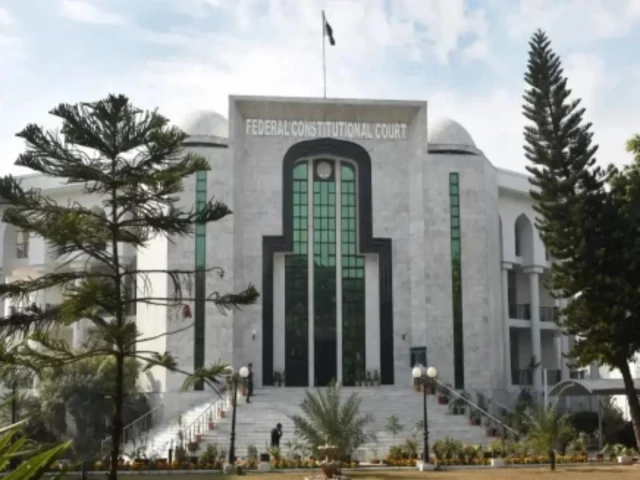
The Federal Constitutional Court building. Photo: File

ISLAMABAD: The Federal Constitutional Court (FCC) has reiterated that its decisions on questions of law are binding on all courts in Pakistan, including the Supreme Court.

The observation came in a 24-page judgment authored by Justice Syed Hasan Azhar Rizvi while deciding a petition filed by a female student whose request for an extension to submit her PhD thesis had been rejected by the International Islamic University Islamabad (IIUI).

The Islamabad High Court (IHC) had also dismissed her petition.

A division bench of the FCC led by Justice Rizvi held that Article 189 of the Constitution gives binding effect to the law declared by the court on all other courts, including the Supreme Court, and places a corresponding responsibility on the FCC to maintain consistency and coherence in its own jurisprudence.

"A principle of law enunciated by an earlier bench of this Court should, therefore, ordinarily be followed by a subsequent bench of lesser or co-equal strength," the judgment stated.

It added that a bench should not depart from, overrule or adopt a view inconsistent with an earlier pronouncement merely because it considers another interpretation preferable.

Where a subsequent bench doubts the correctness of an earlier judgment and considers reconsideration necessary, it should record its reasons and request the chief justice to constitute a larger bench for an authoritative determination, the court said.
 
The court observed that constitutional courts ordinarily exercise restraint in matters involving academic judgment. However, the principle applies to the nature of the decision rather than merely to the status of the institution making it.

An assessment of a thesis, research work or academic merit, involving specialised expertise, ordinarily warrants judicial deference, the judgment said. Administrative or regulatory decisions, however, stand on a different footing and remain open to judicial review regarding legality, jurisdiction, procedural fairness and compliance with the applicable legal framework.

"Academic autonomy and judicial review are, therefore, not mutually exclusive," the court observed, explaining that academic autonomy protects the substantive domain of academic judgment, while judicial review ensures that public power is exercised within the bounds prescribed by law.

It added that judicial restraint preserves the legitimate sphere of academic autonomy but does not amount to abandoning the constitutional responsibility to ensure the lawful exercise of power.

The FCC also highlighted the constitutional guarantees of equality and the protection of women, observing that circumstances affecting women's educational progression may warrant reasonable accommodation within the applicable legal and policy framework.

Referring to Article 25 of the Constitution, the court noted that equality before the law does not invariably require identical treatment. The constitutional provision also permits special measures for the protection of women and children.
 

Non-functional Khyber-Pakhtunkhwa CM Sohail Afridi's brother moves PHC over alleged 'illegal' detention​


Seeks immediate recovery, argues that Afridi's alleged abduction violated his fundamental rights

Yasir Ali
October 13, 2026

cm afridi raises his fist to supporters during a protest march by pti in bara on the outskirts of peshawar khyber pakhtunkhwa on october 7 2026 photo reuters


CM Afridi raises his fist to supporters during a protest march by PTI in Bara, on the outskirts of Peshawar, Khyber-Pakhtunkhwa on October 7, 2026. Photo: Reuters

PESHAWAR: The brother of non-functional Khyber-Pakhtunkhwa (K-P) chief minister Sohail Afridi on Tuesday moved the Peshawar High Court seeking his immediate recovery, arguing that his alleged abduction and continued detention violated his fundamental rights and demanding an independent judicial inquiry into his disappearance.

The petition was filed amid uncertainty over Afridi’s whereabouts following the imposition of emergency and governor’s rule in K-P on October 11, which brought the Pakistan Tehreek-e-Insaf-led provincial government to an end and transferred its powers to Governor Faisal Karim Kundi.

Muhammad Aamir, through his counsel Bashir Khan Wazir, alleged that Afridi had been taken away by armed and masked individuals and was being held illegally. The petition asked the court to establish where the former chief minister was being held, who had custody of him, and under what legal authority he was being detained.
 

Users who are viewing this thread

Country Watch Latest

Back
Top