Navigation
Install the app
How to install the app on iOS
Follow along with the video below to see how to install our site as a web app on your home screen.
Note: This feature may not be available in some browsers.
More options
Style variation
You are using an out of date browser. It may not display this or other websites correctly.
You should upgrade or use an alternative browser.
You should upgrade or use an alternative browser.
General Economic Updates
- Thread starter Sainthood 2.0
- Start date
More options
Who Replied?


Pakistanithinktank
Registered Member
I recently came across an Indian talk show claiming that Karachi is Pakistan’s only fully functional naval and commercial port, and that blocking it would “economically destroy Pakistan.” The scenario itself is unrealistic, Pakistan’s Navy and Air Force would never allow such a blockade, but it did raise a serious strategic question for me.
Why has Pakistan, even after 75 years, kept almost all major commercial and naval infrastructure concentrated in Karachi? Is this the result of political choices, bureaucratic inertia, or a centralized monopoly within the government and establishment?
What makes this even more puzzling is that Pakistan actually had multiple coastline options, Gwadar, Pasni, and Ormara, yet none of them were developed into full-scale commercial or naval hubs by Pakistan itself. In fact, Gwadar’s modern development only happened because China requested it under CPEC, not because Pakistan initiated a long-term national strategy to diversify its ports. Without Chinese interest, Gwadar likely would have remained a small fishing town with minimal infrastructure.
It’s unusual that a country with a 1,000 km coastline still relies overwhelmingly on a single port-city for both economic throughput and naval operations. If Karachi were ever disrupted by conflict, natural disaster, or economic pressure, the consequences would be severe. So why hasn’t Pakistan built a second fully capable port-city or naval base at the same scale?
Why has Pakistan, even after 75 years, kept almost all major commercial and naval infrastructure concentrated in Karachi? Is this the result of political choices, bureaucratic inertia, or a centralized monopoly within the government and establishment?
What makes this even more puzzling is that Pakistan actually had multiple coastline options, Gwadar, Pasni, and Ormara, yet none of them were developed into full-scale commercial or naval hubs by Pakistan itself. In fact, Gwadar’s modern development only happened because China requested it under CPEC, not because Pakistan initiated a long-term national strategy to diversify its ports. Without Chinese interest, Gwadar likely would have remained a small fishing town with minimal infrastructure.
It’s unusual that a country with a 1,000 km coastline still relies overwhelmingly on a single port-city for both economic throughput and naval operations. If Karachi were ever disrupted by conflict, natural disaster, or economic pressure, the consequences would be severe. So why hasn’t Pakistan built a second fully capable port-city or naval base at the same scale?

hydrabadi_arab
Trusted Member
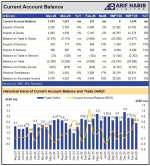
Pakistan posts $1.07 billion current account surplus in March, 9MFY26 balance at $8 million
Exports, remittances support external account as trade deficit widens to $23.5 billion in 9MFY26
Pakistan recorded a current account surplus of $1.07 billion in March 2026, compared to a surplus of $1.27 billion in March 2025 and $231 million in February 2026, according to data compiled by Arif Habib Limited based on State Bank of Pakistan (SBP) figures.
On a cumulative basis, the country posted a marginal current account surplus of $8 million during the first nine months of FY2026, sharply lower than the $1.67 billion surplus recorded in the same period last year.
Exports of goods stood at $2.53 billion in March 2026, down 8% year-on-year from $2.76 billion, but slightly higher by 2% compared to $2.48 billion in February. Imports of goods were recorded at $4.90 billion, down 1% year-on-year and 5% lower month-on-month.
As a result, the trade deficit in goods narrowed to $2.38 billion in March 2026, compared to $2.18 billion in March 2025 and $2.69 billion in February 2026.
In the services sector, exports rose to $903 million in March 2026, up 16% year-on-year and 13% month-on-month. Imports of services stood at $926 million, increasing 3% year-on-year and remaining flat compared to February.
The services trade deficit narrowed to $23 million in March 2026, compared to $120 million in March 2025 and $124 million in February.
Overall, the total trade deficit stood at $2.40 billion in March 2026, compared to $2.30 billion in the same month last year and $2.81 billion in February.
The primary income deficit was recorded at $607 million in March 2026, compared to $678 million a year earlier and $409 million in the previous month.
Workers’ remittances amounted to $3.83 billion in March 2026, down 6% year-on-year but up 17% compared to $3.29 billion in February.
The secondary income balance stood at $4.08 billion in March 2026, compared to $4.25 billion in March 2025 and $3.45 billion in February.
For the nine-month period, exports of goods totalled $23.27 billion, down 6% from $24.70 billion last year, while imports rose 8% to $46.79 billion from $43.38 billion.
The goods trade deficit widened to $23.53 billion in 9MFY26, compared to $18.68 billion in the same period last year.
Exports of services increased 17% to $7.35 billion, while imports rose 11% to $9.49 billion, resulting in a services deficit of $2.15 billion, slightly improved from $2.30 billion last year.
The overall trade deficit reached $25.67 billion during 9MFY26, compared to $20.98 billion in the same period last year.
The primary income deficit narrowed to $6.36 billion from $6.72 billion, while workers’ remittances rose 8% to $30.32 billion from $28.03 billion.
The secondary income balance increased to $32.04 billion, up from $29.38 billion in the same period last year.
Despite a strong monthly surplus in March, cumulative external account data indicate pressure from higher imports and widening trade deficits, partially offset by growth in remittances and services exports.
hydrabadi_arab
Trusted Member
meh_analysis
Registered Member
Nah it happened once, Karachi was naval blockade in 1971 effectively. The second question is not something Pakistani leaders have thought of, they're too busy fighting themselves to think of actual long term planning. Anyways Omara and Gwadar have been used since a long time as naval bases, though Karachi is still the naval centre piece because it's just too big. Unless bureaucracy gets better and ethnic supremacists leave, we won't see any major development apart from Gwadar.I recently came across an Indian talk show claiming that Karachi is Pakistan’s only fully functional naval and commercial port, and that blocking it would “economically destroy Pakistan.” The scenario itself is unrealistic, Pakistan’s Navy and Air Force would never allow such a blockade, but it did raise a serious strategic question for me.
Why has Pakistan, even after 75 years, kept almost all major commercial and naval infrastructure concentrated in Karachi? Is this the result of political choices, bureaucratic inertia, or a centralized monopoly within the government and establishment?
What makes this even more puzzling is that Pakistan actually had multiple coastline options, Gwadar, Pasni, and Ormara, yet none of them were developed into full-scale commercial or naval hubs by Pakistan itself. In fact, Gwadar’s modern development only happened because China requested it under CPEC, not because Pakistan initiated a long-term national strategy to diversify its ports. Without Chinese interest, Gwadar likely would have remained a small fishing town with minimal infrastructure.
It’s unusual that a country with a 1,000 km coastline still relies overwhelmingly on a single port-city for both economic throughput and naval operations. If Karachi were ever disrupted by conflict, natural disaster, or economic pressure, the consequences would be severe. So why hasn’t Pakistan built a second fully capable port-city or naval base at the same scale?

ghazi52
THINK TANK: CONSULTANT
Finance minister meets Fitch Ratings over Pakistan’s credit profile
The finance minister also held a “constructive meeting” with Fitch Ratings on the sidelines of the World Bank–IMF Spring Meetings, his ministry said.
On Monday, Fitch Ratings affirmed Pakistan’s long-term foreign currency issuer default rating (IDR) at “B-” with a “stable outlook”.
Aurangzeb appreciated Fitch’s “continued engagement with and assessment of Pakistan’s credit profile, and thanked the agency for reaffirming Pakistan’s B- credit rating”, the finance ministry said.
The minister highlighted that a Staff Level Agreement had been reached with the IMF for the third review under the Extended Fund Facility (EFF) and the second review under the Resilience and Sustainability Facility (RSF).
Aurangzeb further noted that Pakistan has secured external financing arrangements to meet its FY2026 obligations.
He elaborated on the government’s strategy to maintain a strong presence in international capital markets through diversified instruments, including Panda Bonds, Eurobonds, international Sukuk, and ESG-linked bonds.

Fatman17
THINK TANK: CONSULTANT
Islamabad set to host first-ever EU-Pakistan Business Forum
ISLAMABAD: With the European Union’s €400 billion Global Gateway investment programme in focus, Islamabad is set to...
share.google
EU - Pakistan business forum
Fatman17
THINK TANK: CONSULTANT

Pakistan has started trading through Iranian land routes. What is being transported and where to? - Profit by Pakistan Today
A series of moves including the easing of banking restrictions have made Iran an alternative route for Pakistani goods moving to Central Asia. With meat, fruit, rice, and other items being moved, how far can it go?
 share.google
Pakistan has started trading through Iranian land routes
Fatman17
THINK TANK: CONSULTANT
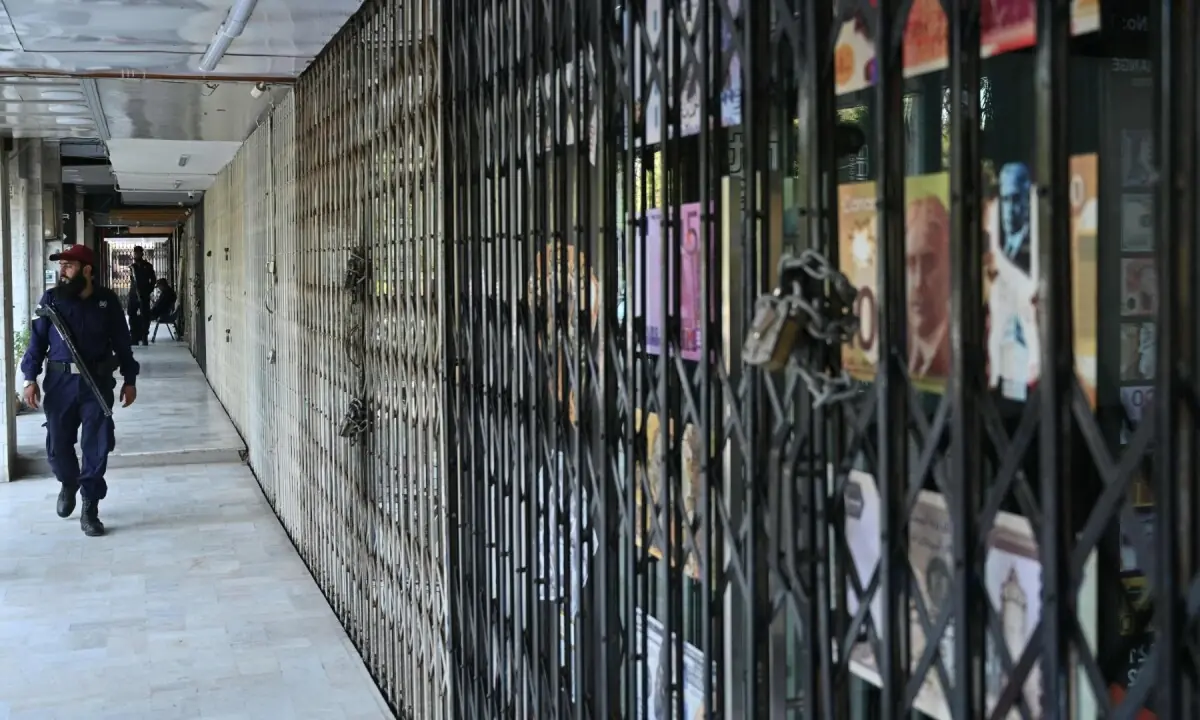
‘Strangled’: Pakistan faces economic imperative in Iran war peace push
Ravaged by decades of external shocks and mismanagement, Pakistan’s economy is heavily dependent on oil and natural gas imports from the Gulf.
share.google
Pakistan faces economic imperative
hydrabadi_arab
Trusted Member
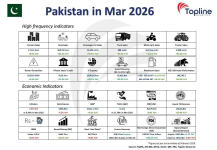
Pakistan was on the way for 4.5% GDP growth this FY before war started.
Pakistanithinktank
Registered Member
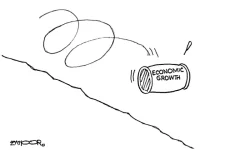
Why Pakistan Must End Its Bailout Dependency, and Why a 34‑Economic‑Zone Model Could Save $22 Billion a Year
For decades, Pakistan has survived on a drip‑feed of emergency cash from China, Saudi Arabia, and the UAE. Each time the economy collapses, Islamabad rushes to friendly capitals with the same request: “Please roll over our loans. Please deposit dollars in our central bank.”But this cycle is reaching its breaking point. Analysts increasingly argue that Pakistan will not be able to rely on these bailouts indefinitely, and several reports highlight that even friendly states are showing signs of fatigue.
At the same time, Pakistan’s internal governance structure especially the cost of maintaining four large provincial bureaucracies continues to drain national resources. This is where the proposed 34‑Economic‑Zone (EZ) governance model becomes relevant. According to multiple policy analyses, replacing the provincial system with a zone‑based administrative structure could save Pakistan up to $22 billion annually in duplicated costs, subsidies, and bureaucratic overhead.
Saudi Arabia, China, and the UAE have all provided billions in deposits and rollovers, but these funds increasingly come with expectations:
- structural reforms
- political stability
- credible economic planning
Pakistan needs $12–$15 billion every year just to stay afloat. Friendly states cannot keep injecting billions into a system that does not reform itself.
Saudi Arabia and the UAE are diversifying their global partnerships. China is recalibrating its overseas lending strategy. Pakistan’s internal instability makes long‑term commitments risky.
Many Pakistanis ask why the establishment long seen as the ultimate power center, cannot simply “fix the economy” instead of supporting political elites accused of corruption. Analysts point to several structural constraints:
Pakistan’s problems come from:
- tax evasion
- loss‑making state enterprises
- circular debt
- low industrial productivity
- These require technocratic reforms, not security‑centric management.
As long as friendly states keep providing emergency dollars, Pakistan’s ruling class avoids difficult reforms.
Frequent interventions disrupt policy continuity and scare away investors.
This is where proposed 34‑Economic‑Zone governance model becomes transformative.
Analysts estimate that Pakistan spends tens of billions annually on:
- four parallel provincial bureaucracies
- duplicated ministries
- overlapping development authorities
- redundant administrative structures
- politically motivated subsidies
- provincial‑level corruption leakages
- eliminate duplicated departments
- consolidate development spending
- reduce political interference
- streamline taxation and revenue collection
- align governance with real economic clusters
- debt reduction
- industrial modernization
- water infrastructure
- education and healthcare
- digital governance
Bailouts Are a Symptom, not a Solution
Pakistan’s economic crisis is not caused by a lack of friendly states, it is caused by a lack of internal restructuring. The world is signaling that the era of easy bailouts is ending. Pakistan must now choose between:
- continuing the cycle of dependency, or
- adopting a modern, zone‑based governance model that saves billions and unlocks long‑term growth.
If Pakistan adopt this system, not only Pakistan economic will grow multiple fold, but Pakistan can also offer universal free Healthcare and Universal free Education to its citizens within 10 years.
Fatman17
THINK TANK: CONSULTANT

Govt invites bids from financiers as it eyes more borrowing
Seeks proposals from global consortiums to act as underwriters, lead managers, book runners.
share.google
Pakistan eyes more borrowing

VCheng
THINK TANK: CONSULTANT
Govt invites bids from financiers as it eyes more borrowing
Seeks proposals from global consortiums to act as underwriters, lead managers, book runners.share.google
Pakistan eyes more borrowing
As long as Pakistan consumes more than what it produces, it will go deeper and deeper into debt.
Fatman17
THINK TANK: CONSULTANT

Economy on a cliff edge
Our economic challenges are rooted in poor governance and declining institutional quality.
share.google
Economy on edge
Users who are viewing this thread
Total: 1 (members: 0, guests: 1)
Pakistan Defence Latest


Country Watch Latest


Latest Posts
-
-
 India Emerges as key diesel supplier to Turkiye amid Russia Middle East disruptions (12 Viewers)
- Latest: Gripen9
-
 Makkah Defence Alliance: Turkey, Saudi Arabia, and Pakistan, news & updates (36 Viewers)
- Latest: Meengla
-
