Navigation
Install the app
How to install the app on iOS
Follow along with the video below to see how to install our site as a web app on your home screen.
Note: This feature may not be available in some browsers.
More options
Style variation
You are using an out of date browser. It may not display this or other websites correctly.
You should upgrade or use an alternative browser.
You should upgrade or use an alternative browser.
General Economic Updates
- Thread starter Sainthood 2.0
- Start date
More options
Who Replied?


Pakistani Dragon
Elite Member

Pakistan forex reserves hit $21.1bn, highest since 2022
Reserves reflect sustainable growth and rising investor confidence
Samaa TV
Dec 22, 2025

US dollar
Pakistan’s economy has crossed a major milestone as the country’s foreign exchange reserves climbed to their highest level since March 2022, signaling a shift toward stability after years of external pressure.
According to the latest official data, Pakistan’s total foreign exchange reserves have reached $21.1 billion, marking their strongest position in more than three years. Economic analysts say the surge reflects sustainable growth and growing investor confidence in the country’s economic leadership.
Central bank reserves show sharp recovery
Out of the total reserves, holdings of the State Bank of Pakistan stand at $15.9 billion. This represents a dramatic recovery from 2023, when central bank reserves had fallen to just $2.9 billion.
A nearly 5.5-fold increase in domestic reserves has been recorded compared to 2023, underlining the scale of the turnaround.
The improvement in reserves has directly strengthened Pakistan’s import capacity, which has now exceeded 2.6 months. This is a sharp contrast to February 2023, when import cover had dropped to less than two weeks, raising serious concerns about external solvency.
Experts say growth driven by confidence
Economic experts stress that the rise in reserves has been driven by domestic economic growth and renewed confidence, rather than short-term borrowing or temporary financial arrangements. Analysts note that the current buildup reflects a clear and sustained recovery, not artificial support.
According to data, Pakistan’s external debt-to-GDP ratio has declined from 31% to 26%, signaling improved fiscal discipline. Economists say the gradual slowdown in external debt acquisition reflects reform measures and better financial management.
Forward liabilities cut, future pressure reduced
Another key development is a 65% reduction in forward foreign exchange liabilities, significantly easing future repayment pressures. Experts view this as a critical step in strengthening the country’s external financial position.
Between 2015 and 2022, Pakistan’s debt continued to rise while foreign exchange reserves steadily declined. However, the trend has reversed since 2022, with reserves increasing rapidly and the debt-to-GDP ratio falling simultaneously.
Key indicators point to economic stability
Economists say this progress sends several strong signals, including reduced external economic vulnerability, stronger reserve buffers, rising business confidence, and improving macroeconomic stability. These indicators suggest a more resilient economic foundation.
Analysts emphasize that the recent rise in foreign exchange reserves is not merely a numerical improvement, but evidence of a qualitative shift in economic policy. Pakistan, they say, is moving away from short-term survival strategies based on debt and toward sustainable external economic stability.
Reserves reflect sustainable growth and rising investor confidence
Samaa TV
Dec 22, 2025
US dollar
Pakistan’s economy has crossed a major milestone as the country’s foreign exchange reserves climbed to their highest level since March 2022, signaling a shift toward stability after years of external pressure.
According to the latest official data, Pakistan’s total foreign exchange reserves have reached $21.1 billion, marking their strongest position in more than three years. Economic analysts say the surge reflects sustainable growth and growing investor confidence in the country’s economic leadership.
Central bank reserves show sharp recovery
Out of the total reserves, holdings of the State Bank of Pakistan stand at $15.9 billion. This represents a dramatic recovery from 2023, when central bank reserves had fallen to just $2.9 billion.
A nearly 5.5-fold increase in domestic reserves has been recorded compared to 2023, underlining the scale of the turnaround.
The improvement in reserves has directly strengthened Pakistan’s import capacity, which has now exceeded 2.6 months. This is a sharp contrast to February 2023, when import cover had dropped to less than two weeks, raising serious concerns about external solvency.
Experts say growth driven by confidence
Economic experts stress that the rise in reserves has been driven by domestic economic growth and renewed confidence, rather than short-term borrowing or temporary financial arrangements. Analysts note that the current buildup reflects a clear and sustained recovery, not artificial support.
According to data, Pakistan’s external debt-to-GDP ratio has declined from 31% to 26%, signaling improved fiscal discipline. Economists say the gradual slowdown in external debt acquisition reflects reform measures and better financial management.
Forward liabilities cut, future pressure reduced
Another key development is a 65% reduction in forward foreign exchange liabilities, significantly easing future repayment pressures. Experts view this as a critical step in strengthening the country’s external financial position.
Between 2015 and 2022, Pakistan’s debt continued to rise while foreign exchange reserves steadily declined. However, the trend has reversed since 2022, with reserves increasing rapidly and the debt-to-GDP ratio falling simultaneously.
Key indicators point to economic stability
Economists say this progress sends several strong signals, including reduced external economic vulnerability, stronger reserve buffers, rising business confidence, and improving macroeconomic stability. These indicators suggest a more resilient economic foundation.
Analysts emphasize that the recent rise in foreign exchange reserves is not merely a numerical improvement, but evidence of a qualitative shift in economic policy. Pakistan, they say, is moving away from short-term survival strategies based on debt and toward sustainable external economic stability.
Destranator
Trusted Member
Reduction of external debt from 31% to 26% in two years is remarkable. Well done.

Watandar
SpeedLimited
This has been achieved by extreme controls on moving foreign currency out of the country and also on imports by Letters of Credit.
The major negative impact is that MNC's are not able to repatriate their profits and have decided to close shop.
The draconian restrictions on LoC's has also damaged many company projects and production as necessary imports are also curtailed.
Hence this presented figure of foreign currency reserves is bogus and as deceitful as the ever increasing stock market, in a country whose economy is moribund.
The major negative impact is that MNC's are not able to repatriate their profits and have decided to close shop.
The draconian restrictions on LoC's has also damaged many company projects and production as necessary imports are also curtailed.
Hence this presented figure of foreign currency reserves is bogus and as deceitful as the ever increasing stock market, in a country whose economy is moribund.

diaspora
Registered Member

BYD, Aramco and Strategic Metals just entered the Pakistani market.This has been achieved by extreme controls on moving foreign currency out of the country and also on imports by Letters of Credit.
The major negative impact is that MNC's are not able to repatriate their profits and have decided to close shop.
The draconian restrictions on LoC's has also damaged many company projects and production as necessary imports are also curtailed.
Hence this presented figure of foreign currency reserves is bogus and as deceitful as the ever increasing stock market, in a country whose economy is moribund.
Better warn them quick - clearly their finance teams haven't done their research.
Pakistani Dragon
Elite Member
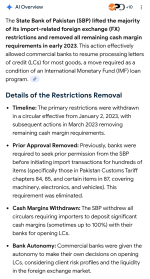
I think you're still living in 2022-2023.This has been achieved by extreme controls on moving foreign currency out of the country and also on imports by Letters of Credit.
The major negative impact is that MNC's are not able to repatriate their profits and have decided to close shop.
The draconian restrictions on LoC's has also damaged many company projects and production as necessary imports are also curtailed.
Hence this presented figure of foreign currency reserves is bogus and as deceitful as the ever increasing stock market, in a country whose economy is moribund.
Last edited:
Watandar
SpeedLimited
These are all state linked firms and their decisions are not always financial. Your claim of them "entering" the Pakistani market also qualifies as exaggeration.BYD, Aramco and Strategic Metals just entered the Pakistani market.
Better warn them quick - clearly their finance teams haven't done their research.
Wages, inflation, cost of living, number of jobs available, labor rights, amount of import/exports and investment, domestic and foreign are the important metrics that tell the true state of the economy. These metrics are hard to manipulate and on those metrics, the economy is terrible.
Watandar
SpeedLimited
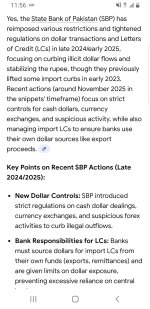
I think you don't even know how to use AI
Attachments
Pakistani Dragon
Elite Member
Your AI "snippet" based source is talking about controls on illicit trade.I think you don't even know how to use AI

Watandar
SpeedLimited
Its talking about re imposing conditions on LoC's, because Pakistan keeps gaming the IMF programs and never implements actual reforms.Your AI "snippet" based source is talking about controls on illicit trade.
Pakistani Dragon
Elite Member
Nope. It's talking about controls and regulations related to illicit trade.Its talking about re imposing conditions on LoC's, because Pakistan keeps gaming the IMF programs and never implements actual reforms.
Please read your own screenshot again or post links here of what you're claiming so I can have a read.

AZADPAKISTAN2009
Elite Member


Fauj CHOOR
JUDGE Choor
Government Choor
After selling PIA a company worth 15 Billion (15,000,000,000 USD) for (200,000,000 USD)
Now talking about Forex Reserve .... BC
FOREX reserve is a Temporary account
This is a "Temporary" account where money is deposited temporarily so you can buy oil and gas for country, it is not indicator of your economy
Your currency value is determined with your DEBT you owe to lenders vs income you make in 1 year
Real Indicator is Sub Ka Baap , Debt to Income Ratio
Musharraf's time Pakistan's Debt ration was dropped considerably between 1999-2007
The Debt rose Massively after 2008-2018 under PPP and Nawaz Sharif
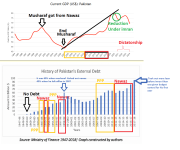
Instead of selling PIA for 15 Billion USD and reducing this Massive 74%-80% debt figure , sold it for 200 million (price of 1 plane)
I have noticed these old data records are becoming rare to find as financial sites are asking membership and showing record for only last 6-7 years
Sare Haram Khoro ke Kartut are recorded in this Graph their Bakwas about Prosperity and bullshit
JUDGE Choor
Government Choor
After selling PIA a company worth 15 Billion (15,000,000,000 USD) for (200,000,000 USD)
Now talking about Forex Reserve .... BC
FOREX reserve is a Temporary account
This is a "Temporary" account where money is deposited temporarily so you can buy oil and gas for country, it is not indicator of your economy
Your currency value is determined with your DEBT you owe to lenders vs income you make in 1 year
Real Indicator is Sub Ka Baap , Debt to Income Ratio
Musharraf's time Pakistan's Debt ration was dropped considerably between 1999-2007
The Debt rose Massively after 2008-2018 under PPP and Nawaz Sharif
Instead of selling PIA for 15 Billion USD and reducing this Massive 74%-80% debt figure , sold it for 200 million (price of 1 plane)
I have noticed these old data records are becoming rare to find as financial sites are asking membership and showing record for only last 6-7 years
Sare Haram Khoro ke Kartut are recorded in this Graph their Bakwas about Prosperity and bullshit
Last edited:

ghazi52
THINK TANK: CONSULTANT
ADR falls to 35pc, IDR goes up to 100pc
Shahid IqbalDecember 27, 2025
https://whatsapp.com/channel/0029VaMc238IiRov8okfYy3n
• Report finds lending to private sector lowest in Pakistan
• Undocumented economy is 40pc of GDP
KARACHI: The advances to deposits ratio (ADR) further declined from 50 per cent in December 2024 to just 35pc as of June this year, while the investments to deposits ratio (IDR) surged from 90pc to 100pc during the same period, according to a report.
The Banking Publication 2025 titled “Banking Forward: Journeying Towards Future Horizons” released by PwC-A.F. Ferguson on Friday said Pakistan’s ADR remains significantly lower than Bangladesh at 87pc, India at 79pc and Sri Lanka at 59pc. In contrast, Pakistan’s IDR of 100pc is much higher than Bangladesh at 29pc, India at 33pc and Sri Lanka at 47pc.
According to the report, priority sector financing continues to remain at sub-optimal levels, with SME contribution to total loans at 3.7pc and agriculture at 4pc. In comparison, SME lending as a percentage of total loans is considerably higher in other countries, including Indonesia at 19pc, Bangladesh at 17pc and India at 16pc.
Meanwhile, lending to the private sector declined to 11pc of GDP in 2024. Conversely, the IDR has increased sharply, rising from 40pc in 2010 to 93pc in 2024 and reaching 100pc as of June 2025.
According to the report, SMEs and the agriculture sector are central to Pakistan’s economy, together representing millions of enterprises across both formal and informal segments. Agriculture contributes 24pc to GDP, while SMEs account for 40pc of GDP, 90pc of enterprises, 30pc of export earnings and employ nearly 30pc of the workforce.
Agricultural borrowers increased by 200,000, reaching 2.9 million by June 2025, while SME borrowers rose by over 55pc to 277,000 during the same period.
The report said industry experts emphasised that a large share of Pakistan’s transactions remains cash-based, contributing to an undocumented economy estimated at 40pc of GDP. Digitising a portion of these transactions could save Rs164 billion annually, while reducing the undocumented economy by 25pc has the potential to unlock over Rs1 trillion in resources, the report added.
As of June 2025, agricultural financing rose to Rs739bn, accounting for 5.2pc of total loans, up from 3.4pc in December 2024. SME lending increased to Rs712bn, representing 5pc of total loans.
ghazi52
THINK TANK: CONSULTANT
Recent initiatives by the regulator and the industry have led to notable progress, with financing to priority sectors surpassing 10pc of total loans, indicating a reversal of historical declining trends. “Despite this positive trend, financing levels remain low compared to regional peers, highlighting the need for expanded credit interventions,” the report said.
Experts also emphasised the need for sustained fiscal discipline, comprehensive tax reforms, improved governance of state-owned enterprises and reduced government debt to maintain and strengthen economic progress, according to the report. “The urgent need to diversify and expand exports has been stressed upon, advocating a shift from consumption-driven growth to a value-added export base,” it added.
Experts further highlighted that boosting domestic investment and productivity is critical for successful import substitution, which requires removing bureaucratic hurdles, simplifying regulations and creating an investor-friendly environment.
Cash continues to pose a challenge to financial inclusion and digitisation, with Pakistan’s cash-in-circulation ratio at 34pc, compared to Bangladesh at 16pc, India at 15pc and Kenya at 9pc, the report noted.
Experts also emphasised the need for sustained fiscal discipline, comprehensive tax reforms, improved governance of state-owned enterprises and reduced government debt to maintain and strengthen economic progress, according to the report. “The urgent need to diversify and expand exports has been stressed upon, advocating a shift from consumption-driven growth to a value-added export base,” it added.
Experts further highlighted that boosting domestic investment and productivity is critical for successful import substitution, which requires removing bureaucratic hurdles, simplifying regulations and creating an investor-friendly environment.
Cash continues to pose a challenge to financial inclusion and digitisation, with Pakistan’s cash-in-circulation ratio at 34pc, compared to Bangladesh at 16pc, India at 15pc and Kenya at 9pc, the report noted.
ghazi52
THINK TANK: CONSULTANT
In Pakistan, paper-based transactions account for 14pc of total transactions, while ATM traffic constitutes 25pc of e-transactions.
“There is greater need for broader government and regulatory push to create a wider ecosystem that incentivises digital and disincentivises cash,” the report said.
The report added that the State Bank of Pakistan’s instant payment system, Raast, recorded 45 million registered IDs by June 2025 and processed 1.3bn transactions worth Rs29.6tr, more than doubling in both volume and value compared to the previous year. It said the number of QR-enabled merchants also crossed one million, twice as many as a year earlier.
However, adoption remains uneven across the economy. Only about 159,000 merchants currently use point-of-sale terminals, far fewer than in comparable emerging markets, while mobile banking penetration stands at roughly 15pc of total bank accounts, the report said.
“There is greater need for broader government and regulatory push to create a wider ecosystem that incentivises digital and disincentivises cash,” the report said.
The report added that the State Bank of Pakistan’s instant payment system, Raast, recorded 45 million registered IDs by June 2025 and processed 1.3bn transactions worth Rs29.6tr, more than doubling in both volume and value compared to the previous year. It said the number of QR-enabled merchants also crossed one million, twice as many as a year earlier.
However, adoption remains uneven across the economy. Only about 159,000 merchants currently use point-of-sale terminals, far fewer than in comparable emerging markets, while mobile banking penetration stands at roughly 15pc of total bank accounts, the report said.
Users who are viewing this thread
Total: 5 (members: 0, guests: 5)
Pakistan Defence Latest
-
 Federal cabinet gives nod to imposition of emergency in KP; summary sent to president (22 Viewers)
- Latest: Master Chief
-

-

-

-

Country Watch Latest


Latest Posts
-

-
Federal cabinet gives nod to imposition of emergency in KP; summary sent to president (22 Viewers)
- Latest: Master Chief
-
 Makkah Defence Alliance: Turkey, Saudi Arabia, and Pakistan, news & updates (49 Viewers)
- Latest: PK781
-
-