General Economic Updates

Hydra bro,

Sindh ought to be divided into Sindh proper and Jinnahpur anyway. That will take care of Karachis needs- plus a dynamic Karachi means a dynamic Pak.

Regards
 
Btw, a very happy Independence Day to all my wondeful Pakistani friends and hosts here. And a special word for my dear distant cousin @Master Chief bro.

Regards
 
I was listening to Dr. Ishrat Husain, he explained how Pakistan once had a world‑class civil service and, how political decisions in the 1970s broke its backbone, and how decades of politicization, weak leadership, and short political tenures destroyed institutional capacity.

Here is the comparison of Civil Service under 34 EZ model:


Traditional Civil Service Reform vs. 34-Zone Hybrid Governance

Governance DimensionTraditional Civil Service Reform (Dr. Husain’s Model)34-Zone Hybrid Economic Governance Model (Raza Framework)Strategic Advantage of 34-Zone Model
Administrative ControlCentralized federal/provincial secretariats vulnerable to political posting/transfer pressures.Autonomous Zone Authorities (AZAs) with direct mayoral and expert executive control.Eliminates MNA/MPA interference in local postings and transfers.
Recruitment & MeritGeneralist-dominated (CSS) with slow, resistant internal promotion tracks.Specialized domain clusters (Export, Tech, Logistics, Agriculture) recruited for specific zones.Bypasses generalist stagnation; injects immediate technical competence.
Fiscal ArchitectureDivision of funds via National Finance Commission (NFC) absorbed by lower-staff overheads (85%).Direct zone-level revenue retention, self-sustaining industrial fees, and digital tax collection.Solves the fiscal deficit by aligning revenue generation directly with municipal/zone delivery.
Accountability MechanismAnnual Confidential Reports (ACRs) prone to political subjectivity and grade padding.Real-time AI-driven KPIs, track-and-trace monitoring, and mandatory 25-year severance rules.Enforces objective, data-backed accountability insulated from patronage.
Political VulnerabilityHighly vulnerable to cabinet turnover and 2-year electoral panic.Constitutionally entrenched economic charters with long-term 50–200 year industrial mandates.Insulates national export growth from short-term populist disruption.

Integrating the Six-Step Reform Plan into Zone-Based Administration​

To ensure the insights from the historical dialogue are fully harnessed, Dr. Husain’s six-step civil service overhaul is directly mapped onto the operational units of the 34 Economic Zones:
  1. Zone-Specific Specialization at Induction:
    • Application: Personnel inducted into the Autonomous Zone Authorities (AZAs) bypass traditional generalist training. Candidates are immediately channeled into functional clusters: Trade Logistics, Industrial Engineering, Agritech, and Digital Infrastructure.
  2. Domain-Specific Mid-Career Academies:
    • Application: Establish specialized technical training institutes inside major regional anchors (Faisalabad for textiles, Karachi for port logistics, Lahore for tech/manufacturing) rather than generalized civil service academies.
  3. Real-Time KPI & Digital Performance Management:
    • Application: Replace subjective ACRs with automated dashboards measuring export volume growth, customs clearance speed, utility uptime, and investor satisfaction within each zone.
  4. Meritocratic Upward Mobility:
    • Application: Adopt military-style efficiency cylinders for zone executives. Promotion to Zone Director-General requires verified export expansion and infrastructure delivery metrics, breaking the automatic seniority pipeline.
  5. Fiscal Reallocation & Lower-Staff Automation:
    • Application: Deploy e-governance and automated digital kiosks across all 34 zones, eliminating redundant lower-tier staff positions and reallocating those fiscal savings to double the compensation of high-grade zone technical specialists.
  6. Strict Severance & Anti-Deadwood Protocols:
    • Application: Enforce the 25-year retirement rule rigorously across zone management boards. Underperforming zone administrators who fail to meet productivity benchmarks face immediate super-session and removal.
 
EZ Governance: Complete Authority Table (Each SEZ will have these)
All of these will eventually be 100% digital, only 10% employees for field support and infrastructure management. Some of these names can be changes.


Umbrella AuthorityFull NameSub‑Authorities (Full Names)Core Responsibilities
UMTAUnified Mobility & Transport Authority- Vehicle Regulation & Mobility Authority (VRMA)

- Vehicle Insurance & Mobility Authority (VIMA)

- Public Transport Operations Authority (PTOA)
Vehicle registration, digital plates, insurance, inspections, public transport, ride‑share regulation, accident claims
UHMAUnified Health & Medical Authority- Health Services Regulation Authority (HSRA)

- Pharmacy & Drug Regulation Authority (PDRA)

- Complementary & Alternative Medicine Regulation Authority (CAMRA)
Hospital licensing, clinic licensing, pharmacy regulation, medicine authenticity, digital patient records, herbalist/homeopath regulation
UERIAUnified Education & Religious Institutions Authority- Madrassah Regulation & Standards Authority (MRSA)

- Education Quality Authority (EQA)

- Religious Heritage Authority (RHA)
Schools, colleges, universities, madrassahs, shrines, teacher licensing, curriculum standards, heritage management
UCFAUnified Commerce, Food & Consumer Authority- EZ Commerce Authority (ECA)

- Food Safety & Standards Authority (FSSA)

- Textile & Apparel Standards Authority (TASA)
POS systems, digital receipts, inventory tracking, food safety, restaurant inspections, clothing & shoe size standards
UHCEAUnified Housing, Construction & Environment Authority- Building & Construction Safety Authority (BCSA)

- Digital Housing & Rental Authority (DHRA)

- Waste & Recycling Authority (WRA)
Building codes, construction safety, fire safety, rental contracts, landlord licensing, waste management, recycling
UBFMAUnified Banking, Finance & Money Laundering Authority- Unified Banking Standards Authority (UBSA)

- Political Finance Regulation Authority (PFRA)

- Financial Crime & Money Laundering Task Force (FCML‑TF)

- Digital Beneficial Ownership Registry (DBOR)

- Digital Bank Account Binding (DBAB)

- Transaction Pattern AI (TP‑AI)

- Cash Deposit Limits (CDL)

- Offshore Transfer Firewall (OTF)
Unified banking standards, AML, political finance regulation, beneficial ownership, offshore firewall, transaction monitoring
UDGAUnified Digital Governance Authority- EZ Digital Registry

- EZ Payment Gateway

- EZ Compliance Engine

- Digital Identity Spine

- Kiosk Network

- Ghost Entity Prevention System (GEPS)
Digital identity, digital registries, payments, AI compliance, kiosks, ghost entity prevention
 
If mods allow it, I’d like to ask a few trivia questions to test people’s knowledge.


QuestionAnswerExplanation
1. What percentage of Pakistan’s population pays income tax??
2. What share of elite groups receive tax exemptions or preferential treatment??
3. How much does Pakistan receive annually in worker remittances??
4. What is the current petroleum levy per litre of fuel??
5. What is Pakistan’s tax‑to‑GDP ratio??
6. Which institutions control the majority of national resources??
7. What sector absorbs most of Pakistan’s domestic savings??
8. What is the estimated GDP loss due to elite tax exemptions and rent‑seeking??
9. Which institutional network controls roughly 7–10% of Pakistan’s formal GDP through welfare-linked conglomerates??
10. What percentage of Pakistan’s agricultural GDP remains outside the federal income tax net??
 

Pakistan Records Strongest Fiscal Performance in 22 Years​

Pakistan has closed FY2025-26 with a historic strengthening of its public finances. This marks a decisive shift from recurring fiscal stress toward discipline, stability, and sustainable growth.

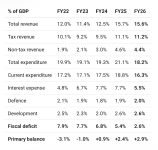
The fiscal deficit fell to just 2.6% of GDP—the lowest in 22 years—while the primary surplus reached a record 2.9% of GDP, the highest since at least FY2000-01.

A Historic Fiscal Turnaround​

In just three years, the fiscal deficit has improved by 5.2 percentage points of GDP, while the primary balance has swung by 3.9 percentage points (moving from a 1.0% deficit to a record 2.9% surplus).

Primary Balance: Three consecutive years of surpluses

  • FY24: +0.9% of GDP
  • FY25: +2.4% of GDP
  • FY26: +2.9% (Record high)
Fiscal Deficit: A 22-year low
  • FY22: 7.9% of GDP (Highest since FY2000-01)
  • FY23: 7.8% of GDP
  • FY24: 6.8% of GDP
  • FY25: 5.4% of GDP
  • FY26: 2.6% (Lowest in 22 years)

Revenue Up, Deficit Down: Rebuilding Fiscal Space​

(Note: All USD conversions are calculated at 1 USD = Rs 278)

Disciplined expenditure management and surging revenues helped deliver the strongest fiscal outcome in decades:

  • Total Revenues (FY26): Rs 19.8 trillion ($71.22 billion)
  • Tax Revenues: Rs 14.2 trillion ($51.08 billion)
  • Interest Payments: Dropped from Rs 8.9 trillion ($32.01 billion) last year to Rs 6.95 trillion ($25.00 billion) in FY26. This is a massive reduction of nearly Rs 2 trillion ($7.19 billion).
  • Interest Burden: Declined from 61% of total revenues in FY24 to just 35% in FY26, materially improving fiscal capacity.
  • Development & Net Lending: Rs 3.25 trillion ($11.69 billion)
The Result: A fiscal deficit of Rs 3.31 trillion ($11.91 billion), alongside a record primary surplus of Rs 3.63 trillion ($13.06 billion). This is not simple deficit reduction; it reflects a fundamental strengthening of Pakistan’s fiscal position driven by stronger revenues, expenditure discipline, and sustained reforms.

From Vulnerability to Strength​

Persistent fiscal deficits have historically been one of Pakistan’s biggest macroeconomic vulnerabilities—adding to debt, financing requirements, inflationary pressures, and external imbalances.

That cycle is being broken.

Three consecutive primary surpluses and sharply lower deficits are now translating into stronger debt dynamics:
  • Debt growth has slowed to a 20-year low.
  • Debt-to-GDP has declined to around 68%.
  • Debt servicing costs have fallen materially.
This means lower financing pressure, improving debt sustainability, and greater fiscal space for development.

Stronger Stability, Stronger Growth​

The fiscal turnaround is reinforcing Pakistan’s broader macroeconomic stabilization. Lower fiscal imbalances, improving debt dynamics, stronger external accounts, and rebuilt reserves are reducing vulnerabilities and strengthening sovereign credibility.

The progress is also being externally recognized: S&P upgraded Pakistan's sovereign rating from B- to B with a Stable Outlook in July 2026. The agency specifically recognized faster fiscal consolidation, stronger revenue mobilization, rebuilding reserves, and declining government debt-to-GDP.

Together, these improvements provide a stronger foundation for investment, development, and sustainable, inclusive growth.

The Bottom Line​

Pakistan’s longstanding fiscal vulnerability is being transformed into a source of macroeconomic strength. Moving from a 7.9% fiscal deficit and 3.1% primary deficit in FY22 to a 22-year-low 2.6% fiscal deficit and record 2.9% primary surplus in FY26 is a remarkable turnaround.

Direction of Travel:Fiscal Reforms ➡️ Three Consecutive Primary Surpluses ➡️ Record Primary Surplus ➡️ 22-Year-Low Fiscal Deficit ➡️ Slower Debt Growth & Lower Interest Burden ➡️ Greater Fiscal Space ➡️ External Validation ➡️ Stability, Development & Sustainable Growth

View attachment 210555
This fiscal tightening, which is strangling the economy, is being done entirely on the basis of IMF's danda. If these surpluses, achieved by cutting development expenditure, had not been generated, IMF would have stopped its funding. So, if anyone is to be "congratulated ", it is the IMF, which has held the government's feet to the fire.
 

Users who are viewing this thread

Pakistan Defence Latest

Back
Top