I fully understand your POV. I fully understand that the UK can develop very high quality machines and systems. But the issue is lack of funds.
I am shedding light on lesser known facts. WE don't know that BAE can develop a world class EW suite [on its own] without American input. BAE's claim of being the world leader in development of EW systems warrants independent scrutiny.
L3 Harris is an American company and locally provides EW system(s) for multiple aircraft including F-16V, B-1B, B-52, F/A-18, EA-18G, and EA-37B. L3 Harris has developed most effective and powerful EW systems for aircraft in the world as per various sources.
Currently, NATO’s air forces are heavily dependent on US Air Force (USAF) and US Navy (USN) aircraft to provide both stand-off and stand-in jamming against a high-end threat like Russia, although several other countries’ fighter fleets have impressive ECM capabilities already for close-range self-defence. NATO’s primary stand-off jamming capability is provided by USN EA-18G Growler aircraft and the USAF EC-130H Compass Call, which is now being replaced by the new EA-37B. SEAD support is also provided by the Tornado electronic combat/reconnaissance (ECR) aircraft of the Italian Air Force and German Air Force, as well as the F-16CM ‘Wild Weasels’ of the USAF’s 480th Fighter Squadron in Germany. However, in terms of EA systems, these Cold War-era aircraft only carry self-protection jamming equipment that is increasingly obsolescent against the more modern Russian threats if used without cover from the more powerful US stand-off systems like the EA-18G and EA-37B. The Tornado ECRs are also only available in small numbers, and the majority of the USAF F-16CM fleet is based in South Korea and Japan. It is notable that in almost any high-end NATO SEAD/DEAD exercise, USN EA-18Gs perform the majority of the EA support, since they offer by far the greatest capability in their class.
Link
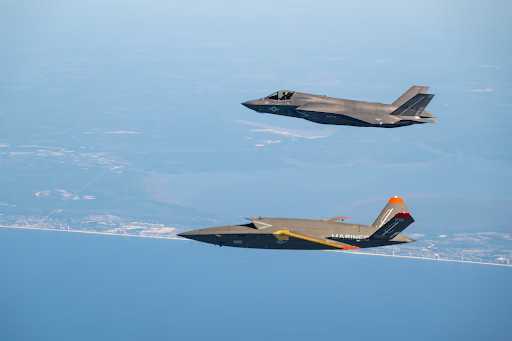
The F-35 is an American military project at its core - the F-35 is a Lockheed Martin product. But the US wanted to sell F-35 and allowed some countries to develop its components to help reduce development costs because a true 5th generation fighter was very costly to develop locally. Who provides blueprints and small parts for development of its components in other countries? Lockheed Martin.
American microprocessors are in use in development of AN/ASQ-239 EW suite in fact.
Most countries that have bought F-35s also lack the capacity or rights to modify or create their own mission data sets, and instead rely on the US for their mission data and threat library updates.
Link
The UK cannot afford ECRS MK2 radar system in large numbers:
Potent ECM capabilities are also a core feature of the new ECRS Mk2 AESA radar, which is being procured to eventually be retrofitted onto the 40 Tranche 3 aircraft in the RAF Typhoon fleet. However, SPEAR EW has not actually been ordered so far, and the ECRS Mk2 has been developed very slowly compared to AESA radar development programmes for comparable fighters. On current timeframes, RAF Typhoons with the new radar are unlikely to be in service on the frontlines before the late 2020s. The threat outlook in Europe, therefore, would seem to suggest that allocating increased funding and priority to whichever of these existing programmes can offer the most rapid path to procurement and introduction to service is something that should be seriously considered. Given the lack of funding so far for ECRS Mk2 radar sets for the remaining 77 RAF Tranche 2 Typhoons, urgent updates to the capability of their existing ESM and Defensive Aid Sub-System (DASS) suites should also be examined – especially if novel software techniques could improve capability faster than hardware upgrades planned but not yet funded within the Typhoon LTE construct.
Link
I have pointed out before that ECRS MK2 is not a ground breaking development - ECRS MK2 has capabilities that are already found in radar system(s) of American jet fighters. The UK is catching up as highlighted in orange above.
Who will pay for replacement of the EuroDASS / Pratorian EW suite with the AN/ASQ-239 EW suite or a derivative of it for Eurofighter? This is not a minor consideration but will require airframe modifications and a revisit to avionics architecture of the Eurofighter.
Germany has ordered the development of 15 ‘Eurofighter EK’ aircraft from existing airframes, designed to replace its ageing Tornado ECRs in the SEAD role. The EK will use an active electronically scanned array (AESA) radar developed by Hensoldt; the Aeraxis EW sensor suit from Saab; and AI-enabled software and mission data by Helsing. However, it will not be certified as combat ready until 2030, and that timeline assumes that the programme faces no delays.
Link
Cutting edge technology has massive R&D costs and Eurofighter will become very costly consequently if equipped with F-35 technology. The UK can either focus on Tempest or transform Eurofighter as per your expectations - it cannot have both.
BAE does not develop Eurofighter but Leonardo. BAE might provide useful inputs but this does not suggest a profound transformation on the level of F-35. Even if BAE has learned much from the US, it cannot transform Eurofighter without funding and American nod. Eurofighter modernization had been slow in comparison to American jet fighters.
The US is a superpower. The US has massive R&D base and funds. The US has made it possible for BAE to expand its manufacturing base and develop cutting edge systems. The US tells BAE what to do. The US provides blueprints to BAE deep down.
But BAE is not the only big dog out there. L3 Harris and Northrop Grunman say hello and laugh at all.