History of Pashtuns

From old PDF ....
Salt Custom House And Levies Post At Bahadarkhel Village Situated On Old Kohat Bannu Road, Teri Tehsil Of Kohat, 1920's (c).

1642082563653.png


These Salt Mines Of Kohat Are Situated In What Was Then Teri Tehsil (Present Day District Karak) - Bahadurkhel Salt Mine, Jatta Ismail Khel Salt Mine, Nari Panos Salt Mine, And Karak Salt Mine. Revenue From These Salt Mines Was Received By Nawab Of Teri (Chief Of Western Khattak's).

Another Salt Mine Of Khattak Area Is At Malgin (Present Day District Kohat) Revenue From This Salt Mine Was Received By Naib Of Gumbat.

Note - The Durrani State (Afghanistan) Was Not The First State Formation Among Afghans (Pashtuns). In The 16th Century, Two Feudal Principalities (Akora Present Day Akora Khattak District Nowshera & Teri Present Day District Karak) Had Emerged In The Territory Populated By An East Afghan Tribe - The Khattak's. Teri Khanete Was The First Oldest Principality Of The Pashtuns, By The Pashtuns In The Land Of Pashtuns. Founded In 1540 By The Cheif Of Khattak's Malik Akor Khan (Great Grandfather Of Pashto-language Poet Khuhsal Khan Khattak).

The Khanete Of Teri (1550 - 1956), Present Day District Karak (Banda Daudshah, Karak, And Takht-e-Nasrati Tehsils) Half Of Present Day District Kohat (Lachi Tehsil And Gumbat Area).

Picture Courtesy - Muhammad Khattak
.............
Portrait of Ahmad Khan Bangash, the ruler of Farrukhabad

1642624917400.png


. https://libwww.freelibrary.org/digital/item/67355…

The grandfather of Ahmad Khan Bangash migrated from Pakhtunkhwa to India during the reign of Aurangzeb and settled at Mau Rashidabad (a Pashtun town in India founded by a grandson of Pir Roshan).

Khuttuk Horsemen "Western Khattak's" In Armour, 1860's (c).

1643731645392.png


Notes After The Picture "Over his turban he wears a cap of light steel chain mail, part of which, thickly quilted with cotton or wool, and fastened across his chest by straps, descends as far as his waist, and, when mounted, protects his back and arms.

He has bright steel gauntlets reaching to the elbow, the leather covering for the hands being studded with bosses of steel or brass. His tunic is of quilted cotton, thick enough to turn a sabre cut, and with strong jack boots reaching to the knee, completes the costume. His arms are a light matchlock and sword, and his powder horns and bullet bag hang at his waist and on his right side.

The Khattak's cannot, however, bring many horsemen into the field, and their strength lies in their foot soldiers, who are formidable in mountain warfare."

Published by India Museum in London - 1872.
 
Life Among The Pathans (Khattaks).

1650889070326.png


"Our dealing with Pashtuns was a gentleman's game. No matter how poor a Pashtun was, he might meet the King of England or the Viceroy of India but he'd look him in the eye and shake hands with him as if to say, I'm as good a man as you are."

For over twenty years from 1927, Colonel Buster Goodwin was stationed on the North-West Frontier among the Pathans. His vivid reminiscences include many incidents of his life in this rugged salt-mining country and bring out strongly his respect and affection for the Khattak tribes whose code of honour and character he knew so well.

Life Among The Pathans (Khattaks)
Author - Colonel Buster Goodwin.
Publisher - London, E. Goodwin (October 1, 1969).

To Read Or Download For Free
👇


https://archive.org/details/life-among-the-pathans-khattaks
 
Photo of a Pashtun wedding procession in Peshawar, Women were shoulder to shoulder with men as seen in this Picture, 1910 (c).

1651256243394.png


Photograph By R.B. Holmes, Peshawar.

The condemned gates tied to the tower. The gates are also known as the weeping willows.

1655220242550.png


The loneliness and darkness of the cage has such an effect on the heart and mind of the prisoner that the very idea of freedom begins to seem foreign to him. Night and day, all hours feel the same. Especially for a prisoner who doesn't even know his guilt. What was my fault? Finding the answer to this question paralyzes thinking.

Of course, incarceration is a painful experience and is only felt by humans or animals who have gone through this ordeal. But last week, I met a prisoner who is neither a human nor an animal, but the two gates of Shabqadar Fort, which have been bound for 180 years under man-made law for uncommitted crime. It seems that after the end of their imprisonment, they went to the prison of the pages of history, that perhaps only imprisonment is written in the destiny of these doors.

It was the reign of Raja Ranjit Singh and in Shabqadar (formerly called Shankargarh) there were fierce attacks by the Mohmand tribes against the Sikh army. During this period, Raja Ranjit Singh ordered his son Sher Singh to build a fort at a safe place in Shabqadar to prevent attacks by the Mohmand tribes. Sher Singh approached Tota Ram, an architect of the time, and after finalizing the design, began the construction of the fort on a relatively high mound at Shankargarh (Shabqadar) in 1835.

The fort was to be used to communicate with Sikh forces in other forts around the city and to monitor the movement of the Mohmand tribes. The construction of the fort was completed in a short span of 2 years and in 1837, the Sikh forces under Sher Singh started regular work here to suppress the Mohmand tribes. Prior to the construction of the fort, Shankargarh was called Sharif Kaur, but after the completion of the construction work, the Sikhs settled around the fort, started their business here and renamed the area Shankargarh.

The purpose of building this fort at a height was to provide long-range surveillance so that it could better line up against possible enemy attacks while also connecting Peshawar and adjoining areas through its Watch Tower. Was done In a short span of 3 years, the Mohmand tribes attacked the fort several times but without much success.
In the winter of 1840, an army of Mohmand tribes led by Saadat Khan attacked the fort of Shankargarh (Shabqadar).

At first, the Sikh forces fought hard but some of the invading lashkar soldiers managed to break through the main gate of the fort and started killing the Sikh soldiers inside the fort. Raja Sher Singh sent a message of help to the troops at Peshawar and Machnai forts, forcing the army of the Mohmand tribes to retreat.

While Sher Singh began to amass an army of his own, the Mohmand tribesmen, after considering the move to break down the gates of the fort, filed a case in the court of the then 'French General Jean Vittoria'. Within two days, the court convicted Tota Ram, the architect who designed the fort, and sentenced him to cut off his hands and imprison him for 100 years. Under this decision, while Tota Ram's hands were cut off, the main gates of the fort were bound with iron chains along with the Watch Tower for a long imprisonment.
 
Khushal Khan Khattak "خوشال خان خټک".

1660256308789.png

Khushal Khan Khattak was born at Akora Khattak, Kabul Province, Mughal Empire in 1613. He was a Pashtun poet, warrior and scholar, and chief of the Khattak tribe of the Pashtuns. Khushal preached the union of all Pashtuns, and encouraged revolt against the Mughal Empire promoting Pashtun nationalism through poetry.

Khushal was the first Afghan mentor who presents his theories for the unity of the Pashtun tribes against foreign forces and the creation of a nation-state. Khushal wrote many works in Pashto but also a few in Persian. Khushal is considered the "father of Pashto literature" and the national poet of Afghanistan.

Khushal's life was spent in struggling against the Mughal Empire who had fluctuating relations with the Pashtuns. In order to restore their freedom, Khushal challenged powers of the Mughal emperor Aurangzeb and defeated the Mughal troops in many engagements. He was a renowned military fighter who became known as an "Afghan warrior-poet". The stand and fight attitude of Khushal was an important stance in Afghan history, and his opinions and ideas form a new stage in the ideological and intellectual development of the Afghans.

Allama Muhammad Iqbal called Khushal the Hakeem and Tabeeb (physician) of Afghan Millat and Afghan Shanas. Maj: Roverty and certain other orientalists say that Khushal was not only Afghan Shanas but like Goethe and Shakespeare he was also a great Insan- Shanas (one who knows man) Iqbal expressed his desire that if he knew Pashto he would have translated Khushal’s poetry into Urdu or Persian. Khushal died at the age of 78 on Friday, 20 February 1689 at Dambara.
 
'A Tochi Scout Tough stuff', Dosalli, North Waziristan, North-West Frontier, 1937 (c).

1666454595340.png


The Tochi Scouts was part of the Frontier Corps which consisted of a number of scout units stationed in fortified posts in the tribal territories.

In late 1936 there was growing agitation against British rule in Waziristan, led by the Waziri leader Ghazi Mirzali Khan Wazir, 'the Fakir of Ipi'. In response the British launched a military operation into the Khaisora Valley, hoping that a show of strength alone would suffice to reduce unrest.

However, the two main columns of troops met stiff resistance and their supply lines were disrupted, forcing them to retire. The operation's failure triggered a wider insurrection and the ensuing guerrilla war drew in more British and Indian forces. Over 30,000 troops, together with aircraft and armoured cars, were deployed to the region.

Violence subsided in late 1937 and after brief flare-ups in 1938 and 1939 the North-West Frontier was relatively quiet until India became independent in 1947.

From an album of 347 photographs compiled by Captain (Later Major) Wynne Howes-Roberts, 1st Battalion 13th Frontier Force Rifles, India and UK, 1936-1937 (c).
,.,.
Damdil, Waziristan, 1937 (c).

1666455073652.png


Picket in Damdil manned by Gurkhas (original picture) Written at the back: Waziristan Operation ’37 Damdil – Ghurka picuet at Damdil which was attacked by tribesmen.

Although every member of picquet was either killed or wounded, they frustrated attackers killing many. Several Ghurkas were awarded medals for bravery. The pictured defensive position known as ‘sangar’, was attacked by the tribesmen throughout the night and defended by only 8 Gurkhas soldiers of 2/5 Gurkhas who hold it until the back-up arrived at dawn. Of the eight, Dalbahadur Gurung and Uttamsing Rana were killed, the other six pictured survived the series of attacks on 20 March 1937.
 
Last edited:
Work In Progress On Galanai Road During 2nd Mohmand Campaign, Mohmand, 1935 (c).

1667072676906.png


The Second Mohmand Campaign Of 1935 Was A British Military Campaign Against The Mohmand Tribes In The North-West Frontier Area Of British India, Now Pakistan. Tanks Were Used, The First Operational Use Of Tanks In British India.

The First Mohmand Campaign In 1897–98 Followed Earlier Military Expeditions In 1851–1852, 1854, 1864, 1879, 1880. After The First Mohmand Campaign, There Was The Mohmand Expedition Of 1908 And The Mohmand And Bajaur Operations Of 1933, Taking About A Month In August.

.............................
Standing stones in Yusafzai Distt Swabi KPK (Pakistan).
Date: 1865

1669502338432.png


Asota Megaliths of Shewa village in Swabi are perhaps one of the rarest and oldest surviving man-made features of the KP province. Often referred to as the “Stonehenge of Pakistan” the standing stones are believed to date back to the Achaemenian period (550-330 BC).

The researchers have associated the circle of stones, each stone approximately 10 feet high, with the philosophy of sun-worshippers of that time. It was a revered site and there may have been two other such ‘sun temple’ sites in the nearby area in the past, however, the Asota Megaliths have remarkably survived the ravages of time to this day. Many interesting myths and superstitions in the local folklore are connected with this curious circle of stones.

One legend recounts that once there was a marriage procession travelling from one village to another when they were ambushed by outlaws on the way. Fearing dishonour at the hands of the robbers the females in the party sought divine help, and they were petrified in their rock state that very instant. Locals identify different stone slabs with bride, groom and other members of the marriage procession.

The site was previously protected by the Federal Archaeology Department and has been transferred to the Provincial Directorate of Archaeology recently. This lesser-known wonder has tremendous tourism potential and is in need of urgent preservation and upkeep because of its unparalleled significance..
Felton Smith
 
Dr.Brydon was a British doctor in the British East India Company Army during the 1st Anglo-Afghan War. He was strong man who survived the impossible journey from Kabul via Khak-e Jabar and Sarobi District to Jalalabad & finally to India in January 1842. He lost many on the way.

Image


Image


Jagdalek Valley, Sarobi District of Kabul where Gen. Elphinstone's Army made its last stand against Afghans in January 1842. British Army was ambushed in southeast of Kabul in Tiraki Pass in Khak e Jabar & in Sarobi District. Over 4,500 British & 12000 Indian soldiers killed.

FmZ7s2cWYAAJi8M


FmZ7s2bWYAAsTua
 
1703802578490.png1703802667883.png


1703803153892.png

1703803276099.png

 
A Tonga is going to Fort Ali Masjid, a Fortress of British India ere.
Ali Masjid is the narrowest point of the Khyber Pass. It is located in the Khyber Agency.
Album Khyber Pass -

1690751008911.png


Photograph of the interior of the Fort at Ali Masjid in the Khyber Pass.
There is a rocky ledge in the foreground with a man walking across it to the left. To the right, a man wearing a turban is standing facing right with a long gun in his left hand. The ruined fort is on a plateau behind. Mountains extend into the distance.
Year: 1978-80
Photo credit: John Burke
Source: Royal Collection Trust.

1690751077210.png


A distant view of the famous Ali Masjid at Khyber, NWFP (KPK) Pakistan.
Date: 15th May 1909.

1690751113234.png


The fort (top of the mountain) and the mosque at Ali Masjid in the Khyber Pass, NWFP (KPK).Pakistan.
Year: 1930 c
This is the famous historical "Ali Masjid" in Distt. Khyber.
Recently, this Mosque was destroyed in a suicide attack. It is around 10 miles (16 km) east of Landi Kotal (West of Peshawar).

1690751178292.png
 
To view this content we will need your consent to set third party cookies.
For more detailed information, see our cookies page.


To view this content we will need your consent to set third party cookies.
For more detailed information, see our cookies page.
 
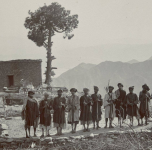
A group of Tanoli tribesmen guarding a remote outpost on Amb States western boundary with the territory of the Salar Gadoons, October 1904.
Photo by Aurel Stein. Via Jahandad Khan

1705446271908.png


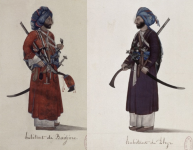
Pashtuns from Bajaur and Dir, 1835 (c).
Painting by Imam Bakhsh Lahori, an artist in the service of a French general of Ranjit Singh.

1705446345717.png
 
Portrait of Hari Singh Nalwa, made in 1850 (c).

1705446490348.png

He was the Khalsa governor of Hazara (1822–1837) and Peshawar (1835-1837). He was defeated and killed by Afghans in the battle of Jamrud (1837).
History of conflicts between Pashtuns and Sikhs: https://www.youtube.com/playlist
 

To view this content we will need your consent to set third party cookies.
For more detailed information, see our cookies page.


To view this content we will need your consent to set third party cookies.
For more detailed information, see our cookies page.


To view this content we will need your consent to set third party cookies.
For more detailed information, see our cookies page.
 
Many Pakistanis (including Pashtuns) are clueless about the fact that there is also a 'Bala Hissar' in the Kabul city of Afghanistan. Whenever I post a photo of Bala Hissar of Kabul, there always are some comments telling me to correct my post, that Bala Hissar is in Peshawar not Kabul.
'Bala Hissar' simply means High fort in Farsi. Any fort built on high ground, was referred to as Bala Hissar. There are several Bala Hissars in Afghanistan. I think confusion among Pakistanis arises because it is erroneously referred as "Qila-i-Bala Hissar" (the fort of Bala Hissar) in Urdu, making people think that it is distinct name of the fort.

1705446853373.png
 

Users who are viewing this thread

Back
Top