R. Niazi
@lone_wolf1727
25 Cavalry Men of Steel,
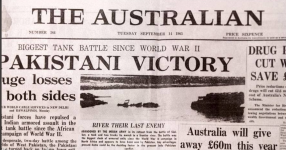
In the early hours of 8th September 1965, the Indians launched a major offensive in Sialkot sector along Suchetgarh-Sialkot-Chobara-Chawinda axes.
Suchetgarh-Sialkot was halted after some loss of ground, however, the enemy put in its main offensive effort

checked the Indian advance and acted as the "Steel knuckle" of Pakistan.
On 8th September, 24 brigade and 25 cavalry were struggling to reach Pasrur. 24 brigade arrived by about 0500 hours while 25 Cavalry was on the way.

About an hour later, 24 brigade headquarters recieved news that 3FF's positions had been run over by the advancing enemy. It was then that commander 24 brigade, Brigadier Ali Malik contacted CO 25 cavalry, Lieutenant Colonel Nisar Ahmad and ordered him to "do something". Half an hour later, at 0630, CO and Second in command 25 cavalry

went to Squadron Commander Major Ahmad and ordered him to "stop the enemy" who had attacked through Charwa. That was all the information they had but 25 cavalry had the advantage of operating in similar terrain. Appreciating a quick response by CO 25 cavalry, the Indians describe the situation in the following words, "LT Col Nisar Ahmad reacted quickly and decided he would employ B squadron, equipped with M47 Patton tanks, to block the advancing Indian force and strike with the rest of the regiment. The regiment was moving into a well-known and reconnoitered area that would be an advantage to them against the advancing Indian force they had no information about." For several preceding days, Lieutenant Colonel Mian Muhammad Mahmud, officer commanding 1 army aviation squadron, flying in an L19 observer plane, had

anxiously followed and reported on the alarming build up by Indian army units. Airborne again in the early morning of 8th September, he could clearly see the spearheading Indian centurion tanks with Infantry and Artillery support.
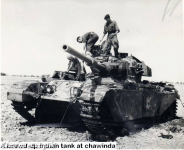
He knew of Pakistan army's presence in the area, but wondered why the Indian Armour had been allowed to come unhindered this deep towards Chawinda. That was until he saw well spaced-out dust plumes rising on the Pakistan side, moving towards the Indian Armour. On the ground, one of the most heroic tank on tank battle had begun.
The Indian side says about this battle, "...Major Ahmad moved to the east of his position and saw 16 Cavalry Tanks in the open between Gadgor and Gillanwali and his tanks opened fire. Major Ahmad claimed that in the initial engagement four tanks of 16 cavalry were destroyed; he
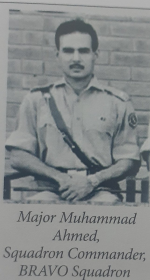
Also claimed that he saw eight 16 cavalry tanks destroyed and burning."
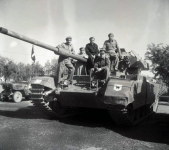
Alerted to the advancing enemy, Bravo squadron's Pattons spread out to an unusual extended line formation.
Each tank closed in boldly but fired accurately. Major Ahmad himself destroyed four centurions but
his tank was also hit and he was injured. Swiftly he commandeered another Patton and dispatched his fifth centurion. Utterly shaken, Indian 16 Cavalry turned back. Later, Alpha and Charlie squadrons also joined Bravo in pursuit of the enemy. Major Muhammad Ahmad was awarded the "Sitara-e-Jurat" in recognition of his leadership and courage.
As per details of the 6 armoured Division of Pakistan, it lost 60 tanks while destroying a staggering 173 in this war.
The unmatched courage and professionalism of the men of 25 Cavalry and specifically Bravo squadron has been noted and appreciated by not only the Pakistan army and it's top brass, but by the Indian army and it's leadership as well.
Special thanks to @Hulakukhan11 for helping in the composition of this thread.



 Punjab faces greater threat from other provinces than 'neighbouring countries': CM Maryam (34 Viewers)

 Iran - Israel/US War: Israel-US declare war on Iran, Iran responds (272 Viewers)
 Putin says Russia ready to make visa-free travel with China permanent (10 Viewers)