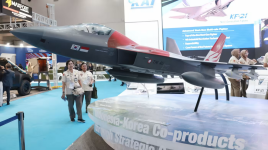
IFX Indonesian Fighter Experiment (KF21/IFX program)

KAI's KF-21 conducts four daily test flights, eyes fighter jet export supremacy​

KAI’s KF-21 takes to the skies four times a day, seeking global dominance in fighter jet exports
By
Lee Jong-hyun
Published 2025.06.18. 06:00


To view this content we will need your consent to set third party cookies.
For more detailed information, see our cookies page.

The first KF21 next-generation Korean fighter jet passes through the ramp section connected to the runway at KAI in Sacheon, Gyeongnam.


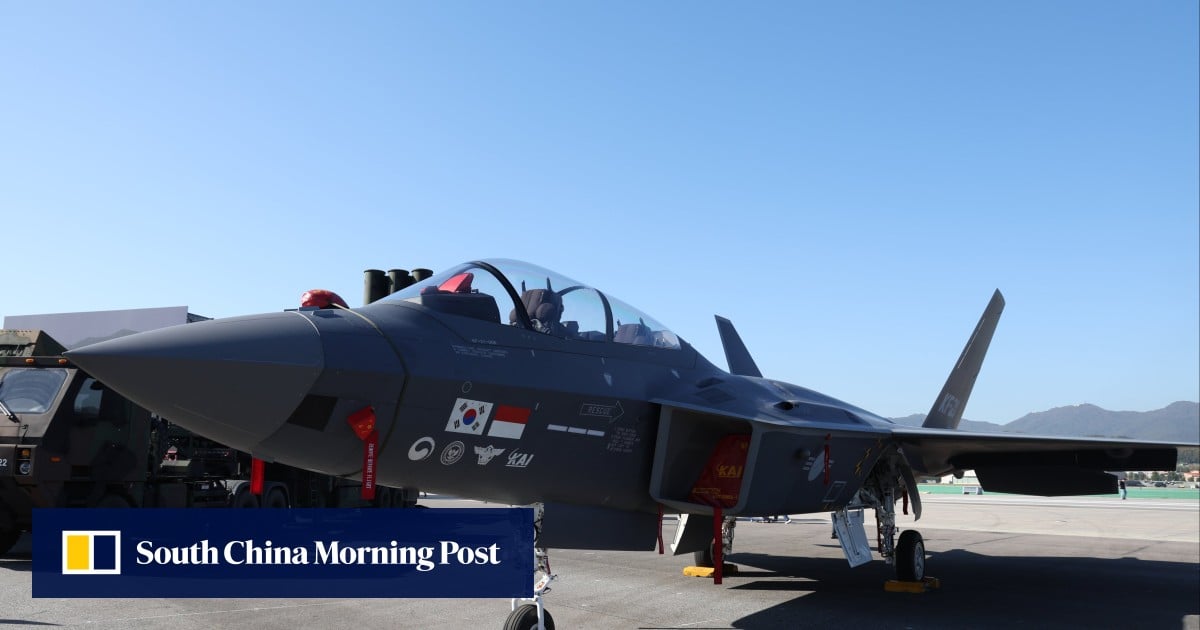
On the afternoon of the 11th, the Korean-style supersonic fighter Boraemai (KF-21) prototype was spotted at the Korea Aerospace Industries (KAI) hangar in Sacheon, Gyeongnam. Ahead of the suitability evaluation scheduled for the first half of next year, the KF-21 is currently conducting four test flights a day. The KF-21 in front of us also conducted test flights up to Seosan and returned to Sacheon for inspection an hour ago.

Lee Sang-hwi, Deputy Minister of Aircraft Production at KAI, said, “The aircraft is just coming back after completing the test flight at 2 p.m. and is currently undergoing post-flight inspection.” He noted, “We conducted two test flights today, one in the morning and one in the afternoon.”

Post-flight inspections are a necessary procedure for the mass production of the KF-21. Inside the KF-21 undergoing inspection, white and orange wires were visible. The white wires are standard wires, while the orange ones are a kind of sensor used to collect data. The KF-21 flies equipped with nearly 3,000 sensors. The Deputy Minister explained, “For every test flight, about 40 experts gather at the ground Mission Control Room (MCR) to monitor the aircraft's status in real time.”

At the rear of the KF-21 undergoing maintenance in the hangar, an orange parachute was also visible. This was a feature not seen on other KF-21s. The Deputy Minister remarked, “The main mission of the second aircraft is to gather data while flying vertically, and due to the possibility of losing lift and falling during this process, we have equipped it with a parachute as a precaution.”


To view this content we will need your consent to set third party cookies.
For more detailed information, see our cookies page.

The first mass-produced KF-21 fighter jet is undergoing assembly at KAI in Sacheon, Gyeongnam./Courtesy of Defense Acquisition Program Administration


KAI recently began assembly work on the first unit of the KF-21 for mass production. Since June of last year, it has been processing parts for the first unit, producing key components, and assembling the airframe, and last month it entered the final assembly stage. In the final assembly stage, wings are attached to the airframe, and key components such as electronic equipment and engines are installed.

During the visit to KAI's fixed-wing production site, the first unit of the KF-21 for mass production undergoing final assembly could be seen. The production site, which spans about 23,000 square meters, featured long lines for the KF-21, FA-50 fighters, and T-50 high-altitude trainers. The scale allows for five KF-21s and seven FA-50s to be lined up in a row.

The fighter is a culmination of advanced technology, incorporating 220,000 parts and 32 km of wiring, yet more than 90% of the manufacturing process is done manually. Due to the complexity of the structure and the need to assemble various shaped parts, automation is difficult. Because special metals are used, welding is also not feasible. The Deputy Minister explained, “Parts and components are made in different areas and then assembled on the central line,” and added, “You can expect that one fighter jet is produced per month per line.”


At the fixed-wing production site, several national flags could be seen. This indicates that many countries are interested in Korean-made fighters. The T-50 high-altitude trainer being assembled at the far end had flags from Indonesia and Poland, while the FA-50 production line displayed flags from Malaysia and the Philippines. All these countries have purchased fighter jets and trainers from Korea.

A short drive from the fixed-wing production site led to the appearance of the rotary-wing facility, where helicopters are made. The Korea Utility Helicopter (KUH) and Light Armed Helicopter (LAH) are both manufactured here. While production quantities for the KUH have decreased as deliveries to the army have concluded, one side is still producing KUHs exported to Iraq.

The Deputy Minister noted, “In the case of rotary-wings, we are trying to localize the main gearbox technology that relies on imports,” adding, “Design is almost complete, and we plan to develop components until 2026, with the goal of testing them on actual aircraft by 2029.”

Recently, KAI has been focusing on implementing a composite system of manned and unmanned aircraft enhanced with artificial intelligence (AI) technology. The KF-21, which is currently being prepared for mass production, is classified as a 4.5 generation fighter. The upcoming 5th and 6th generation fighters will combine AI technology with 6th generation (G) communication technology, enabling coordinated operations between fighters and unmanned aircraft.

Kim Ji-hong, KAI's Director of Future Convergence Technology, said, “Joint operations with unmanned aircraft will be important for the 6th generation fighter,” and noted that KAI will first unveil a multi-purpose unmanned aircraft flying alongside the FA-50 at the Seoul International Aerospace and Defense Exhibition (ADEX) in October.

In addition to producing core aircraft such as the KF-21 and KUH, KAI announced its ambition to grow into one of the world's top seven defense corporations based on a composite system of manned and unmanned aircraft powered by AI technology. Hong Sung-hoon, head of KAI's Future Strategy Team, stated, “This year's sales are expected to be around 4.1 trillion won, aiming for 40 trillion won by 2040,” and added, “To achieve this, we plan to shift KAI's focus from domestic to export, from military to civilian, and from hardware to software.”


KAI considers design options for loyal wingman​


By Akhil Kadidal |
23 August 2024

1750233296546.jpeg
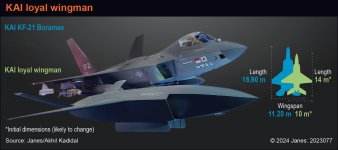
The initial design of KAI's loyal wingman conceived an unmanned aircraft that was roughly a third of the size of the KF-21 Boramae manned fighter aircraft. (Janes)


Korea Aerospace Industries' (KAI's) ‘loyal wingman' unmanned combat aerial vehicle (UCAV) is undergoing design changes to “satisfy future market requirements”. Changes include a possible reduction in the size of the aircraft, KAI said.

The UCAV programme was conceived to support KAI's KF-21 4.5-generation fighter aircraft with a low acquisition, low-operating-cost attritable, combat platform. While the UCAV is being developed to be relatively inexpensive compared with the KF-21, KAI now acknowledges an increase in programme costs.

“[This is] because KAI's engineers are looking for optimal design options [including] the use of a [high-performance] … turbofan engine,” a company spokesperson told Janes on 19 August. However, the spokesperson added that the “iterated or revised design can be downsized without reduced capabilities”.

Janes reported in 2023 that designers expected the UCAV to be a third of the size of the KF-21. In October 2023 during the Seoul International Aerospace and Defense Exhibition 2023 (ADEX 23), a KAI representative told Janes that the unmanned fighter will have a potential length of 14 m and a wingspan of 10 m. This is roughly equivalent to the dimensions of the KAI FA-50 light attack aircraft, the KAI representative added at the time.

However, in the company's latest communication with Janes , the spokesperson said that “a change of aircraft size can occur anytime during the design iteration if a revised design is expected to meet the requirements”.

“As KAI's loyal wingman is in the conceptual design phase, indeed, there can be many options to satisfy expected future market,” the spokesperson added.

 
To view this content we will need your consent to set third party cookies.
For more detailed information, see our cookies page.


To view this content we will need your consent to set third party cookies.
For more detailed information, see our cookies page.
 
To view this content we will need your consent to set third party cookies.
For more detailed information, see our cookies page.
 
To view this content we will need your consent to set third party cookies.
For more detailed information, see our cookies page.


To view this content we will need your consent to set third party cookies.
For more detailed information, see our cookies page.
 

South Korea set to join global race to develop sixth-generation fighters​

A senior executive at aerospace firm KAI says the country will upgrade its warplanes to match those developed by China, the US and others

1750675805060.webp
Seong Hyeon Choi
in Paris
Published: 9:00pm, 22 Jun 2025

South Korea is set to become the latest country to develop a sixth-generation fighter, according to a senior aerospace executive.

Shin Dong-hak, vice-president of international business development at Korea Aerospace Industries (KAI), said in an interview at the Paris Air Show that the technology it was showcasing at the event – including 4.5-generation fighters and unmanned aerial vehicles – would “ultimately” become “key elements” of the switch to sixth-generation fighters.
The country is joining a global race where footage recently released on social media suggests China may have started testing its sixth-generation prototypes.

Meanwhile, in the United States, US President Donald Trump has confirmed that the US will go ahead with its sixth-generation fighter programme by awarding Boeing the contract to develop the planes.

Last week at the event – the world’s largest and oldest air show – KAI’s display included the KF-21 Boramae, its latest 4.5-generation fighter jet, FA-50 light combat aircraft and next-generation unmanned combat aircraft.


These aircraft were each accompanied by multiple unmanned aerial vehicles (UAVs), suggesting it was working on crewed-uncrewed teaming – a key element of new-generation aerial warfare in which drones operate alongside piloted planes to increase their operational range and serve as a defensive shield.

The KF-21 is South Korea’s first domestically produced 4.5-generation fighter jet, and is scheduled to enter service by the end of next year.

Its partial stealth design is expected to receive a fifth-generation upgrade, and Shin indicated this would not be the end of the process.

“So we are exhibiting products that are the basis of the sixth-generation [capabilities],” Shin said.

“Especially in the case of UAVs, there are many purposes in that direction, but the development goal is ultimately geared towards the sixth generation.”

He said the KF-21 differed from its peers because it was able to make the “most rapid” transition to becoming a sixth-generation fighter thanks to the application of stealth capabilities and artificial intelligence pilot software that controls multi-role combat UAVs.

He added that his company aimed to carry out a flight test of the multi-role combat UAV during the Seoul International Aerospace and Defence Exhibition later this year.

“The sixth-generation concept is already implemented [in the KF-21]. The first step is to apply stealth, which will happen around 2030. Then AI software will be installed, and … will be linked with the multi-role combat UAV,” Shin said.

“The sixth-generation concept will probably be realised around the mid-2030s, but since there are a lot of programmes competing against each other, that timeline can be pushed back [to an earlier date].”


Shin said the development of crewed-uncrewed teaming was a “global trend” that recognised there were limits to what piloted planes could do.

“As we expand infinitely with unmanned aircraft, manned aircraft are focusing on functions that can control the entire thing – thereby reducing the risk to manned aircraft, increasing attack effectiveness, and drastically reducing the cost of combat investment. We need to apply this concept and need to respond promptly,” he said.

Shin also said KAI was working on a command and control system that would be “hyper-connected from the ground to the air and even to space based on communication satellites”.

He added: “Developing an aircraft itself will have many issues and difficulties, but in particular, we have focused on the hardware and software … I think it will be a bit challenging to have such expanded capabilities that we have not experienced, but as I have said, we can overcome it because we have the portfolio.

“The fastest way is to work with people who know how to do it instead of learning the skills ourselves.”

 
To view this content we will need your consent to set third party cookies.
For more detailed information, see our cookies page.


To view this content we will need your consent to set third party cookies.
For more detailed information, see our cookies page.

The game of Indonesia is hard to follow.
Apart Rafale, there is option on 3 jets : F15, KAAN, KF21.

A sole common point between these last 3 : US engines.
I don't see Trump agreeing a sole of jets with US engines when Boeing assembly line is a little bit dry.
 
The game of Indonesia is hard to follow.
Apart Rafale, there is option on 3 jets : F15, KAAN, KF21.

A sole common point between these last 3 : US engines.
I don't see Trump agreeing a sole of jets with US engines when Boeing assembly line is a little bit dry.

F15 EX and Kaan deal are all MOU level. I doubt we will likely ever signed any contract for those two jets. For example KAN for Indonesia based on MOU level should also use Turkish engine.

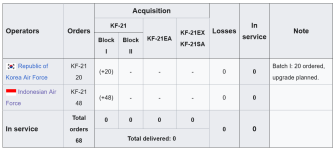
While 48 order for IFX is a contract agreement of KF21 EMD deal. It is part of the cost share, work share, and KF21 order betweeen 2 nations before both undergo EMD phase. June deal is Contract Amendement, it is not MOU level anymore. Of course all 48 KF21/ IFX order needs to wait Indonesian Aerospace IFX version and its manufacturing line preparation.

Regarding engine issue, KF21 has possibility to use other engine than USA made as Indonesia is not just a buyer in KF21/IFX program, but one of the plane developers.

If USA for example later embargo the F414 engine to Indonesia due to any kind of reason, we could possibly use non USA engine for Indonesian IFX version.

For example, current IFX will have less USA component compared to KF21 due to US export license ban for Indonesia. So the experience of majority of Indonesian F16 and Hercules cannot fly and sit helplessly on the tarmac during US embargo period is unlikely to repeat with KF21/ IFX.

Different with F16 and Hercules, Indonesia is part of KF21 OEM that has more right on the plane. I dont know the deal exactly, but even if we dont have KF21 source code for IFX system integration, we could get Korea help on that part since the ability to upgrade the plane independently is one of the reason of why we can get KF21 5th prototype for development purposes.

Actually, I believe the KF21 next development (block 2, block 3, and possibly block 4 until 5) will likely be still done together by both Korea and Indonesia. For example, for KF21 block 2 development, Korea still ask Indonesia to participate.

Why ? Because getting other partner will open the secret of phase 1 development to other country that dont become the part of block 1 development that needs huge money (billions USD in total). While developing the plane for further block together again (Korea and Indonesia) will reduce the development cost to each nation (compared to each Korea and Indonesia develop the plane further block alone) and with fixed bigger order (Korea and Indonesia) in the front so it can reduce the plane price before it is finally offered to the market if the development completed.

Last but not least. Dont forget, Korea is also now developing its own engine for KF21 (Hanwa).
 

UK lobbies South Korea to switch to Rolls-Royce for new fighter jets programme​


Britain seeks closer ties with Asian nation’s booming arms sector to help rebuild its own defence industrial base

1750746906749.png

Christian Davies in Seoul and Sylvia Pfeifer in Paris

Published
Jun 23 2025


UK officials are lobbying for Rolls-Royce to replace US rival GE Aerospace as the main engine partner on South Korea’s fighter jet programme, as Britain seeks closer ties with the Asian nation’s booming arms sector to help rebuild its own defence industrial base.

South Korean defence group Hanwha Aerospace produces current-generation engines on the KF-21 fighter jet under licence from GE. But US export restrictions over national security concerns have frustrated Seoul’s ambitions to sell the jet to potential buyers such as the United Arab Emirates and Indonesia.

As an alternative, South Korea has been looking to develop its own engines, with Hanwha and local rival Doosan Enerbility pitching for a role in the next generation of the KF-21, which is due to enter production in the mid-2030s.

But with some defence experts expressing scepticism about their capabilities within the timeframe, UK officials have been pressing the case for co-production with a foreign partner as an intermediary step, according to several people familiar with the discussions.

“Rolls-Royce’s involvement would de-risk the project and accelerate the timeline,” said a British official. “This is not about simply selling engines to South Korea. It is about developing a new engine together and seeing that relationship through to the end of the engine’s life.”

Rolls-Royce declined to comment, but one person familiar with the situation said the company, which is hoping to work with India on its indigenous jet engine programme, had made no secret of its interest in opportunities to help other countries develop their own combat capabilities.

UK officials acknowledged their campaign on behalf of Rolls-Royce was part of a wider effort to forge closer defence procurement ties with South Korea, one of the world’s top 10 arms exporters.But analysts said the efforts could be complicated by Seoul’s decades-long security alliance with the US. Hanwha was pushing for shipbuilding contracts with the US Navy, as well as engine maintenance and repair contracts for US fighter jets based in Asia, said a person close to the company.

Seoul sees defence procurement as a way to meet Washington’s demands to reduce South Korea’s $55bn trade surplus with the US. GE is also interested in continuing its involvement in the KF-21 programme, according to a person familiar with the company’s thinking.

Rolls-Royce supplies gas turbine engines for South Korean naval frigates, while the KF-21’s ejector seat is produced by Uxbridge-based Martin-Baker and its missile system was supplied by MBDA, a European consortium jointly owned by BAE Systems, Airbus and Leonardo.

Hanwha has talked to British officials about partnering with BAE to build munitions factories in the UK, according to people familiar with the discussions, as European countries seek to boost their weapons production capacity following Russia’s full-scale invasion of Ukraine and signs of wavering US commitment to the continent’s defence.

The UK Strategic Defence Review this month recommended the creation of an “always on” munitions production capacity that could be “scaled up at speed if needed”.

BAE this month announced a partnership with Hanwha Systems, the South Korean conglomerate’s radar and software subsidiary, to co-develop an advanced satellite system for intelligence gathering, surveillance and reconnaissance. Hanwha already supplies BAE with “modular charge systems” for its Nato-standard 155mm artillery rounds.

A UK defence ministry spokesperson said: “The Republic of Korea is an important industrial partner and we continue to scope future collaboration opportunities together.

”GE declined to comment on its future involvement in the programme, but a spokesperson said: “GE Aerospace is proud to be a trusted partner in Korea for more than 60 years. We remain committed to supporting Korea’s defence industry and contributing to future programmes with proven expertise and a strong track record.

”South Korea’s defence procurement agency said: “No decision has been made yet on whether we will co-develop the engines with foreign engine makers or with which foreign company to partner with.

”BAE and Hanwha declined to comment.

Additional reporting by Song Jung-a in Seoul and Charles Clover in London

 
Every new so called fifth generation stealth fighter looks like F35.
Only Chinese ones look bit different.
 

KAI Serves KF-21 Partner Indonesia School Reconstruction​


2025-06-24 10:17

1750782295785.webp
Provided by Korean Aerospace Industries (KAI)

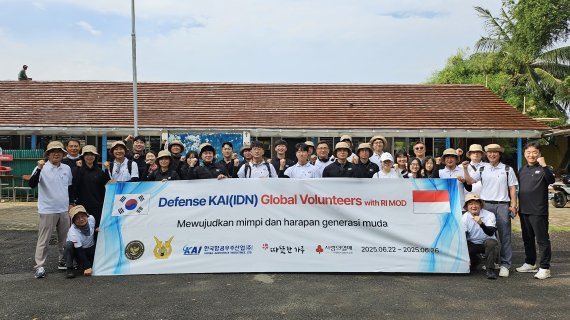
[Financial News] Korea Aerospace Industries (KAI) announced on the 24th that it will carry out volunteer work to rebuild the Tugu Bhakti School in Jakarta, Indonesia as part of its social contribution.

A volunteer group consisting of 27 KAI employees participated in the construction for three days from the 23rd to the 25th. They completed work such as creating murals, repairing desks, and organizing the garden.

Tugu Bhakti School, located in Jakarta, Indonesia, is an integrated school where vulnerable students from kindergarten, elementary, and middle schools attend together. It is the oldest in the area. With approximately 200 students, it has the largest number of students in the area.

KAI and the volunteer group raised approximately 200 million won and began remodeling work in May. They are currently promoting activities under the title of ‘Renewal of the vulnerable school by the Indonesian Ministry of National Defense and KAI’ in cooperation with the Indonesian Ministry of National Defense and city council members.

Choi In-soo, head of KAI’s Management Support Office, who participated as the head of the volunteer group, said, “KAI has maintained a long-standing partnership with Indonesia in the aircraft business based on deep trust, and we hope to continue to grow and sustain this relationship beyond technology and industry, connecting people to people and hearts to hearts.”

KAI’s social contribution brand, ‘Defense KAI,’ continues to conduct overseas social contribution activities every year to promote mutual trust and friendly relations by extending a helping hand to vulnerable facilities or organizations in need of help in defense and security-related potential export countries.

Indonesia was selected as the target country for ‘Defense KAI’ as the first exporter of aircraft, the largest exporter of aircraft with 20 KT-1s and 16 T-50s, and a business partner for the KF-21.

Starting in 2023, Defense KAI, which started with supporting veterans of the Korean War and other national heroes under the motto of social contribution for national defense and security, has gradually expanded by visiting the UN Memorial Park and National Cemetery, conducting fundraising campaigns for veterans and their families of the Korean War in the Philippines, and conducting a free photo shoot project for veterans of the Korean War.

Currently, it is expanding various activities beyond Korea to overseas through the voluntary participation of executives and employees, such as school reconstruction, support of science books and educational equipment, volunteer work, and fundraising for natural disaster relief, focusing on Southeast Asia and South America. #KoreaAerospace #Indonesia #KAI #KF-21

 
I had the first phone call with the President Prabowo Subianto of Indonesia.

Indonesia, the largest economy in ASEAN with a population of 280 million, is one of Korea’s key partners.

The Special Strategic Partnership between our two countries has developed on the foundation of mutual trust and friendship.

Amid a rapidly changing global environment, President Prabowo and I shared our common vision to further strengthen our bilateral cooperation as longstanding friends and strategic partners.

To view this content we will need your consent to set third party cookies.
For more detailed information, see our cookies page.
 
IFX Configuration (Indonesian Aerospace will try to develop it using KF21 fifth prototype as test bed plane/ prototype for development purposes)

View attachment 106448
View attachment 106449

Indonesian engineers during first flight of KF21 - 5th prototype, May 2023

View attachment 106450


Story

--------------

February 6, 2014 (Angkasa/Space Magazine)

KFX / IFX program continued , Government Asked to Immediately Selecting Design

1660676282441.png


Korea was once considered Indonesia engineer do not understand about the design of a jet fighter. But the notion was quickly turned , when the Indonesian team describes the design and the various inputs. The Indonesian side also the one who finally managed to convince that the aircraft take-off weight of 50,000 pounds must .

Confirmation of the Parliament of South Korea on the resumption of the program KFX / IFX team warmly welcomed designers from Indonesia. They include asking both governments immediately call the engineers involved in preparing work that has been long overdue. They also want the governments of both countries to make sure one of the two designs that have been produced in the Technology Development phase for cultivation in the next phase .

"Program KFX / IFX is a multi - program years , costly, and involve various sectors and foreign partners. For that there must be a definite declaration on it goes. For Indonesia it is important to determine the financing schemes and their human resources planning, "said Dr Rais Zain, M. Eng , KFX / IFX Configuration Design Leader for Angkasa , in late January.

"In the near future Indonesia will also work on the N219 and R - 80. We do not have enough engineers to work three programs, especially KFX / IFX will take place until the 2020s. The government is expected to call home engineers who are now working abroad to come help the regeneration process. Outside there are approximately 200 people . If half of it can be returned to the country, it is enough to help, " added Rais who is also a lecturer at the Faculty of Aerospace Engineering ITB, Bandung.

As reported by the national media, the confirmation of the continuation of the program of making front - liner Korean - Indonesian fighter jets received by the Ministry of Defense on January 3, 2014. Notice is further announced Defense Minister Purnomo Yusgiantoro told reporters, Wednesday, January 8, 2014, on the sidelines of Rapim Kemenhan in Jakarta. Explanations related to exposure delivered weapon system procurement plans in the Strategic Plan II, 2015-2019.

The Indonesian government hopes the project of making the 4.5 generation fighter jet could be done because it would be a referral program to remove the dependence of the transfer of technology from other countries. Besides KFX / IFX, Indonesia is also pursuing a program of making submarines , warships, propellants , rockets, and tank size medium. For submarines, Indonesia is also cooperating with the same country.

Superior to the Su - 35 Program, KFX / IFX was stopped temporarily by Korea's new leader Park Geun - Hye end of 2012 after reviewing the state financially in the country. This prestigious project was worked on since the beginning of 2011, shortly after President Lee Myung - bak and President Susilo Bambang Yudhoyono confirmed the bilateral cooperation in the defense field in Jakarta. From the Technology Development Phase that has been completed, a team of scientists has completed a number of conical design that later became two.

The two designs is a model of the stealth fighter jet -winning twin-engine air superiority with horizontally - tails in the back, and the other one is with canards on the front. "Each has consequences different financing and partners. Thus , it must first be decided which one is selected. It is important that when followed, all parties are ready to do it , "said Rais Zain , whose day-to- day lecturer at the Faculty of Engineering, Aerospace Engineering,ITB, Bandung.

As stated Wamenhan Sjafrie, Korean parliament has prepared 20 million U.S. dollars (temporary , Indonesia : $ 5 million) to continue this program in 2015. At that time , the team will go to the Engineering Manufacturing Development Phase. In addition must have a high thrust engine with a power to be able to fight in the air, the aircraft must also have weapons stored in the internal weapons bay , the data - link capable of randomizing communications, advanced radar target voters, and anti - jamming device.

The prototype is expected to finish by the end of the Strategic Plan II . Even if there are things that need to be criticized , it is a matter of operation requirements are much more determined the Korean Air Force . This was inevitable because the Korean bear 80 percent of the funding, and the country actually have a real enemy. This program is targeted to spawn a jet fighter with performance equivalent or superior to the opponent fighter jets which are the Sukhoi Su - 35.

Prerequisites requirement dismissed the proposed counter designs by KAI ( Korean Aerospace Industrie) recently, which is intended to cut development costs. In the configuration ( see Space, December 2013 ), looks KFX type E is only one engine powered with weapons outside the radar sweep prone opponent.

Angkasa examine admiration of ADD ( Agency for Defense Development, Defence Research and Development Agency of Korea ) submitted to the Indonesian engineer team. Initially, the team assumes Korea really had no idea about the design of Indonesian fighter jets.

However, the assumption was turned when Indonesian engineers began to describe the design and the various inputs to the design of Korea. The Indonesian side also who ultimately ensure that the aircraft must have a takeoff weight of 50,000 pounds.(A.Darmawan/Angkasa magazine).

Can you merge your video thread here please
 
Can you merge your video thread here please

I prefer to separate both, as this is for important info and sticky while for video and picture is another thread and non sticky one
 

Users who are viewing this thread

Pakistan Defence Latest

Back
Top