IMF - International Monetary Fund Program Updates

The bulk of your debt belongs to china btw
But china do that ...They entice you in claim support for huge projects on your land
Gain strategic access to your ports and borders then when you can't pay they money they lease the land and ports for 100 years .oh and you still pay interest as well
This is how they got string of pearls in the first place
Around 30% of the external debt is. Pak needs to pay its debts as nothing is for free.
 
The thing the IMF which is a western controlled institution fear the most is a religious leadership taking over Pak with hundreds of nukes. To ensure the secularists in the form of Showbaz & co, and Mr 10% stay in power the IMF will hand a life line which in reality will be worse than death.

We are looking at modern slavery with a whole nation stuck in a never ending debt trap, unless Pak hits huge raw materials like oil and gas.

I understand your point and you are correct. IMF loans aren't a lifeline. In reality it is poison that you continue to accumulate and have to repay with interest. Pakistan will remain in a vicious circle.
 
The bulk of your debt belongs to china btw
But china do that ...They entice you in claim support for huge projects on your land
Gain strategic access to your ports and borders then when you can't pay they money they lease the land and ports for 100 years .oh and you still pay interest as well
This is how they got string of pearls in the first place

Absolutely wrong. The majority of the debt is owed to multilateral institutions. Let me prove it to you with sources and figures:
  1. Multilateral Institutions:
  2. Bilateral Creditors:
  3. Commercial Creditors:


As of the latest data, Pakistan’s external debt and liabilities amount to approximately $126.3 billion.
 
Last edited:
If the Pakistani external debt was sustainable then, it should be sustainable now. And if it is not sustainable today, how could it be sustainable back then?
I think it is a question of sentiment. It may be that China, Saudi Arabia and UAE thought things are going to improve with the new government and there is light at the end of the tunnel. They might have turned pessimistic now and are no longer interested in rolling over their loans. That makes IMF loan that is conditional on obtaining forbearances impossible. This is a prisoner's dilemma situation where the actors do not trust each other.
 
I think it is a question of sentiment. It may be that China, Saudi Arabia and UAE thought things are going to improve with the new government and there is light at the end of the tunnel. They might have turned pessimistic now and are no longer interested in rolling over their loans. That makes IMF loan that is conditional on obtaining forbearances impossible. This is a prisoner's dilemma situation where the actors do not trust each other.

So, why don't the UAE, China and Saudi Arabia trust the new Pakistani government?
 
Last edited:
So, why don't the UAE, China and Saudi Arabia trust the new Pakistani government?
Don't know enough to give a satisfactory answer. Glancing at headlines, it appears that the current government seems to lack mandate to do anything substantial; so, it is just adopting status quo and kicking the can down for a few more days. Lenders can sense they won't get their loans back and are getting fidgety.

I just picked a random headline from today's newspaper, and it seems to suggest the constitutional process is in utter chaos.

Some sample sentences:

After PTI, BNP-M claims lawmakers under pressure to vote for ‘constitutional package’

houses of two of his party’s senators were being raided.
intelligence agencies’ cars are patrolling his house,” Mengal alleged.
Our second senator Nasima Ehsaan has said that her relatives and her husband are being pressurised,” he added.
He said Ehsaan was threatened that her property would be confiscated
government wanted to bring about the constitutional amendment by either keeping the people unaware of it or by using force.
 
To secure IMF loan .....

1726488209337.png
 

Primary goals of new deal​

The primary goals of the new bailout package include stabilising Pakistan’s economy by consolidating public finances, rebuilding foreign exchange reserves, and reducing fiscal risks from state-owned enterprises. The programme also aims to create a more conducive environment for private-sector-led growth.

The loan deal, finalised in July, was contingent on Pakistan securing $12bn in financial commitments from key allies such as Saudi Arabia, China, and the UAE.

Pakistan secured $5bn in deposits from Saudi Arabia, $4bn from China, and $3bn from the UAE. An additional condition from the IMF required Pakistan to obtain $2bn in external funding from bilateral and commercial sources.

The remaining financing gap of $2-2.5bn was bridged through various means, including Saudi Arabia’s oil facility, a $400 million loan from the International Islamic Trade Finance Corporation (ITFC) and contributions from Middle Eastern commercial banks, such as Standard Chartered Bank.
 
The fears of approval were laid to rest after the State Bank Governor Jameel Ahmad said that Pakistan planned to raise up to $4bn from banks by the next fiscal to plug the gap. According to him, Pakistan was in the “advanced stages” of securing $2bn in additional external financing required for IMF approval.

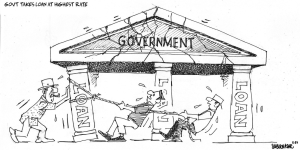
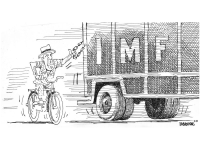
Pakistan has long relied on IMF programmes to avoid default, frequently turning to financial assistance from friendly nations to meet IMF requirements.

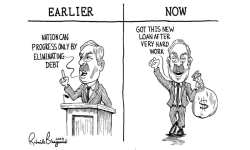
This is Pakistan’s 25th IMF programme since 1958 and its 6th under the EFF framework. Despite the influx of funds, the programme leaves unaddressed a crucial issue: restructuring Pakistan’s external and domestic debt, which consumed 81 per cent of the nation’s tax revenues in the last fiscal year.

Faced with chronic mismanagement, Pakistan’s economy had found itself on the brink, challenged by the Covid-19 pandemic, the effects of the war in Ukraine and supply difficulties that fuelled inflation, as well as record flooding that affected a third of the country in 2022.

In February 2023, the rupee had undergone a historic devaluation of 15pc while the foreign reserves shrunk to a meagre $3.7bn, exacerbating fears that Pakistan was heading towards a default without a comprehensive IMF programme to prop it up. However, the country managed to clinch a nine-month $3bn IMF deal in June after addressing the Fund’s concerns about its reform agenda — with reserves hovering around $3bn.

In April, the finance minister had confirmed that the country had initiated talks for a longer programme to support strengthening public finances, restoring the energy sector’s viability, returning inflation to the target, and promoting private-led activity.
 
Nathan Porter, director of the International Monetary Fund’s (IMF’s) mission for Pakistan, in a recent interview with the Voice of America, while commenting on Prime Minister Shehbaz Sharif’s statement that this would be the last IMF programme of Pakistan, is reported to have stated that this could be possible if Pakistan sincerely acted on economic reforms.

The crux of Porter’s statement is “if Pakistan sincerely acted on economic reform”.

Implementation of economic reforms has always been the weak link in the IMF programmes - often condoned by the IMF itself. Reforms which truly matter like power sector fiscal viability, privatization of loss-making entities and enhancing the tax revenues through widening of the tax net and efficient implementation remain un-accomplished while moving from one IMF programme to another.

Added now to these long pending requirements are the economic reforms laid out in the current (25th) IMF programme. They are far more extensive, complex and challenging and are required to be accomplished in the next 37 months when this programme will run out. So far it is not in public knowledge if the government has prepared a road map with defined milestones to achieve this ambitious target of “no further IMF debt programme”.

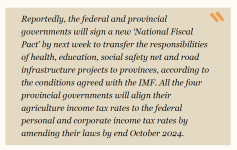
Unlike in the past, when the provincial budgets were out of the purview of the IMF, the new programme is expanded to the provincial budgets and their revenues. Nearly one dozen IMF conditions directly impact the provinces under the new programme.
 
the agricultural income tax rate is to increase from 12-15 per cent to 45 per cent in January next year. There will be no support price system for food and subsidies on agriculture. All the provincial governments will refrain from giving further subsidies on electricity and gas.

Under censorship is also the fiscal discipline of the country. One of such conditions is that Pakistan needs to show a primary budget surplus of 4.2 per cent of the Gross Domestic Product (GDP) during the three-year programme period.

The economists fear that this would significantly squeeze non-interest expenses and put an additional tax burden of 3 per cent on the existing taxpayers. Critical is Pakistan’s external debt repayments obligations for the next four years of $ 100 billion.

Pakistan is reported to have committed to the IMF that it would refrain from repaying the USD 12.7 billion debt to Saudi Arabia, China, the UAE, and Kuwait during the programme period. This may exhaust Pakistan’s chance of further bailouts from these sources.

While the government’s thumbs-up on the rising stock market, falling inflation and significant increase in taxpayers’ base can be celebrated for a while, but this alone will not move the country out of the IMF programme. The government needs massive revenues to retire loans, meet the expenditure to run the government and sustain loss-making public sector enterprises and the ailing power sector. With much of the industry, real estate and investors out of the revenue chain, the massive revenue generation is unlikely.
 

Users who are viewing this thread

Latest Posts

Back
Top