IMF - International Monetary Fund Program Updates

Sindh government is planning agricultural interest-free loans to small growers’ dependent on moneylenders or aarthis for purchasing inputs (seed, fertilizer etc.); the Benazir Hari Card aims to provide interest-free loans to the middle class for installing solar systems.

And free bus transport on three strategic routes notably Surjani to Tower, Orangi Iqbal market to Tower. Bypassing BISP when it bears the name of the party’s assassinated leader and was initiated during the PPP-led government’s tenure in 2008 is baffling.

KPK has subsumed distribution of two kilowatt free solar systems among deserving families under the party’s signature Ehsaas (BISP) programme (inclusive of solar panels, inverters, wiring, fans and bulbs). And directed Directorate of Education to provide free education to workers’ children and provide free pick-up and drop, free uniform, free textbooks and notebooks which can be supported.
 
The International Monetary Fund (IMF) has agreed to demands for sales tax exemptions and the elimination of equity losses to facilitate the privatization of Pakistan International Airlines (PIA), sources told.

Sources said that PIA’s buyer will be granted sales tax exemptions for purchasing or leasing aircraft for both national and international routes.

With the sales tax exemption and elimination of losses, the bidding value for PIA could increase from Rs. 250 billion to Rs. 350 billion
 
The International Monetary Fund (IMF) has again asked Pakistan to submit a plan for orderly transition from the agricultural support price mechanism to market-determined rates of commodities aimed at preventing farmers from losses and supply chain disruption.

In the absence of any such plan, there is a policy paralysis and no decision has been taken on the quantum of maintaining the strategic reserves of wheat.

The global lender inquired about the agricultural transition plan late last month during a virtual meeting, two months after the deadline to prepare and submit the plan lapsed, according to the government sources.

The plan had to be submitted by the end of September 2024 but so far the Ministry of National Food Security and Research has not submitted any such document, according to sources in food and finance ministries. However, the food ministry has prepared a brief for provinces, where it emphasised the need for maintaining strategic reserves but there is no consensus that could determine the volume of reserves and give farmers a plan to deal with the end to the support price mechanism.

Sources said that the IMF held a virtual meeting three weeks ago and inquired about the plan. It also emerged that during talks for the $7 billion loan programme, the food ministry had certain reservations about ending the current agricultural policies. But those views were overruled and Pakistan signed the loan agreement. It is now bound to meet the agreed deadlines.
 
Pakistani authorities also held internal discussions last week to discuss the challenges being faced in smooth implementation of the IMF programme. The issue of submitting the transition plan was also discussed.

The government last week transferred National Food Security Secretary Ali Tahir without attributing any reason, just three months after his posting. Prime Minister Shehbaz Sharif has been frequently transferring the food secretary after assuming the office.

Sources said that during the IMF meetings, the mission chief raised questions about the transition plan and building strategic reserves in case Pakistan Agricultural Storage and Services Corporation (Passco) was closed down.
 
The IMF's staff-level report stated that the government's intervention in the agricultural market has created distortions, stifling private sector activity and innovation, exacerbated price volatility and hoarding, and placed fiscal sustainability at risk, stated the finance minister.

The state's support of businesses through subsidies, favourable taxation arrangements, protection and governmental price setting has undermined the development of a dynamic and outward-oriented economy, according to the report.

The Khyber-Pakhtunkhwa (K-P) government has expressed concern that in case of a ban on inter-provincial movement of wheat and absence of strategic reserves, there could be a wheat crisis in the province.
 

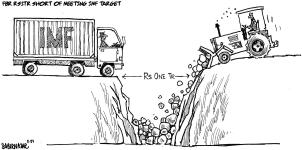
FBR Rs1tr short of meeting IMF target​

Under a condition from the IMF, the FBR is required to collect Rs6.009 trillion during July-December period.

Shahbaz Rana
December 27, 2024

federal finance minister muhammad aurangzeb app file


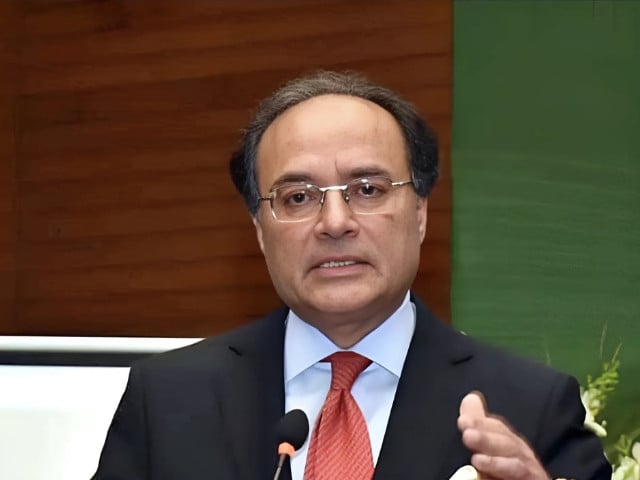
Federal Finance Minister Muhammad Aurangzeb.

ISLAMABAD:
Finance Minister Muhammad Aurangzeb hoped on Thursday that the International Monetary Fund (IMF) programme would continue but dodged a question whether the government was bringing a new budget or renegotiating the annual tax target because of a yawning shortfall.

Aurangzeb spoke at a press conference about the measures to broaden the tax base. His challenges had suddenly mounted as the Federal Board of Revenue (FBR) hardly achieved 50% of the Rs1.37 trillion monthly tax target as of Thursday.

Five days are left at the end of the month and the FBR still needed another Rs1 trillion to meet the IMF condition.

The government also hinted at compromise with the commercial banks on the issue of 15% additional advance-to-deposit ratio tax. It admitted that the non-filers would still be legally allowed to do transactions barring purchases of property, cars and shares.

"When the IMF mission will come we will have a discussion with them in good faith, as we are making every possible effort to get to the target," the finance minister said, responding to a question whether he would bring a mini-budget or seek reduction in the tax target.

Aurangzeb said that the government was making every effort to widen, broaden and deepen the tax base. "I am hopeful that the IMF programme will continue," he said, adding that the government was not backing off from any commitment given to the IMF.
 

Pakistan to impose levy on captive power plants to meet IMF condition​

Captive industry gas prices to align with LNG rates, sources confirm.


Irshad Ansari
January 07, 2025

photo file

Photo: FILE


Listen to article
The federal government has made a key decision to meet another significant condition set by the International Monetary Fund (IMF), agreeing to impose a levy on captive power plants before the release of the next tranche of funding.

According to sources, the government has made preparations to implement this levy on captive power plants, which will be applied gradually to prevent a significant reduction in gas supply to these plants.

Sources indicated that the IMF has shown flexibility on the issue of gas cuts to captive power plants, and the levy will be introduced before the next IMF tranche is disbursed.

In the first phase, a 5% levy on the gas supplied to captive power plants could be implemented in January, while the second phase may see the levy increase to 10%.

The sources further revealed that the price of gas supplied to the captive industry will be brought in line with LNG prices. The imposition of this levy aims to eliminate the disparity between captive power plants and other industries
 

Pakistan to honour IMF commitments, but excessive taxes unsustainable: PM​

Prime minister says Pakistan will part ways with the IMF "when the time is right."

News Desk
January 08, 2025

photo radio pakistan


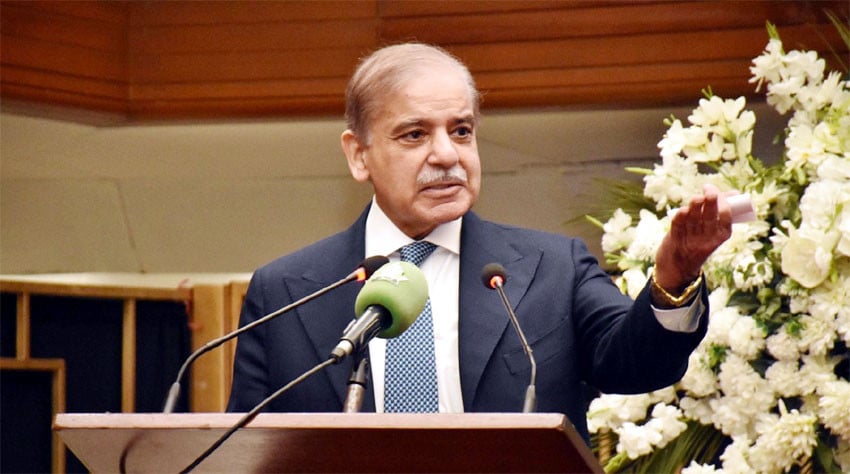
Prime Minister Shehbaz Sharif has stated that Pakistan will honour its commitments to the International Monetary Fund (IMF) but emphasised that excessive taxation cannot sustain the country's economy.

Speaking at the Pakistan Stock Exchange in Karachi on Wednesday, the prime minister reiterated plans for self-reliance.

PM Shehbaz remarked that while IMF agreements are currently necessary, Pakistan will part ways with the institution "when the time is right."
 

Pakistan to honour IMF commitments, but excessive taxes unsustainable: PM​

Prime minister says Pakistan will part ways with the IMF "when the time is right."

News Desk
January 08, 2025

photo radio pakistan


Prime Minister Shehbaz Sharif has stated that Pakistan will honour its commitments to the International Monetary Fund (IMF) but emphasised that excessive taxation cannot sustain the country's economy.

Speaking at the Pakistan Stock Exchange in Karachi on Wednesday, the prime minister reiterated plans for self-reliance.

PM Shehbaz remarked that while IMF agreements are currently necessary, Pakistan will part ways with the institution "when the time is right."
Qatal bhi karto ho,
ronay bhi nahi datay ho,
ajeeb qism kay harami ho....
 

IMF agreed for cleaning of PIACL’s Rs45 billion negative equity, NA panel told


Washington-based lender also gave its nod for removal of 18% GST on aircrafts, Standing Committee on Privatisation informed

BR Web Desk
January 9, 2025

The National Assembly’s (NA) Standing Committee on Privatisation was informed on Thursday that the International Monitory Fund (IMF) had agreed for cleaning of Rs45 billion negative equity of the Pakistan International Airlines Company Limited (PIACL).

The Washington-based lender also gave its nod for the removal of 18% goods and services tax (GST) on aircrafts, according to an official release from the NA on Thursday.

The committee was further informed that it had been decided to capitalise on positive momentum generated by the IMF’s consent on critical asks, opening up of European routes, and to avoid further loss to national exchequer.

“It was decided to go for fresh Expression of Interest (EOI) at the earliest,” the statement read.

The 5th meeting of the Standing Committee on Privatisation was held under the Chairmanship of Muhammad Farooq Sattar, MNA, at Parliament House, Islamabad.

As per the details, the committee discussed ‘The Privatisation Commission (Amendment) Bill, 2024’ and decided to defer the same.

Meanwhile, the committee appointed a sub-committee under the convenership Sehar Kamran, MNA to look into the reasons of decline of the PIACL.
 

IMF delegation in Pakistan to discuss process of appointing judges​


byThe Frontier Post


867193_70233110.jpg


ISLAMABAD: An International Monetary Fund (IMF) delegation has arrived in Pakistan to evaluate efforts to strengthen anti-corruption institutions and improve governance reforms.

The delegation will stay in Islamabad until February 14 and hold meetings with key officials.

According to sources, the IMF team will meet with representatives from the National Accountability Bureau (NAB), Ministry of Finance, State Bank of Pakistan, and Ministry of Law, among others.

The discussions are expected to cover judicial independence, legal and financial transparency, and the process of appointing judges.

The primary objective of the visit is to review rule of law measures, anti-corruption strategies, suspicious transactions monitoring, banking regulations, and transparency in development projects. Special focus will be placed on NAB’s role in combating corruption and ways to enhance its effectiveness. The delegation will release its assessment report in July.

Officials from the Ministry of Finance have refrained from commenting on the visit. However, they have indicated that an IMF mission will soon arrive to assess Pakistan’s overall economic performance from July to December.

The anti-corruption and anti-money laundering measures are also part of the $7 billion bailout package Pakistan secured from the IMF.
 

IMF revises Pakistan’s GDP growth outlook for 2025 to 3%​


Despite challenges, IMF's revised projections show Pakistan's GDP growth at 4% by 2026.

News Desk
January 18, 2025

tribune


The International Monetary Fund (IMF) has revised Pakistan's economic outlook, downgrading its projected Gross Domestic Product (GDP) growth for 2025 to 3%, down from 3.2% forecasted just three months ago.

The adjustment comes amid a broader global economic assessment presented in the IMF's "World Economic Outlook Update: Global Growth – Divergent and Uncertain."

The IMF's revised projections also indicate that Pakistan’s GDP growth will remain at 4% in 2026. However, the latest downgrade reflects ongoing economic challenges in the country, although the IMF did not provide specific reasons for the revision.

This latest revision mirrors the forecast made by the Asian Development Bank (ADB) last month, which also adjusted Pakistan’s growth forecast to 3% for the fiscal year 2024-25, up from a previously projected 2.8%.

Both institutions have cited challenges faced by Pakistan's economy but have maintained a cautiously optimistic outlook for the medium-term.

Global Economic Growth Forecasts

Globally, the IMF forecasts a global growth rate of 3.3% for both 2025 and 2026, slightly below the historical average of 3.7%.

The IMF's chief economist, Pierre-Olivier Gourinchas, highlighted that the global economy continues to face diverging growth patterns, with stronger-than-expected performance in the United States partially offsetting weaker results in other major economies.

Inflationary trends are expected to ease in the coming years, with the IMF projecting global inflation to decline to 4.2% in 2025 and 3.5% in 2026. However, the IMF cautioned that inflation remains stubbornly high in some regions, despite a global trend of disinflation.

The IMF also noted a significant decrease in energy commodity prices, with a forecasted 2.6% decline in 2025, while non-fuel commodity prices are expected to rise by 2.5%, largely due to adverse weather conditions affecting key producers.

Regional and Major Economies' Growth Projections

The IMF's global outlook includes more optimistic projections for some major economies. In the United States, GDP growth is expected to reach 2.7% in 2025, revised upward by 0.5 percentage points due to stronger domestic demand. However, U.S. growth is forecast to slow to 2.1% in 2026.

In contrast, the euro area is facing a weaker economic trajectory, with growth projected at 1% for 2025, down from an earlier estimate of 1.2%.

This downward revision reflects slower-than-expected momentum, particularly in manufacturing, and ongoing political and policy uncertainties. The IMF anticipates a recovery in 2026, with growth expected to rise to 1.4%.

The United Kingdom is projected to see modest growth, with an estimated 1.6% increase in 2025 and 1.5% in 2026.

Meanwhile, China’s GDP is expected to grow at 4.6% in 2025 and 4.5% in 2026, with the IMF urging China to boost domestic demand to support its economic expansion.

India, on the other hand, continues to show robust growth, with the IMF projecting a solid 6.5% GDP increase in both 2025 and 2026, in line with its potential.

As the IMF’s outlook suggests, the global economy remains in a period of uncertainty, with divergent growth paths across regions.
 

Users who are viewing this thread

Back
Top