IMF - International Monetary Fund Program Updates

Within the government, views differ on whether to adjust programme targets or continue with the original goals despite some early setbacks. One group favours resetting certain targets, especially on revenue, while others argue that the IMF's stance during loan approval leaves little room for renegotiation.

If Pakistan sticks to the original targets, sources indicate that the government may be compelled to introduce a mini-budget to address first-quarter shortfalls and anticipated second-quarter gaps. Another option could be to offset tax targets using savings from lower debt servicing costs due to recent interest rate cuts.

The IMF Mission typically includes specialists in monetary and exchange rate policy, financial markets, digitalisation, sovereign debt, climate financing, and fiscal affairs.
 

IMF team to check progress on EFF shortly

  • IMF staff to visit Pakistan on November 11
Tahir Amin
November 7, 2024

07100251e625a1b.jpg


ISLAMABAD: The International Monetary Fund (IMF) staff, led by Nathan Porter, will travel to Pakistan between November 11-15 for a staff visit to discuss recent developments and Extended Fund Facility (EFF) programme performance to date.

Top officials revealed that this mission is not part of the first review under the $7 billion EFF, which will be no earlier than the first quarter of 2025.

Sources said during the visit, the IMF staff would hold meeting with the finance minister, chairman Federal Board of Revenue (FBR), State Bank of Pakistan (SBP) and other concerned ministries including energy.

The FBR has collected Rs877 billion during October 2024 against assigned target of Rs980 billion, reflecting a shortfall of Rs103 billion. The FBR has collected Rs3,440 billion during first four months of 2024-25 against the assigned target of Rs3,636 billion set for July-October of current fiscal year, reflecting a shortfall of Rs196 billion.

The IMF staff is expected to discuss the revenue shortfall and may ask the government for more measures to bridge the revenue gap. The government closed first quarter of current fiscal year 2024-25 with overall budget balance of Rs1.696 trillion equivalent to 1.4 percent of Gross Domestic Product (GDP).

Further, the government achieved a primary balance of Rs3.002 trillion, equivalent to 2.4 percent of GDP.

Copyright Business Recorder, 2024
 

Finance minister affirms transparency in IMF deal​

Muhammad Aurangzeb says Chinas Saudi Arabia ready to invest as few nations offer loan rollovers

News Desk
November 08, 2024

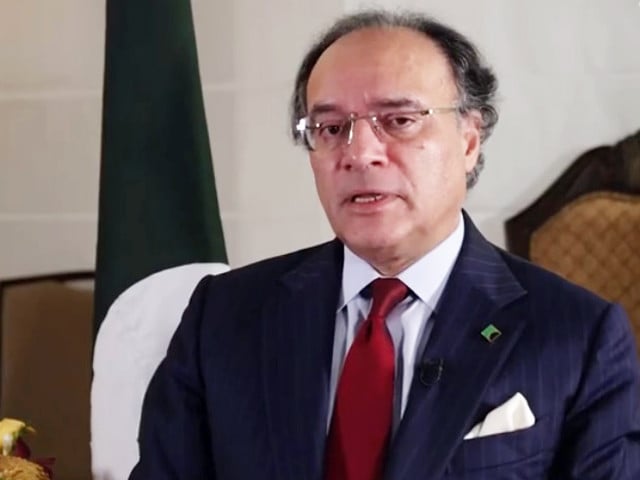
finance minister senator mohammad aurangzeb during an interview with voa screengrab


Finance Minister Senator Mohammad Aurangzeb during an interview with VOA. SCREENGRAB


Addressing the audience at a literature festival in Islamabad on Friday, Finance Minister Muhammad Aurangzeb clarified that there are no undisclosed conditions in the country's loan agreement with the International Monetary Fund (IMF).

He stated that while few nations are willing to extend deposits or roll over existing loans, key allies such as China and Saudi Arabia remain interested in investing within Pakistan.

He urged the business community to avoid "speed money" practices and stated that donations alone cannot sustain the country’s needs. Instead, he encouraged the private sector to take a more active role in driving economic progress, as few countries are currently willing to extend deposits or roll over loans.

Pakistan is particularly focusing on attracting investment from friendly countries, including China, Saudi Arabia, and the UAE, with Phase II of the China-Pakistan Economic Corridor (CPEC) now pivoting towards business-to-business (B2B) collaboration after completing initial infrastructure projects.

Aurangzeb noted that Pakistan’s currency has shown stability, and foreign exchange reserves are projected to cover three months' worth of imports by March to June. He stressed that while inflation has decreased, it is essential that this improvement benefits ordinary citizens.

Discussing tax and economic reforms, the finance minister pointed out that Pakistan's tax-to-GDP ratio of 9-10% is unsustainable, highlighting the need for structural reforms and an overhaul of the Federal Board of Revenue (FBR) to restore credibility and public trust.

Aurangzeb admitted that even salaried individuals find it challenging to file tax returns independently, suggesting further improvements in digitisation are necessary.

He underscored the government’s focus on end-to-end digitisation to reduce leakages, aiming to streamline the tax process and curb corruption and bribery within refund mechanisms.

PM Shehbaz, Aurangzeb further said, has a clear vision for encouraging foreign direct investment, with a shift toward B2B frameworks, as it is not the government’s role to directly engage in business.

Instead, the private sector should lead, with privatisation of state-owned enterprises (SOEs) a priority despite complexities—such as with Pakistan International Airlines (PIA)—that have hindered past efforts.

The finance minister discussed various methods for SOE privatisation, including outsourcing and public-private partnerships. He also revealed that Pakistan plans to issue Eurobonds next year and is in talks to issue Panda bonds.

However, he cautioned about the country’s rapidly growing population, which has surged to 240 million with an annual growth rate of 2.55%. Aurangzeb warned that if this rate continues, reaching 400-450 million could create severe challenges.

Further, he highlighted the importance of energy, tax, and institutional reforms as vital for sustainable growth. While energy costs have started to reach manageable levels, more structural reforms are needed.

Public sector institutions must undergo transformation, with the private sector stepping up to reduce reliance on the government and improve efficiency within the system.

Aurangzeb concluded that while welfare initiatives are valuable, taxes are indispensable for the country’s long-term growth and development. He reiterated that privatising SOEs and allowing the private sector to lead would relieve pressure on the government and foster a more efficient economy.
 

No gas for CPPs as per IMF terms: MoC moves PM for reversal of decision

Mushtaq Ghumman
November 8, 2024

672d4c80cf260.jpg


ISLAMABAD: The Commerce Ministry has approached the Prime Minister for reversal of federal government’s decision to disconnect gas to Captive Power Plants (CPPs) as per understanding with International Monetary Fund (IMF) as implementation on the plan to be effective from January 1, 2025 would have adverse implications for exporters and further lose confidence of global buyers due to highly uncertain situation in Pakistan, well-informed sources told Business Recorder.

According to background discussions, federal government had encouraged industries to install electricity production engines of naturalgas, furnace oil and diesel, to become internationally competitive.

Over the period of time, the sector gradually adapted to the shortfall of electricity in the country by installation of Captive Power Plants which helped to manage their energy demands quite effectively and also facilitated them to be competitive.
 

Pakistan seeks rescheduling of $3.4b China debt​

IMF team due in Islamabad on Monday

Shahbaz Rana
November 09, 2024

the report proposed holding the government accountable for violating the fiscal responsibility and debt limitation act and introducing legislation to prevent currency manipulation photo reuters


The report proposed holding the government accountable for violating the Fiscal Responsibility and Debt Limitation Act and introducing legislation to prevent currency manipulation. photo: REUTERS

ISLAMABAD: Pakistan has requested China to reschedule another $3.4 billion worth of official and guaranteed debt for two years, which is maturing during the International Monetary Fund programme period, in a move that highlights Islamabad's reliance on Beijing's largesse.

The government sources told The Express Tribune that the rescheduling of the $3.4 billion debt was very crucial for Pakistan to meet its $5 billion external financing gap that the IMF identified at the time of signing of the bailout package in September.

The sources said that Pakistan was seeking a two-year extension in repayment of the official and guaranteed debt obtained from Chinese Export-Import (Exim) Bank. The guaranteed debt is obtained by the State-Owned Enterprises, which is only one-third of the $3.4 billion repayments.

Finance Minister spokesman Qumar Abbasi did not respond to a question whether China has agreed to rollover the debt. But the Pakistani authorities remained hopeful for a helping Chinese hand, which often quietly helps Islamabad without any fanfare and publicity.

It is the second such request that Pakistan made to the Chinese Exim Bank in the past one and half years.
 
In July last year, the then finance minister and now Deputy Prime Minister Ishaq Dar had announced the $2.4 billion debt rescheduling by China. Dar had said that the Chinese EXIM Bank had rolled over for two years principal amounts of loans totaling $2.4 billion, which were due from July 2023 to June 2025. Pakistan was only making interest payments on the $2.4 billion rescheduled debt.

The sources said that Pakistan has formally requested the Exim Bank of China to reschedule the $3.4 billion debt that was maturing between October 2024 and September 2027.

The $750 million Exim bank debt is maturing within this fiscal year and its rescheduling is very important for Islamabad and the IMF to certify that the $7 billion programme is fully funded and Pakistan's debt is sustainable.

The Pakistani authorities were of the view that the Exim Bank's repayments had contributed to the external financing gap of $5 billion, which the IMF had identified at the time of signing the $7 billion Extended Fund Facility (EFF) in September.


Out of the $5 billion financing gap identified by the IMF, roughly $2.5 billion pertained to the current fiscal year. Although Islamabad has assured the IMF that it had made the requisite arrangements for the $2.5 billion financing requirements, a couple of promised borrowings are falling behind the schedule, said the sources.

The development comes amid the IMF's decision to send an unscheduled Mission to Pakistan after Islamabad did not meet some major conditions agreed for the July-September period of this fiscal year.

The IMF team is reaching Islamabad on Monday and will stay till next Friday to 'discuss recent developments and programme performance to date'.

According to the schedule approved by the IMF board at the time of approval of the $7 billion package, first programme review is scheduled for March 2025 and the pre-scheduled arrival of the Mission confirms apprehensions that the $7 billion deal was badly negotiated by both sides.

Despite the arrival of the unscheduled mission, the formal review for the approval and release of the next $1.1 billion tranche will 'be no earlier than the first quarter of 2025'.

Pakistan is heavily dependent on Beijing for remaining afloat the friendly nation that is constantly rolling over the $4 billion cash deposits, $6.5 billion worth commercial loans and $4.3 billion trade financing facility.

Beijing has recently expressed concerns over the security of its "citizens, projects and institutions" in Pakistan, demanding a safe working environment for further expanding the economic relations.

The $3.4 billion request is in addition to a $1.4 billion new loan that Finance Minister Muhammad Aurangzeb requested during his last month interaction with the Chinese vice Finance Minister in Washington.

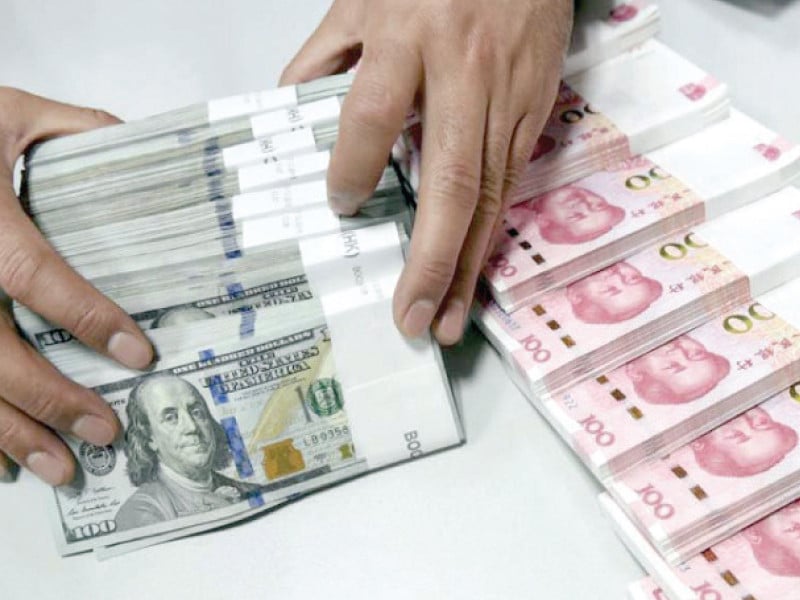
Aurangzeb "requested the Chinese side to raise the limits under the Currency Swap Agreement to CNY 40 billion," according to a statement from the Ministry of Finance last month. Pakistan has already used the existing CNY 30 billion ($4.3 billion) Chinese trade facility to repay its debts and now seeks to raise this limit by an additional CNY 10 billion, translating to $1.4 billion at the current exchange rate.

It is not clear whether China has entertained the $1.4 billion new request or not.

Pakistan had also requested for over $16 billion Chinese energy debt rescheduling but its wishes to secure at least a memorandum of understanding to express intentions by China for rescheduling remained unfulfilled last month.
 

IMF’s Pakistan mission chief meets finance minister Aurangzeb to discuss $7bn loan performance


Tahir Sherani | Reuters
November 12, 2024

The International Monetary Fund’s mission meets with Finance Minister Mohammad Aurangzeb on November 12. — via author


The International Monetary Fund’s mission meets with Finance Minister Mohammad Aurangzeb on November 12. — via author

The International Monetary Fund’s (IMF) Pakistan mission chief Nathan Porter met with Finance Minister Mohammad Aurangzeb in Islamabad on Tuesday to discuss the $7 billion loan performance, a statement from the Finance Ministry said.

The meeting comes a day after the opening of an unplanned official visit of the IMF to the country, led by Porter. The unscheduled visit of the IMF mission chief comes four months ahead of the first review under the new $7 billion Extended Fund Facility (EFF) granted to Pakistan by the global lender in September.

The visit is “unusual” and comes months ahead of the first EFF review which is due in the first quarter of 2025, according to Reuters.

The ministry and the IMF have not officially released details of the visit.

On Monday, Pakistan authorities stuck to budgeted revenue targets and promised to overcome first-quarter shortfalls through enforcement and administrative measures.

Informed sources told Dawn that the visiting fund staff initiated discussions on the revenue situation with the Pakistani team.

The mission will stay here until Nov 15 “to discuss recent developments and programme performance to date”, according to informed sources. “This mission is not part of the first review under the extended fund facility (EFF), which will be no earlier than the first quarter of 2025,” they said.

Under the programme modalities, the IMF and Pakistan authorities are required to hold biannual review meetings. As such, the first formal review has to take place on the basis of end-December 2024 performance for Pakistan to qualify for disbursement of a second instalment of over $1bn by March 15, 2025. The $7bn programme is divided into six biannual reviews for equal tranches of $1bn each.

The sources said the Pakistani side updated the visiting mission about Rs190bn revenue shortfall in the first four months, almost half of which accrued in October alone. This had raised alarms in the lenders’ quarters that revenue shortfall was gradually increasing with the declining rate of inflation.

An unplanned mission was thus rolled out to take stock of the situation, not only at the revenue front but also on the privatisation programme that met with a setback at the botched sale of Pakistan International Airlines, raising a question mark over the prequalification of bidders and privatisation strategy on a whole.

The sources said the FBR team assured the mission that its enforcement and administrative measures were just taking off and its efforts were gaining momentum to show initial results by the end of the current month and narrow down early revenue losses.

The shortfall, they added, was within the 1pc quarterly rolling target. They said the FBR may wish to plead a “downward revision in revenue target instead of a mini-budget” as the talks progress but had not even given a hint in the first round.

Over the coming days, the two sides will be deliberating on key programme benchmarks, particularly relating to federal revenues, SOEs, external financing gap and provincial fiscal direction and revenue measures, to ensure that any slippages on performance criteria are corrected ahead of scheduled biannual revenue.

This is for the fact that not only Pakistan’s past programme performances but IMF’s own credibility remains at stake.
 
Proper collection and transparency on Agricultural tax and real estate tax, can only save Pakistan, and the law must be amended so that the these taxes are taken control by the federation instead of the provinces, because the provinces don't have the proper mechanisms of collecting these taxes and even if they do, in some form or the other, they wont tax themselves because the majority of the lawmakers in the provincial assemblies [National assembly too] are themselves large land owners / feudal Lords / Agriculturalists and no one is strong enough to step on their land and verify the Agricultural produce and income. You will always hear a loss due to climate / weather changes, whereas on the other hand, the collection of cars or their house furniture is always worth millions of dollars.

Increasing exports takes time and few thousand exporters always cry out loud regarding the higher value of rupees attributed to lower exports. If you depreciate the value of PKR, you are causing loss and harm to 200 million + population, that is not involved with the export industry because our economy is import dependent. The salaried class is complete squeezed out and is barely surviving hand to mouth or even debt.

Then again, such corrupt law makers wouldn't have been elected / nominated in the first place if electronic voting machines were used and elections were held transparently and voices of the people / public heard.

When the rulers yearning for power, and ever more extensions given, breaking previous records, the results are not going to be good, no matter you spend day and night making up 200 + bogus cases
 

IMF expresses satisfaction with BISP's performance​

Briefing highlights progress including BISP's aid distribution to eligible beneficiaries and financial challenges

Express News
November 13, 2024

tribune


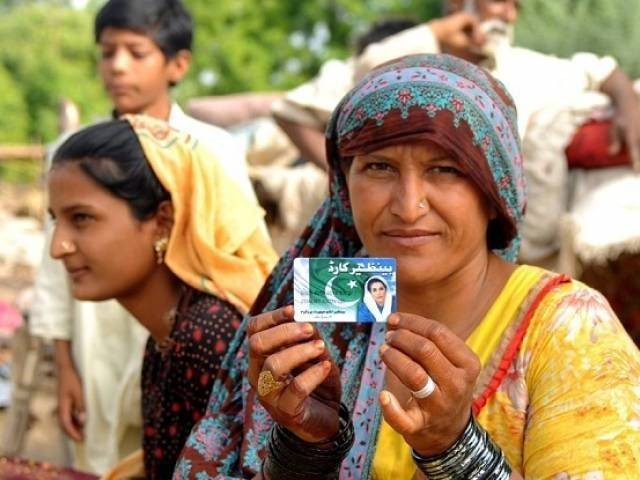
ISLAMABAD: The International Monetary Fund (IMF) has expressed satisfaction with the performance of Pakistan's Benazir Income Support Program (BISP), a cash transfer initiative aimed at aiding the country's poor and vulnerable citizens.

On the third day of ongoing discussions and meetings between the IMF review mission and Pakistani officials, the IMF delegation received a detailed briefing on BISP's operations.

The briefing highlighted the progress made during the first four months of the current fiscal year, including the distribution of aid to eligible beneficiaries and the financial challenges faced by the program.

According to sources, the IMF team was informed about the timely delivery of assistance to those in need, and the briefing covered the steps taken to address any ongoing financial difficulties related to the program.

IMF officials conveyed their satisfaction with the successful implementation of BISP and its contribution to providing crucial financial support to Pakistan's low-income population.

The IMF review mission, which has been in Pakistan to assess the country's economic performance under the ongoing program, has shown confidence in the positive outcomes of the cash transfer initiative.
 

IMF mission in town

EDITORIAL:
The schedule of reviews shared in the staff-level agreement report uploaded on the International Monetary Fund website last month noted 25 September as the approval date of the 37-month 7 billion dollar Extended Fund Facility (EFF) arrangement with disbursement of 760 million dollars and the first quarterly review was scheduled for 15 March 2025 which, if successful, would lead to the disbursement of another 760 million dollars.


It is therefore little wonder that there is intense speculation within the country as to which of the key agreed time-bound quantitative conditions/benchmarks were unmet compelling the advent of the IMF’s mission to Pakistan with the objective of either setting new time-bound conditions and/or implementation of agreed contingency measures.

An exclusive report in Business Recorder indicates that the mission has met with the Federal Board of Revenue (FBR) with a projected shortfall of 230 billion rupees by the end of December this year.

The Tajir Dost Scheme has certainly not yet been launched due to traders organised resistance (which should have been expected based on past precedence), with reports suggesting that talks have concluded successfully with FBR officials acquiescing to all the traders’ proposals; yet while some senior officials of the FBR now claim that the budgeted amount under this head was only 50 billion rupees yet at the launch of this programme in March 2024 — launched on the media amidst much fanfare, but never implemented — the projected revenue was around 400 to 500 billion rupees.

Therefore, while the exact revenue shortfall from the target from this scheme is not known due to widely disparate estimates between the first launch to today, yet the total revenue shortfall of 230 billion rupees is significant enough for the Mission’s arrival in Pakistan.

One obvious way out of this shortfall, which would be fair as well is for the government to defer the 20 to 25 percent budgeted pay rise for its employees who constitute 7 percent of the total labour force and whose salaries are paid for at the taxpayers’ expense while the remaining 93 percent of the country’s labour force is struggling not only with minimal if any wage increase for the past four to five years but also grappling with the massive rise in inflation during these years.

The government instead has, like its predecessors, unfortunately opted for cutting down on development outlay budgeted for the year, a prime mover of Gross Domestic Product (GDP) growth, given that private sector output remains dampened notwithstanding claims to the contrary by SBP surveys.

The budgeted 3.5 percent growth has already been downgraded to 3 percent by donor agencies and the Monetary Policy Committee (MPC) in its 4 November ruling downgraded it to between 2.5 to 3.5 percent with domestic economists pointing out that citing 3.5 percent as within achievable limits may be due to pressure, tacit or otherwise, as opposed to any deeply held perception that it will be attained.

Be that as it may, lower growth implies lower tax collections and in this context it is relevant to note that the discount rate remains much too high even at the recently reduced 15 percent for the private sector and, as succinctly stated in the IMF report, “the balance sheets of the three parties, the sovereign (government), commercial banks, and the central bank have become highly interconnected.

This complex tripartite relationship means that developments or actions in one domain (e.g., fiscal, monetary policy and the banking sector) can have wide-ranging effects across the economy.” In addition, ever-rising administered prices as per the Fund conditions, notably of electricity and petroleum products, are further raising input costs and acting as a deterrent to private sector output.

Business Recorder has been consistently maintaining that there is not only a need to be realistic in agreeing to tax targets with the Fund, a trend that accounts for the Fund now specifying contingency tax measures in the event of a failure to meet the agreed target, but also that any increase in the government’s leverage to phase out harsh politically challenging conditions (administered prices and the prevalence of indirect taxes whose incidence on the poor is greater than on the rich to name just two) require voluntary sacrifice by all the elite recipients of current expenditure at least in the current fiscal year.

Copyright Business Recorder, 2024
 

Mini-budget unlikely as IMF satisfied with tax steps

Khaleeq Kiani
November 14, 2024

• Hike in petroleum levy, imposition of GST on petroleum products not expected anytime soon
• Govt sees economic activity picking up next month due to stable rupee, lower policy rate
• Senate body points to issues in Islamic banking, fraudulent POS receipts, fake ATM notes
• 10pc levy on transport with Iran has left over 600 trucks stalled


ISLAMABAD: The International Monetary Fund (IMF) is reported to have expressed satisfaction over the increase in the tax-to-GDP ratio by nearly 1.5 percentage points, relieving the authorities from any push for additional tax measures through a mini-budget.

According to sources closely involved in ongoing discussions with the visiting IMF mission, the Federal Board of Revenue’s (FBR) revenue collection target for the current fiscal year will remain unchanged at Rs12.97 trillion. Authorities have ruled out the need for additional taxes or a mini-budget, citing the IMF’s positive response.

Officials said that economic activity is expected to pick up by December in view of a stable exchange rate and a reduction in the State Bank’s policy rate, likely offsetting a tax shortfall of around Rs190 billion recorded in the first four months (July to October) of the fiscal year.

There would neither be any increase in the petroleum levy nor would general sales tax (GST) be imposed on petroleum products, the sources said after a meeting of the Senate Standing Committee on Finance and Revenue presided over by PPP Senator Salim Mandviwalla.

They said the tax-to-GDP ratio had increased from 8.8pc to 10.3pc and the IMF was satisfied with this 1.5 percentage point improvement.

The sources reiterated the commitment given to the IMF that tax collection on agriculture income would start from the next fiscal year.
 
Pakistan has assured the International Monetary Fund that despite initial delays, it still remained hopeful of securing the Chinese debt rescheduling and will receive oil from Saudi Arabia on deferred payments as part of its efforts to fill the $5 billion external funding gap.

The hopes are rooted in the assurances that the executive directors of those countries gave to the IMF board at the time of approval of the $7 billion bailout package.

The government also requested the IMF visiting delegation to review its condition on drastically amending the Pakistan Sovereign Wealth Fund law by end of December. The IMF remained non-committal on Wednesday on the request.
 

IPPs talks and power sector: Minister to brief IMF team today


Ghumman
November 15, 2024


67368c1414dcc.jpg


ISLAMABAD: Power Division’s team led by Minister for Power, Sardar Awais Ahmad Khan Leghari is to give a detailed briefing on the country’s under-performing power sector, including update on revision on IPPs contracts and ongoing negotiations to the visiting team of International Monetary Fund (IMF) on Friday (Nov 15), well-informed sources told Business Recorder.

The Task Force on Energy, comprising Minister for Power, Special Assistant to the Prime Minister on Power, Muhammad Ali and Lt. General, Muhammad Zafar Iqbal, Chairman NEPRA, CEO CPPA-G and others, have succeeded in premature termination of contracts with five IPPs and signed revised arrangements with eight baggasse-fired IPPs including the Prime Minister’s son.

The government has projected saving of Rs 412 billion from remaining period of five IPPs, ie, HUBCO, Lalpir, Saba Power, Rousch Power, and Atlas Power, already approved by the federal cabinet whereas saving from revised arrangements with eight baggasse- based IPPs is projected to be Rs 80-100 billion which are yet to be cleared by the cabinet.

DFIs having interests in IPPs move Nepra

The Task Force is now after 18 IPPs set up under 1994 and 2002 policies, of which three IPPs i.e. Engro Powergen (Gas), Sapphire Power, (Gas) and Fauji Kabirwala have also partially initialed the revised pacts with the Task Force. However, some IPPs are still resisting and not ready to pay the extra profit of Rs 55 billion.

The earlier report on IPPs had detected overpayment of Rs 55 billion, the sources said, adding that those IPPs who made less extra profits are ready to return that amount but those that made huge profits are making hue and cry and are still resisting. Next week will be crucial in this regard, the sources continued. The next round will be with Government Power Plants (GPPs) and then wind and solar projects will be invited for revision.

The government has projected Rs 200-300 billion annual savings through negotiated deals. However, re-profiling of debts of Chinese IPPs for five to ten years could further reduce tariff by Rs 3.25 per unit, which implies total reduction in tariff is expected to be around Rs 6 per unit.

Pakistani authorities have already given commitment to the Fund that in FY25, they will settle up to Rs 263 billion earmarked for IPPs and GPPs with revised PPA terms using the established contract structure (10-year floating-rate PIBs and 5-year Sukuks in equal parts, or a more efficient financial instrument). We will also strive to reduce capacity payments as we pay arrears, either by renegotiating PPAs with a new strategy, including by lengthening the duration of bank loans, depending on adequate budget space and Circular Debt Management Plan (CDMP) implementation progress.

The sources said that Power Division has fulfilled all the commitments made with Fund including timely notification of rebasing, Fuel Charges Adjustments (FCAs) and Quarterly Tariff Adjustments (QTAs). Circular debt is not only within the limits agreed with the Fund but over achieved. Currently, circular debt stands at Rs 2.6 trillion and is expected to be reduced as Finance Division starts releasing the amount under TDS claims and subsidy.

According to sources losses are also within the limits, however, NEPRA is not satisfied with the performance of Discos and is initiating legal action against the DISCOs who contributed to the circular debt of Rs 276 billion in terms of increase in Transmission and Distribution (T&D) losses.

Power Division’s team will also brief the IMF team on the proposed privatisation plan of Discos which is under progress under the guidelines of World Bank.

The sources said, Power Division will share ongoing reforms in power sector, including bifurcation of National Transmission and Despatch Company (NTDC) into three entities, installation of AMI meters to reduce losses, new professional Boards in Discos and other entities.

Copyright Business Recorder, 2024
https://defencepk.com/forums/javascript:void(0)
 

IMF calls for reduced govt intervention, energy reforms in Pakistan’s economy


  • Washington-based lender's mission led by Nathan Porter states conclusion of a staff visit to Pakistan from November 12 to 15, 2024

BR Web Desk
November 16, 2024


The International Monetary Fund (IMF) has urged authorities in Islamabad to take steps “to decrease state intervention in the economy and enhance competition” while emphasising the importance of structural energy reforms terming it “critical to restore the sector’s viability”.

“We had constructive discussions with the authorities on their economic policy and reform efforts to reduce vulnerabilities and lay the basis for stronger and sustainable growth,” said Nathan Porter, IMF mission chief, in a statement released by the Washington-based lender on Friday.

“We agreed with the need to continue prudent fiscal and monetary policies, revenue mobilisation from untapped tax bases while transferring greater social and development responsibilities to provinces.

“In addition, structural energy reforms and constructive efforts are critical to restore the sector’s viability, and Pakistan should take steps to decrease state intervention in the economy and enhance competition, which will help foster the development of a dynamic private sector,” Porter was quoted as saying.

The remarks come after the IMF mission led by Nathan Porter concluded a staff visit to Pakistan from November 12 to 15, 2024.

The IMF delegation was in Pakistan to discuss recent developments and the Extended Fund Facility (EFF) programme performance to date.

During the visit, the IMF team met with senior officials from the federal and provincial governments, the State Bank of Pakistan (SBP), as well as representatives from the private sector.

The IMF mission chief noted that strong programme implementation can “create a more prosperous and more inclusive Pakistan, improving living standards for all Pakistanis”.

“We are encouraged by the authorities’ reaffirmed commitment to the economic reforms supported by the 2024 Extended Fund Facility (EFF),” he said, while informing that the next mission associated with the first EFF review is expected in the first quarter of 2025.

On Friday, the visiting IMF team held final meetings with federal and provincial governments’ representatives and asked for meeting the benchmarks and conditionalities for the EFF.

According to a Business Recorder report, Finance Minister Mohammad Aurangzeb also participated in the final round of talks.

The report, while citing its sources, said the IMF team stressed the need to implement tax targets and the National Fiscal Pact.

Sources revealed to Business Recorder that the lender stressed the importance of accelerating tax revenue collection to meet the tax target of Rs12,970 billion for the ongoing financial year. The IMF team also urged for the collection of taxes on agricultural income starting January 2025.

Moreover, the IMF has recommended Pakistan strengthen its capacity at the Finance Division to lead and coordinate macro-fiscal forecasts to support budget preparation, increasing forecast cycles and synchronising them with the budget.

The Fund has also asked Pakistan to initiate legal changes, required to limit the discretionary powers granted to the federal government over the use of supplementary grants, while maintaining some flexibility in budget execution.

Notably, IMF staff visits are standard practice for countries with semi-annual programme reviews and aim to engage with the authorities and other stakeholders on the country’s economic developments and policies and the status of planned reforms.
 

Users who are viewing this thread

Pakistan Defence Latest

Back
Top