India - US Tariff and Relations | News + Updates

1756581605742.jpeg
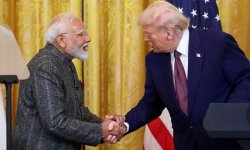
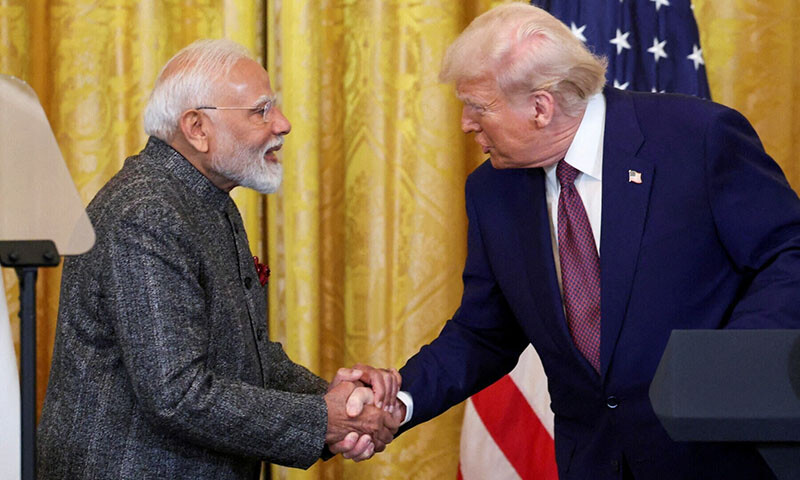
US President Donald Trump and Indian Prime Minister Narendra Modi shake hands as they attend a joint press conference at the White House in Washington, DC, US, February 13. — Reuters/File

United States President Donald Trump has scrapped plans to attend an upcoming summit of the ‘Quad’ grouping in India amid deteriorating ties between Washington and New Delhi, US newspaper The New York Times (NYT) reported on Saturday.

Relations between the two countries have plummeted, with 50 per cent levies on many Indian imports into the US taking effect this week as punishment for New Delhi’s massive purchases of Russian oil; a part of US efforts to pressure Moscow into ending its war in Ukraine.

As ties between both nations deteriorate, NYT reported on Saturday that the breakdown in relations was caused after a phone call on June 17.

“After telling [Indian Prime Minister Narendra] Modi that he would travel to India later this year for the Quad summit, Mr Trump no longer has plans to visit in the fall, according to people familiar with the president’s schedule,” the NYT reported, citing “interviews with more than a dozen people in Washington and New Delhi”.

The NYT mentioned how Trump’s repeated claims about having ended the recent brief conflict between India and Pakistan reportedly “infuriated” Modi. The paper added that the dispute “dates back more than 75 years and is far deeper and more complicated than Mr Trump was making it out to be”.

India blamed Pakistan for the April 22 Pahalgam attack without evidence, triggering a military escalation. On May 6–7, New Delhi launched air strikes that killed civilians, followed by a week-long missile exchange. A US-brokered ceasefire ended the war.

“During a phone call on June 17, Mr Trump brought it up again, saying how proud he was of ending the military escalation,” the NYT reported.

“He mentioned that Pakistan was going to nominate him for the Nobel Peace Prize, an honour for which he had been openly campaigning. The not-so-subtle implication, according to people familiar with the call, was that Mr Modi should do the same.”

It added that the “bristled” Indian premier told Trump that American involvement had nothing to do with the ceasefire and the conflict had been settled directly between India and Pakistan.

“Mr Trump largely brushed off Mr Modi’s comments, but the disagreement — and Mr Modi’s refusal to engage on the Nobel — has played an outsize role in the souring relationship between the two leaders, whose once-close ties go back to Mr Trump’s first term,” the report reads, adding that the two leaders have not spoken since the June 17 phone conversation and Trump has only doubled down on taking credit for the ceasefire.

Amid this dispute, India has grown closer to Beijing and Moscow. Modi is currently in Tianjin, China, for the Shanghai Cooperation Organisation’s Council of Heads of State summit, where he is expected to meet with Chinese President Xi Jinping and Russian President Vladimir Putin.

“At its core, the story of Mr Trump and Mr Modi is about two brash, populist leaders with big egos and authoritarian tendencies, and the web of loyalties that help keep both men in power,” the NYT reported.

“But it is also the tale of an American president with his eye on a Nobel Prize, running smack into the immovable third rail of Indian politics: the conflict with Pakistan.”

Bloomberg reported earlier this month that Modi turned down an invitation from Trump to visit the White House after a G7 meeting in Canada, over concerns that he would set up a meeting with Chief of Army Staff (COAS) Field Marshal Asim Munir, who was visiting the US at the time.

Reporting the same, NYT said: “Modi declined an invitation from Mr Trump to stop by Washington before he flew home. His officials were scandalised that Mr Trump might try to force their leader into a handshake with Pakistan’s army chief, who had also been invited to the White House for lunch around the same time. It was another clear sign, a senior Indian official said, that Mr Trump cared little for the complexity of their issue or the sensitivities and history around it.”

The COAS carried out two visits to the US. The first, in June, saw him meet Trump at the White House for luncheon, making him the first sitting army chief to do so.

The field marshal termed his second visit to the US in just one-and-a-half months a “new dimension” in ties between Washington and Islamabad. During this trip, the COAS engaged in high-level interactions with senior political and military leadership, as well as members of the Pakistani diaspora.

Pakistan and the US also finalised a trade deal at the start of August, lowering tariffs to 19pc from the previously announced 29pc and helping develop Pakistan’s oil reserves while trade talks between the US and India have stalled.
 
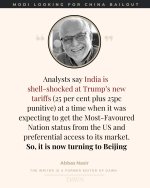
View attachment 143787

India changing camp overnight


They need to. Operation sindoor has shown that without foreign help and assistance, india is on the same level as the Congo, afghanistan and Somalia. I wouldn't be surprised if the citizens in those countries have a better life and health than the average indian.
 
Question: Why do Indians always jump at some post randomly to say "Jai Hind" or to inform everyone else,no matter what the topic is,that they are Indian?
 
Question: Why do Indians always jump at some post randomly to say "Jai Hind" or to inform everyone else,no matter what the topic is,that they are Indian?
main character syndrome. you understand once you watch even just one of their movies
 

The Nobel Prize and a Testy Phone Call: How the Trump-Modi Relationship Unraveled​

President Trump’s repeated claims about having “solved” the India-Pakistan war infuriated Prime Minister Narendra Modi of India. And that was only the beginning.

Mujib Mashal and Anupreeta Das reported from New Delhi, and Tyler Pager from Washington.
  • Aug. 30, 2025
Prime Minister Narendra Modi of India was losing patience with President Trump.

Mr. Trump had been saying — repeatedly, publicly, exuberantly — that he had “solved” the military conflict between India and Pakistan, a dispute that dates back more than 75 years and is far deeper and more complicated than Mr. Trump was making it out to be.

During a phone call on June 17, Mr. Trump brought it up again, saying how proud he was of ending the military escalation. He mentioned that Pakistan was going to nominate him for the Nobel Peace Prize, an honor for which he had been openly campaigning. The not-so-subtle implication, according to people familiar with the call, was that Mr. Modi should do the same.

The Indian leader bristled. He told Mr. Trump that U.S. involvement had nothing to do with the recent cease-fire. It had been settled directly between India and Pakistan.

Mr. Trump largely brushed off Mr. Modi’s comments, but the disagreement — and Mr. Modi’s refusal to engage on the Nobel — has played an outsize role in the souring relationship between the two leaders, whose once-close ties go back to Mr. Trump’s first term.

The dispute has played out against the backdrop of trade talks of immense importance to India and the United States, and the fallout risks pushing India closer to American adversaries in Beijing and Moscow. Mr. Modi is expected to travel to China this weekend, where he will meet with President Xi Jinping and President Vladimir V. Putin of Russia.

This article is based on interviews with more than a dozen people in Washington and New Delhi, most of whom spoke on condition of anonymity to discuss a relationship that has far-reaching implications for both sides, with Mr. Trump eroding a strategic relationship and India alienating its biggest trading partner as it tries to keep its economy afloat.

Just weeks after the June phone call, and with trade talks dragging on, Mr. Trump startled India by announcing that imports from the country would be subjected to a tariff of 25 percent. And on Wednesday, he slapped India with an additional 25 percent tariff for buying Russian oil, adding up to a crushing 50 percent.

Mr. Modi, who once called Mr. Trump “a true friend,” was officially on the outs. After telling Mr. Modi that he would travel to India later this year for the Quad summit, Mr. Trump no longer has plans to visit in the fall, according to people familiar with the president’s schedule.

In India, Mr. Trump is now seen in some quarters as a source of national humiliation. Last week, a giant Trump effigy was paraded around a festival in the state of Maharashtra, with signs declaring him a backstabber. The blows from the United States have been so intense that one Indian official described them as “gundagardi”: straight-up bullying, or thuggery.

The two men have not spoken since the June 17 phone call.

At its core, the story of Mr. Trump and Mr. Modi is about two brash, populist leaders with big egos and authoritarian tendencies, and the web of loyalties that help keep both men in power. But it is also the tale of an American president with his eye on a Nobel Prize, running smack into the immovable third rail of Indian politics: the conflict with Pakistan.

A Political Nonstarter​

Few in India expected Mr. Modi to end up in this situation.

He won his third term in office on the promise of transforming himself and his country into global players. And even if Mr. Trump was known to focus more on personal relationships and less on geopolitical strategy, the Indians thought that dynamic would work in their favor.

During Mr. Trump’s first term, he attended the large “Howdy Modi!” rally of the Indian diaspora in Texas. Months later, the American president visited Mr. Modi’s home state of Gujarat for an event branded “Namaste Trump!”

In Mr. Trump’s second term, foreign leaders have found success by tending to his ego with compliments and gifts. The British prime minister arrived at the White House with a letter from King Charles. The Finnish president bonded with Mr. Trump on the golf course. Even President Volodymyr Zelensky of Ukraine, whom Mr. Trump once berated in public, showed up at the White House and thanked him in front of the cameras.

But what Mr. Trump wants most from Mr. Modi is a political nonstarter.

If Mr. Modi were to be perceived as having caved to American pressure for a cease-fire with a weaker nation, the costs at home would be enormous. Mr. Modi’s strongman identity depends, in large part, on how tough he is on Pakistan. Acknowledging that Mr. Trump had a role, let alone nominating him for a Nobel for it, would be seen as surrender. For Pakistan, which has found itself in Mr. Trump’s good graces recently, the decision to nominate him for the prize came quickly.


It is difficult to quantify exactly how much influence the United States had in resolving the latest outbreak of violence between India and Pakistan. Mr. Trump contends that he used trade as leverage to get the two sides to stop fighting. After these enticements and warnings, he said, “all of a sudden they said, ‘I think we will stop’” the fighting.

India denies that.

Washington does carry a lot of sway on both sides, and historically, messages from American leaders have helped quell tensions. But the fact that Mr. Modi could not find a way to even subtly acknowledge some Trump role, given the stakes, shows how explosive the issue is for him. Analysts say the extreme rigidity of the Indian response also speaks to how power over the past decade has been increasingly centralized at the service of protecting Mr. Modi’s strongman image at all costs.

“The idea that Modi would accept a cease-fire under U.S. pressure or that he needed or sought mediation — it doesn’t just go against his personality,” said Tanvi Madan, a senior fellow at the Brookings Institution. “It goes against Indian diplomatic practice. Modi sold his relationships with U.S. presidents as an asset — strategically and politically — and now the opposition is portraying his friendship with Trump as a liability.”
Image

After the June call with Mr. Trump, Indian officials put out a statement saying Mr. Modi had “firmly stated that India does not and will never accept mediation” and that “President Trump listened carefully” and “expressed his support toward India’s fight against terrorism.”

The White House did not acknowledge the call, nor did Mr. Trump post about it on his social media accounts. And yet, four days after he spoke with Mr. Modi, Mr. Trump mentioned the issue again when he announced a peace deal between Congo and Rwanda.

“I won’t get a Nobel Peace Prize for this, I won’t get a Nobel Peace Prize for stopping the War between India and Pakistan,” Mr. Trump posted. “No, I won’t get a Nobel Peace Prize no matter what I do.”

Our economics reporters — based in New York, London, Brussels, Berlin, Hong Kong and Seoul — are digging into every aspect of the tariffs causing global turmoil. They are joined by dozens of reporters writing about the effects on everyday people.

‘This Is About More Than Just Russia’​

Mr. Trump says the tariffs on India are punishment for buying Russian oil and for the protectionist nature of the Indian market, a longstanding complaint for Mr. Trump and other American presidents.

The White House insists that the two men have “a respectful relationship” and “remain in close communication,” Anna Kelly, a White House spokeswoman, said in a statement.

“President Trump was able to successfully bring peace to the conflict between India and Pakistan,” she said, repeating the assertion that India had flatly denied.

But to many officials and observers, the colossal penalties on India in particular appear to be punishment for not falling in line rather than any kind of cohesive effort to reduce the trade deficit or cut off funding for Mr. Putin’s war. They point out that China, the biggest importer of Russian crude, has been spared.

Image


India is now alone with Brazil, led by a president who has antagonized Mr. Trump directly, in being subject to 50 percent tariffs, higher than any other country. (Pakistan came away with 19 percent.)

Another point of tension has been the power of the anti-immigrant sentiments within Mr. Trump’s base. Indian officials believed early on that they could find common ground with the American right-wing movement but they were caught off guard by the rift among Mr. Trump’s supporters over H-1B visas, with much of the attention directed at Indians, who make up the largest holders of such visas.

Indian students also make up one out of every four foreign students in the United States, so Mr. Trump’s crackdown on student visas took the country by surprise.

Stephen Miller, a top adviser to Mr. Trump, has repeatedly complained to the president about the high numbers of undocumented immigrants from India, who are among those who have been rounded up and deported as part of Mr. Trump’s crackdown on illegal immigration. The method and timing of some of those deportations caused headaches for Mr. Modi and made clear Mr. Trump would not be sensitive to the political realities the Indian leader was facing.
Image


But at a friendly news conference during the visit that month, there were signs that the two sides could still find a way forward, with India buying billions of dollars more of American oil and gas, to assuage Mr. Trump’s grievance over the balance sheet.

“We can make up the difference very easily with the deficit,” Mr. Trump said, with Mr. Modi standing next to him.

‘Do You Believe Me or Trump?’​

Then, in May, some of the worst fighting in decades erupted between India and Pakistan.

The conflict began after 26 people were killed in a terrorist attack on the Indian side of Kashmir, a contested region between the two nations, while Vice President JD Vance and his family were on a visit in India. Mr. Trump dialed up Mr. Modi to express his sympathies.

As the fighting raged, with both sides firing drones and missiles over four days, the Trump administration stepped in to lend its weight for a diplomatic solution, with the vice president and the secretary of state making calls to both sides.

Early in the evening on the fourth day of fighting, reporters were called for a news conference in New Delhi with rumors that a conditional cease-fire had been agreed to by the two sides. But just before India’s foreign secretary, Vikram Misri, stepped up to the podium to make the announcement, Mr. Trump upstaged him by flashing an announcement of “FULL AND IMMEDIATE CEASEFIRE” on Truth Social.

Minutes later, Marco Rubio, the secretary of state, announced that India and Pakistan had agreed “to start talks on a broad set of issues at a neutral site.”

That statement in particular was galling to the Indians because it has been India’s policy for decades that the issue of Pakistan — especially in relation to Kashmir — is one for the two countries to handle alone, without third-party mediation.


A Declined Invitation to Washington​

By the time Mr. Trump and Mr. Modi got on the phone in June, there might have been an opportunity to mend ties and refocus on the ongoing trade negotiations.

But that did not happen.

The call, which lasted 35 minutes, took place as Mr. Trump flew back to Washington on Air Force One after he left early from the Group of 7 industrialized countries meeting in Canada, which Mr. Modi also attended.

Mr. Modi declined an invitation from Mr. Trump to stop by Washington before he flew home. His officials were scandalized that Mr. Trump might try to force their leader into a handshake with Pakistan’s army chief, who had also been invited to the White House for lunch around the same time. It was another clear sign, a senior Indian official said, that Mr. Trump cared little for the complexity of their issue or the sensitivities and history around it.

Later on, there was talk of trying to set up another call to finalize a partial trade deal. But with the trust between the two leaders eroding, the Indians were wary of putting Mr. Modi on the phone with Mr. Trump. Indian officials were nervous that Mr. Trump would post whatever he wanted on Truth Social, regardless of what agreements were made on the call, a senior Indian official said.

Mr. Trump, frustrated by the tariff negotiations, reached out to Mr. Modi several times, according to two people briefed on the discussions who spoke on condition of anonymity because they were not authorized to discuss them publicly.

Mr. Modi did not respond to those requests, they said.

Ms. Kelly, the White House spokeswoman, denied that Mr. Trump had reached out.

In the final stretch before the additional 25 percent tariff kicked in on Wednesday, Mr. Trump announced he was nominating Sergio Gor, a close adviser, to serve as ambassador to India, with the additional charge of special envoy for the region. (Indian officials were torn over how to read the nomination — Mr. Gor was close to Mr. Trump, yes, but they were offended that the “regional” envoy designation lumped India in with Pakistan.)

In the hours before the deadline, officials from the United States and India held a virtual meeting, discussing a range of issues from trade to defense cooperation.

But not only have the additional tariffs gone into effect as announced, Mr. Trump’s advisers have continued railing against India. One called India’s approach to trade negotiations “arrogant” and another went as far as calling the conflict in Ukraine “Modi’s war.”

Now, Mr. Modi, in public at least, appears to be moving on from talk of trade negotiations. Instead, he is talking about “self-reliance” and reviving his decade-old “Make in India” campaign as he continues to play to his home base.

And during this weekend’s trip to China — Mr. Modi’s first in seven years — he is expected to have a receptive audience for stronger and expanded ties with Beijing and Moscow.
 
1. India is a very insular economy in which the contribution of exports to GDP is low. Economists estimate between a 0.3% - 0.6% hit to the GDP which, whole not nothing , is not substantial relative to the 7.8% GDP growth in the most recent quarter. A large number of jobs would be affected, but they are mostly in low value addition sectors.
2. Celebrations about a permanent collapse in India-US relations may be premature. Donald Trump is capable of more U-turns.
3. The sector most affected by the tariffs would be textiles , where China itself has spare capacity and is hardly in a position to provide a "bailout". It may buys some more gems and jewellery and shrimps from India, though.

The detente was initiated by China and is in the mutual interest of both countries. Trump's tariffs will definitely accelerate the pace, but it had its own ( slower) momentum even without them.
 

The Nobel Prize and a Testy Phone Call: How the Trump-Modi Relationship Unraveled​

President Trump’s repeated claims about having “solved” the India-Pakistan war infuriated Prime Minister Narendra Modi of India. And that was only the beginning.

Mujib Mashal and Anupreeta Das reported from New Delhi, and Tyler Pager from Washington.
  • Aug. 30, 2025
Prime Minister Narendra Modi of India was losing patience with President Trump.

Mr. Trump had been saying — repeatedly, publicly, exuberantly — that he had “solved” the military conflict between India and Pakistan, a dispute that dates back more than 75 years and is far deeper and more complicated than Mr. Trump was making it out to be.

During a phone call on June 17, Mr. Trump brought it up again, saying how proud he was of ending the military escalation. He mentioned that Pakistan was going to nominate him for the Nobel Peace Prize, an honor for which he had been openly campaigning. The not-so-subtle implication, according to people familiar with the call, was that Mr. Modi should do the same.

The Indian leader bristled. He told Mr. Trump that U.S. involvement had nothing to do with the recent cease-fire. It had been settled directly between India and Pakistan.

Mr. Trump largely brushed off Mr. Modi’s comments, but the disagreement — and Mr. Modi’s refusal to engage on the Nobel — has played an outsize role in the souring relationship between the two leaders, whose once-close ties go back to Mr. Trump’s first term.

The dispute has played out against the backdrop of trade talks of immense importance to India and the United States, and the fallout risks pushing India closer to American adversaries in Beijing and Moscow. Mr. Modi is expected to travel to China this weekend, where he will meet with President Xi Jinping and President Vladimir V. Putin of Russia.

This article is based on interviews with more than a dozen people in Washington and New Delhi, most of whom spoke on condition of anonymity to discuss a relationship that has far-reaching implications for both sides, with Mr. Trump eroding a strategic relationship and India alienating its biggest trading partner as it tries to keep its economy afloat.

Just weeks after the June phone call, and with trade talks dragging on, Mr. Trump startled India by announcing that imports from the country would be subjected to a tariff of 25 percent. And on Wednesday, he slapped India with an additional 25 percent tariff for buying Russian oil, adding up to a crushing 50 percent.

Mr. Modi, who once called Mr. Trump “a true friend,” was officially on the outs. After telling Mr. Modi that he would travel to India later this year for the Quad summit, Mr. Trump no longer has plans to visit in the fall, according to people familiar with the president’s schedule.

In India, Mr. Trump is now seen in some quarters as a source of national humiliation. Last week, a giant Trump effigy was paraded around a festival in the state of Maharashtra, with signs declaring him a backstabber. The blows from the United States have been so intense that one Indian official described them as “gundagardi”: straight-up bullying, or thuggery.

The two men have not spoken since the June 17 phone call.

At its core, the story of Mr. Trump and Mr. Modi is about two brash, populist leaders with big egos and authoritarian tendencies, and the web of loyalties that help keep both men in power. But it is also the tale of an American president with his eye on a Nobel Prize, running smack into the immovable third rail of Indian politics: the conflict with Pakistan.

A Political Nonstarter​

Few in India expected Mr. Modi to end up in this situation.

He won his third term in office on the promise of transforming himself and his country into global players. And even if Mr. Trump was known to focus more on personal relationships and less on geopolitical strategy, the Indians thought that dynamic would work in their favor.

During Mr. Trump’s first term, he attended the large “Howdy Modi!” rally of the Indian diaspora in Texas. Months later, the American president visited Mr. Modi’s home state of Gujarat for an event branded “Namaste Trump!”

In Mr. Trump’s second term, foreign leaders have found success by tending to his ego with compliments and gifts. The British prime minister arrived at the White House with a letter from King Charles. The Finnish president bonded with Mr. Trump on the golf course. Even President Volodymyr Zelensky of Ukraine, whom Mr. Trump once berated in public, showed up at the White House and thanked him in front of the cameras.

But what Mr. Trump wants most from Mr. Modi is a political nonstarter.

If Mr. Modi were to be perceived as having caved to American pressure for a cease-fire with a weaker nation, the costs at home would be enormous. Mr. Modi’s strongman identity depends, in large part, on how tough he is on Pakistan. Acknowledging that Mr. Trump had a role, let alone nominating him for a Nobel for it, would be seen as surrender. For Pakistan, which has found itself in Mr. Trump’s good graces recently, the decision to nominate him for the prize came quickly.


It is difficult to quantify exactly how much influence the United States had in resolving the latest outbreak of violence between India and Pakistan. Mr. Trump contends that he used trade as leverage to get the two sides to stop fighting. After these enticements and warnings, he said, “all of a sudden they said, ‘I think we will stop’” the fighting.

India denies that.

Washington does carry a lot of sway on both sides, and historically, messages from American leaders have helped quell tensions. But the fact that Mr. Modi could not find a way to even subtly acknowledge some Trump role, given the stakes, shows how explosive the issue is for him. Analysts say the extreme rigidity of the Indian response also speaks to how power over the past decade has been increasingly centralized at the service of protecting Mr. Modi’s strongman image at all costs.

“The idea that Modi would accept a cease-fire under U.S. pressure or that he needed or sought mediation — it doesn’t just go against his personality,” said Tanvi Madan, a senior fellow at the Brookings Institution. “It goes against Indian diplomatic practice. Modi sold his relationships with U.S. presidents as an asset — strategically and politically — and now the opposition is portraying his friendship with Trump as a liability.”
Image

After the June call with Mr. Trump, Indian officials put out a statement saying Mr. Modi had “firmly stated that India does not and will never accept mediation” and that “President Trump listened carefully” and “expressed his support toward India’s fight against terrorism.”

The White House did not acknowledge the call, nor did Mr. Trump post about it on his social media accounts. And yet, four days after he spoke with Mr. Modi, Mr. Trump mentioned the issue again when he announced a peace deal between Congo and Rwanda.

“I won’t get a Nobel Peace Prize for this, I won’t get a Nobel Peace Prize for stopping the War between India and Pakistan,” Mr. Trump posted. “No, I won’t get a Nobel Peace Prize no matter what I do.”

Our economics reporters — based in New York, London, Brussels, Berlin, Hong Kong and Seoul — are digging into every aspect of the tariffs causing global turmoil. They are joined by dozens of reporters writing about the effects on everyday people.

‘This Is About More Than Just Russia’​

Mr. Trump says the tariffs on India are punishment for buying Russian oil and for the protectionist nature of the Indian market, a longstanding complaint for Mr. Trump and other American presidents.

The White House insists that the two men have “a respectful relationship” and “remain in close communication,” Anna Kelly, a White House spokeswoman, said in a statement.

“President Trump was able to successfully bring peace to the conflict between India and Pakistan,” she said, repeating the assertion that India had flatly denied.

But to many officials and observers, the colossal penalties on India in particular appear to be punishment for not falling in line rather than any kind of cohesive effort to reduce the trade deficit or cut off funding for Mr. Putin’s war. They point out that China, the biggest importer of Russian crude, has been spared.

Image


India is now alone with Brazil, led by a president who has antagonized Mr. Trump directly, in being subject to 50 percent tariffs, higher than any other country. (Pakistan came away with 19 percent.)

Another point of tension has been the power of the anti-immigrant sentiments within Mr. Trump’s base. Indian officials believed early on that they could find common ground with the American right-wing movement but they were caught off guard by the rift among Mr. Trump’s supporters over H-1B visas, with much of the attention directed at Indians, who make up the largest holders of such visas.

Indian students also make up one out of every four foreign students in the United States, so Mr. Trump’s crackdown on student visas took the country by surprise.

Stephen Miller, a top adviser to Mr. Trump, has repeatedly complained to the president about the high numbers of undocumented immigrants from India, who are among those who have been rounded up and deported as part of Mr. Trump’s crackdown on illegal immigration. The method and timing of some of those deportations caused headaches for Mr. Modi and made clear Mr. Trump would not be sensitive to the political realities the Indian leader was facing.
Image


But at a friendly news conference during the visit that month, there were signs that the two sides could still find a way forward, with India buying billions of dollars more of American oil and gas, to assuage Mr. Trump’s grievance over the balance sheet.

“We can make up the difference very easily with the deficit,” Mr. Trump said, with Mr. Modi standing next to him.

‘Do You Believe Me or Trump?’​

Then, in May, some of the worst fighting in decades erupted between India and Pakistan.

The conflict began after 26 people were killed in a terrorist attack on the Indian side of Kashmir, a contested region between the two nations, while Vice President JD Vance and his family were on a visit in India. Mr. Trump dialed up Mr. Modi to express his sympathies.

As the fighting raged, with both sides firing drones and missiles over four days, the Trump administration stepped in to lend its weight for a diplomatic solution, with the vice president and the secretary of state making calls to both sides.

Early in the evening on the fourth day of fighting, reporters were called for a news conference in New Delhi with rumors that a conditional cease-fire had been agreed to by the two sides. But just before India’s foreign secretary, Vikram Misri, stepped up to the podium to make the announcement, Mr. Trump upstaged him by flashing an announcement of “FULL AND IMMEDIATE CEASEFIRE” on Truth Social.

Minutes later, Marco Rubio, the secretary of state, announced that India and Pakistan had agreed “to start talks on a broad set of issues at a neutral site.”

That statement in particular was galling to the Indians because it has been India’s policy for decades that the issue of Pakistan — especially in relation to Kashmir — is one for the two countries to handle alone, without third-party mediation.


A Declined Invitation to Washington​

By the time Mr. Trump and Mr. Modi got on the phone in June, there might have been an opportunity to mend ties and refocus on the ongoing trade negotiations.

But that did not happen.

The call, which lasted 35 minutes, took place as Mr. Trump flew back to Washington on Air Force One after he left early from the Group of 7 industrialized countries meeting in Canada, which Mr. Modi also attended.

Mr. Modi declined an invitation from Mr. Trump to stop by Washington before he flew home. His officials were scandalized that Mr. Trump might try to force their leader into a handshake with Pakistan’s army chief, who had also been invited to the White House for lunch around the same time. It was another clear sign, a senior Indian official said, that Mr. Trump cared little for the complexity of their issue or the sensitivities and history around it.

Later on, there was talk of trying to set up another call to finalize a partial trade deal. But with the trust between the two leaders eroding, the Indians were wary of putting Mr. Modi on the phone with Mr. Trump. Indian officials were nervous that Mr. Trump would post whatever he wanted on Truth Social, regardless of what agreements were made on the call, a senior Indian official said.

Mr. Trump, frustrated by the tariff negotiations, reached out to Mr. Modi several times, according to two people briefed on the discussions who spoke on condition of anonymity because they were not authorized to discuss them publicly.

Mr. Modi did not respond to those requests, they said.

Ms. Kelly, the White House spokeswoman, denied that Mr. Trump had reached out.

In the final stretch before the additional 25 percent tariff kicked in on Wednesday, Mr. Trump announced he was nominating Sergio Gor, a close adviser, to serve as ambassador to India, with the additional charge of special envoy for the region. (Indian officials were torn over how to read the nomination — Mr. Gor was close to Mr. Trump, yes, but they were offended that the “regional” envoy designation lumped India in with Pakistan.)

In the hours before the deadline, officials from the United States and India held a virtual meeting, discussing a range of issues from trade to defense cooperation.

But not only have the additional tariffs gone into effect as announced, Mr. Trump’s advisers have continued railing against India. One called India’s approach to trade negotiations “arrogant” and another went as far as calling the conflict in Ukraine “Modi’s war.”

Now, Mr. Modi, in public at least, appears to be moving on from talk of trade negotiations. Instead, he is talking about “self-reliance” and reviving his decade-old “Make in India” campaign as he continues to play to his home base.

And during this weekend’s trip to China — Mr. Modi’s first in seven years — he is expected to have a receptive audience for stronger and expanded ties with Beijing and Moscow.
Honestly, I don't think even the Nobel prize nomination would have been the end of it. As the Chinese Ambassador to India said, and the Mexican President is finding out, " give the bully an inch and he will take a mile". The options before India were either to surrender to all demands like many other countries have done or to politely tell Trump to f off. The leadership evaluated the risk - reward profile and chose the latter course of action.
 
1. India is a very insular economy in which the contribution of exports to GDP is low. Economists estimate between a 0.3% - 0.6% hit to the GDP which, whole not nothing , is not substantial relative to the 7.8% GDP growth in the most recent quarter. A large number of jobs would be affected, but they are mostly in low value addition sectors.
2. Celebrations about a permanent collapse in India-US relations may be premature. Donald Trump is capable of more U-turns.
3. The sector most affected by the tariffs would be textiles , where China itself has spare capacity and is hardly in a position to provide a "bailout". It may buys some more gems and jewellery and shrimps from India, though.

The detente was initiated by China and is in the mutual interest of both countries. Trump's tariffs will definitely accelerate the pace, but it had its own ( slower) momentum even without them.
That is the optimistic view. Any downside.
 
That is the optimistic view. Any downside.
I think the numbers ( 0.3% -0.6% hit) are balanced and they assume the tariffs will last for the full year. Pharma and electronics exports are exempt , so around $60 bn of exports are impacted. Some of them, like diamonds for wedding rings are price inelastic in the short term because those are not things you pinch pennies on and almost 100% of diamond polishing is done in India, so the skills for the labour intensive process does not exist anywhere else . Some of that production can be absorbed locally as the nation rallies around the flag and imported goods are avoided. Some can be diverted to other export markets, perhaps at lower margins. A significant part of the production will move to countries in Africa and Central America , which have 10% tariffs and where Indian companies are already active , but some part of the supply chain may still stay in India, depending on how the transhipment rules are interpreted and enforced. My guess is that it will be difficult to police because of the limited bureaucracy the US has, which will be more focussed on obvious transhipment countries like Vietnam and BD, rather than Ethiopia or Barbados.

The worst case scenarios like pharma and electronics getting tariffed or taxing service exports will involve a lot of pain for American consumers and companies and invite India retaliation on digital and other services since the US has a surplus in the services trade with India. Another scenarios is getting the EU to join US sanctions , but that is unlikely because 1) they themselves are importing more Russian energy than India and even buying refined product from India and 2) they themselves are pissed off at home Trump screwed them over and are now looking to diversify exposure away from the US, aside from the ongoing de-risking from China . India is the largest economy that is available for them to diversify.

In my opinion, Trump was looking to kill three birds with one stone 1) pressurise India into signing a deal on his terms 2) cut off Russia from its second largest customer and pressure him to end the Ukraine war 3) after getting India on board, isolate and threaten China with Russian oil tariffs as a pressure tactic and get them to make concessions on trade. His advisors probably told him he would look like a genius, but since Trump has fired most of the career officials with expertise on India , China and Russia and he only has yesmen around him, no one warned him that he could drive India closer to , and not away from , China and Russia. Peter Navarro was probably one of them and is now looking like an idiot in front of Trump , which is probably why he is ranting against India and Modi.
 
US issues fresh warning to Indian students amid Trump's immigration crackdown; 'Your visa may be revoked if...'

To view this content we will need your consent to set third party cookies.
For more detailed information, see our cookies page.


Users who are viewing this thread

Back
Top