ejaz007
Registered Member

Defence minister warns if Pakistanis attacked, Indian citizens won’t remain safe either: Pakistan hits back at India as war clouds loom over subcontinent
Decisions were taken in meeting of National Security Committee (NSC) chaired by Prime Minister Shehbaz
By Ag App & Muhammad Anis & News Desk & Shekeel Anjum
April 25, 2025
ISLAMABAD: Pakistan on Thursday announced to suspend trade cooperation with India, close Wagah Border crossing, downgrade diplomatic ties and warned of holding all bilateral accords in abeyance, calling any attempt to usurp its water rights as an “act of war”.
The decisions were taken in the meeting of the National Security Committee (NSC) chaired by Prime Minister Shehbaz Sharif.
The meeting discussed the national security environment and the regional situation, particularly in the wake of Pahalgam attack in the Anantnag District of Indian Illegally Occupied Jammu and Kashmir (IIOJK) on April 22.
The committee expressed concern over the loss of tourists’ lives, reviewed the Indian measures announced on April 23, and termed them “unilateral, unjust, politically motivated, extremely irresponsible and devoid of legal merit.”
Rejecting the Indian announcement to hold the binding Indus Waters Treaty in abeyance, the top security body observed that water was a “vital national interest” of Pakistan, and a lifeline for its 240 million people which would be safeguarded at all costs.
“Any attempt to stop or divert the flow of water belonging to Pakistan as per the Indus Waters Treaty, and the usurpation of the rights of lower riparian, will be considered as an Act of War and responded with full force across the complete spectrum of National Power,” the committee declared.
It said that noting the reckless and irresponsible behaviour of India in total disregard of international conventions, UN Security Council Resolutions and international obligations at will, “Pakistan shall exercise the right to hold all bilateral agreements with India including but not limited to Simla Agreement in abeyance, till India desists from its manifested behaviour of fomenting terrorism inside Pakistan; trans-national killings; and non-adherence to international law and UN Resolutions on Kashmir.”
The committee decided that Pakistan would close down the Wagah Border Post, with immediate effect suspending all cross-border transit from India through this route without exception. However, those who have crossed with valid endorsements may return through that route immediately but not later than April 30, 2025.
Pakistan announced the suspension of all visas under the Saarc Visa Exemption Scheme (SVES) issued to Indian nationals and deemed them cancelled with immediate effect, with the exception of Sikh religious pilgrims.
The Indian nationals currently in Pakistan under SVES have been asked to exit within 48 hours, excluding Sikh pilgrims.
Pakistan declared the Indian Defence, Naval and Air Advisors in Islamabad persona non grata, directing them to leave Pakistan immediately but not later than April 30, 2025. Annulling the said posts in the Indian High Commission, the support staff of these advisers have also been directed to return to India.
Pakistan also announced to reduce the strength of Indian High Commission in Islamabad to 30 diplomats and staff members, with effect from end of this April.
“Pakistan’s airspace will be closed with immediate effect for all Indian owned or Indian operated airlines. All trade with India including to and from any third country through Pakistan, is suspended forthwith,” the committee decided.
The security body underscored that Pakistan and its armed forces remained fully capable and prepared to defend its sovereignty and territorial integrity against any misadventure, as clearly demonstrated by its measured yet resolute response to India’s reckless incursion in February 2019.
“India’s belligerent measures have vindicated the Two-Nation Theory as well as the apprehensions of Quaid-i-Azam Muhammad Ali Jinnah, as encapsulated in the 1940 Pakistan Resolution, which continues to echo the sentiments of the complete Pakistani nation. The Pakistani nation remains committed to peace, but will never allow anyone to transgress its sovereignty, security, dignity and their inalienable rights.”
The NSC observed that Kashmir remained an unresolved dispute between Pakistan and India as recognised through multiple UN resolutions. “Pakistan continues to support the right of self-determination of the Kashmiri people. The continued Indian state oppression, abrogation of statehood, political and demographic gerrymandering, has persistently led to an organic backlash from the people of IIOJK, which perpetuates cycles of violence,” it said.
The participants believed that India’s systemic persecution of minorities, particularly Muslims, had become more pervasive with attempts at forced passage of Waqf Bill, the latest one to marginalise Muslims across India. “India must resist the temptation to exploit such tragic incidents to its advantage and take full responsibility for its failure to provide security to the people.”
The committee unequivocally condemned terrorism in all its forms and manifestations and that Pakistan was the world’s front-line state against terrorism, having suffered immense human and economic losses. “Indian attempts to inject volatility in the environment along Pakistan’s eastern borders is aimed at distracting Pakistan’s counter-terrorism efforts. In the absence of any credible investigation and verifiable evidence, attempts to link the Pahalgam attack with Pakistan are frivolous, devoid of rationality and defeat logic,” the committee said.
The NSC said that India’s worn-out narrative of victimhood could not obfuscate its own culpability in fomenting terrorism on Pakistan’s soil, nor could it distract attention from its systematic and state sponsored oppression and human rights violations in the IIOJK.
“Contrary to Indian claims, Pakistan has in its custody incontrovertible proof of Indian-sponsored terrorism in Pakistan, including the confession of a serving Indian Navy officer, Commander Kulbhushan Jadhav, who remains a living testament to India’s state-sponsored terrorist activities.”
The forum deplored the implicit threat contained in the Indian statement of April 23 and urged the international community to remain mindful of India’s state sponsored extraterritorial assassinations or attempts on foreign soil.
It said that Pakistan had recently exposed such Indian heinous acts along-with various other states with undeniable evidence. Pakistan will pursue all those responsible, planners and perpetrators alike and ensure that justice is served. Any threat to Pakistan’s sovereignty and to the security of its people will be met with firm reciprocal measures in all domains, the NSC resolved.
The top security body asked India to refrain from its reflexive blame game and cynical staged managed exploitation of incidents like Pahalgam to further its narrow political agenda which served only to inflame tensions and obstruct the path to peace and stability in the region.
Extremely irresponsible warmongering Indian state-controlled media, fueling volatility in the regional calculus is reprehensive, which requires serious introspection, it added.
The deputy prime minister, who is also the foreign minister, ministers for defence, information and broadcasting, interior, special assistant to PM on foreign affairs, Chairman Joint Chiefs of Staff Committee, three services chiefs and heads of Intelligence agencies also attended the meeting.
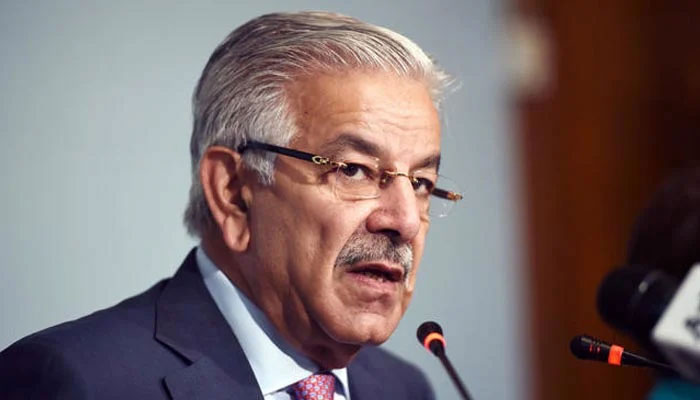
Meanwhile, Minister for Defence Khawaja Asif categorically said that any terrorist attack on Indian soil was always sponsored by India itself to achieve its ulterior motives.
Addressing a news conference with Deputy Prime Minister Mohammad Ishaq Dar, Federal Minister for Information and Broadcasting Attaullah Tarar and Federal Minister for Law and Justice Azam Tarar, the defence minister said that when Pulwama incident occurred, the then Indian government subsequently revoked Article 370 in Indian Illegally Occupied Jammu and Kashmir (IIOJK).
He said that India had been the sponsor of terrorist activities in the region, adding that India had deputed 0.9 million armed troops in the IIOJK to suppress the voice of innocent Kashmiris people. The minister questioned how Pahalgam incident occurred and stated that, following the attack, India suspended the Indus Waters Treaty which is tantamount to a clear violation of international law. He said that Pakistan has always been ready to give a befitting response to Indian aggression and adventurism, without yielding to international pressure.
He said that following the Pulwama incident, India violated Pakistan’s airspace, prompting Pakistan’s valiant armed forces to shoot down their two fighter jets. “Pakistan is fully capable of giving a befitting reply to India if it violates the country’s soil or airspace again and Pakistan armed forces and people will protect every inch of its motherland and teach an exemplary lesson to India,” he vowed.
He went on to say that Pakistan is a responsible sovereign state that does not engage in terrorism anywhere in the world. “India is responsible for terrorist incidents within Pakistan, including those in Balochistan and Khyber Pakhtunkhwa,” he added.
The minister reiterated that India was behind terrorist attacks in Pakistan and Kulbhushan Jadhav was an ample proof of it, who confessed that he was involved in terrorist incidents and killing of innocent citizens in Pakistan. He said that India was also supporting Balochistan Liberation Army (BLA) and Tehreek Taliban Pakistan (TTP) as both banned organisations’ chiefs were stationed in India.
Khawaja Asif said that Canada and the United Kingdom (UK) had exposed India as a terrorist state internationally.
Responding to a question regarding Indian Prime Minister Narendra Modi, the minister said that Modi was involved in killing innocent Muslims in Gujarat and the IIOJK and he was considered a terrorist. The defence minister said that “a certified terrorist ruler” like Modi was not in power in any country of the world.
Asif also revealed that India was planning to carry out terror incidents in Pakistani cities. “If our citizens are attacked, then Indian citizens will not remain safe,” he warned. He reiterated that Pakistan would not allow anybody to carry out terrorist attack or violate its airspace and would protect its soils at all costs.
On the occasion, Deputy Prime Minister and Foreign Minister Ishaq Dar urged India to share evidence with the global community if Pakistan was involved in the Pahalgam attack.
Dar said Pakistan has evidence and intelligence that some foreigners had arrived in Srinagar with weapons. “Indian intelligence agencies have kept these people in Srinagar,” he added. The foreign minister said the Indian spy agencies were supporting the foreigners who “are trying to export IEDs (improvised explosive devices)”.
The FM added Pakistan’s armed forces were ready to respond to any Indian aggression.
Recalling the capture of an Indian pilot by Pakistan in 2019, Dar said India will be given a befitting response if it resorts to any misadventure. He also warned that Pakistan would respond in kind if India withdrew security from Pakistan’s embassy in New Delhi.
The deputy premier warned that Pakistan has the option to suspend the Shimla agreement in response to India’s unilateral move against the Indus Waters Treaty. “We will take our friends in confidence. Pakistan is fully prepared,” he reiterated, adding that the World Bank will also be apprised of India’s announcement.
He said the decisions taken by the NSC will be handed over to the Indian envoy as a demarche.
On the occasion, Minister for Information and Broadcasting Attaullah Tarar said the unilateral action of India to suspend the Indus Waters Treaty had no legal justification, which denotes its disregard and ignorance of trans-boundary accord. “The statement from India about the suspension of Indus Waters Treaty is childish and highly non-serious, which shows that they neither read the Indus Waters Treaty nor ever tried to fathom its legal standing,” the minister said.
He said Pakistan had given an appropriate response to India’s hollow and shaky threats. He said bilateral trade with India was out of the question, and through any third country, it has also been suspended today. He said that Pakistan’s airspace had been closed to India, which would eventually cause millions of dollars in losses to Indian airlines.
The minister paid tribute to Pakistani journalists who effectively pleaded the country’s case in the Indian media. He said the entire world knew that India sponsored terrorism in Pakistan and this had been its tactic for political gain.
Meanwhile, Foreign Secretary Amna Baloch briefed a group of Islamabad-based heads of missions and diplomats on the evolving situation following the Pahalgam attack in the IIOJK.
The foreign secretary shared the outcomes of the NSC meeting. She rejected Indian misinformation campaign against Pakistan and said that such tactics would obstruct the path to peace and stability in the region.
Baloch underscored that Pakistan has always rejected terrorism in all its forms and manifestations. She also cautioned against Indian attempts to escalate tensions and reaffirmed Pakistan’s readiness to counter any misadventure.
Meanwhile, India has summoned the top diplomat in the Pakistan High Commission in New Delhi, local media reported, to give notice that all defence advisers in the Pakistani mission were persona non grata and given a week to leave, one of the measures Indian Foreign Secretary Vikram Misri announced on Wednesday.
Meanwhile, Pakistan Rangers captured a soldier of the Indian Border Security Force in Punjab, according to reports in Indian media. The Indian soldier reportedly strayed into the Pakistani territory when he was arrested.
According to Indian media, the trooper was captured in the Ferozepur area and was identified as Constable P K Singh of the 182nd battalion of the BSF. “During the routine movement, Singh inadvertently moved beyond the Indian border fence and entered the Pakistani territory, where the Pakistan Rangers detained him across the Ferozepur border,” said India Today.
Meanwhile, Pakistani citizens representing a diverse spectrum of religious and political affiliations alongside civil society activists, staged a protest in front of the Indian Embassy.
The demonstration served as a powerful denunciation of what protestors decried as escalating conspiracies orchestrated by India and its government against Pakistan, beleaguered Kashmiri populace and marginalised Muslim community within India.
A significant contingent of police and law enforcement agencies was deployed to ensure the sanctity of the Diplomatic Enclave.
The speakers urged New Delhi to immediately cease all hostile activities directed towards Pakistan, cautioning that any such aggression would be met with a resolute and befitting response from Islamabad.
Following an hour of orderly demonstration, the protestors dispersed peacefully.
Meanwhile, the National Assembly Standing Committee on Defence condemned the loss of lives in Pahalgam incident and categorically rejected the unfounded allegations levelled by India against Pakistan.
The committee expressed deep concern over the actions taken by the Indian government, including unilateral suspension of the Indus Waters Treaty, the closing of Attari border and the withdrawal of diplomats, and noted that such measures risk escalating tensions between the two nuclear nations.
The committee, which met with Fatehullah Khan, MNA, in the chair, emphasised that Pakistan has been a victim of terrorism and that its government and Armed Forces have consistently demonstrated a responsible approach to maintaining peace. However, the panel reiterated, in case if the Indian side engages in any unwarranted action, an appropriate response will be necessary.
The committee also offered Fateha and Dua for the departed souls of the mother and sister-in-law of Chief of Army Staff General Syed Asim Munir.
Members of the Standing Committee also considered “The Pakistan Navy (Amendment) Bill 2024.” During the course of deliberations, the ministry apprised committee members about the key features of the proposed Bill, which mainly focuses on welfare activities, electronic crimes and procedural updates. The committee urged all the provinces to avail the services of SOP in order to safeguard classified information for the betterment of the nation.
The meeting was attended by MNAs Aqeel Malik, Ibrar Ahmad, Saba Sadiq, Ispandyar M Bandara, Salahuddin Junejo, Sanjay Parwani, Gul Asghar Khan, Pullain Baloch, Aslam Ghumman, Ghulam Muhammad and Parliamentary Secretary on Defence Zeb Jaffar.
Besides, the parliamentarians, the meeting was attended by Defence Secretary Lt Gen (retd) Muhammad Ali, Additional Secretary (Army) Major General Amir Ishfaq Kiani and other senior officers of the Ministry of Defence, Law and Justice and the provincial governments.
Meanwhile Istehkam-e-Pakistan Party President and Federal Minister for Communications Abdul Aleem Khan said that Pakistan has given a strong and effective response to India’s unilateral provocations. He emphasized that India must not remain under any false assumptions as Pakistan’s Armed Forces are always ready to deliver a decisive blow to any aggression, said a press release.
Meanwhile, Adviser to the Prime Minister on Interior Affairs Pervez Khattak condemned India’s decision to suspend the Indus Waters Treaty. Speaking to reporters in Nowshera, he described the move as a clear reflection of India’s malicious intentions. He said the suspension of the internationally recognised agreement was both lamentable and a blatant violation of United Nations protocols and international law.
The United Nations on Thursday urged India and Pakistan to exercise “maximum restraint.”
Spokesperson Stephane Dujarric said, “Any issues between Pakistan and India, we believe can be and should be resolved peacefully through meaningful mutual engagement. ”
Dujarric said Secretary-General Antonio Guterres “has not had any direct contact” with those governments in the past 24 hours, but is “following the situation very closely and with very great concern.”
“We were very clear in our condemnation of the terror attack that occurred in Jammu and Kashmir on the 22nd, which killed a large number of civilians,” Dujarric said at a news conference, as he encouraged both governments to “exercise maximum restraint and to ensure that the situation and the developments we’ve seen do not deteriorate any further.”


Pakistan hits back at India as war clouds loom over subcontinent
ISLAMABAD: Pakistan on Thursday announced to suspend trade cooperation with India, close Wagah Border crossing, downgrade diplomatic ties and warned of holding all bilateral accords in abeyance,...
 www.thenews.com.pk