Navigation
Install the app
How to install the app on iOS
Follow along with the video below to see how to install our site as a web app on your home screen.
Note: This feature may not be available in some browsers.
More options
Style variation
You are using an out of date browser. It may not display this or other websites correctly.
You should upgrade or use an alternative browser.
You should upgrade or use an alternative browser.
Indian Navy News & Discussions
- Thread starter EyelessInGaza
- Start date
More options
Who Replied?
DDG-80
Trusted Member
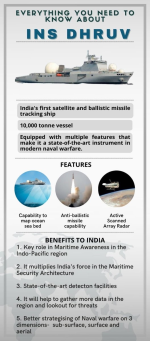
The spy ship is fitted with a primary X band and a secondary S band AESA radar. The technology was originally developed by India’s DRDO, as the core of its AAAU programme for the Indian Navy.
@Pingle @Zarvan @arjunk @hussain0216 @Yasser76 @Ali_Baba @Windjammer @Falcon26
@Pingle @Zarvan @arjunk @hussain0216 @Yasser76 @Ali_Baba @Windjammer @Falcon26
DDG-80
Trusted Member
The spy ship is fitted with a primary X band and a secondary S band AESA radar. The technology was originally developed by India’s DRDO, as the core of its AAAU programme for the Indian Navy.
View attachment 18326
@Pingle @Zarvan @arjunk @hussain0216 @Yasser76 @Ali_Baba @Windjammer @Falcon26
The ship can also track satellites in the Lower Earth Orbit (LEO); hence it can actively contribute to the Indian space missions and also can provide crucial inputs when it comes to Anti-satellite operations.
DDG-80
Trusted Member

Chinese Analysts Express Unease Over New Delhi’s Naval Surge in the Arabian Sea
The Indian Navy has deployed an unprecedented number of warships to the Arabian Sea to join the multinational effort protecting civilian vessels coming under attack from Houthi militants based in Yemen. Although India is not a formal member of the U.S.-led coalition that's launching...
 chinaglobalsouth.com
Pingle
Trusted Member
Chinese Analysts Express Unease Over New Delhi’s Naval Surge in the Arabian Sea
The Indian Navy has deployed an unprecedented number of warships to the Arabian Sea to join the multinational effort protecting civilian vessels coming under attack from Houthi militants based in Yemen. Although India is not a formal member of the U.S.-led coalition that's launching...
Its high time Indian navy needs to prioritize acquisitions and be able to project herself as a further dominating navy in the region..... Good that they're not as retarded as IAF.......
In future when Arab nations will tilt towards India we should have a navy that can fight any type of conventional as well as asymmetrical warfare too.....
Deployment of our warships and engaging such powers that rely on asymmetrical warfare will make our navy battle hardened and smart to deal with such engagements in future...... I don't want bloodshed but from purely defense point of view this is a God's gifted opportunity for our navy to show the world.... what the Indian navy is.......
Pingle
Trusted Member
That's great news they have started responding to changing battle patterns these days.....
DDG-80
Trusted Member
How Pirates Kick-Started India’s Navy Into Action
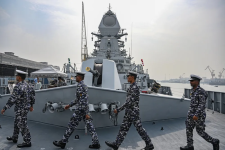
Sailors walk on the deck of the INS Imphal (Yard 12706), the third stealth guided missile destroyer of Project 15B, ahead of its commissioning into the Indian Navy, at the Naval Dockyard in Mumbai on Dec. 22, 2023. INDRANIL MUKHERJEE/AFP VIA GETTY IMAGES
The unexpected and dramatic resurgence of piracy off the east coast of Africa has galvanized the Indian Navy into playing a dominant security role in one of the world’s critical waterways, with its biggest-ever naval deployment to the waters off Somalia in the last couple of months. India’s naval renaissance throws down a marker about its great-power ambitions—and sends a message to Beijing about how it will contest any challenge for dominance in the wider Indian Ocean region.
Pirates affiliated with the al-Shabab terror group in Somalia have suddenly taken again to the high seas after nearly a decade in which ship hijackings were in abeyance. Nearly 20 ships have been attacked, hijacked, boarded, or otherwise harassed in the waters of the Gulf of Aden since late November. Major shipping bodies had removed the area from the piracy high-risk designation just over a year ago.
“The piracy uptick is a puzzle, not just for India but for nations and navies around the world,” said Abhijit Singh, a former naval officer and the current head of the Maritime Policy Initiative at the Observer Research Foundation, a think tank in New Delhi.
The problem is that Somali pirates aren’t the only security headache in those waters: Since about the same time, Iran-backed Houthi rebels in Yemen have been attacking commercial ships in the constricted waters of the Red Sea, nominally as part of a campaign against Israel, causing widespread disruptions and diversions. Shipping container costs have basically doubled since the start of the dual campaign.
Since U.S. and U.K. naval vessels in the region have been trying to tackle the Houthi threat in the Red Sea, both by shielding transiting commercial ships and striking at Houthi targets on land, a security vacuum emerged in the Gulf of Aden, which the pirates were only too happy to fill—or try to. In response, the Indian Navy massively ramped up its deployment of large surface ships and aircraft to clamp down on pirates and backstop the otherwise busy Americans and British. India has increased its surface deployments from two ships to 12, all focused on that vulnerable stretch of the eastern Indian Ocean.
“If you look at the operational focus of the Western powers, it is much more on the Red Sea. You need naval powers like India to come and do constabulary services, and the kind of effort that India has put in—this is in some sense the largest deployment of the Indian Navy,” said Yogesh Joshi, an Indo-Pacific specialist at the National University of Singapore.
India’s naval flexing underscores how the country, long seen as a junior partner in the evolving security landscape of the Indo-Pacific region, is becoming a crucial component, with implications not just for short-term crises such as the piracy flare-up and protecting the global commons but also for the future balance of power in the Indian Ocean after years of Chinese efforts to leverage greater diplomatic and military presence in the region.
“It’s a combination of three factors: context, capacity, and commitment,” Joshi said. The international context has seldom been as favorable for India as it is now, with countries in the Middle East and the United States increasingly looking to New Delhi for partnerships. India’s capacity, especially its military and naval heft, has grown exponentially in recent decades, he noted. And the political commitment from Prime Minister Narendra Modi’s government has given new impetus to the kind of forward-leaning posture Indian admirals had sought for decades.
“The direction and clarity of purpose coming from the top is driving this extension of India’s security stance all over the Indian Ocean,” he said.
Of course, India is free to focus on the uptick in piracy precisely because it has avoided getting entangled in the problems with the Houthis and the Red Sea—much like how China, which for years has had a small anti-piracy deployment active off Somalia, has refused to play any role in protecting shipping under Houthi attack. India, like China, is leery of alienating any Middle Eastern countries that are big sources of energy. But that still leaves a vital role for New Delhi to play.
“A lot of trade has been hit by these [pirate] attacks,” Singh said. “There is the sense that the U.S. and others are busy with Operation Prosperity Guardian in the Red Sea, and so we must pick up the slack here in the Indian Ocean.”
What’s still not clear is the degree, if any, of coordination between the al-Shabab-sponsored pirates and the Houthi rebels. Most experts see the pirate attacks as simple opportunism with Western navies busy putting out fires elsewhere. The pirates have also attacked a number of Iranian-flagged vessels, which also speaks against a well-coordinated campaign. But it’s not inconceivable, Singh said, given the two groups’ similar tactics and motivations, as well as their shared sympathy for Hamas and its objectives.
“If you just look at the tactics of the pirates and the methods that have been employed by the Houthis, other than the drones and the missiles, basically it’s the same drive, the same motivation, the same chutzpah” to disrupt normal operations off their coasts, he said.
Beyond the fight against modern-day pirates, the real importance of the Indian naval deployment is how it fits into the U.S.-led conception of Indo-Pacific security—and China’s efforts to challenge that.
For years, China has been extending its political, economic, and, to a lesser extent, military influence throughout the Indian Ocean, worrying New Delhi. Beijing has done port deals with Sri Lanka, Pakistan, and Cambodia; sent submarines on port visits and to join the piracy fight; established a base in Djibouti and looked wider afield; and ramped up diplomatic engagement with all the island nations in the Indian Ocean, all while it was steadily dispatching surface ships on long-term deployments to the far reaches of India’s backyard. India’s initial maritime response was diplomatic and included a military shift toward the eastern Indian Ocean, with a special focus on the Andaman Islands. Now, though, India’s naval focus has become a lot more all-encompassing, and bigger.
“I think the Chinese are a bit concerned that India, which was earlier active in the eastern Indian Ocean, is now in the west with big numbers—a fivefold increase in capital ships,” Singh said. “From a Chinese lens, it is a bit unusual. The Chinese think we might be using this as a pretext to project, if not power, influence in the region. China, of course, disregards India’s considerable contributions. The [Chinese] Navy remains surprisingly muted in its own response to growing pirate and Houthi attacks.”
But if India’s naval arrival could be cause for alarm in Beijing, it’s good news for Washington. For decades, the United States and India have had an ambivalent relationship, after India moved closer to the Soviet Union during the Cold War and clung to a non-aligned foreign-policy stance. But in recent years, defense cooperation, especially between the two navies, has grown dramatically, with logistics and technology deals and an increasing number of joint exercises. The latest step-up by the Indian Navy is an example of just the kind of burden-sharing that the United States has long urged partner nations in Asia and Europe to adopt.
“The naval component of the U.S.-India military relationship is the most mature, the most developed,” Joshi said. “That feeds directly into American grand strategy for the Indo-Pacific.”

How Pirates Kick-Started India’s Navy Into Action
The Indian Navy has suddenly become the go-to security provider in the Indian Ocean—with big implications for both the U.S. and China.
 foreignpolicy.com

ZeEa5KPul
Registered Member

I think not. The Indian navy is beneath the PLAN's notice. The PLAN is gearing up to fight the US and Japan in a war throughout the Pacific, India doesn't even show up on the radar.“I think the Chinese are a bit concerned that India, which was earlier active in the eastern Indian Ocean, is now in the west with big numbers—a fivefold increase in capital ships,” Singh said. “From a Chinese lens, it is a bit unusual. The Chinese think we might be using this as a pretext to project, if not power, influence in the region. China, of course, disregards India’s considerable contributions. The [Chinese] Navy remains surprisingly muted in its own response to growing pirate and Houthi attacks.”
As for the Indian navy more generally, I'm always reminded of this Reddit classic:
G
GatlingGun
Guest
I think not. The Indian navy is beneath the PLAN's notice. The PLAN is gearing up to fight the US and Japan in a war throughout the Pacific, India doesn't even show up on the radar.
As for the Indian navy more generally, I'm always reminded of this Reddit classic:
Ah 13 years old post (real incident if true, can be even older than that) , it's from era when China wasn't even operating a single aircraft carrier.
Money can only buy you floating casino, not experience of operating it.
Users who are viewing this thread
Total: 3 (members: 0, guests: 3)
Pakistan Defence Latest
-
 KP govt backs out of counterterrorism commitments during talks: Naqvi (19 Viewers)
- Latest: hussain0216
-

-
-
-

Country Watch Latest


Latest Posts
-
 Govt 'seriously' considering imposing emergency in Khyber-Pakhtunkhwa: Tariq Fazal (2 Viewers)
- Latest: Watandar
-

-
KP govt backs out of counterterrorism commitments during talks: Naqvi (19 Viewers)
- Latest: hussain0216
-
‘Stand on the right side of history’: Starbucks urged to close stores in China’s Xinjiang (19 Viewers)
- Latest: Pioneer
-
 Makkah Defence Alliance: Turkey, Saudi Arabia, and Pakistan, news & updates (68 Viewers)
- Latest: Mobius