Navigation
Install the app
How to install the app on iOS
Follow along with the video below to see how to install our site as a web app on your home screen.
Note: This feature may not be available in some browsers.
More options
Style variation
You are using an out of date browser. It may not display this or other websites correctly.
You should upgrade or use an alternative browser.
You should upgrade or use an alternative browser.
Indonesia and Geopolitics
- Thread starter Indos
- Start date
- Status
- Not open for further replies.
More options
Who Replied?

Indos
INT'L MOD
- Thread starter
- #92
70 years after Bandung, the ‘Global South’ seeks leadership and direction
The world now, as in 1955, is primed for fundamental changes in power relations.
Ravi Velloor
PUBLISHED Apr 17, 2025, 05:00 AM
Seventy years ago this week, in the afterglow of Asian decolonisation, 29 Asian and African nations came together in the Indonesian city of Bandung, seeking to give the developing world a new and positive direction.
South-South cooperation was embodied in the final communique’s call for economic cooperation and technical assistance at the conclusion of the conference held from April 18 to 24, 1955. But it went beyond that. As Mr Roeslan Abdulgani, the Indonesian secretary-general of the conference, saw it, animating the gathering of these diverse post-colonial nations was a “spirit of love for peace, anti-violence, anti-discrimination and development for all without trying to intervene for one another wrongly”.
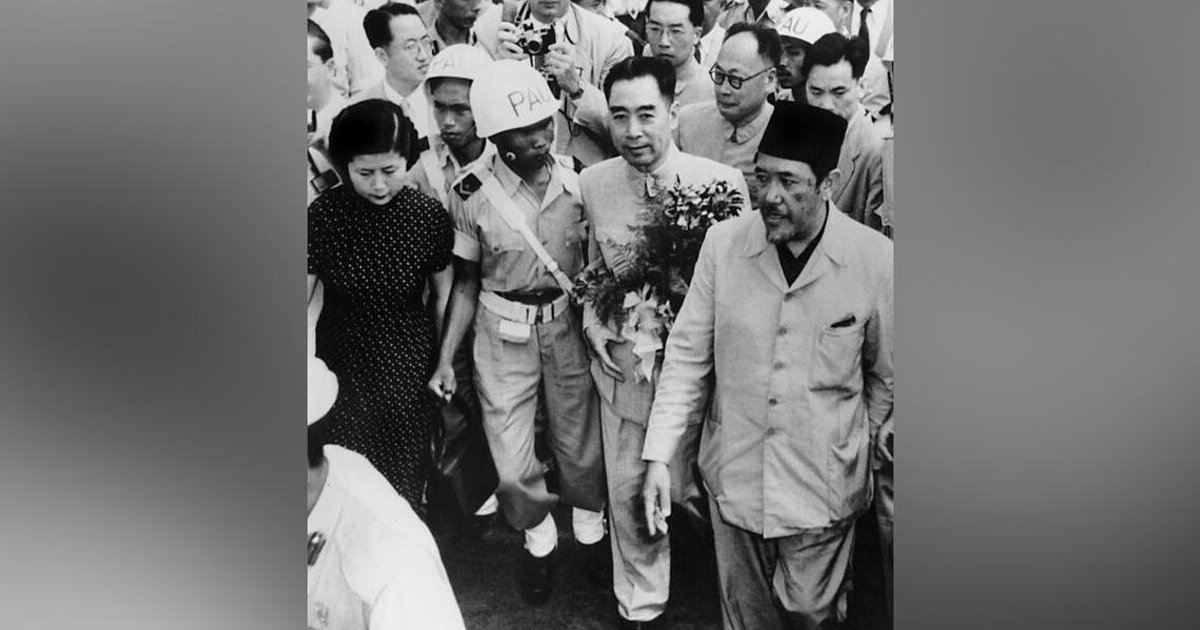
70 years after Bandung, the ‘Global South’ seeks leadership and direction
The world now, as in 1955, is primed for fundamental changes in power relations. Read more at straitstimes.com.
Revisiting the historical site of the 1955 Asian-African Conference
Indos
INT'L MOD
- Thread starter
- #95
Prabowo Congratulates Albanese on Reelection, Seeks Stronger Indonesia-Australia Ties
Heru Andriyanto, Associated Press
May 4, 2025 | 8:41 pm
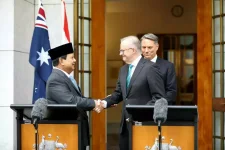
FILE - Then-Defense Minister Prabowo Subianto, left, shakes hands with Australian Prime Minister Anthony Albanese during their meeting in Canberra, Tuesday, Aug. 20, 2024. (Photo courtesy of the Defense Ministry)
Jakarta. President Prabowo Subianto on Sunday called Australian Prime Minister Anthony Albanese to congratulate him on his reelection and expressed his commitment to deepening bilateral ties, particularly in the face of global economic headwinds sparked by sweeping US tariff hikes.
With Albanese remaining in office, bilateral negotiations on trade and defense cooperation are expected to continue without disruption.
“President Prabowo Subianto personally conveyed his congratulations to Anthony Albanese on his reelection as Prime Minister of Australia,” Cabinet Secretary Teddy Indra Wijaya said in a statement.
Indonesia is currently strengthening trade engagement with key partners such as Australia and the European Union to mitigate the potential impact of declining exports to the United States, following steep tariff increases imposed by President Donald Trump.
Last month, Coordinating Minister for Economic Affairs Airlangga Hartarto said that Australia had agreed to expand imports of Indonesian goods during a meeting with Australian Trade Minister Don Farrell.
Indonesia has also requested Australia’s support in gaining broader access to the Comprehensive and Progressive Agreement for Trans-Pacific Partnership (CPTPP), as Jakarta seeks to strengthen trade ties with Mexico and other South American markets.
While Indonesia’s exports to Australia rose 56 percent year-on-year to $4.95 billion in 2024, the country still recorded a trade deficit of $5.49 billion with its southern neighbor.
To bolster financial cooperation, the two countries renewed their bilateral currency swap agreement in March, extending it for another five years. The deal allows Bank Indonesia (BI) and the Reserve Bank of Australia (RBA) to exchange up to 10 billion Australian dollars -- or about $6.2 billion -- enabling local currency settlements and reducing reliance on the US dollar.
In August 2024, while still serving as defense minister ahead of his inauguration as president, Prabowo visited Canberra to finalize negotiations that upgraded Indonesia-Australia defense cooperation to a treaty-level agreement.
“I greatly value the friendship between our nations, and Indonesia will always remember Australia as one of the first countries to support our independence in the 1940s,” Prabowo said at the time. “I am committed to fostering an even closer relationship with our neighbor.”
Read More:
Indonesia and Australia Conduct Joint Military Drills Following New Defense PactThe two leaders met again on November 14, 2024, during the APEC forum in Lima, Peru. At the time, Prabowo reaffirmed Indonesia’s long-standing relationship with Australia, saying: “Australia is a very good friend of Indonesia. As neighbors, we sometimes have our ups and downs, but we will remain neighbors forever.”
Albanese’s center-left Labor Party won an emphatic victory in elections on Saturday. As vote counting continued, the government was on track to win at least 85 seats in the 150-seat House of Representatives, the lower chamber where parties need a majority to form an administration.
Labor held 78 seats in the previous Parliament, and gaining seats in a second term is rare in Australian politics.
“The Australian people voted for unity rather than division,” Albanese told reporters in the crowded café in inner-suburban Leichhardt where he and his fiancée, Jodie Haydon, gathered with colleagues and supporters for coffee on Sunday.
“We'll be a disciplined, orderly government in our second term, just like we have been in our first,” he added.
Treasurer Jim Chalmers, the government’s top economic minister, explained the election result as voters seeking stability after US President Donald Trump’s tariff disruptions to the global economy.
“This was beyond even our most optimistic expectations,” Chalmers told Australian Broadcasting Corp. of the election result.
“We know that this second term has been given to us by the Australian people because they want stability in uncertain times,” he added.
Australian Election Result Reminiscent of Canada
In an election result reminiscent of Canada’s recent contest, conservative opposition leader Peter Dutton lost his parliamentary seat. His alliance of parties was reduced to 37 seats.
Canada's opposition leader, Pierre Poilievre, lost his seat after Trump declared economic war on the US neighbor. Poilievre had previously been regarded as a shoo-in to become Canada’s next prime minister and shepherd his Conservative Party back into power for the first time in a decade.
Read More:
Prabowo Talks Combating Drugs, People Smuggling with AlbaneseSenior Australian lawmakers say they feared late last year they would become the first government to be tossed out after a single three-year term since the turmoil of the Great Depression in 1931.
Like the center-left Canadian government, the Australian government had linked their political opponents to Trump's administration and its Elon Musk-led Department of Government Efficiency (DOGE).
Australia was hit during the five-week election campaign with 10 percent tariffs on exports to the United States despite trading with its bilateral free trade partner at a deficit for decades.
Opposition Leader Branded ‘DOGE-y Dutton’
The opposition leader was branded “DOGE-y Dutton,” and Labor warned that a Dutton government would slash public sector services to pay for seven government-funded nuclear power plants.
Labor said Dutton never campaigned at any of the proposed power plant sites and argued the conservatives realized that nuclear reactors were not popular. There is no nuclear power generation in Australia.
Labor also accused Dutton of igniting culture wars. While Albanese stands before the Australian flag and two Indigenous flags at media announcements, Dutton had said that as prime minister, he would only stand in front of the national flag.
Indigenous Australians account for 4 percent of the population and are the nation's most disadvantaged ethnic minority.

Prabowo Congratulates Albanese on Reelection, Seeks Stronger Indonesia-Australia Ties
While Indonesia’s exports to Australia rose 56% y-o-y to $4.95 billion in 2024, the country still recorded a deficit of $5.49 billion.
Indos
INT'L MOD
- Thread starter
- #96
Indonesia foreign minister, Sugiono, attended BRICS meeting in Brazil recently. Indonesia is included in the group this year as full member as Prabowo accept the invitation to join after he becomes Indonesia President, which is in opposite with prior President decision, Jokowi, that more prefer Indonesia to seek OECD membership as his focus more on the economy than geopolitics
Indos
INT'L MOD
- Thread starter
- #98
Re-elected Australia PM Albanese to visit Indonesia first in ‘signal’ to region
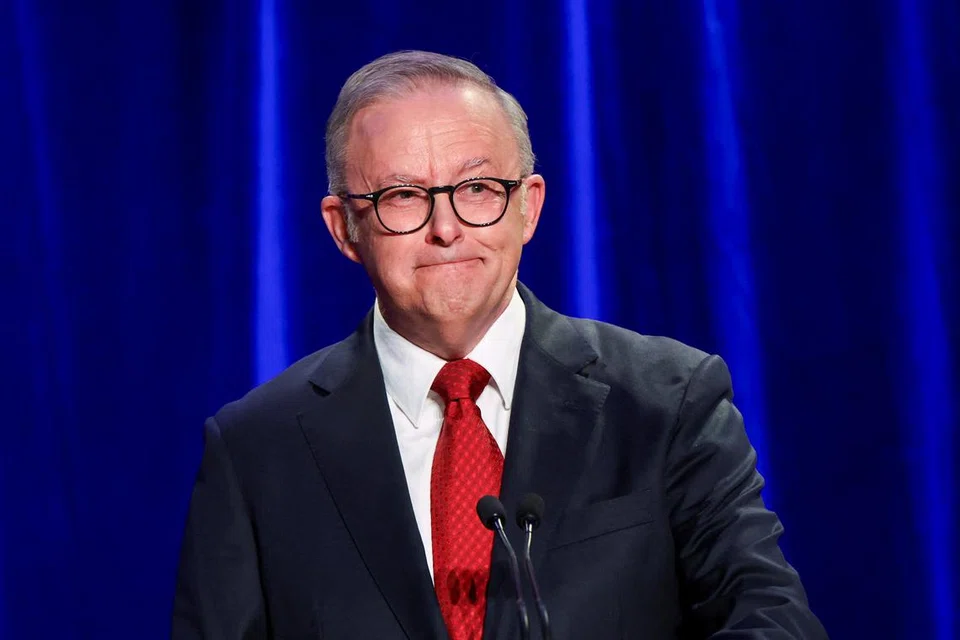
Australia's Prime Minister Anthony Albanese said Australia has "no more important relationship than Indonesia".PHOTO: REUTERS
SYDNEY, May 7 (Reuters)
Australian Prime Minister Anthony Albanese said on May 7 he will travel to Indonesia next week as a “signal” of the importance Canberra places in the region in his first overseas visit since his May 3 election victory.
“We have no more important relationship than Indonesia just to our north,” Mr Albanese said in a television interview with the Australian Broadcasting Corporation.
Mr Albanese said he will travel to Indonesia on May 14, the day after his government is sworn into office. Mr Albanese was re-elected and his centre-left Labor party increased its majority in parliament in the poll.
Indonesia will grow to become the fourth-largest economy in the world, and Australia has an important defence and security relationship with Jakarta, he said.
The visit will be “a signal to our region of the importance we place on this region”, he added.
During the election campaign, Indonesia dismissed reports that Russia had requested to base military aircraft in Papua, about 1,200km north of the Australian city of Darwin, where a US Marine Corps rotational force is based for six months of the year. REUTERS

Re-elected Australia PM Albanese to visit Indonesia first in ‘signal’ to region
“We have no more important relationship than Indonesia just to our north,” he said. Read more at straitstimes.com.
Grand and warm welcome for Albanese in Indonesia | 9 News Australia


Indos
INT'L MOD
- Thread starter
- #102
Understanding Indonesia as an offshore balancer
Published: 17 April 2025
- Dylan Motin
Seoul National University
Indonesia’s geographic seclusion makes it an ‘offshore balancer’ that typically focuses on domestic development over continental power politics. But offshore balancers may abandon neutrality and become more assertive when faced with a potential regional hegemon. In Indonesia’s case, the rise of China has begun to push the state towards counterbalancing.
International relations scholars frequently classify the United Kingdom and the United States as quintessential ‘offshore balancers’, but an often-overlooked major island country also enters this category — Indonesia. As an offshore balancer, the rise of a regional hegemon will be a wake-up call for Indonesian foreign policy.
Offshore balancers often feel less urge to commit to continental power politics. They can enjoy the benefits of seclusion to focus on domestic development instead. Since the sea palisades them against invasions, offshore balancers require less formidable ground forces relative to continental powers. At the same time, large bodies of water make expansion on the continent more difficult.
There is one peril for which offshore balancers will firmly commit to continental security. A regional hegemon is the only type of rival strong enough to accumulate and project sufficient forces to subjugate or even conquer an offshore power. Once relieved from neighbouring rivals, a regional hegemon can focus on more faraway targets. As the dominating behemoth, it can mobilise all the continent’s resources at its leisure for distant endeavours. As such, ensuring that no regional hegemon arises is imperative for offshore balancers.
If Indonesia is an offshore balancer, we should witness distinguishable patterns of behaviour. Typically, Indonesia would feel little need to participate in continental power politics, thanks to seclusion from the continent by bodies of water. Safe from invasions, the country should maintain a relatively small military relative to its potential. But Jakarta would turn more assertive in the face of a could-be regional hegemon.
History suggests Indonesia behaves like an offshore balancer.
When Indonesia gained independence in 1949, Southeast Asia faced no significant hegemonic threat. China remained weak, and Vietnam was torn asunder by war. Jakarta could safely ignore continental conflicts and declare neutrality in the Cold War.
The regional balance shifted dramatically after Vietnam’s reunification in 1975 and its invasion of Cambodia in 1978. The growing Vietnamese threat pushed Jakarta to strengthen its military capabilities and improve combat readiness. It assumed a leading position within ASEAN, helping transform it into a coalition to contain the expansion of communism in Southeast Asia. It also moved to mend its strained relations with China to counter-flank Hanoi’s formidable military capabilities. But as expected from an offshore balancer, Indonesia ruled out direct military involvement, following an indirect strategy similar to the United Kingdom’s when confronting hegemonic threats.
As of 2025, Indonesia has, on paper, a massive power potential. It is home to 280 million people, not very far behind the United States. The several thousand-island-large archipelago has plenty of natural resources. Its large population and growing economy should allow it to play a leading role in Southeast Asia and the Indo-Pacific. Yet, without a hegemonic threat, little in Indonesia’s behaviour suggests a willingness to invest much in continental power politics. Its military spending is small compared to other leading powers, as it invests around one per cent of its GDP in defence.
But this is likely to change since Jakarta now faces a potential regional hegemon. China is well-positioned to reach hegemonic elevation over the Indo-Pacific and the Malay Archipelago. A Chinese hegemon would be strong enough to force unpleasant territorial and economic concessions on Indonesia and turn the country into a mere satellite.
Signs that Jakarta is taking action to counterbalance Beijing’s rise are unmistakable.
The country’s defence spending is increasing — under President Prabowo Subianto, it aims to spend one and a half per cent of its GDP on armed forces by 2029. There is now a strong willingness to overhaul the military in the face of the Chinese threat. Jakarta is especially interested in reinforcing the defences of its northernmost islands that are targeted by Beijing’s claims to rule the entire South China Sea.
A pivot towards the anti-hegemonic coalition accompanies this military awakening. Indonesia has increasingly shed its Cold War-era neutralist skin to move decisively towards the United States and its partners. Jakarta is eager to train with US troops, purchase US weapons and improve interoperability with US forces. Washington contributed to building a maritime training centre on Batam Island, which overlooks the Strait of Malacca. In June 2023, US B-52 strategic bombers made their first-ever visit to Indonesia — something inconceivable a decade earlier.
What comes next will depend on the regional balance of power. If it remains stable, Indonesia will face less incentive to confront China head-on. It will probably be content to rely on continental states and Washington for regional security.
But if Beijing keeps rising, Jakarta will feel hard-pressed to play the power politics game. The Chinese threat may force it to invest far more in defence and claim its mantle as a major power. Indonesia would also need to dedicate more energy to Southeast Asian security, notably by forming a closer alignment with Vietnam, Singapore, Malaysia, Thailand and the Philippines. Insularity offered security for decades, but this era is likely coming to an end.
Dylan Motin is Visiting Scholar at Seoul National University Asia Center and Non-resident Kelly Fellow at Pacific Forum.

Understanding Indonesia as an offshore balancer
With China emerging as a regional hegemon, Indonesia’s era of neutrality may be ending.
 eastasiaforum.org
Indos
INT'L MOD
- Thread starter
- #105
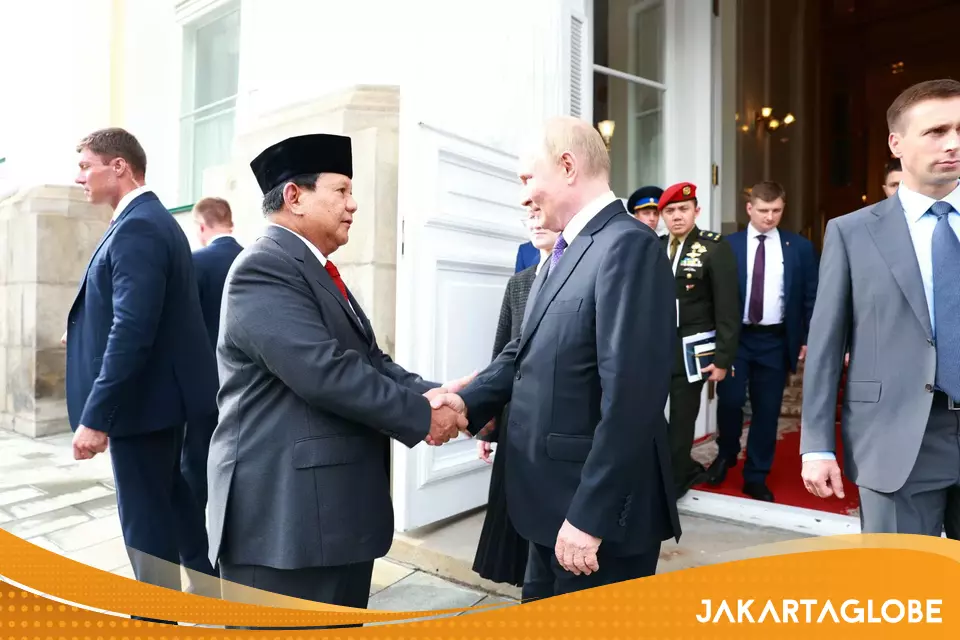
Prabowo to Skip G7 Summit, But Will Meet Putin in Russia
Foreign Affairs Ministry says that Prabowo’s tight schedule makes it difficult for the Indonesian leader to attend the G7 Summit.
- Status
- Not open for further replies.
Users who are viewing this thread
Total: 1 (members: 0, guests: 1)
Pakistan Defence Latest
-
 Federal cabinet gives nod to imposition of emergency in KP; summary sent to president (15 Viewers)
- Latest: Forsvaret
-

-

-

Country Watch Latest
-
-
-

-
Indian General Admits: We Cannot Defend India Against Pakistan & China (12 Viewers)
- Latest: ThoroughPro
-

Latest Posts
-

-
 Why all countries especially small Muslim states flocking to Pakistan for defense. A debate (55 Viewers)
- Latest: Yasser76
-
-
-