Indos
INT'L MOD

- Thread starter
- #106
Trends in Geopolitical
Relations
KEY FINDINGS
• Global economic stagnation, increasing debt, and the weaponisation of economic interdependence via trade wars are
key factors shaping the economic landscape of geopolitics in the
21st century.
• Geopolitical fragmentation is rising, with levels now exceeding those seen during the Cold War. The rise in fragmentation has been especially noticeable since 2008, after it had been steadily decreasing since the end of the Cold War.
• Global trade has plateaued at around 60 per cent of global GDP over the past decade, following rapid growth after 1990.
• Global military spending hit a record $2.7 trillion in 2024, a nine
per cent increase from the previous year, driven largely by conflicts like the war in Ukraine.
• Competition for influence is intensifying in regions like Africa, South Asia, and South America. In the Sahel, instability and scarce resources are drawing in rival powers and fuelling a complex struggle for control.
• The number of globally influential countries has nearly tripled
since the Cold War, rising from 13 to 34 by 2023, with nations like Türkiye, the UAE, Vietnam, South Africa, Brazil and Indonesia expanding their influence.
COMPETITION FOR INFLUENCE
The final area in which increasing geopolitical fragmentation can be seen is in increasing competition for influence, particularly among ‘middle power’ countries seeking to extend their influence in lower and middle income countries (LMICs).
In the evolving international order, middle powers are emerging as increasingly significant actors.
While the definition of a ‘middle power’ is debated, it generally refers to states occupying an intermediate position in the global power hierarchy, possessing resources and influence below those of great powers but significantly above smaller states.
This status is often assessed based on factors like GDP, population size, and military strength, but also on their foreign policy behaviour.
Middle powers frequently favour multilateralism, diplomacy, and coalition-building, often carving out specific roles in ‘niche diplomacy’, focusing on areas like peacekeeping, arms control, or human rights.
In the current climate of US-China rivalry, these middle powers employ a variety of strategies to protect their interests, maintain autonomy, and exert influence.
Some engage in 'balancing', explicitly aligning with one great power to counter another, as seen in Australia's strengthened security ties with the United States through alliances like AUKUS to counter China's influence. Others pursue 'hedging', maintaining workable relations with both competing powers to maximise flexibility and economic benefits while seeking security assurances, a strategy historically employed by nations like Indonesia.
The rise in the importance of middle power countries can be seen by looking at the data on Foreign Bilateral Influence Capacity (FBIC), which measures the amount of economic, diplomatic, and military influence one country has over another.
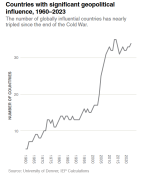
Figure 2.11 charts the number of countries that account for over ten per cent of foreign influence in five or more countries. This number has increased significantly over the past sixty years, rising from five countries in 1960 to 34 in 2023. The steepest increase in the number of countries with significant influence began in 2005.
Relations
KEY FINDINGS
• Global economic stagnation, increasing debt, and the weaponisation of economic interdependence via trade wars are
key factors shaping the economic landscape of geopolitics in the
21st century.
• Geopolitical fragmentation is rising, with levels now exceeding those seen during the Cold War. The rise in fragmentation has been especially noticeable since 2008, after it had been steadily decreasing since the end of the Cold War.
• Global trade has plateaued at around 60 per cent of global GDP over the past decade, following rapid growth after 1990.
• Global military spending hit a record $2.7 trillion in 2024, a nine
per cent increase from the previous year, driven largely by conflicts like the war in Ukraine.
• Competition for influence is intensifying in regions like Africa, South Asia, and South America. In the Sahel, instability and scarce resources are drawing in rival powers and fuelling a complex struggle for control.
• The number of globally influential countries has nearly tripled
since the Cold War, rising from 13 to 34 by 2023, with nations like Türkiye, the UAE, Vietnam, South Africa, Brazil and Indonesia expanding their influence.
COMPETITION FOR INFLUENCE
The final area in which increasing geopolitical fragmentation can be seen is in increasing competition for influence, particularly among ‘middle power’ countries seeking to extend their influence in lower and middle income countries (LMICs).
In the evolving international order, middle powers are emerging as increasingly significant actors.
While the definition of a ‘middle power’ is debated, it generally refers to states occupying an intermediate position in the global power hierarchy, possessing resources and influence below those of great powers but significantly above smaller states.
This status is often assessed based on factors like GDP, population size, and military strength, but also on their foreign policy behaviour.
Middle powers frequently favour multilateralism, diplomacy, and coalition-building, often carving out specific roles in ‘niche diplomacy’, focusing on areas like peacekeeping, arms control, or human rights.
In the current climate of US-China rivalry, these middle powers employ a variety of strategies to protect their interests, maintain autonomy, and exert influence.
Some engage in 'balancing', explicitly aligning with one great power to counter another, as seen in Australia's strengthened security ties with the United States through alliances like AUKUS to counter China's influence. Others pursue 'hedging', maintaining workable relations with both competing powers to maximise flexibility and economic benefits while seeking security assurances, a strategy historically employed by nations like Indonesia.
The rise in the importance of middle power countries can be seen by looking at the data on Foreign Bilateral Influence Capacity (FBIC), which measures the amount of economic, diplomatic, and military influence one country has over another.
Figure 2.11 charts the number of countries that account for over ten per cent of foreign influence in five or more countries. This number has increased significantly over the past sixty years, rising from five countries in 1960 to 34 in 2023. The steepest increase in the number of countries with significant influence began in 2005.