Indonesia Economy and Industry

Perbanas Research: 90% of MSMEs Feel They Do Not Need Bank Loans


Andi Hidayat
Kamis, 18 Jun 2026

1781872251496.png


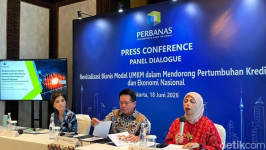
Jakarta – The Indonesian National Banking Association (Perbanas) has found that 90% of micro, small, and medium enterprises (MSMEs) feel they do not need to apply for bank loans. This is considered one of the main reasons behind the relatively low level of bank lending to the MSME sector.

Aviliani, Chair of Research and Economic & Banking Studies at Perbanas, stated that MSME lending is largely demand-driven. According to Perbanas research, around 90% of both formal and informal MSMEs have not applied for bank loans because they believe they do not need them.

“MSME lending is more demand-driven. Nearly 90% of formal and informal MSMEs do not apply for loans because they feel there is no need,” Aviliani said during the event Revitalizing MSME Business Models to Drive Credit Growth and the National Economy at the Four Seasons Hotel in Jakarta on Thursday (June 18, 2026).
According to the study, 88% of MSMEs operate using their own funds. Perbanas is therefore encouraging MSMEs to seek bank financing to support business expansion.

“What does this mean? It means they prefer to use their own capital. However, if we expect them to move up to the next level, they will certainly need to expand, and expansion inevitably requires bank financing,” she explained.
The findings are considered a structural challenge for Indonesia’s banking sector. While overall bank lending continues to grow positively, financing to MSMEs has been contracting.

Perbanas Chairman Hery Gunardi emphasized that the findings indicate that the issue is not a shortage of credit supply from banks, but rather low demand for loans from MSMEs. This is despite the fact that MSME loan approval rates are relatively high.

“The majority of MSME entrepreneurs have not applied for loans because they feel they do not yet need financing and continue to rely on their own capital. Meanwhile, when MSMEs do apply for loans, the approval rate is relatively high,” he said.

Key Figures​

  • 90% of MSMEs do not apply for bank loans because they feel they do not need them.
  • 88% of MSMEs rely on their own funds to run their businesses.
  • Perbanas views low loan demand—not limited credit availability—as the main obstacle to MSME lending growth.
  • Banks report relatively high approval rates for MSME loan applications.


Government Debt Growth Drives Indonesia’s External Debt to $439.8B​


Ria Fortuna Wijaya
June 15, 2026 | 4:20 pm

1781874937141.png
A Bank Syariah Indonesia teller shows American banknotes in South Tangerang, Banten, on Wednesday, Jan. 21, 2026. (Antara Photo/Hafidz Mubarak)


Jakarta. Indonesia’s external debt rose to $439.8 billion in April, with higher government borrowing offsetting a continued decline in private-sector debt, while the country’s debt indicators remained within prudent levels.

The country’s external debt grew 1.9% year-on-year in April, accelerating from an annual growth of 1.0% in March, according to Bank Indonesia.

Government external debt reached $216.4 billion in April, rising 3.7% from a year earlier, slightly slower than the 3.8% growth recorded in March.

“The moderation was mainly driven by slower growth in outstanding external loans,” said Ramdan Denny Prakoso, executive director of communications at Bank Indonesia.

Foreign investors continued to record net inflows into government bonds, reflecting sustained confidence in Indonesia’s economic outlook, the central bank said.

As one of the government’s financing instruments for the state budget, external debt “continues to be directed toward supporting productive sectors while maintaining debt sustainability,” Ramdan said.

Health services and social activities accounted for the largest share of government external debt utilization at 22%, followed by public administration, defense, and mandatory social security at 20.5%, education services at 16.2%, construction at 11.5%, and transportation and warehousing at 8.5%.

Nearly all government external debt, or 99.99%, consisted of long-term obligations.

Private external debt continued to contract, although at a slower pace. Outstanding private external debt totaled $193.2 billion in April, down 0.7% year-on-year, following a 1.4% contraction in March.

The decline was primarily driven by financial corporations, whose external debt shrank 5.0% annually, improving from a 6.3% contraction in the previous month.

Manufacturing, financial and insurance services, electricity and gas supply, and mining remained the largest contributors to private external debt, accounting for 79.6% of the total. Long-term debt represented 75.8% of overall private external debt.

“Indonesia’s external debt structure remains healthy, supported by the prudent application of debt management principles,” Ramdan said.

The country’s external debt-to-GDP ratio remained stable at 29.6% in April, while long-term debt accounted for 84.5% of total external debt.

Bank Indonesia said it would continue coordinating with the government to monitor external debt developments and optimize the use of external financing to support sustainable economic growth while mitigating risks to macroeconomic stability.


Indonesia Identifies 61 National Priority Programs for the 2027 State Budget​


Arrijal Rachman, CNBC Indonesia
30 June 2026 08:40

1782901337340.png

JAKARTA — The Indonesian Government and the House of Representatives (DPR) have agreed on 61 national priority programs that will serve as the basis for calculating government expenditure under the 2027 State Budget (RAPBN 2027).

The programs are grouped into eight National Priority Program Clusters (PKPN) under the administration of President Prabowo Subianto, covering food security, energy independence, education, healthcare, industrialization, infrastructure, village development, and poverty reduction.

According to the working committee (Panja) report, all central government spending must be supported by a clear logical framework linking policy objectives, ministerial programs, activities, budget allocations, and measurable performance outcomes.

Fiscal Framework​

The agreed fiscal framework projects total state expenditure at 13.81%–14.80% of GDP in 2027, consisting of:

  • Central government expenditure: 11.26%–12.01% of GDP
  • Transfers to regional governments: 2.55%–2.79% of GDP

Eight National Priority Clusters​

1. Food Security​

The food security cluster includes twelve major programs aimed at strengthening agricultural and fisheries production, including:

  • Merah Putih Fishermen Villages
  • Modern fishing vessels
  • Integrated inland aquaculture zones
  • North Coast saline tilapia pond revitalization
  • Integrated shrimp farming development
  • Integrated food estate development
  • National salt industry centers
  • Sugarcane development
  • Palm oil development
  • Coconut, coffee, cocoa, and cashew development
  • Spice production (pepper and nutmeg)
  • Increased production of meat, dairy, and eggs

2. Energy and Water Independence​

The government plans sixteen strategic programs, including:

  • B50 biodiesel mandate
  • E20 bioethanol mandate
  • 100 GW solar power program
  • Minimum Energy Performance Standards (MEPS)
  • Motorcycle conversion to electric vehicles
  • Expansion of city gas networks
  • Increased oil and gas production
  • Small-scale modular green refineries
  • New oil and gas exploration
  • Rural electrification
  • Waste-to-energy projects
  • Large-scale integrated hydropower
  • Household electric stove program
  • Optimization of community oil wells
  • Revitalization of mature oil fields
  • National water security initiatives

3. Education​

Fifteen education initiatives have been prioritized, including:

  • Free Nutritious Meals (MBG) for schoolchildren
  • School infrastructure revitalization
  • School equipment assistance
  • Integrated National Schools
  • Teacher Studios
  • Education digitalization
  • Garuda Schools
  • People's Schools
  • New STEMM-based Medical University
  • 500,000 globally competitive vocational graduates
  • National Sports Academy and Training Center
  • Teacher welfare improvements
  • Child protection in digital spaces
  • Maintaining the constitutional requirement that education spending accounts for at least 20% of the national budget
  • Gradual expansion of universal basic education

4. Healthcare​

The healthcare cluster includes:

  • Free Nutritious Meals (MBG) for pregnant women, nursing mothers, and toddlers
  • Hospital upgrading program
  • Free medical checkups
  • National tuberculosis elimination program

5. Downstream Industrialization and Manufacturing​

Five strategic industrial programs have been identified:

  • Strategic industrial downstream processing
  • Semiconductor industry development
  • Aerospace industry ecosystem development
  • National automobile development
  • National motorcycle program

6. Infrastructure, Housing, and Disaster Resilience​

Priority infrastructure programs include:

  • Giant Sea Wall
  • Post-disaster reconstruction in Sumatra
  • ASRI environmental movement (roof improvement, waste management, and greening)
  • Housing construction, home renovation, and settlement improvement
  • National railway network development

7. People's Economy and Village Development​

Programs include:

  • Merah Putih Village and Urban Cooperatives
  • Accelerated development of disadvantaged, frontier, and outermost regions (3T)

8. Poverty Reduction​

The government will implement two integrated social programs:

  • PRO-KESRA Integrated Social Assistance
  • PRO-KESRA Employment and Entrepreneurship Program

Supporting National Priorities​

To support implementation of the priority programs, the government will also strengthen national defense, public security, and law enforcement through several supporting initiatives, including:

  • Development of the National Data Center
  • Combating online gambling and digital fraud
  • Strengthening anti-narcotics programs (P4GN)
  • Protecting women and children while combating human trafficking and smuggling
Together, these 61 priority programs form the foundation of Indonesia's 2027 fiscal agenda, reflecting the government's strategy to combine economic growth, industrial transformation, energy security, human capital development, and social welfare while maintaining macroeconomic stability.


Users who are viewing this thread

Pakistan Defence Latest

Latest Posts

Back
Top